


On this page
A fixed price gives useful budget certainty when the product, quantity, delivery basis and covered release period are defined. Crop-year pricing can keep later releases aligned with a new production season, but it needs an agreed reset date, evidence basis and treatment of existing orders. Neither label tells you whether supply is reserved, freight is included or every future shipment carries the same price.
Compare the two mechanisms over the same product and release schedule. Then test what happens if the next crop price rises, falls, arrives late or cannot be agreed. We start with that coverage question before comparing an attractive unit price. A price mechanism is dependable only when both parties can identify which item, quantity and dispatch it applies to.
Quick answer: Choose a bounded fixed price when you need a defined cost for committed releases. Consider a clearly governed crop-year reset when future crop costs remain open and your downstream business can accommodate repricing. Specify the coverage, trigger, evidence, notice, acceptance and fallback in either case.
Define what the price actually covers
Begin with the item specification and commercial basis. Record the product, form, composition where relevant, grade or acceptance fields, pack, quantity unit, currency and delivery term. A price for bulk corn kernels at one shipment basis cannot be compared directly with a delivered retail pack containing different handling and freight obligations. Pricing discussions become much clearer when every difference has a named place in the comparison.

List included and excluded cost elements. Product, primary packing, printed materials, storage, inland movement, reefer freight and destination charges may be treated differently by the two offers. Do not assume that a fixed product price also fixes an unquoted logistics cost. Equally, an agreement can fix a delivered price for a defined scope if the parties expressly accept that obligation. The written scope decides the answer.
Distinguish price validity from supply commitment. A quotation may remain open for acceptance until a certain date without reserving inventory for a year. An accepted purchase order may cover a specific lot and shipment, while a framework agreement describes future ordering rules. Write down which document creates which commitment, rather than using “annual price” to stand in for all three.
Use one comparison sheet for both proposals. If a requirement changes during negotiation, update both offers or show the effect as a separate scenario. A lower later quote can be caused by a smaller pack, different cut or changed delivery basis rather than a better pricing mechanism. The original specification is the baseline that lets you tell those causes apart.
A fixed price needs a bounded commitment
A fixed price has four essential boundaries: the item, the covered quantity, the period and the delivery basis. State whether the commitment covers confirmed orders only, a specified total quantity released in installments, or future orders accepted during a period. Those arrangements expose both parties differently. A forecast is not automatically a minimum purchase obligation, and an estimated requirement is not necessarily a guaranteed volume.
Clarify release timing and tolerances. If the buyer moves a dispatch beyond the covered window, the agreement needs a treatment for the delayed quantity. That treatment might involve a revised commercial review, storage charges, cancellation rights or another negotiated route. Do not imply that one of these outcomes applies automatically. Establish the rule before a delay creates a disagreement.
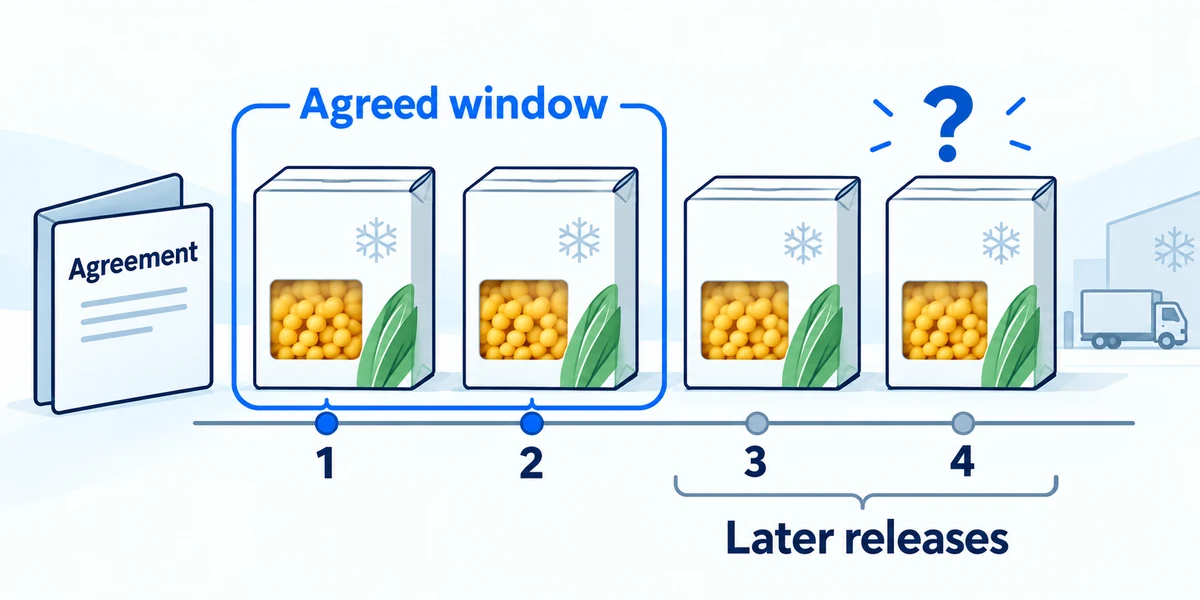
Ask how a quantity change affects the price. A unit price based on a committed program may not apply to a small additional release outside it. Conversely, the supplier should not treat a quantity already covered by the agreed commitment as a new quotation merely because market prices changed. Both parties need to be able to distinguish a covered release from a genuinely new order.
Budget certainty has a tradeoff. The purchaser may retain the agreed price even if comparable market offers later become cheaper, while the supplier carries agreed cost exposure when its input costs rise. That describes the intended price allocation, not a guarantee that every other contractual risk disappears. Quality, delivery, payment and remedies still need their own terms.
The useful negotiating question is therefore specific: “For this item and these releases, which cost changes can alter the agreed price?” A clear answer can be checked against the document. “The price is fixed unless circumstances change” leaves the central allocation unresolved.
Crop-year pricing needs a precise reset rule
“Crop-year pricing” is not one standardized frozen-food contract type. The parties may use it to mean a new quotation for each production season, a review when new-crop product becomes available, or a defined adjustment mechanism. Establish which meaning is intended. A reset that requires a new agreement differs from a formula that calculates a price without a new negotiation.
Define the crop year by product and agreed production reference. A mixed-product program can involve several crop windows, so one calendar date may not describe every line. Even for one product, the offer needs to distinguish the production season from the date the goods are dispatched. Later dispatch of an earlier-crop lot does not, by itself, establish which price the agreement applies.
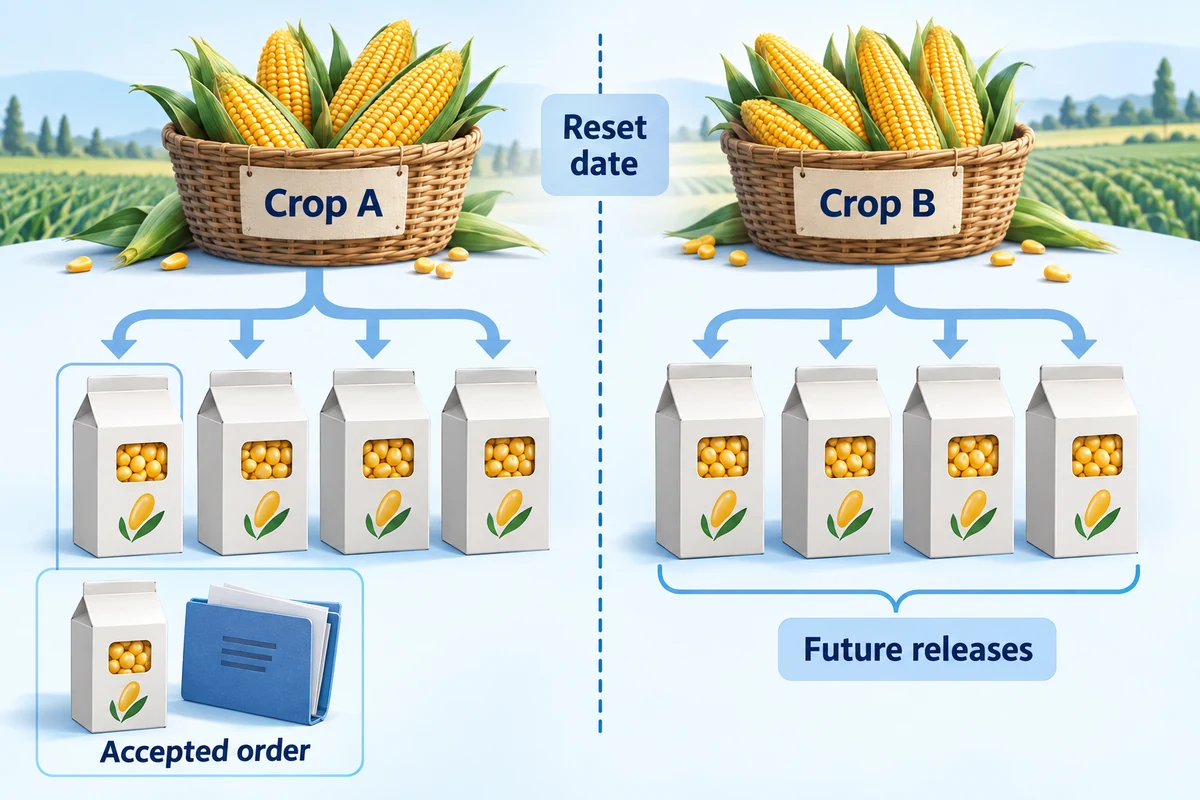
State the trigger and its evidence. It might be a scheduled review date, an agreed new-crop availability event, or a named published index observation. A trigger based only on “new costs” is difficult to verify. A crop reset should identify who supplies the evidence, how it is checked and when the resulting price becomes applicable.
Decide whether the revised price affects new orders, releases not yet confirmed, or goods dispatched after an effective date. These are different rules. An accepted order can straddle a crop transition. Preserve its treatment explicitly rather than assuming that the crop label either protects it or automatically reprices it.
The FAO discussion of agricultural contracts [1] distinguishes several pricing structures and links them to specifications and obligations. Its focus is upstream contract farming. It supports the need for clarity, but it does not prescribe a frozen-produce importer’s crop-year reset clause.
Compare both models over the same releases
Use a release schedule with the same quantities, product, pack, currency and delivery basis. Calculate the total covered cost, rather than comparing the first fixed quote with the first crop-year quote alone. A lower starting price may be offset by a higher later reset. The reverse can also occur. The comparison needs both directions to show the exposure.
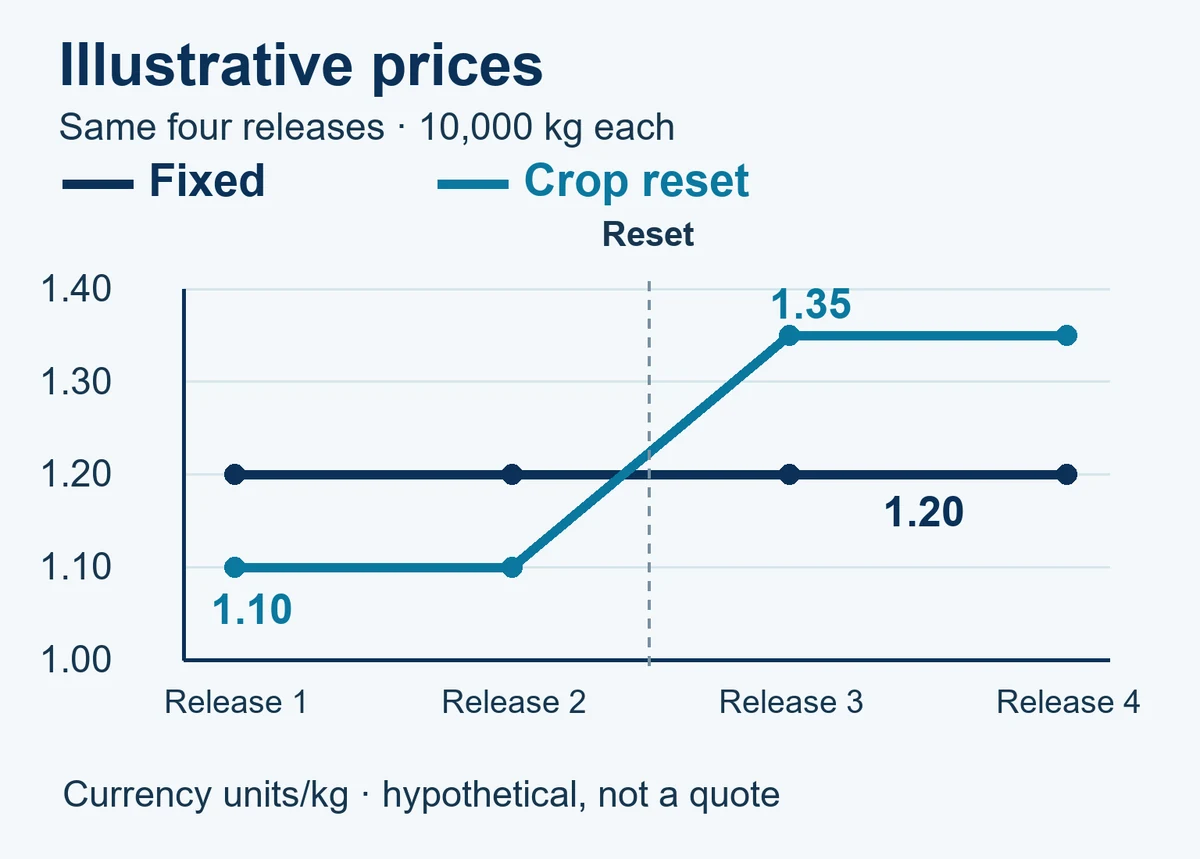
Here is a hypothetical arithmetic example. Four releases each contain 10,000 kg. The fixed price is 1.20 currency units per kilogram throughout. The crop-year price is 1.10 for the first two releases and 1.35 after the agreed reset for the last two. Freight and other charges are excluded from both routes in this example. These are invented values, not an XMG quotation or a market forecast.
| Release | Quantity | Fixed route cost | Crop-reset route cost |
|---|---|---|---|
| 1 | 10,000 kg | 12,000 | 11,000 |
| 2 | 10,000 kg | 12,000 | 11,000 |
| 3 | 10,000 kg | 12,000 | 13,500 |
| 4 | 10,000 kg | 12,000 | 13,500 |
| Total | 40,000 kg | 48,000 | 49,000 |
The crop-reset route is 1,000 currency units higher in this scenario, despite its cheaper starting price. Its weighted average is 49,000 divided by 40,000, or 1.225 per kilogram. If the later price instead falls to 1.05, the crop-reset total becomes 43,000. That second scenario does not predict a fall; it shows why the result depends on the future reset and the quantities exposed to it.
Change the release timing as well as the price assumption. If more quantity falls after the reset, more of the program is exposed to that price. Keep the scenarios tied to your expected ordering pattern. Do not recommend a fixed percentage split merely because it makes an example look balanced; the suitable allocation depends on the actual commercial obligations.
Keep freight, currency and product changes separate
A crop change does not explain every cost movement. If freight is reviewed independently, give it an independent trigger and basis. If the quote currency stays fixed but an internal exchange rate affects the supplier’s costs, identify whether that exposure belongs to the supplier or has a negotiated adjustment rule. Do not add an undefined currency surcharge to an otherwise fixed price after the fact.
Product changes require a new comparison of what is being supplied. A different blend, cut, maturity specification or pack can change the cost basis. Record the specification change first, then its agreed commercial treatment. Calling the resulting difference a crop adjustment hides the cause and makes the old and new prices look more comparable than they are.

Separate storage and delayed-release effects too. A fixed product price may coexist with a defined storage obligation for a limited period. If releases move later, the price review should identify which cost or obligation changed. A broad adjustment attributed to “the season” is weaker than a documented change in the agreed holding or delivery requirement.
This separation helps prevent double counting. If a formula already adjusts a packing component, the supplier should not apply the same increase again as a separate pack surcharge. If a delivered price includes freight and a revised freight allowance is agreed, show how the old allowance is removed or replaced. A simple reconciliation can expose an overlap that a single revised unit price conceals.
Keep a revision log with the old value, new value, cause, evidence, affected releases and approval. The log does not need to be elaborate. It needs to let the purchaser and supplier reproduce the commercial change using the same inputs.
Write an adjustment rule that can be checked
A formula needs a baseline, a named variable, a calculation date, a weight where relevant and an applicability rule. It also needs a treatment for unavailable data, corrections and rounding. The US federal economic price adjustment description [2] illustrates distinctions among established prices, actual costs and identified cost indexes. That framework is a US government example, not a clause that automatically governs a private frozen-food agreement.
Check whether the chosen indicator represents the cost being adjusted. A broad food index may move differently from the relevant frozen ingredient, packing or freight route. A convenient public number is not automatically a good proxy. If the parties choose it, acknowledge what it measures and what remains outside the formula.
For another hypothetical example, suppose a base price is 1.20 per kilogram and the parties choose to index only a 40% component. Multiply the base price by a bracket containing the unindexed share plus the indexed share times the ratio of current index to baseline index. With a baseline index of 100 and a current index of 115, that gives 1.20 × (0.60 + 0.40 × 1.15) = 1.272. The 40% weight is invented for teaching, not a recommended frozen-food cost share.
Make increases and decreases explicit. A mechanism that reacts only to increases allocates risk differently from a symmetric one. Caps, floors or thresholds also change the exposure and need a treatment when they are reached. None should be inserted as a “standard” percentage without a reason and agreement.
For an actual-cost review, decide what records support a claimed change and which components qualify. Avoid accepting an unexplained overall cost increase as proof of a product-specific adjustment. The reviewer needs enough detail to verify the defined calculation while respecting legitimate commercial confidentiality.
Preserve the input that produced each reset
Keep the baseline observation and the later observation with their dates and source versions. If an index publisher revises a historical value, the agreement needs to identify whether the original published figure or the revised figure governs the calculation. Without that rule, two people can use the same named index and still calculate different prices.
For a quoted crop review, preserve the actual offer and its acceptance record instead of treating a verbal indication as the reset. Note the product specification, validity period and affected releases. A provisional new-crop estimate and an accepted revised price belong in separate records. That distinction is particularly useful when purchasing decisions are made before the proposed supply option is fully confirmed.
Recalculate a representative invoice using those preserved inputs. Check the unit, rounding and covered quantity as well as the rate. A correct adjustment percentage applied to the wrong release can still produce a wrong charge. If your two calculations differ, reconcile the input or coverage issue before describing the mechanism as settled.
Decide what happens when a reset fails
A reset date can arrive before the parties agree a new price. Write the temporary operating state in advance. Does the existing price continue for already accepted orders? Are new releases held pending confirmation? Is there a defined negotiation period followed by another contractual route? The answer belongs in the agreement, with responsibility for communication and decisions.
Separate price disagreement from crop failure or product nonconformity. A higher proposed price is not the same event as an unavailable crop or a failed specification. Each needs its own evidence and treatment. Broad emergency wording can create uncertainty if routine cost changes are treated as extraordinary events without an agreed basis.
Identify who can approve a revision and how it is recorded. Sales and procurement contacts may exchange preliminary proposals that are not final acceptance. A release should carry a traceable price version and approval state. If the buyer sends an order at the old price after receiving a proposed revision, the supplier needs a clear process for accepting it or raising the mismatch before dispatch.
Discuss termination, suspension and dispute handling with the people responsible for the contract. The UNIDROIT contract-farming overview [3] emphasizes clear obligations and the legal framework within its agricultural scope. It does not supply a universal remedy for frozen-food import agreements. Applicable law and the actual document govern enforceability and remedies.
The practical objective is a defined next step under stress. An agreement that works only when prices and delivery plans stay unchanged leaves the most difficult decision unresolved. A fallback should preserve visibility of covered orders and new commitments while the issue is reviewed.
Match the price mechanism to your downstream promise
If you have sold a defined finished-product program at a fixed price, identify the frozen ingredient releases that support it. An open crop reset can change the input cost while your sales revenue stays fixed. That does not automatically rule out crop-year pricing, but it makes the exposure visible. Compare it with your ability to revise downstream prices, adjust timing or absorb cost changes.
If demand remains uncertain, a long fixed commitment can create a different problem: purchasing obligations that exceed what you use. Separate the expected forecast from the quantity you can responsibly commit. The pricing benefit should be assessed alongside stock, cash and release obligations, without assuming that lower unit cost always improves the whole program.
A mixed arrangement can be discussed when it fits the actual business. For example, confirmed near-term releases can carry one agreed price while later crop-year releases require a new review. Define the boundary by actual orders or quantities. Do not describe an informal split as protection unless the document makes its coverage and obligations clear.
Review the mechanism when the program changes. A new product line, packaging format or delivery pattern may make the original exposure assumptions obsolete. Keep that review separate from an automatic price reset. Changing the business scope and updating the price variable are different decisions.
Our guide to crop windows, commitments and delivery plans covers the related supply-planning question. Reservation and price coverage should support each other, but one does not prove the other. Check both before relying on a repeat-order program.
How we review a repeat-order supply brief
We supply frozen vegetables, fruits and mushrooms and review the product, specification, packing, quantity and delivery window together. For a repeat-order discussion, that matching work helps keep the priced item and release scope explicit. We also coordinate specification and sample questions so an apparent price improvement is not compared against an unnoticed product change.
Our commercial review can identify open product, packing and shipment assumptions before you evaluate the offered supply route. We do not publish a universal crop-year formula or fixed-price period; an actual proposal needs its own product and order basis.
Send your product specification, release quantities and shipment windows, plus the price coverage you need to compare. We will review the brief, identify missing assumptions and coordinate suitable supply options for your commercial assessment.
References
These references have defined agricultural or jurisdictional scopes. The numerical examples in this article are hypothetical and are not quotations, forecasts or proposed legal terms.
