


On this page
A useful bulk frozen-food quotation lets you decide what will arrive, what you will pay for, and which conditions still need approval. Send every supplier the same product and commercial brief, require each reply to list departures from it, then compare offers on net product quantity, pack, delivery point, evidence and timing. A lower unit price is not a better offer if it describes a different cut, a smaller net fill, a different port or an unapproved document package.
Our request-a-quote form collects the starting information. This guide takes the next step: turning those inputs into a comparison that procurement, quality and logistics colleagues can actually sign off. You can begin before every specification detail is settled. Mark unknowns as open, ask for a priced base option and keep any proposed substitute in a separate column. The decision is made against the final written version, not a chain of informal messages.
Compare only after fixing the buying basis
Swipe to read the figure on a narrow screen.
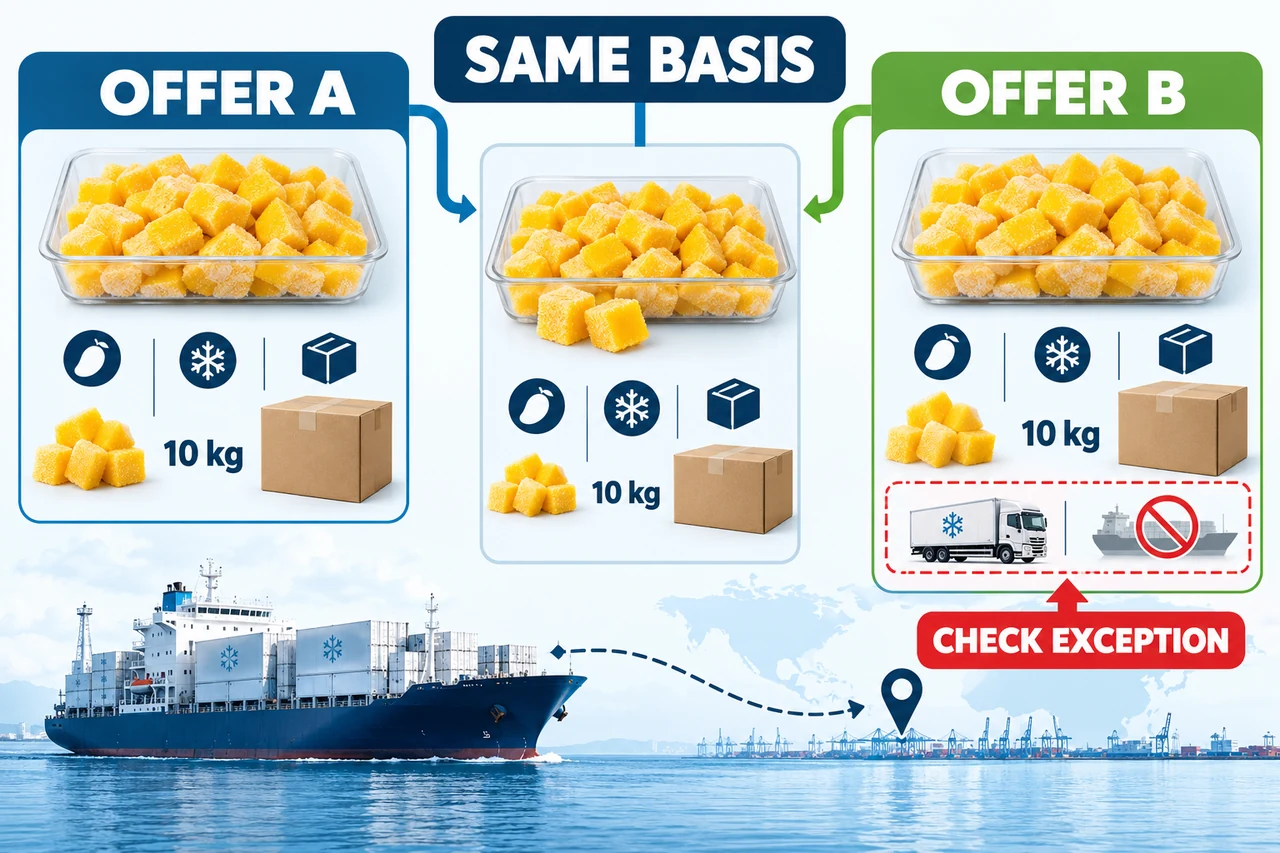
Illustrative comparison: confirm the same product, pack and quantity before ranking offers; clarify the exception.
The first comparison is between your request and each offer, not between the two prices. We would put the required form, grade, net weight and pack at the top of the sheet and mark each supplier’s response as confirmed, proposed alternative, or unanswered. A quote for IQF mango dice and one for mango chunks are different products even if both line items say “frozen mango.” A price for one full reefer shipment and a price conditional on an annual call-off are different commitments.
Use three controls. First, issue one dated RFQ version to all suppliers. Second, separate non-negotiable requirements from items on which you will consider an option. Third, ask the supplier to identify every deviation in its response. A supplier may have a sensible alternative; that can be valuable, but it should be visible and costed as an alternative. It should not silently replace the common base on which you intend to compare bids.
The comparison should answer five questions: Is the offered product technically acceptable? Is the quoted quantity the quantity of food you intend to buy? Does the price include the same pack and delivery boundary? Can the required evidence be supplied for the proposed product and facility? Can the order be made and shipped in the needed window? If any answer is open, record the next decision and its owner before selecting a winner.
Write a quotable frozen-food brief
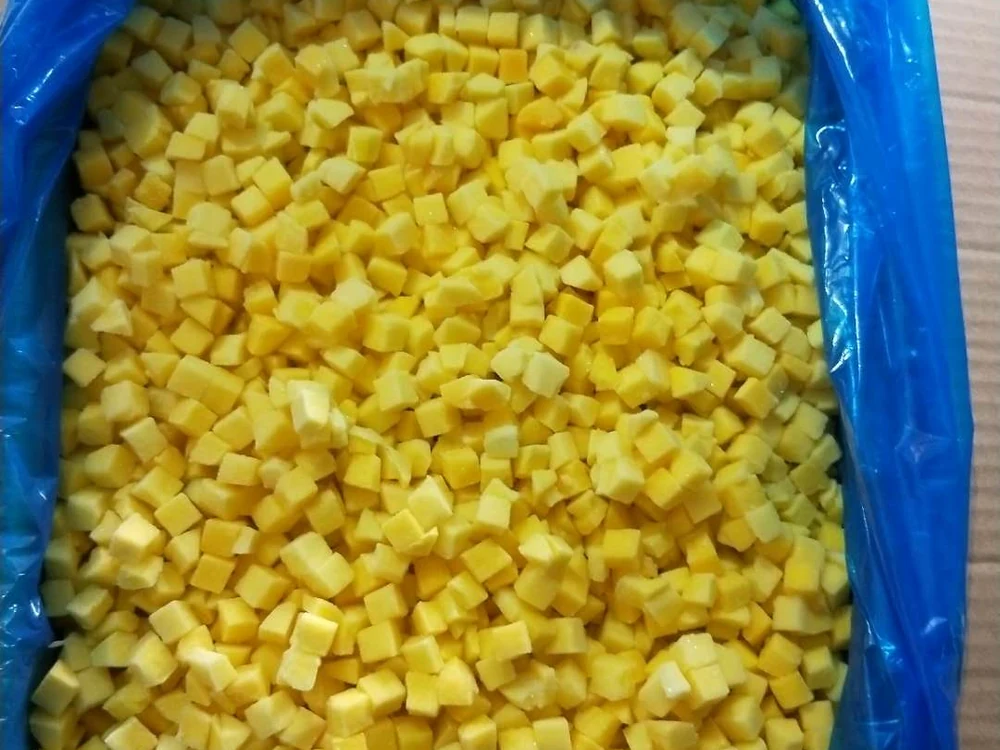
Frozen mango dice illustrate an exact product form; the photograph does not establish grade or pack terms.
Start with the product identity and intended use. “Frozen fruit” is not enough for a food manufacturer deciding whether a piece will survive mixing. Name the fruit or vegetable, form or cut, size basis, grade or defect limits that affect your use, and any critical processing state. For a distributor, the channel and local pack requirements may matter as much as the ingredient form. If you have a target specification, attach its version. If you do not, state the end use and the few acceptance points you already know, then request the supplier’s proposed specification for review.
Add the order unit in two forms: net kilograms by SKU and the intended inner-pack/carton configuration. A count of cartons without net fill can hide a quantity difference. A statement such as “one container” still leaves the product mix, loading form and exact weight open. Give the target quantity and an acceptable adjustment band separately. A supplier can then show whether carton multiples or production minimums require a change without treating your maximum as the order you have approved.
Set the commercial frame: currency, preferred Incoterms® 2020 rule, named place or port, destination, approximate shipment month, payment proposal and quote validity. The International Chamber of Commerce explains [1] why the named place is essential to delivery, cost and risk allocation. Ask the logistics team to confirm the actual route and destination charges before awarding an import order.
Then specify what evidence you require before order approval and what is needed for shipment. Product specification, representative sample, facility-specific certificate scope, lot-related test record, commercial invoice, packing list and destination-specific documents are different records. Do not ask for every document by habit. Name the market and the customer requirement, and have the importer confirm its legal obligations. We can help map the request to a proposed product and supply route, but a generic certificate list is not an order-specific approval.
| RFQ field | Put in the common base | Keep visibly open when undecided |
|---|---|---|
| Product | Species or product, form, cut, intended application, critical tolerances | Allowable origin, alternate cut or grade |
| Quantity | Net kilograms by SKU, target carton configuration, one-time or call-off pattern | Acceptable case-count adjustment |
| Pack | Unit net fill, bags per carton, label and carton-mark need | Plain versus printed route and artwork status |
| Delivery | Incoterms rule and version, named place, destination, shipment window | Carrier choice and local charges still to confirm |
| Evidence | Sample, specification, certificate/document scope and timing | Optional tests or third-party inspection |
This table is a working brief, not a substitute for the final purchase specification. Its value is that the same blanks appear in every supplier reply. When the RFQ changes, send a new version to everyone still in the comparison rather than forwarding an isolated clarification to one bidder.
Keep mandatory fields separate from open options
Mark each requirement as must meet, option acceptable if approved, or supplier to propose. For example, a 10 kg net carton may be mandatory for a processor’s receiving line. For another buyer it may be only a starting point if a 4 × 2.5 kg inner pack gives better handling. Those choices affect price and warehouse work differently. State the rule before you see the offers so an attractive price does not quietly redefine what was required.
For private-label orders, separate the food from the printed-material decision. A supplier might be able to supply the standard bulk product in your trial volume while printed retail pouches need another minimum or artwork lead time. Our packing options page describes why material, print method, selected facility and quantity affect the route. Ask for a standard-pack trial quote and a separately priced branded-pack option if the final design is not approved. This preserves a comparable food offer and exposes the extra launch work.
Treat proposed origin, grade or facility changes the same way. The supplier should give the alternative an identifiable line, explain which specification or document would change, and quote it separately. Do not collapse two alternatives into a single unit-price cell. Procurement can choose a lower-cost alternative after quality and importer review; the choice should be deliberate and traceable.
Read each quote as an offer with exceptions
Swipe to read the figure on a narrow screen.
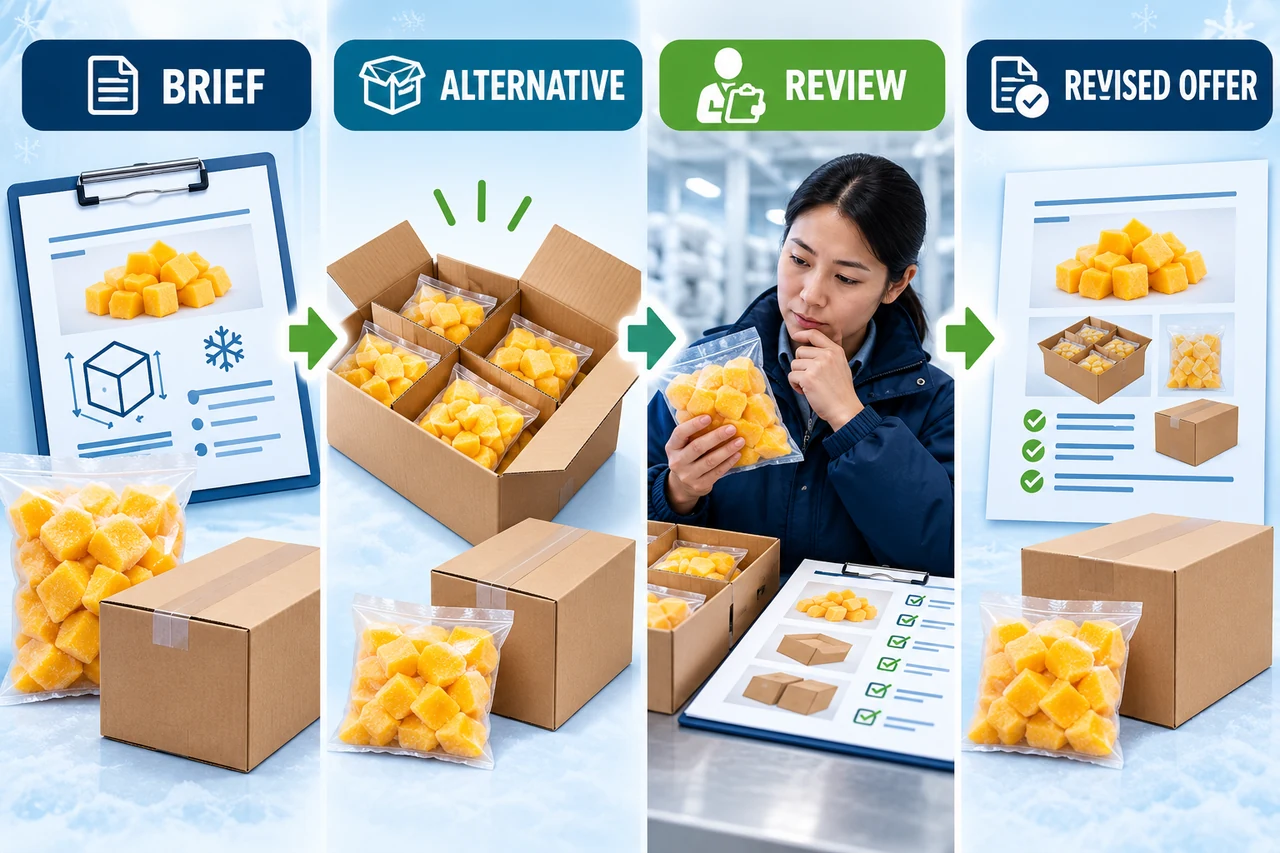
Illustrative sequence: an alternate pack needs a buyer decision and revised written offer.
Before doing arithmetic, read the words around the price. The offer should identify the exact SKU and pack, quantity basis, currency, term and named place, shipment and payment assumptions, validity date, proposed facility or supply route where relevant, sample status, and documents included or still subject to confirmation. “As per your request” is weak if an attachment gives a different net fill or if the certificate belongs to a different facility.
Create an exception log with four columns: RFQ requirement, supplier reply, decision, and revised quotation reference. A missing answer is not a rejection by itself, but it is not confirmation either. For each open item, decide whether it prevents technical approval, price comparison or shipment planning. Ask only the questions that change the decision. This produces a shorter and more useful clarification round than sending a generic demand for a “best price.”
Supplier responsiveness matters when it improves the record. A fast answer that identifies a pack constraint and gives a revised option is more useful than a fast round number with no scope. The same principle applies to apparent discounts. Ask what changed: product grade, lot availability, pack, quantity, freight assumption, payment timing or quotation validity. If nothing is documented, the discount cannot be evaluated reliably.
Normalize quantity, pack and delivery scope

A second product family needs its own quantity and carton basis in a multi-SKU quote.
Choose one denominator for the comparison, normally currency per net kilogram of the ordered product for bulk ingredients. Keep the case price and cases per pallet visible because warehouse and handling costs may still change. If a product has a glaze, drained-weight or other quantity issue, define the purchased mass and acceptance basis explicitly; our net-weight and drained-weight guide explains that distinction. Do not mix gross carton weight with product net weight.
Convert the quoted cases to the proposed net mass: cases × bags per case × net kilograms per bag. Then divide the goods price by that net mass. Round only for display; keep unrounded figures in the worksheet. If the seller quotes by metric tonne, convert using 1,000 kg per metric tonne. Verify any currency conversion date and rate separately instead of concealing it inside the supplier unit price.
Next bring the offers to an agreed cost boundary. Record the rule, version and named place exactly. A quotation to the port of loading, to the destination port and to your warehouse can include different transport legs and charges. Add the missing, documented buyer-paid costs for each option to reach the same chosen receiving point. Destination terminal, customs, inspection, onward reefer haulage and storage may be buyer costs depending on the contract and location. Do not fill an unknown cell with zero. Put “awaiting forwarder estimate” and withhold a final landed-cost ranking until the material open costs have been priced.
Separate price comparability from risk acceptance. A costed quote can still be unsuitable if its certificate scope, proposed product specification or loading timeline is unapproved. Use a two-stage decision: technical and execution fit first, normalized cost among acceptable options second. That is more useful than a weighted score that allows a low price to offset a failed mandatory requirement.
Work through a two-offer comparison
Swipe to read the figure on a narrow screen.
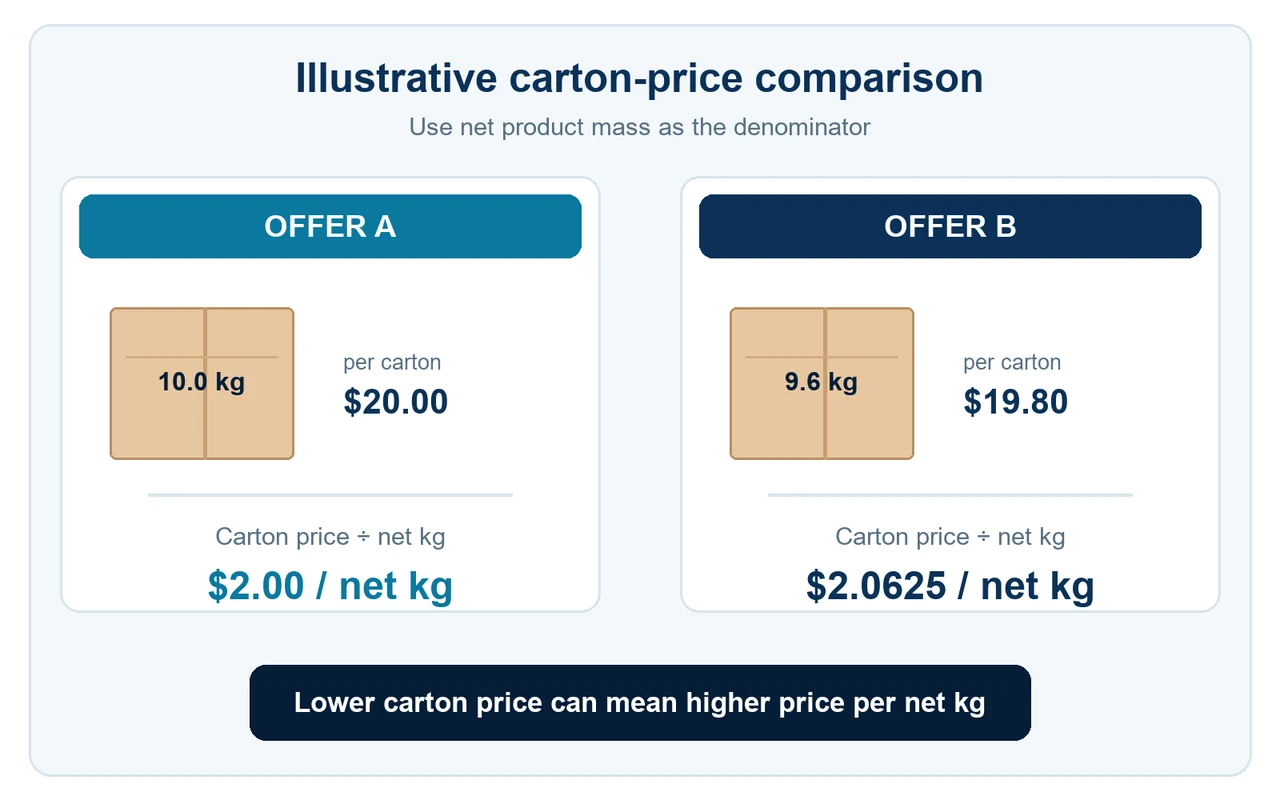
Hypothetical arithmetic only: compare carton prices using the net food quantity in each carton.
The following figures are an illustrative arithmetic example, not market prices or XMG quotations. Assume the same approved frozen mango form, quality limits, shipment window and delivery boundary. Offer A is USD 20.00 for a carton holding 10.0 kg net. Offer B is USD 19.80 for a carton holding 9.6 kg net. On carton price alone B looks cheaper. On product mass, A is USD 2.00 per net kg; B is USD 2.0625 per net kg. At 9,600 kg net, the goods lines would be USD 19,200 and USD 19,800 respectively, before any documented differences in freight, insurance, local charges, duty or handling.
| Illustrative field | Offer A | Offer B | Buyer action |
|---|---|---|---|
| Carton line price | USD 20.00 | USD 19.80 | Do not rank yet |
| Net product per carton | 10.0 kg | 9.6 kg | Confirm label and packing list basis |
| Goods price per net kg | USD 2.00 | USD 2.0625 | Compare only after product/pack acceptance |
| Delivery and local cost | Same boundary assumed for this calculation | Same boundary assumed for this calculation | Price actual differences if terms change |
| Specification/evidence | Assumed equal for arithmetic | Assumed equal for arithmetic | Obtain written confirmation before award |
This example isolates the denominator. It does not claim that a smaller carton is worse: it may fit your operation better and save labor or waste. Record that operational value separately. If B also offers a different delivery term or an unapproved grade, keep its cost and technical status open. Ask both suppliers to reissue against the final common base if you change a required pack or specification.
For a multi-SKU order, calculate the mass and landed estimate by SKU before summing the shipment. A blended average can hide a highly priced trial item or an unworkable pack minimum. Keep the carton count, net weight, and exception for each line; only the shipment-level freight or consolidation charges should be allocated on a documented basis such as weight, volume or another agreed method. If that allocation would change your choice, ask your logistics colleague to test it rather than using a convenient but unsupported split.
Check evidence and approval conditions before award
Ask what exactly the proposed product and facility can support. The useful question is not whether a supplier can send a certificate PDF, but whether the named holder, site, activity and product scope match the route it proposes. Specification and sample references should point to the same product form and intended use you are buying. An available sample may be from stock; if the order is custom, agree how its approval will carry into the production lot. Our specifications and sampling process provides the approval context.
Decide who checks which record. Procurement owns price, quantity and contract revisions. Quality reviews critical product limits, sample method and evidence scope. Logistics confirms container, shipping instructions, destination costs and receiving readiness. The importer of record confirms destination-market requirements. A single comparison sheet lets these colleagues see the same outstanding decisions instead of keeping different assumptions in separate inboxes.
Record the arrival acceptance basis before shipment where possible: carton and label identity, lot references, net weight, condition evidence and the process for reporting a discrepancy. The quotation can refer to the required specification and inspection method, but it does not replace the purchase contract or destination compliance review. Ask who issues each document and when, and identify any item conditional on the final facility or shipping route.
Record the revised offer and purchase-order baseline
Once you have chosen an acceptable option, freeze the decision record. Save the final RFQ version, the accepted supplier quotation, each approved exception, product specification, pack/artwork version, sample or trial reference, delivery term with named place, quantity by SKU, payment milestones and planned shipment window. A purchase order can then refer to the same set. If the buyer approves a different pack after quotation, request a revised price and loading quantity rather than assuming the old offer survives unchanged.
Set an expiry reminder. A quote validity date is not a production reservation, and a production plan is not a confirmed sailing. Reconfirm material assumptions before order confirmation, particularly seasonal product availability, packing components and any freight quotation that was time limited. If a supplier changes the proposed facility or product form, reopen the relevant approval checks. Keep the old version as a record, not as the instruction for the current order.
For a repeat program, the comparison sheet becomes a control record. You can note whether the arrival matched the approved form, whether carton and document details were correct, and which assumptions generated avoidable cost. Use that evidence to improve the next RFQ rather than merely asking suppliers to quote a larger annual number.
How we help turn a brief into a usable quotation
We supply frozen fruits, vegetables and mushrooms through suitable partner-factory routes. We clarify the product form and specification first, coordinate a feasible pack and quantity, and identify the sample or document questions that belong to that route. This helps you compare a real order proposal instead of several prices attached to different assumptions. We will distinguish a confirmed line from an alternative or an item that still needs facility, timing or destination confirmation.
Send a comparable frozen-food RFQ
Send the product and form, your critical specification, quantity and pack, destination and target shipment window. Attach an existing comparison sheet if you have one. We will review the brief, identify the order-specific questions and respond with suitable frozen-food supply and quotation details.
