


On this page
Food-fraud control for frozen produce starts with the claim you are buying. Species identity, growing origin, variety and certification are separate questions. A clean microbiological report cannot establish all four, and an attractive sample cannot prove the history of a shipment. Define the claim, identify where it could be changed or lost in the supply chain, and choose evidence capable of checking it.
We would put the greatest review effort into a valuable claim that is difficult to verify after cutting, mixing or processing. That is a purchasing judgment, not an accusation against a supplier. Keep ordinary specification errors, unresolved evidence and suspected deliberate deception separate while deciding whether an identified order can proceed. The immediate aim is a defensible product and release decision; proving fraudulent intent is a different investigation.
Start with the claim that could be misrepresented
Write the promised feature as a complete sentence: the product contains only the listed species; the fruit was grown in the stated country; or the supplied goods are covered by the specified certification programme. A loose request for “authentic frozen fruit” gives neither party a useful inspection question. Include the product form and the point in the transaction where the claim applies. A raw-material statement and a claim printed on a finished private-label pack may require different supporting records.
The FDA’s explanation of economically motivated adulteration [1] describes intentional substitution, removal or addition for economic advantage. It also explains that some deception can introduce safety hazards. For your purchasing review, keep an authenticity question beside the existing food-safety assessment rather than treating either as a replacement for the other.
Consider what would make misrepresentation financially attractive and practically possible. A substantial price premium for a named variety creates a different incentive from an unqualified commodity description. A finely chopped mixed ingredient may conceal substitutions more easily than an intact recognisable unit. These are prompts for assessing vulnerability; they do not establish that any particular commodity, origin or business is fraudulent.
Make an initial claim register with an owner for each unresolved item. Record the requested wording, the supplier’s wording, the evidence available and the decision still needed. If the description changes during quotation, preserve both versions. A cheaper alternative can be perfectly legitimate when it is accurately described and approved before purchase. The problem begins when a material difference is hidden behind the original promise.
Separate species, variety, origin and certification
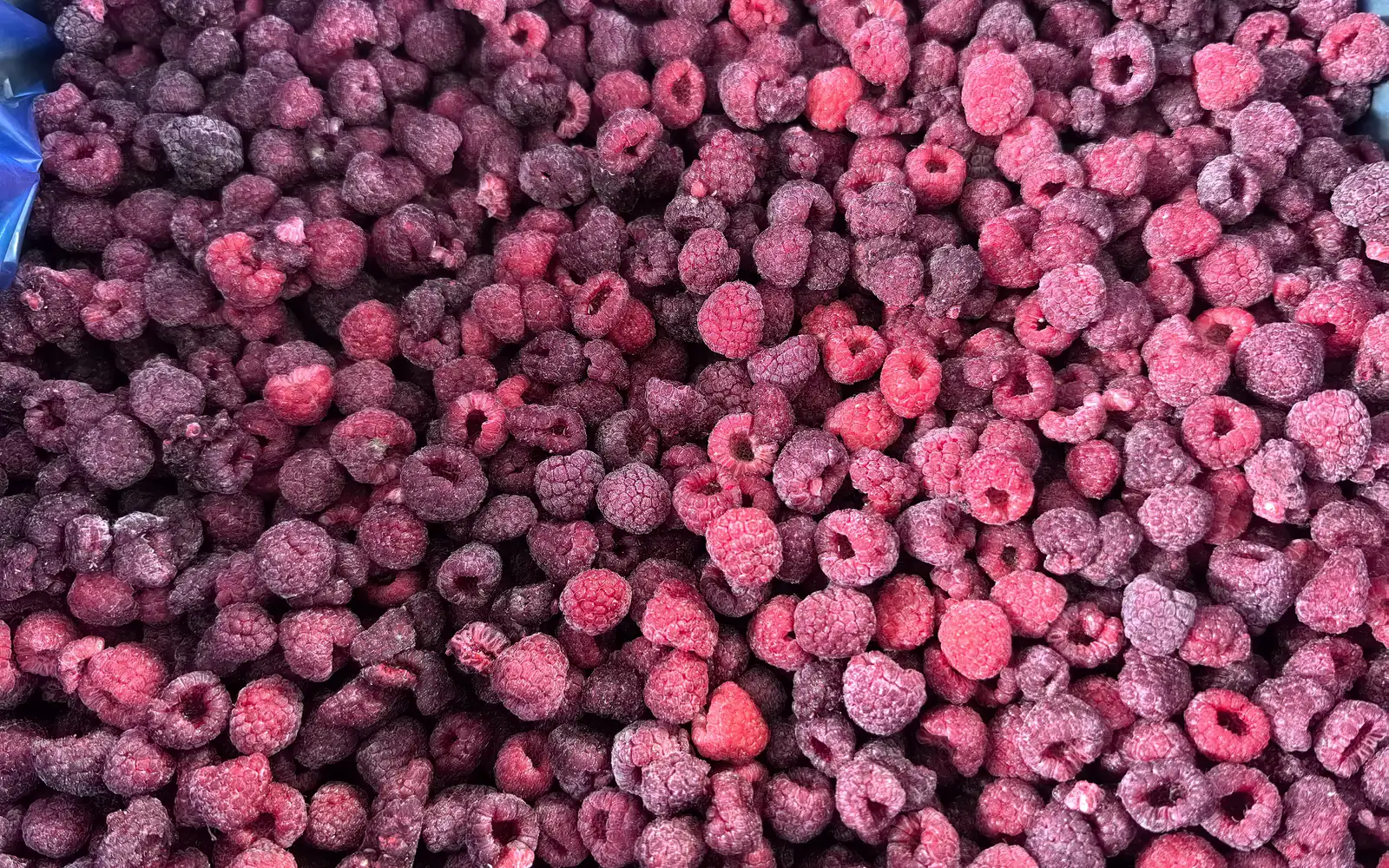
Recognisable fruit form can support visual screening. It does not establish growing origin or certification.
A species name identifies an organism. A variety or cultivar claim may require finer discrimination within that species. A growing-origin claim concerns a place and the product’s history. Certification concerns the applicable programme, operator, activity and goods. None of these follows automatically from the others. Knowing that a berry is recognisable as a raspberry does not identify its growing country or confirm an organic supply route.
For mushrooms, common and commercial names can cover different expectations. Use a complete scientific name or an agreed list where species is material to the order. Our separate guide to porcini and boletus names deals with that identity decision in more detail. In a wider fraud assessment, the next question is where an undeclared replacement could enter and what would reveal it.
Clarify what “origin” means before reviewing a document. Country of cultivation, country of freezing and country of dispatch need not be the same. A shipping address identifies one transaction location; it is not sufficient evidence of where the crop grew. Avoid translating one origin term into another while preparing the quotation, artwork or document brief. Applicable labelling and customs requirements must be checked for the destination and exact claim.
Certification also needs a defined scope. A facility’s food-safety certificate and an organic product claim address different matters. Check the actual issuer, operator, product and activity coverage, validity and any shipment evidence required by the applicable programme. A familiar logo is an invitation to verify the claim, not an authenticity result. Our organic certification and shipment-evidence guide separates those records.
Map the chain before assigning a risk score
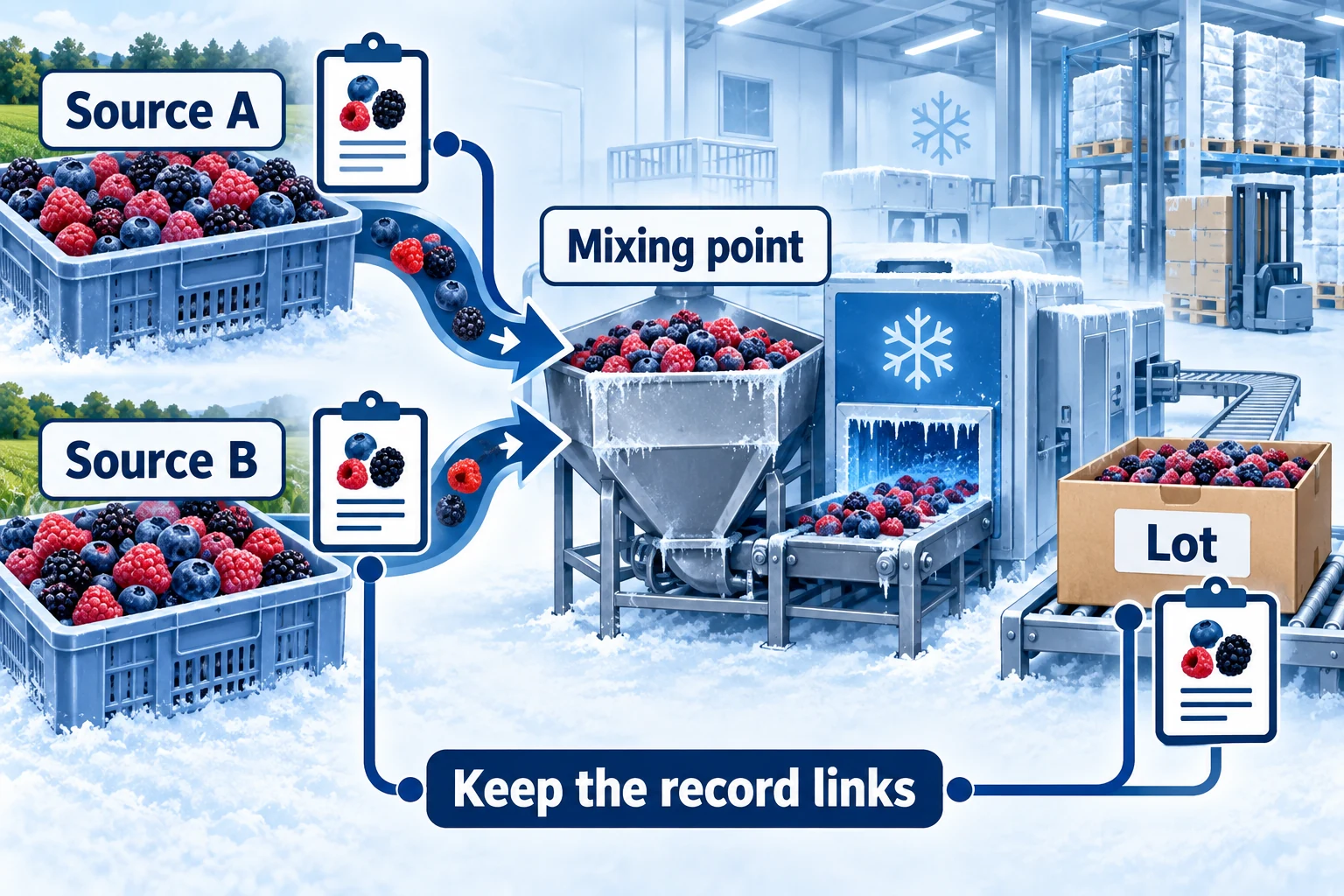
Conceptual supply-chain scene. Mixing and repacking require the relevant upstream links to remain reviewable; this is not a pictured XMG facility.
Start with the crop or ingredient source and follow it through collection, processing, freezing, storage, repacking and shipment. Mark which organisation controls each step, where different incoming streams can meet, and where the description or lot code changes. A short commercial chain is not automatically transparent; a longer chain is not automatically fraudulent. What matters is whether the material and its declarations remain connected through the actual operations.
At a mixing point, ask how the outgoing batch connects to its incoming lots. At repacking, ask how the original identity and claim are carried into the new pack. At subcontracted processing, ask which records move between organisations. You do not need to collect every internal document indiscriminately. Identify the information needed to support the promised claim, then agree an appropriate way to review it without exposing unrelated confidential material.
The IFS product-fraud mitigation guideline [2] discusses supply-chain transparency and product and supplier vulnerability. It does not impose one universal assessment formula. An internal scoring method can help prioritise work, but its inputs and justification must remain visible. “Low risk” means little when no one can explain which claim, chain stage or control was assessed.
Separate inherent exposure from the protection supplied by actual controls. For example, a valuable origin claim may remain inherently vulnerable even after a clear incoming-to-outgoing record review reduces uncertainty. Do not give the same reduction twice because an audit and a questionnaire both rely on the same underlying supplier statement. Record what each control adds, who checks it and how a failure changes the order decision.
Choose evidence that can answer the claim
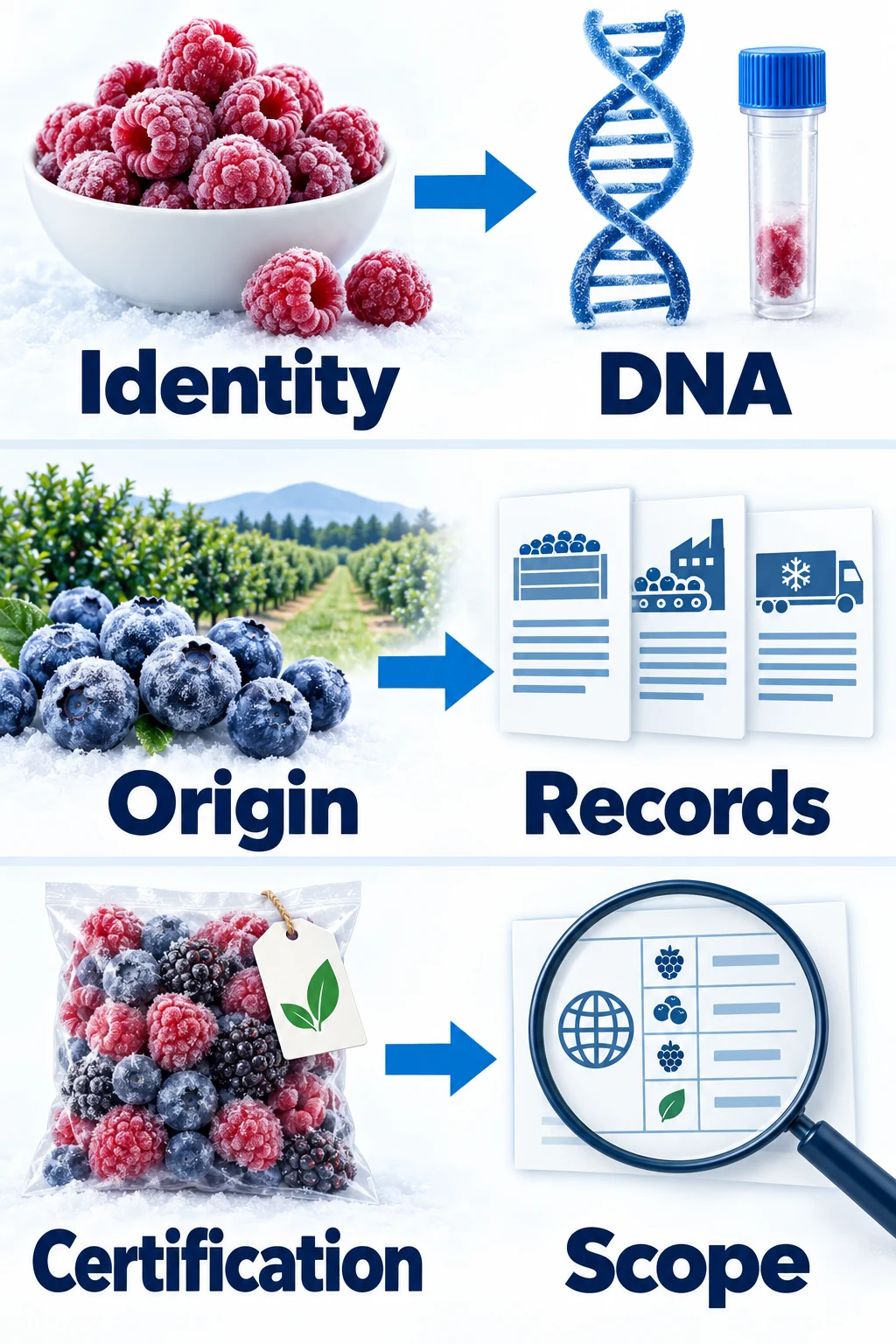
Conceptual comparison: species, growing origin and certification are separate questions. Any analytical route needs suitable method coverage.
Use appearance as a screening tool where the supplied form retains useful distinguishing features. Whole units may reveal an unexpected form or visibly different constituent. Dicing, crushing, cooking and mixtures can reduce that value. A visual inspection can document a discrepancy in an identified sample; it cannot certify the growing country or reconstruct every upstream transaction.
The European Commission’s food-fraud laboratory [3] describes several analytical approaches, including genetic methods and isotope-based analysis. These are different tools, not a single universal authenticity test. Before commissioning analysis, explain the suspected substitution or origin question to the laboratory and ask whether its method is suitable for your species, processing state and sample matrix.
| Question | Evidence to consider | Limit to resolve |
|---|---|---|
| Is the declared species present? | Declared identity, representative samples and an appropriate identification method | Detection in tested material does not establish every unit in the lot |
| Does the growing-origin claim hold? | Connected upstream records; suitable analytical support where available | Dispatch location and species identity do not alone prove cultivation origin |
| Are mixture constituents declared accurately? | Formulation and batch records plus an agreed composition check | A pooled result may not describe distribution between individual pieces |
| Is a certification claim applicable? | Issuer verification, operator scope and relevant goods or transaction records | An authentic certificate can still be outside the required scope |
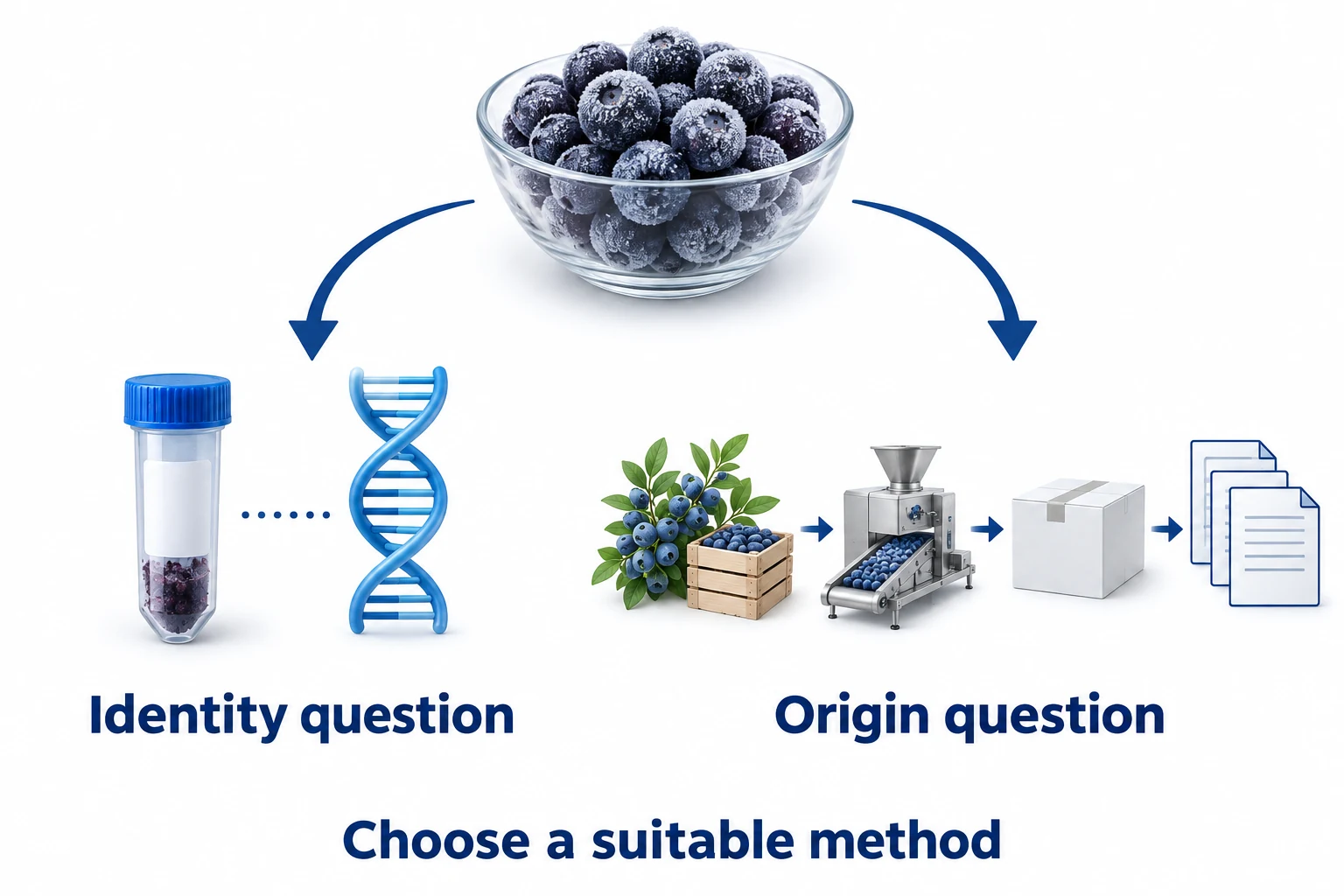
A species result and an origin evidence review answer different questions. The illustration shows method selection, not a completed test.
Before accepting an origin analysis, ask the laboratory to explain its comparison basis. Which origins can its validated method distinguish for this product? Which processing states are covered? If the analysis uses a reference library, what relevant samples does that library contain? How are uncertain results or material outside the reference coverage reported? Keep those answers with the report. Do not turn a broad compatibility finding into a precise farm identification.
Sampling and chain of custody remain part of the question. Record who selected the material, from which identified units, under what conditions and how it reached the laboratory. Agree whether the method analyses separate pieces or a pooled preparation. Keep the report’s exact conclusion with its sample identity. A broad statement such as “tested and passed” removes the details needed to interpret the result responsibly.
Read negative findings within their stated scope. If a laboratory did not detect a target in the tested preparation, ask which target, method and reporting limit the conclusion covers. That is different from proving that every possible undeclared constituent is absent. A screening method and a confirmatory method may also serve different stages of the investigation. Ask the laboratory how the result should be followed up rather than rewriting its conclusion into an unrestricted authenticity certificate.
For records, check connections as well as plausibility. A genuine purchase record can concern a different incoming lot; a genuine certificate can concern a different operator. Follow the identifiers between the claim-bearing material and the evidence submitted. Where records are redacted for confidentiality, agree which identifying fields must remain visible and who can verify the concealed information. Confidentiality should lead to an appropriate review arrangement, not an unsupported declaration being treated as a verified fact.
Build a proportionate mitigation plan
Turn each material vulnerability into a control with an owner and a decision point. For an origin claim, that might mean reviewing the defined record chain before approval. For species substitution, it might mean tighter identity wording, a suitable sampling plan and targeted testing when justified. For a certification claim, it might mean independent issuer verification and confirmation that the goods and transaction fall within scope. Choose the control because it addresses the weakness.
Agree how material substitutions or supply-route changes will be communicated before they occur. A new growing source, processing site, constituent or subcontractor may change the evidence supporting an approved claim. The change process should describe who reviews the proposed difference and whether new samples, records or label approval are needed. It should not make silent replacement convenient simply because a production schedule is tight.
Use price and availability changes as investigation prompts. An unusually cheap offer could reflect a different grade, pack, form or commercial term. A sudden shortage may increase pressure to find alternative inputs. Ask for an explanation and compare the full offer before inferring deception. Document why the change does or does not alter the particular claim under review.
A review frequency is useful only when it follows meaningful triggers as well as a calendar. New products, changed sources, revised claims, suspicious discrepancies and relevant alerts may justify reopening an assessment. Routine review should also ask whether the existing checks still work. A file can be complete while the current order follows a different route from the one originally examined.
Keep the plan small enough to operate. For every control, identify the evidence required, the responsible person, the stage at which it is reviewed and what stops release. If a control has no consequence when the evidence is missing, it is unlikely to protect the claim. Conversely, collecting an expensive test that cannot distinguish the suspected substitution consumes effort without closing the vulnerability.
Reconciliation can help at a mixing or repacking stage, but its basis must be explicit. Compare identified incoming material, outgoing material, retained stock and recorded processing losses over an appropriate period. A mismatch is a reason to investigate the records and process. Apparent arithmetic agreement is not proof of species or origin: consistent numbers can still describe incorrectly declared material. Use reconciliation alongside the identity and claim evidence that the order actually needs.
Keep independent checks independent in practice. If the same declaration appears in a questionnaire, quotation and copied certificate summary, it has not become three separate confirmations. An issuer’s direct record, an appropriately scoped laboratory report and connected transaction records can add different information. Review what each contributes and where it still depends on an unverified statement. This prevents a thick document file from obscuring one unresolved link.
Work through a frozen berry example

The fruit form supplies context for the hypothetical example; this photograph is not an authenticity or origin result.
Consider a hypothetical quotation for single-species blueberries with a named growing origin and a premium production claim. This is a planning example, not a report of a supplier investigation. Begin with three separate rows in the claim register. The berry identity, the growing country and the production claim each need a defined supporting route. Approval of one row does not clear the others.
Suppose a sample looks consistent with the requested fruit, but the dispatch paperwork lists a different country from the growing-origin declaration. That can be a legitimate processing or distribution route. Ask which record identifies cultivation and how the incoming lot connects to the outgoing shipment. The discrepancy should be explained in the transaction file before deciding whether the requested wording remains supportable.
Now suppose repacking combines several incoming lots. Review which sources those lots came from and whether every incoming source satisfies the promised claim. A new outgoing code can be legitimate, but it should not erase the necessary upstream links. Request a relevant reconciliation within the agreed scope rather than accepting an unrelated certificate or a sample photograph as a substitute.
If the remaining uncertainty concerns origin, a species test would answer the wrong question. Discuss whether a suitable origin method and reference coverage exist for this product, or whether better documentary verification is the appropriate next step. If the available evidence cannot support the premium claim, possible commercial outcomes include holding approval, revising the description with the buyer’s agreement or choosing another supply option. None requires inventing certainty.
Finally, carry the agreed outcome into the purchase documents. If the buyer accepts accurately declared material without the premium claim, revise the description and any affected artwork before release. If the premium remains essential, keep the missing evidence as a condition of approval. Preserve the reason for the decision so a later reviewer can see what was accepted. A verbal compromise should not leave the original unsupported wording on the commercial record or finished pack.
Handle a discrepancy without jumping to an accusation
Preserve the original quotation, declaration, sample photographs, relevant pack codes and report. Describe what does not match in neutral terms. “The growing-origin declaration is not connected to the supplied lot” is more useful than “the supplier is fraudulent” when the evidence has not established intent. Identify which order or units may be affected and who is responsible for the release decision.
The European Commission’s explanation of suspected agri-food fraud [4] distinguishes noncompliance, deception, advantage and intention. Its operative criteria should not be replaced by a purchasing suspicion. You can withhold commercial approval because a necessary claim is unsupported without presenting that decision as a legal finding of fraud.
Consider safety separately when an unexpected ingredient or species is found. Stop using the authenticity discussion as reassurance if the finding introduces a possible safety issue. Follow the applicable internal incident, product-hold and reporting procedures with the responsible specialists. A colour, flavour or appearance comparison is not a way to clear an unknown substitute for food safety.
Ask for corrective evidence, not only a general promise. What caused the mismatch? Which records or goods are affected? What changed in the control? How will the next order be checked? Keep unresolved findings open until the appropriate reviewer accepts the response. The UK food-crime overview [5] distinguishes substitution, misrepresentation and document fraud; use the applicable official channel if the circumstances require reporting, rather than relying on public accusations.
How we coordinate an authenticity brief
We supply frozen fruits, vegetables and mushrooms through partner-factory routes. For a claim-sensitive order, we first connect the requested product description to the specification and sample identity. Our specification and sampling coordination helps keep buyer comments, versions and approval scope together.
We also coordinate the inspection question, timing and expected records. The applicable facility, laboratory or agreed inspector performs the confirmed checks; your acceptance decision should use the actual report scope. Our quality-control and inspection page explains that division of responsibility. This makes the next discussion specific without promising that one document or test will prove every claim.
Send the claims that your order must support
Send the frozen product and form, the exact identity or origin wording, any certification requirement, the evidence your approval needs, and the quantity and destination. We will review the missing specification fields and coordinate feasible sample and record steps with the proposed supply route.
