


On this page
A nutrition database can be a useful starting point for plain frozen produce or a documented blend. Laboratory analysis becomes more valuable when the food is poorly represented in the database, processing changes its composition, variation matters to a claim, or a customer requires product-specific evidence. Many projects benefit from both: a transparent calculation for the recipe, checked against representative analytical results.
The decisive question is whether the numbers describe the food you actually sell. A fresh raw entry, a cooked-and-drained entry and a plain frozen ingredient are different comparison bases. Testing the wrong sample is no better than choosing the wrong database entry. Define the product, its condition and the destination market before commissioning either route.
Quick answer: choose the data source around product identity, processing and the evidence needed. Keep the calculation or laboratory result separate from the final label, which also needs market-specific serving, nutrient, rounding and presentation rules.
Choose the basis before choosing the method
Start with a written description: product name, cultivar or species where relevant, cut, ingredients, processing state, added sugar or salt, and the condition in which the food will be declared. Record whether the figures apply to the contents as supplied, after preparation, or after draining. That single paragraph prevents several familiar mismatches.
For a bag of broccoli florets, a raw-broccoli entry may appear close but does not document the actual blanching and freezing route. For a vegetable mix, a supplier’s figures for one component do not describe the whole bag. For fruit in syrup, a value for unsweetened fruit cannot silently become the finished product’s value. Treat these as questions to resolve, rather than accepting the first plausible number.
The FDA’s database guidance [1] leaves responsibility for valid declared values with the manufacturer. It acknowledges the choice of data source and recommends product-composition analysis. This supports a considered selection; it does not give every database calculation an approval stamp.
We would resolve the ingredient description before asking whether a report is expensive or a calculation is convenient. If the buying brief says only “mixed vegetables,” neither route has a dependable target. A signed composition and specification creates that target. The same identity should appear on sample requests, reports, calculations and the artwork handoff.
Match the database entry to the food you sell

Visible frozen broccoli form helps match a food record; it does not provide measured nutrient values.
A database search result is a record to examine, not a nutrient statement to copy. Read the food description beyond the first few words. Check raw versus cooked, frozen versus fresh, drained versus undrained, edible portion, added ingredients and the basis of the values. Keep the record identifier and the version or access date with the calculation.
USDA’s Foundation Foods documentation [2] explains that its basic-food data include analytical and sampling metadata. FoodData Central also contains other data types, including industry-provided branded-food information and historical records. The fact that two entries appear in the same search does not make their evidence equivalent.
For a frozen ingredient, make a short match note: what agrees, what differs, and why the entry is still usable or needs another source. “Broccoli, cooked and drained” might help model a specified prepared serving. It is a weak silent substitute for broccoli sold frozen when the declared basis is the package contents. A missing nutrient is another decision point: absence of a reported value is not proof of zero content.
A manufacturer-specific ingredient statement can sometimes provide a closer match than a broad public entry. Ask what product and date it covers, whether the numbers are analytical or calculated, and what preparation basis was used. Preserve those answers. Do not combine a supplier’s sodium value with a database’s vitamin value without documenting why each source represents the same food.
Calculation, analysis or a combined approach

Conceptual calculation and sampling routes address one defined product; the illustration is not a laboratory result.
Calculation models the nutrient contribution of documented ingredients and processing assumptions. Analysis measures the submitted sample through specified methods. Each has a different weakness: a calculation can model the wrong recipe faithfully, while an accurate analysis can describe a sample that represents too little of the production you intend to label.
| Route | Useful starting condition | Evidence to retain | Question it cannot answer alone |
|---|---|---|---|
| Database or ingredient calculation | Defined plain ingredient or controlled recipe with suitable source data | Entry IDs, ingredient weights, yield and processing assumptions | Does the actual production differ materially from the model? |
| Laboratory analysis | Product-specific evidence is needed or modeling is uncertain | Sample plan, identity, preparation basis, methods and results | Do the submitted samples represent the future labeled supply? |
| Combined approach | Recipe modeling needs validation or changes need an explanation | Both records plus reconciliation of meaningful differences | Has the final label been checked under the destination rules? |
For a stable plain product, begin by reviewing the available matching data and the intended declaration. For a blend with a controlled formula, build the calculation so changes can be traced to ingredients. If the formula has a difficult processing step, an added nutrient, a close-to-threshold claim or a material uncertainty, discuss analytical verification with the technical owner.
A combined approach is especially useful when a laboratory result disagrees with the calculation. The model shows where to investigate: proportions, moisture, ingredient identity or treatment. The measured result supplies evidence about the actual samples. Neither number should be adjusted merely to make the two columns agree. Keep the original records and document the reason for the eventual declared values.
A useful investigation starts by aligning the two bases. If the spreadsheet describes frozen contents as supplied but the laboratory prepared a cooked and drained sample, the difference is not yet a disagreement about the same food. Check sample preparation and final mass before judging the nutrient values. Then compare the actual ingredient proportions with the recipe used in the calculation. A formula revision that never reached the spreadsheet can explain a difference without any analytical failure.
If those fields agree, examine the ingredient data and the sampled supply. A generic record may describe a broader food population than the lots tested. Several product-specific results can help reveal whether the first sample was unusual, but decide the follow-up with the technical owner rather than testing repeatedly until a convenient result appears. Record the reason for each new sample and keep all relevant results in the dossier.
The reconciliation should end with a decision, not just a corrected total. State which basis now describes the product, which assumptions remain, and what future change would require review. That makes the combined approach useful when a new crop lot, supplier statement or recipe revision arrives.
A worked blend calculation and its limits
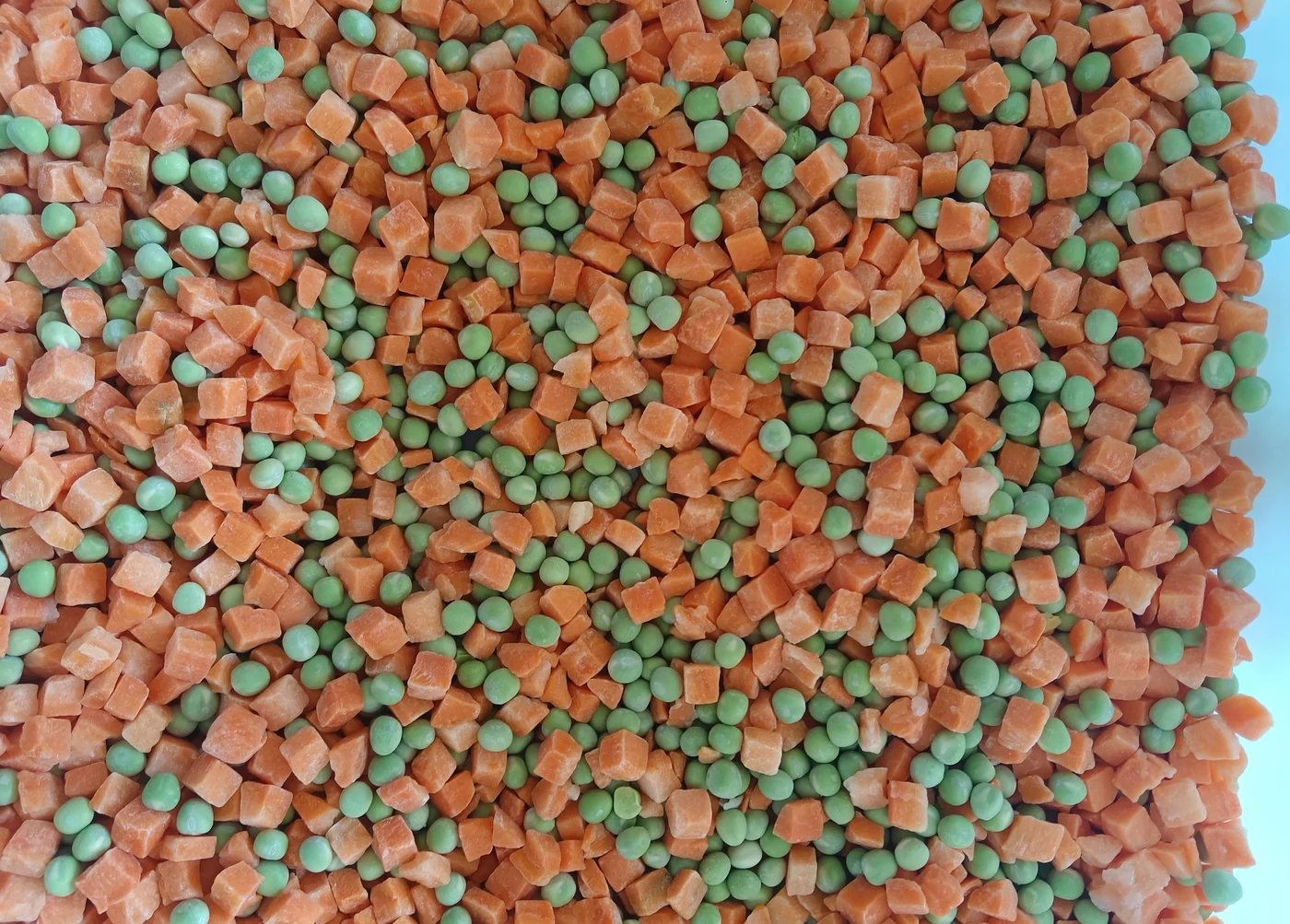
This real pea and carrot mixture illustrates component identity. Its photograph does not establish the proportions used in the worked calculation.
Consider an illustrative 1,000 g mixture containing 600 g of Ingredient A and 400 g of Ingredient B. Assume, only to demonstrate the arithmetic, that a nutrient has values of 40 mg and 70 mg per 100 g respectively. These are invented teaching inputs, not measurements of peas, carrots or an XMG product.
Ingredient A contributes 600 ÷ 100 × 40 = 240 mg. Ingredient B contributes 400 ÷ 100 × 70 = 280 mg. The mixture therefore contains an assumed 520 mg in 1,000 g, or 52 mg per 100 g. A calculation file should keep the input weights and unrounded source values, so another reviewer can reproduce the result.

Illustrative arithmetic only: a fixed 520 mg nutrient total gives 52 mg per 100 g at 1000 g, or 57.78 mg per 100 g at 900 g if only water is lost.
Now suppose the final mass becomes 900 g and, for this simplified example, only water is lost while all 520 mg remains. The concentration becomes 520 ÷ 900 × 100 = 57.78 mg per 100 g. The nutrient total has not increased. Its amount per unit mass has changed because the denominator changed.
Real processing can also remove solids, transfer soluble material into discarded liquid or change individual nutrients. The water-only assumption would then fail. Record the actual yield and the disposition of losses; do not apply a concentration adjustment without checking what left the product. The chart isolates one mathematical effect and is not a prediction for a specific freezing or cooking operation.
Finally, mixture proportions must be more than a visual estimate. A photograph can identify peas and carrot cubes, but it cannot establish their mass ratio. Use the agreed formula and its control record. Where the commercial mix permits proportion ranges, ask how that variation is represented in the nutrient-data decision rather than calculating one nominal recipe and forgetting the range.
Design samples around the product variation

Conceptual lots and sample cups explain representativeness. The illustrated count is not a universal sampling protocol.
Before sending a sample, decide what population the report is meant to represent. One delivery lot, several crop lots, a recipe made at a named facility and a whole annual supply program are different populations. A result for one bag cannot be stretched to all of them simply because the product name stays the same.
Map the sources of plausible variation: ingredient proportions, crop inputs, process route, packing period and any other material changes in the defined product. Then agree the sample selection, number of units, composite preparation and any separate analyses with the laboratory and the responsible technical team. Keep the units traceable to their lots.
The CFIA’s nutrition-label compliance test [3] describes an official enforcement method and explicitly distinguishes it from a manufacturer’s sampling plan. Its structure demonstrates why sampling and variation matter; it should not be pasted into every supplier request as a universal testing protocol.
For a mixed product, selection also needs to avoid segregation. A scoop rich in corn taken from one part of a bag may not reflect the intended blend. Record how the laboratory receives, prepares and homogenizes the material, including how it handles thaw liquid. Ask the technical team to define an appropriate preparation method rather than improvising one at dispatch.
Use a sample submission sheet with the product code, ingredient list, batch references, package condition, preparation basis and requested tests. Retain the courier and receipt details if condition or timing may affect the analytical question. That gives a discrepancy investigation something more useful than a photograph of an unidentified sample cup.
Read the laboratory report before using its numbers
Check identity first. Does the report name the correct product and sample code? Does its description agree with the supplied material? Does it state units and whether results are expressed per 100 g, per serving, on an as-received basis or on a dry-matter basis? A correct analytical result on the wrong basis is still an incorrect input for the label file.
Next examine the analytical scope. A broad test package does not automatically cover every nutrient required by the destination or every proposed claim. Confirm the methods with the laboratory, including whether they suit the product matrix and how calculated fields such as energy are derived. Ask how results below reporting limits are shown; do not replace a “less than” result with an arbitrary exact zero.
Where uncertainty, repeatability or unusual results could change the declaration, bring them to the technical reviewer. A report’s decimal places do not prove the sample represents production precisely. Equally, differences between reports can arise from preparation, measurement basis or sample composition rather than a laboratory error. Compare those fields before comparing individual numbers.
Separate the original report from the normalized calculation sheet. Keep the laboratory values unchanged, and show any unit conversions or basis adjustments in a new column with a reason. If a corrected report is issued, retain the superseded version with its status. This lets you explain which evidence supported an approved panel at a particular date.
Convert composition data into a market-specific label
A nutrient result is not a finished nutrition panel. Destination rules determine the applicable nutrient list, serving information, rounding, expression of values and any conditions attached to claims. A composition file needs a separate label-conversion review, even when every underlying figure was obtained analytically.
For US products, consult the current 21 CFR 101.9 provisions [4] for the relevant declaration and compliance requirements. Do not use an old example panel’s daily values or rounding as a substitute for the current rule. This article’s illustrative arithmetic intentionally stops before choosing a label value or a nutrient-content claim.
For another destination, build a separate conversion sheet around that market’s requirements. Preserve the same unrounded composition evidence where appropriate, but record the destination, product condition, serving basis and review version. Copying a US panel into a Canadian or other-market template can retain the wrong assumptions even after the typography looks correct.
Claims deserve their own review. A rounded displayed amount should not be treated as the complete evidence that a threshold is met. Ask which underlying value, variation and applicable rule support the proposed wording. If the margin is narrow, address it before ordering printed material. A supplier’s generic nutrition statement cannot by itself authorize the customer’s final pack claim.
Keep artwork review distinct from data selection. Our pre-print artwork checklist covers the later handoff: the approved wording and panel must reach the correct pack revision. Here the earlier question is whether the data supporting that panel describe the right product.
Keep one nutrient dossier with change triggers
Create a dossier that another reviewer can follow without opening an old email chain. It should connect the product specification, formula if applicable, ingredient sources, database records, sample plan, analytical reports, calculations, destination conversion and approved artwork reference. Assign someone to maintain the relationship between those records.
Put explicit review triggers in the file. A changed ingredient, proportion range, processing route, supplier statement or preparation instruction may alter the basis. A revised legal requirement or proposed claim may change the conversion or evidence needed even if the food itself stays the same. Describe the trigger and the technical owner who decides the response.
For example, changing a vegetable mix from peas-and-carrots to peas-carrots-and-corn should initiate a composition review. Moving from a plain fruit to a sweetened version requires an ingredient and added-sugar review. A cut-size change may be less consequential for composition, but still needs assessment if it comes with a different product or processing route. Avoid treating all changes as either harmless or an automatic full retest.
When comparing repeat orders, work from the approved dossier version and ask what changed. If the source information is incomplete, identify the missing field specifically: frozen/raw basis, formula proportions, analytical method or lot identity. “Please confirm nutrition” is too broad to produce a dependable answer.
Document the final decision in a short approval note: selected route, major assumptions, unresolved limits and next review trigger. That note explains why the values were accepted. A folder containing a report and a spreadsheet without a decision leaves the same questions open at the next print run.
Coordinate the ingredient and packing handoff
We supply frozen fruits, vegetables and mushrooms from China and coordinate product specifications, samples and packing requirements with our partner supply network. For a nutrition-data project, the useful starting point is the exact ingredient or blend and the market in which it will be sold.
Our specification and sampling coordination helps connect the product description to the supporting material. Our packing review connects the approved label and artwork version to the intended unit and carton configuration. Laboratory scope and the final regulatory declaration remain decisions for the applicable technical and market review.
Send the product and form, destination, packing format and the nutrition statement or testing requirement you need. We will review the brief and coordinate the available product information and the next sample or packing step.
References
Primary materials checked on 7 October 2026: FDA database guidance [1]; USDA FoodData Central data documentation [5]; Foundation Foods documentation [2]; 21 CFR 101.9 [4]; and CFIA nutrition-label compliance test [3]. FDA’s older guidance is used for data principles; current regulations govern current declarations.
