


On this page
Compare FOB and CIF frozen-food quotes at the same delivery boundary, with the same product, loaded weight, reefer type, origin, destination and shipment window. An FOB number leaves ocean freight for you to arrange and cargo insurance for you to decide. A CIF number includes seller-arranged freight and minimum cargo insurance to the named destination port, yet it can still leave terminal handling, reefer power, customs work, inland delivery and container return to your account. Both rules transfer cargo risk when the goods are on board the vessel at the shipment port. A lower CIF invoice is therefore not proof of a lower delivered cost or of seller risk through arrival.
Ask for a line-item bridge from each offer to one point, such as your receiving cold store. Mark every row as included, separately quoted or unresolved. If a destination charge is unknown, keep it visible instead of assigning it zero. For a container handed to a terminal before loading, also check whether FCA or CIP fits the actual handoff better [1] than the familiar FOB/CIF wording. The comparison method below works as a commercial worksheet, but the named Incoterms rule in the purchase agreement must match the movement you actually book.
Quick answer: FOB + buyer ocean freight + buyer insurance + destination and inland costs should be compared with CIF + destination and inland costs. Normalize quantity and service scope first, then verify the unresolved rows with your destination agent. CIF shifts the freight and insurance procurement to the seller; it does not shift the on-board risk point to arrival.
What FOB and CIF actually divide
The cost split and the risk split are different questions. Under FOB Incoterms® 2020, the seller delivers the goods on board at the named port of shipment; the buyer contracts for the main carriage and decides how to insure the transit risk. Under CIF, the seller also contracts and pays for carriage to the named destination port and obtains minimum cargo insurance. The ICC’s explanation of C rules [2] makes the key point: paying freight to a destination does not move delivery or risk transfer there. For CIF, the buyer carries the transit risk after on-board delivery and must be able to use the insurance documents if a covered loss occurs.
Swipe to read the diagram on a narrow screen.
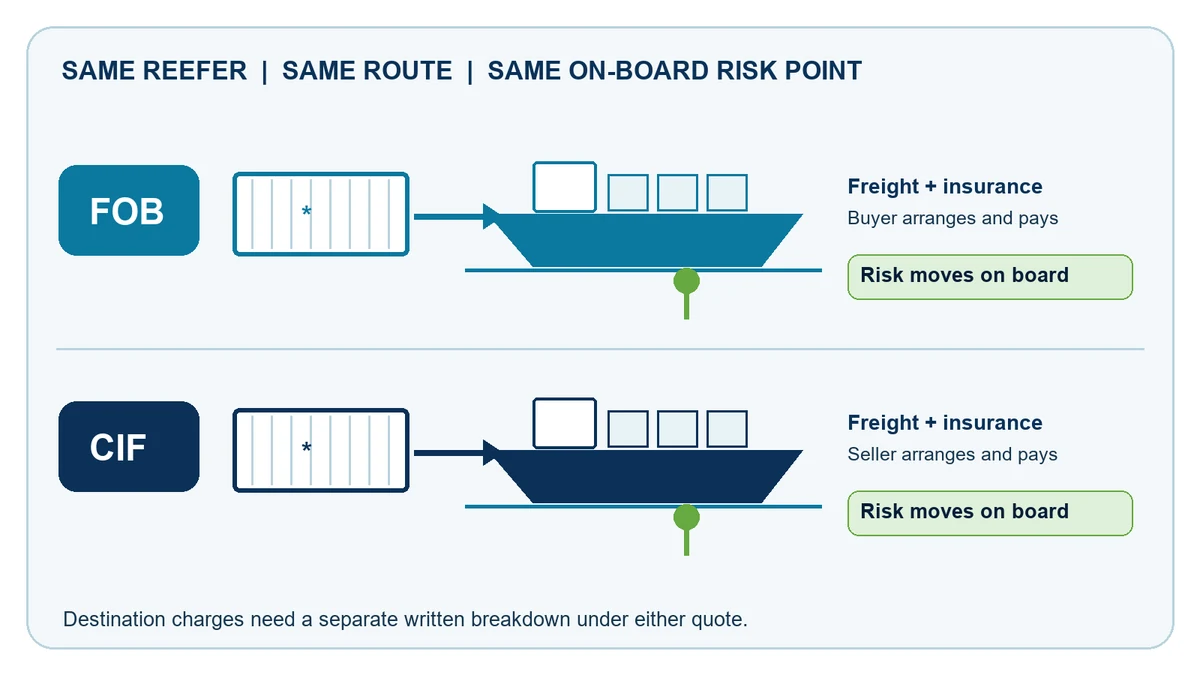
In both rules risk moves on board; the party arranging freight and insurance changes.
| Question | FOB, named shipment port | CIF, named destination port |
|---|---|---|
| Who arranges the ocean leg? | Buyer | Seller |
| Who pays the ocean freight? | Buyer, outside the FOB goods price | Seller, built into the CIF price |
| Who arranges cargo insurance? | No seller obligation under FOB; buyer should decide cover | Seller obtains minimum cover unless better cover is agreed |
| When does risk transfer? | When goods are on board at shipment port | The same on-board point |
| Are destination charges and import work included? | Do not assume so | Do not assume so |
CIF’s minimum insurance is a starting obligation, not a tailored cold-chain claims program. Ask for the insurer, insured value, clauses, temperature-related conditions, exclusions, claims documents and beneficiary or assignment arrangements. The parties can agree stronger cover, but the quote must say so. A line saying “insurance included” alone does not tell you whether a temperature excursion, machinery failure, delay or failure to maintain power is covered. Have your broker or insurer review the actual wording before relying on it.
For a reefer dropped at a container terminal, the on-board delivery point in FOB/CIF may be awkward because neither party directly controls the time between terminal handoff and vessel loading. The ICC checklist for container movements [1] points to FCA when the buyer organizes carriage and CIP when the seller pays carriage and insurance. This is a reason to discuss a better-fitting named place and rule with your logistics and contract teams, not a claim that every existing FOB or CIF container sale is invalid.
Swipe to read the diagram on a narrow screen.
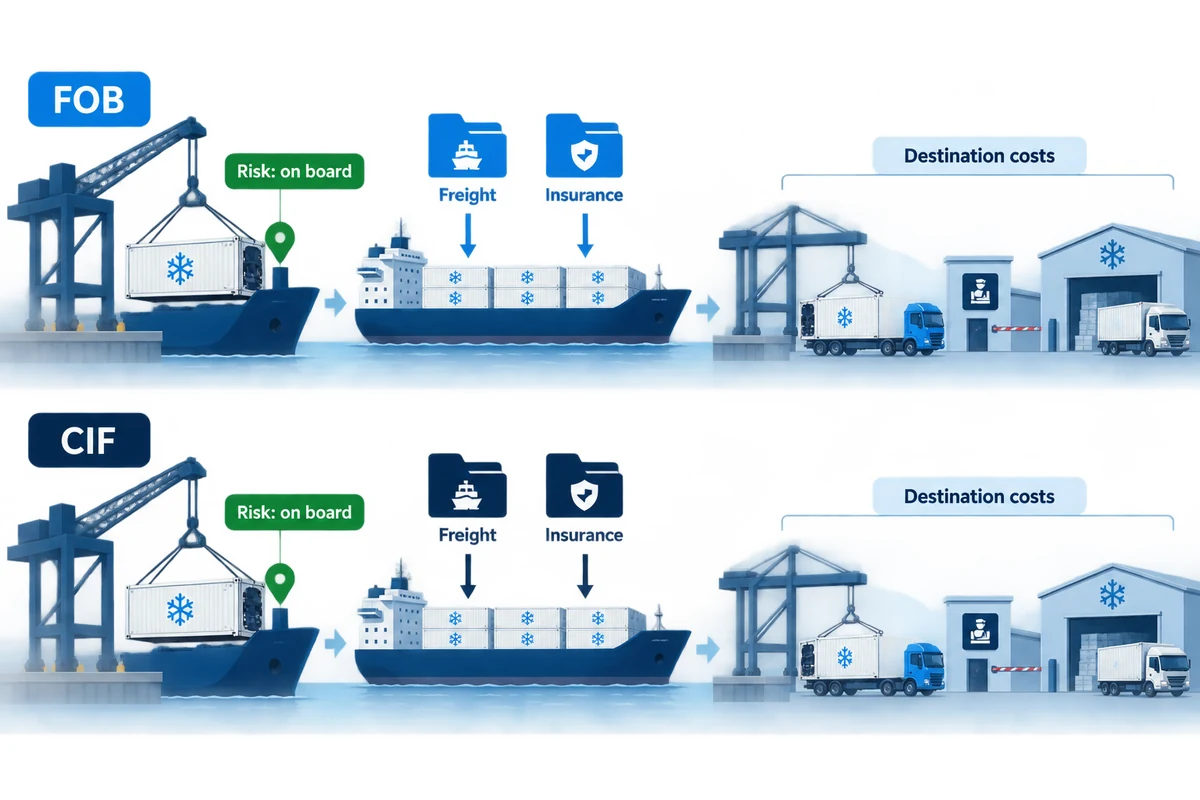
Conceptual shipment paths. Both terms place risk transfer on board at origin; check destination costs separately.
Freeze the quote basis before comparing prices
We first make the cargo and route the same in both columns. A quoted price per kilogram is useful only if the denominator is the same saleable net weight. Two suppliers can quote the same frozen item while assuming different cuts, defect limits, unit packs, carton sizes or pallet plans. Those differences can change both the product cost and the usable payload of a reefer. A cheaper freight cost per container may become dearer per net kilogram if one configuration loads less product.

Product form belongs in the matched quote brief; this photograph does not establish a container loading quantity.
Write one comparison header above every offer: product and specification revision; unit and master pack; net and gross weight per carton; carton count; palletized or floor-loaded plan; total net and gross kilograms; container type; named origin and destination ports; target sailing window; temperature instruction; currency; and quote validity. Confirm whether the price is per net kilogram, carton or complete load. Record the expected discharge port, onward delivery address and receiving appointment separately. “CIF Europe” or “FOB China” is too broad to assign charges and responsibilities cleanly.
The loading plan has an operational side beyond the commercial worksheet. Our cold-chain and container-loading guidance covers the handoff, airflow and temperature evidence questions. In this article, the decision is what each quote includes and who will invoice the services. A price comparison still needs the loading assumptions from that operational plan, but it should not replace the plan.
Ask both sellers to put origin costs in words. Does the quoted price include the agreed product packing, export clearance, transport to the named port or terminal, origin handling and container loading under the selected rule? Is a special inspection, certificate, pallet treatment or document amendment separately priced? Do not use the same checklist to imply that every item is a seller obligation under every term; record the agreed scope and any extra service separately.
Put both quotes on the same destination cost line
The practical comparison is a bridge to your own cold-store gate or another named handoff. For FOB, add your forwarder’s ocean freight and your chosen insurance to the goods price. For CIF, those items are part of the seller’s quoted price, but get the carrier, routing and insurance details. Then add destination items under both offers using the current carrier, terminal, broker and inland-carrier quotations. The destination rows can differ between offers because the carrier, agent, free time or service package differs.
Swipe to read the diagram on a narrow screen.

Treat unquoted destination charges as open items, not zero-cost services.
| Cost or control row | FOB column | CIF column | Evidence to collect |
|---|---|---|---|
| Goods price | FOB invoice | CIF invoice | Same product, pack and net kg |
| Ocean carriage and surcharges | Add buyer booking | Included to named port; check exceptions | Carrier offer, route, validity and prepaid/collect terms |
| Marine cargo insurance | Add buyer policy | Minimum seller policy; price any upgrade | Actual clauses and claims route |
| Destination terminal and release | Get local tariff | Get local tariff | Handling, documentation, delivery order and payment party |
| Reefer power, monitoring and storage | Confirm inclusion or tariff | Confirm inclusion or tariff | Terminal rules, free time and daily charges |
| Import clearance, duty and tax | Destination-specific | Destination-specific | Broker calculation for actual product and origin |
| Truck, power and empty return | Get inland offer | Get inland offer | Distance, genset, appointment, wait time, depot |
A line item can be “included”, “separately quoted” or “unresolved”. Keep an extra column for who issued the evidence and its date. A blank cell is not a zero cost. Ask the forwarder to distinguish carrier charges from terminal and third-party charges. For example, Maersk’s Philippines import information [3] lists destination handling and document rows as separate local charges, while its Vietnam import information [4] describes local payment and reefer demurrage treatment. Those pages illustrate why a port and carrier must be named; their tariffs are not transferable to another route or sailing.
Use duty and tax estimates supplied by a qualified destination broker for the actual product code, origin, preference claim, customs valuation basis and entry date. Incoterms alone do not calculate customs value or settle a destination’s entry requirements. Keep recoverable tax apart from nonrecoverable landed cost if your finance team treats them differently. If one offer is quoted in a different currency, normalize with a dated exchange assumption and show the currency exposure separately.
A worked comparison with the same cargo
Assume two offers for the same 18,000 net kilograms of frozen pineapple pieces in one specified reefer, shipped from the same Chinese origin port to the same destination port and received at the same cold store. The following figures are illustrative arithmetic only, not XMG prices, carrier rates or a forecast. The purpose is to show how a missing destination row can reverse an apparent saving.

The worked arithmetic assumes matched product and net kilograms; this image shows product form only.
| Illustrative row, USD per container | FOB offer | CIF offer |
|---|---|---|
| Seller invoice | 32,400 | 37,100 |
| Buyer ocean freight and insurance | 4,300 + 180 | Included in seller invoice |
| Verified destination handling, release and reefer power | 750 | 1,020 |
| Broker and cold-store delivery | 1,060 | 1,060 |
| Total to cold-store gate before duty and tax | 38,690 | 39,180 |
| Cost per net kg before duty and tax | 2.149 | 2.177 |
In this example, the CIF seller invoice is only USD 220 above FOB plus buyer freight and insurance (37,100 versus 36,880). Yet the confirmed destination difference adds USD 270, so the FOB route is USD 490 lower at the cold-store gate. That is a small margin against possible changes in port time, currency, insurance scope or actual loaded net weight. If the CIF destination agent cannot confirm the USD 1,020 row, we would show an unresolved estimate rather than call FOB the winner.
Compare duty and tax only after a broker confirms how each entry is assessed. If the cargo weighs 17,200 net kilograms instead of the quoted 18,000, both per-kilogram results change, and fixed port charges weigh more heavily. Recalculate from the approved packing list, not a nominal reefer capacity. For an internal budget, retain the full container total, cost per net kilogram, the date of each quote and a separate contingency for delay exposure; do not bury the contingency inside a fictitious carrier charge.
Reefer charges that deserve their own questions
Refrigerated cargo makes timing and power part of the cost plan. Ask whether the ocean offer identifies an operating reefer, the required set-point instruction, any ventilating or controlled-atmosphere option if applicable, the carrier’s treatment of pre-trip inspection and the point where the unit will be plugged in at origin and destination. The sales contract and shipment instruction should agree. The cost worksheet should identify who orders each service and who receives the bill; the operational plan should identify how product temperature and handoffs are evidenced.
At destination, request the free-time basis for the specific carrier and terminal, how reefer electricity or plug-in is charged, whether monitoring or storage is separate, and when demurrage and detention begin and end. A short customs or document delay can add both money and exposure to the cold chain. A free-time allowance on one quotation cannot simply be copied to another carrier. Confirm the empty-container return location and any truck genset or power requirement between terminal and cold store. For longer inland moves, your haulier’s offer should state fuel, waiting, appointment and return conditions.
Also ask who obtains the arrival notice, delivery order, bill of lading release and temperature data. The consignee and broker need enough time to clear the cargo and reserve a powered receiving slot. If your acceptance plan calls for a product-temperature check, seal verification or logger review on arrival, put those actions in the receiving instruction rather than treating a shipping term as a quality protocol. A CIF price can include the sea leg and still leave those practical controls to you.
Which term gives you the better decision?
FOB can work when your forwarder has a firm reefer booking, destination agent, cargo insurance and the ability to manage the shipment from the agreed on-board point. It gives you direct visibility into freight and the carrier selection. It also gives you the work of booking and paying those services. Before choosing it, verify equipment availability for the requested sailing and make sure the named shipment port and booking responsibilities are written into the order.
CIF can work when the seller has a credible, clearly specified ocean booking and you want one seller invoice for goods, freight and minimum insurance. The convenience has value only if you can see the vessel or service, destination agent, insurance wording and local charges. Ask for the destination agent’s schedule before approving the purchase order. Do not infer that the supplier has paid customs, port electricity or truck delivery because the quote says “CIF destination port”.
If the sealed reefer is handed to a carrier at a depot or terminal before it reaches the ship, ask your logistics team to evaluate FCA (buyer-arranged carriage) or CIP (seller-paid carriage and insurance) with a precisely named place. The ICC’s container guidance is a practical reason to check that option. The correct term is the one whose delivery point, insurance promise and document flow match the physical handoff and your control, not the abbreviation your last purchase order happened to use.
The final choice should survive three checks. First, can you state the total to one chosen receiving boundary, with all unresolved rows named? Second, can each party execute its booking, insurance, release and claims responsibilities? Third, do the product, packing, loaded kilograms, temperature instruction and schedule match across offers? If any answer is unclear, request a revised quote rather than compare headline numbers.
How we prepare a comparable frozen-food offer
We work with long-term partner factories for frozen fruit, vegetables and mushrooms and coordinate the order basis before a freight term is attached to it. We confirm the product form and specification with the relevant supply route, then review unit packing, cartons and the planned load basis. That lets you compare the same net kilograms and shipping configuration rather than two different products disguised as an Incoterms choice.
We can also coordinate shipment and document requirements against the agreed named ports and temperature instruction, while your destination agent confirms local charges and clearance scope. We label any unresolved destination cost or insurance detail so you can see where the delivered total is still incomplete. Our packing options and cold-chain pages show the operational questions that feed this commercial comparison.
Send a brief that produces comparable answers
Send one brief to each quoted party: product and cut, target specification, unit and master pack, expected net kilograms, pallet or floor-load preference, reefer type, named origin and destination ports, target sailing window and cold-store delivery point. Ask for the Incoterms rule with named place and edition, included and excluded charges, quote validity, carrier or routing, insurance terms, and the destination agent who can confirm local charges. Attach the same information to your forwarder’s FOB freight request so the two columns use one physical shipment.
The return quote should make unanswered items easy to spot. An “all in” description is useful only when it names the final handoff and the services inside it. Keep your destination broker’s duty/tax calculation and receiving plan beside the commercial comparison. When those pieces agree, procurement can choose the better controlled landed-cost route, not merely the lower invoice.
Request a matched frozen-food quote
We supply frozen fruits, vegetables and mushrooms through our partner network. Send the product and cut, packing, estimated quantity, named ports and shipment window. We will review the order basis and identify which FOB/CIF items need a confirmed destination quote before you compare the options.
