


On this page
Frozen water chestnuts can leave a clear, crisp point in a steamed dumpling, but the result depends on piece size, even distribution and the amount of loose liquid in the filling. A large piece may feel striking in one bite and be absent from the next. A very fine mince may disappear into the meat or vegetable matrix. The useful question is whether a typical cooked dumpling gives the intended contrast throughout the serving, not whether an uncooked water chestnut cube feels crunchy by itself. Start with a frozen cut you can identify, drain any free thaw liquid, mix the same mass into equal filling portions, and judge several fully steamed dumplings after a consistent rest.
Water chestnut is unusual because it can remain comparatively firm after heating, but that property does not turn every frozen cut into the same sensory result. Published dumpling recipes often use canned, drained water chestnuts. Those recipes show a culinary role for the ingredient; they do not prove the behavior of a particular frozen lot. Evaluate the selected lot in your own filling, where the cut, distribution and steam cycle together determine the bite.

Authentic diced form before dumpling mixing.
Quick answer: a discernible crunch can remain
A steamed dumpling gives water chestnut a short, moist heat treatment inside a cohesive filling. The corm’s texture can survive cooking better than many vegetables, so a crisp contrast is a reasonable target. A peer-reviewed study of steam-heated Chinese water chestnut [1] examines how its texture changes during heating. That studied material cannot guarantee an identical bite across whole, sliced and diced frozen products. Freezing, cut size and the surrounding filling still matter.
Define the target in useful language before changing the recipe. Some dumplings need tiny, evenly spaced crisp points so every bite has a little contrast. Others need one or two obvious chunks beside a tender shrimp filling. If a customer says only “more crunch,” ask whether the complaint is weak force at the first bite, too few pieces per dumpling, or a watery filling that makes the whole product seem soft. These are different problems. More water chestnut may solve scarcity but can also crowd out the filling’s cohesive matrix. A different cut may be a better first adjustment.
Why water chestnut can stay firm after heating
Chinese water chestnut is an aquatic corm, not a tree nut. Its pale pieces have a crisp, juicy bite even when cooked in many preparations. Research into its cell walls helps explain why cooking does not soften it in the same way as many other vegetables. The steam-heating study examined texture through instrumental and sensory measures. The sensible takeaway for a dumpling developer is narrower than a laboratory result: steaming may change the bite, and the change should be assessed in the actual recipe, with the actual cut and process.
Do not confuse the piece’s firmness with the perception of the dumpling as a whole. A corm cube surrounded by a very soft, wet filling may still register as a crisp inclusion. Yet if the filling leaks liquid, the wrapper and surrounding matrix can turn slack, masking that contrast. Similarly, a few large hard pieces can make a dumpling feel uneven rather than pleasantly crunchy. We judge the finished bite, not only the ingredient in isolation.
Freezing introduces another reason to test the actual product. Ice can affect plant tissue and release liquid on thawing. The extent depends on product form and handling; we do not assume the same effect as in a different vegetable. A frozen whole corm, a slice and a dice also have different surface area and portioning behavior. Those differences can be more important to the dumpling than a broad statement about water chestnut’s typical resilience.
Choose particle size for the bite
Start by spreading a representative sample on a tray. Look for whole pieces, slices, cubes and fines; note any sticking or uneven cut. A large dice gives a more obvious individual crunch, but it can interfere with a thin wrapper or make the filling difficult to portion. Small dice can distribute more evenly, but at an extremely fine size the contrast may become hard to perceive against minced meat or vegetables. The ideal size is not a universal millimeter value; it depends on dumpling size, wrapper thickness, filling grind and the bite you want.
Keep cut and dose separate in the first comparison. If you test a small dice at a higher proportion than a large dice, you will not know which variable caused the perceived change. Use the same drained ingredient mass in otherwise identical filling, then compare cut A and cut B. Count pieces in several weighed spoonfuls before wrapping. This simple distribution check can reveal whether an ingredient that looks abundant in the mixing bowl is actually unevenly dosed at the portioner.
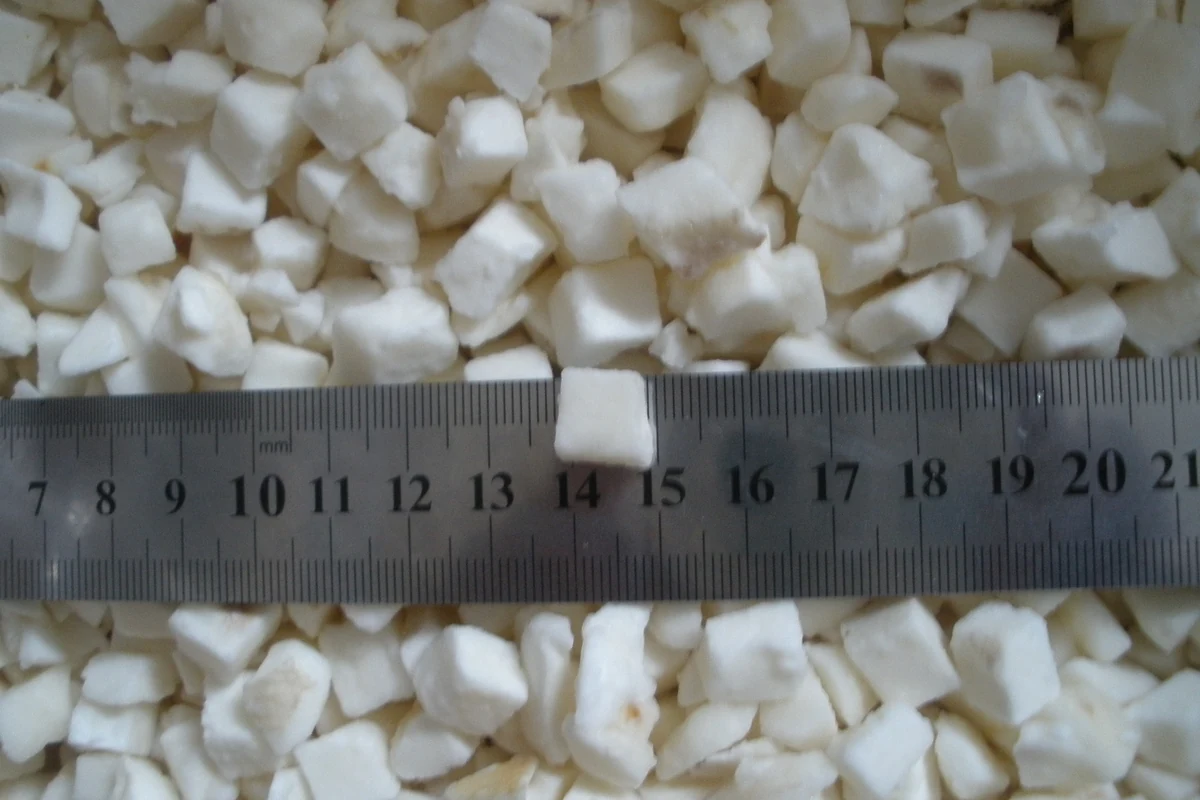
A second original diced sample shows piece variation.
Check how the cut survives mixing. A fragile or irregular piece may produce fines when mixed aggressively with a sticky protein filling. If the filling uses a mixer, examine both the beginning and end of a normal run. Hand mixing may be gentler but less uniform. Neither process should be described as automatically superior; the useful record is the actual particle distribution entering the wrapper. Our frozen water-chestnut range lists form options to clarify before a trial, but the final size and tolerance need order-specific confirmation.
Distribute pieces through the filling
A dumpling is a small sample of a larger batch. Even a well-chosen cut can fail if the pieces settle, clump or stay in one part of the mixing bowl. Add the water chestnut at a stage that lets the filling distribute it without pulverizing it. After mixing, take several spoonfuls from different parts of the bowl and count or photograph visible pieces. Then wrap dumplings from those different positions. This reveals whether the first tray and last tray offer the same eating experience.
For a shrimp or minced-meat filling, the base must still bind around the inclusions. Big, tightly packed chestnut clusters can break that continuity. If a sealed dumpling splits or the filling crumbles, do not automatically blame the wrapper. Check whether the corm cut is too large or concentrated for the filling’s particle structure. The comparison below shows how piece size and spacing can affect filling continuity.

The diagram scrolls horizontally on smaller screens.
Conceptual comparison of piece frequency, not measured crunch.
Published recipes illustrate that cooks deliberately add water chestnut for contrast. SBS Food’s spinach dumplings [2] use finely chopped, drained canned pieces; Jamie Oliver’s prawn dumplings [3] also call for drained, finely chopped tinned chestnuts. Those choices are useful context, but frozen ingredient development must still record the frozen cut and thaw condition. Copying a canned measure by volume can hide a different water content or particle size.
Keep added water and thaw liquid distinguishable
Juicy dumpling filling often includes a deliberately controlled liquid addition. That liquid has a purpose: it is incorporated into a cohesive matrix. Free liquid released from a frozen vegetable is not automatically incorporated in the same way. Drain and measure what comes away from a test portion before adding it to the base. Do not assume every drop must be discarded; decide deliberately whether the formula can hold it. If you reduce the separately added water to account for vegetable liquid, record the adjustment and compare the final bite.
Two bowls can feel equally moist during mixing and behave differently during steaming. In one, water is well bound; in the other, liquid pools after resting or is squeezed toward the wrapper. Watch for shine, puddles at the bowl edge, watery residue on the spoon and leakage at the seam. These cues are about process control, not a food-safety verdict. If the filling is meat or seafood, follow the recipe’s and local food-safety requirements for chilling and full cooking; water management alone does not establish safety.

The diagram scrolls horizontally on smaller screens.
Keep vegetable liquid and formula water separately visible.
Keep the trial small enough that you can track its arithmetic. Weigh the frozen water chestnuts, weigh the drained pieces, record any added water, and use the same base mass for the comparison. A one-batch adjustment such as adding starch after the filling becomes runny might rescue service, but it hides the effect of the chestnut cut. To learn what the ingredient contributes, change one variable at a time and only then optimize the full recipe.
Steam and evaluate the finished dumpling
Wrap equal portions with the same wrapper and seal. Steam in the same vessel and loading pattern, following a validated method for the filling. Keep a thermometer or suitable cooking control for meat, poultry or seafood filling as required; opacity or wrapper translucency alone may be insufficient. When the dumplings are fully cooked, rest equal samples for the same short interval before tasting. An immediate bite and a held-service bite can differ, so check both if the product will wait on a pass or enter a meal kit.
Cut several dumplings open. Is the water chestnut visible in most cross-sections, or concentrated in one or two pieces? Does the wrapper carry a pocket of free water? Does the corm offer an audible or tactile crisp break, or does the filling simply feel firmer? A blind paired tasting can help if the difference is subtle. Ask tasters to score frequency and pleasantness of crunch separately, because a large hard piece may score high on force but poorly on balance.

The diagram scrolls horizontally on smaller screens.
Look for the piece in the cooked bite.
For development work, capture the result in a short table: ingredient form, cut range, drained mass, addition rate, mixing order, portion size, steaming method, rest time, crisp-point frequency, wrapper condition and free liquid. It makes the next sample request or production adjustment much more precise than “use more water chestnut.”
A fair trial for foodservice development
Start with one familiar filling and two water-chestnut cuts from the same supply context if possible. Maintain identical seasoning, base hydration, wrapper, portioning and steam cycle. Make enough dumplings to sample beginning, middle and end of the mixing bowl. If you also want to compare thawed and direct addition, run that as a second experiment. Four combinations in one uncontrolled morning can produce a confusing result because the filling ages and warms while you work.
Decide in advance what would count as success. A central kitchen may value consistent deposition and a clearly perceptible crisp point after hot holding. A restaurant may value the freshest possible bite immediately after steaming. A retail dumpling may need testing after freezing, distribution and consumer preparation. These are different use conditions. The neighboring XMG article on water-chestnut crunch in reheated meals covers a later heating cycle; the present method concentrates on the first steamed dumpling.
Specify the frozen form for the next batch
Once a cut works, translate the sensory finding into information another team can act on: requested cut and size range, acceptable fines or oversized pieces, frozen separation, portion distribution and the intended filling method. Ask for a representative sample and compare it under your actual steam and holding conditions. We can coordinate form and sample discussions for an order, but a generic description of “crunchy water chestnut” is not a substitute for your finished-dumpling trial.
If the test fails, keep the diagnosis narrow. No crisp point in most bites points first to cut size, dose or distribution. Too much loose liquid points to thaw handling and formula hydration. A wrapper that tears around occasional large cubes points toward cut size or fill weight. A piece that feels hard but unpleasant may require a different cut rather than a higher dose. The useful outcome is a specification and method that produce the bite you actually want.
View frozen water chestnuts
Review the listed ingredient forms and preparation information for this application. Choose the cut and processing route that suit your intended result.
View product forms →