


On this page
A Chinese water chestnut is the edible underground corm of Eleocharis dulcis, a water-loving sedge. Once peeled, it has pale flesh, a mild taste and a distinct firm bite. It is not a tree chestnut. In a prepared meal, the useful question is less about its name than about the piece you want people to notice: a whole piece, a visible slice, small dice distributed through a filling, or a narrow strip in a mixed dish.
Water chestnut is often described as staying crisp when cooked, and that is a fair description of the ingredient’s appeal. It is not a promise for every frozen cut or every finished meal. Cut size, processing history, recipe moisture, cooking and holding all affect the bite at service. If you are choosing an IQF form, start with its role in the finished dish, then confirm the actual frozen sample and its performance in your own process.
What the name actually means
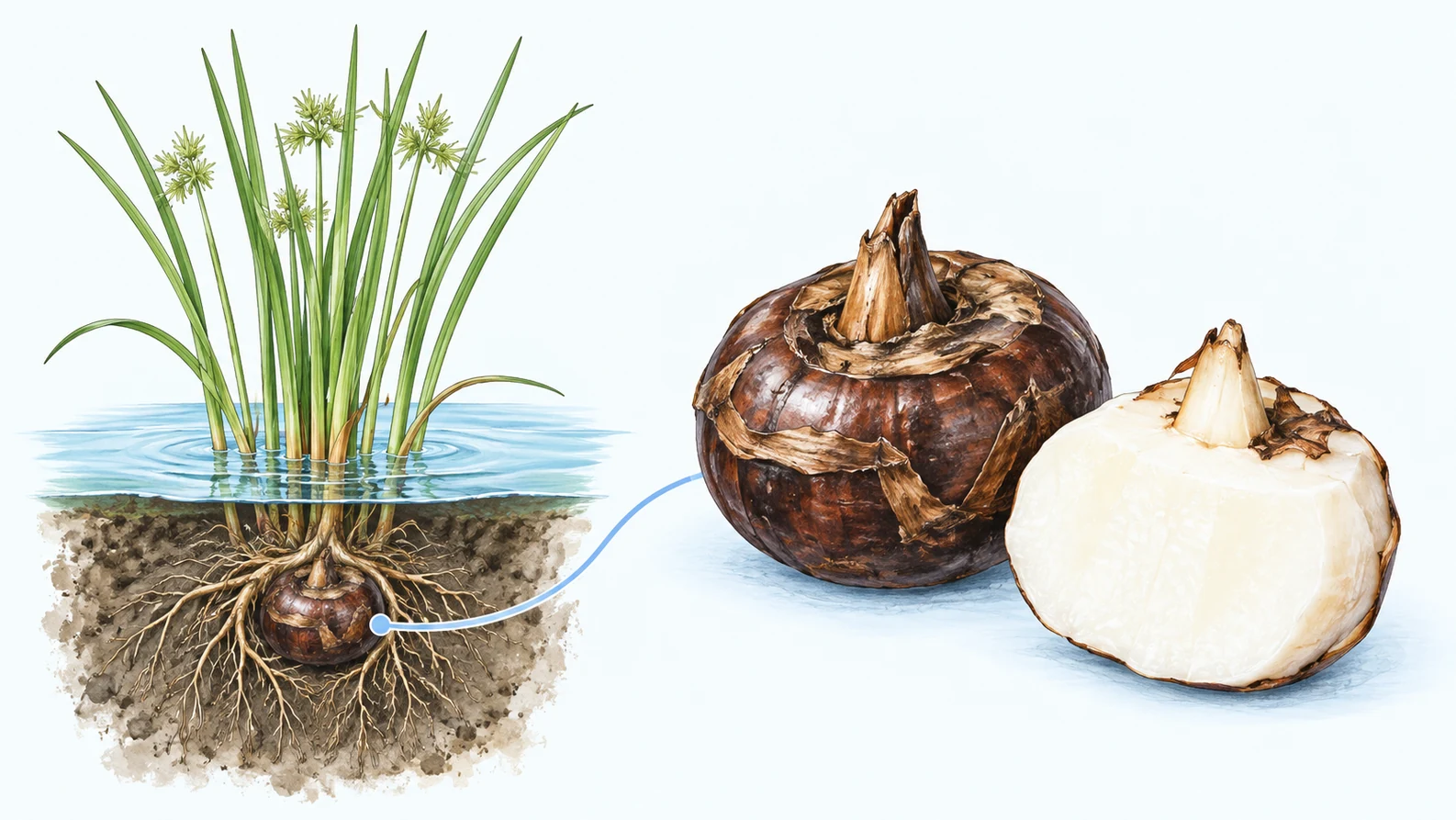
Illustration of the sedge corm and peeled flesh; it explains plant identity.
The familiar Chinese water chestnut grows as a sedge and stores food in a rounded corm below the wet ground. The USDA’s waterchestnut account [1] identifies it as Eleocharis dulcis and describes the edible corm’s white, crisp interior. The brown outer skin of a freshly harvested corm is removed for the pale pieces commonly seen in prepared dishes.
The common name causes two kinds of confusion. First, this is not the chestnut that grows on a tree. Second, other aquatic plants may also be called “water chestnut” in English. For an ingredient brief, the botanical name and a product photo are more useful than the common name alone. They help you confirm that the offered item is the pale corm used in your recipe, rather than a differently named aquatic product. A botanical distinction does not by itself settle allergen or cross-contact questions; those require the applicable product and facility information.
The flavour is mild. Water chestnut rarely carries a dish by strong aroma or sweetness. It earns its place through contrast: pale pieces and a firm bite among softer vegetables, sauces or minced fillings. That contrast depends on the size and position of the pieces. A whole corm that looks right in a plated dish could be too dominant in a dumpling filling, while a fine dice may disappear in a loose stir-fry.
Recognize the frozen product

Diced frozen water chestnut shows the cut and piece shape; finished texture needs a recipe check.
Most prepared-food developers encounter peeled water chestnut after it has been cut and individually frozen. The XMG frozen water chestnut range lists whole, sliced, diced and strip-cut forms. Those names are starting points, not complete specifications. Two suppliers can both say “dice” while supplying pieces with a different apparent size, amount of fragments or degree of peel removal.
Look at a representative frozen sample before discussing its cooking result. Can you still recognize the intended cut? Are pieces largely separate, or is a substantial portion bound into clusters? Are there obvious fragments, dark spots or peel remnants that would matter in the dish? A photo may show shape and colour, but it cannot establish the sensory bite of a delivered lot. Confirm any acceptance limits and sample basis in the order specification.
The distinction between the raw corm and a frozen cut matters here. A fresh-market description of “crisp white water chestnut” tells you what the ingredient is; it does not tell you whether a particular cut survives a filled pastry, tray meal or sauce hold. We would use the ingredient description to choose candidates, then judge those candidates in the form the kitchen will actually receive.
Choose the cut for the finished dish
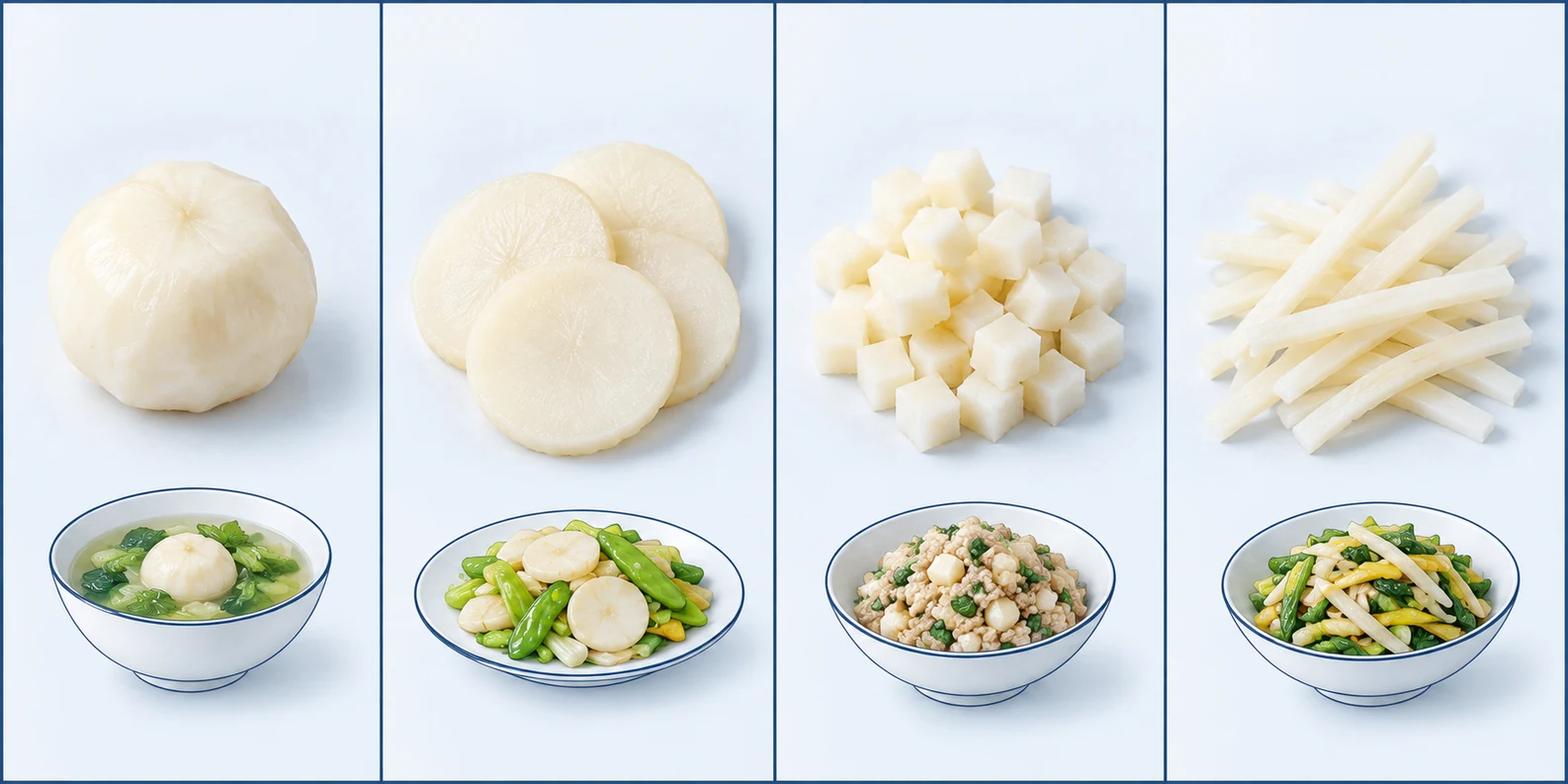
Illustrative form comparison; choose the cut against the intended recipe and sample.
The cut controls how often a diner encounters water chestnut and how clearly the piece reads on the plate. These are starting uses, based on visible geometry and the applications shown in the current XMG product range. Confirm the exact cut and finished effect with a sample.
| Frozen form | Where it tends to work | What to confirm before approval |
|---|---|---|
| Whole peeled | A dish where each piece should remain visible and countable | Diameter range, peel removal, portion fit and bite after the intended cook |
| Slices | Stir-fries and vegetable mixes where broad pale pieces should be easy to see | Slice thickness, broken pieces, distribution and appearance after mixing |
| Dice | Dumpling, spring-roll or formed fillings that need small pieces throughout | Dice definition, fragment level, distribution in the filling and bite after cooking |
| Strips | Prepared Asian-style mixes where a narrow piece should follow the direction of other cut vegetables | Length and width, breakage, tangling and portion consistency |
No line in that table is a guaranteed recipe result. A slice may be excellent in one stir-fry and awkward in another if it overwhelms the other cuts. Dice can give a pleasing scattered bite, but pieces that are too small for the filling may add little textural contrast. Whole pieces make the ingredient unmistakable, yet they may be hard to portion consistently in a crowded tray. We choose the starting form from the intended visual and eating experience, then adjust against a real sample.
If the recipe already uses several pale ingredients, visibility deserves extra attention. White water chestnut can be hard to pick out against onion, bamboo shoot or a light sauce. If it must be a named component on a menu, a larger, recognizable cut may help. If it is intended to supply bite without changing the dish’s appearance, smaller, evenly distributed pieces may fit better. The correct choice comes from the finished portion, not the frozen bag alone.
Check the frozen form before deciding

A frozen slice sample can reveal piece shape and fragments; its cooked bite needs separate evaluation.
Take a useful portion from more than one part of the sample pack. Spread the pieces so you can see the declared form rather than judging only the attractive pieces on top. Compare the apparent cut, intact pieces and fragments, clumps, surface colour and any residual skin. Photograph the sample with a scale or reference object if the team needs to agree on appearance later. The image documents what was in that sample; it does not prove future lots will be identical.
For slices, look at both face and edge. A wide face is what makes the piece visible in a mix, while the edge gives a first impression of thickness. For dice, check whether the pieces are sufficiently recognizable to stay distributed after mixing. For strips, inspect both width and length rather than judging only the handful’s overall volume. Whole pieces should be assessed for a practical diameter range and whether the portioning plan counts or weighs them.
Agree on what matters commercially before writing a detailed tolerance. If a few smaller fragments would be harmless in a minced filling, chasing a near-perfect cube may add cost without improving the dish. If the product is sold as visible slices, the same fragment level could change the plate. Colour variation should also be evaluated in the recipe context: a slight cream tone may be unobtrusive in a dark sauce, while a conspicuous dark spot or peel remnant may be unacceptable in a pale filling. Write the actual acceptance condition against the use, not a vague “premium appearance” phrase.
The frozen inspection and the cooked assessment answer different questions. A well-defined slice can soften or disappear beneath a heavy sauce. A modestly irregular dice may still work well in a filling. Neither appearance alone nor the ingredient’s general reputation for crunch is enough to approve the finished application.
Match the form to its job in the recipe

Illustrative dish contexts show how slices can remain visible while dice distribute through a filling.
Think about when the piece enters the process and what surrounds it. In a quick vegetable mix, slices can remain visually distinct among longer or softer vegetables. In a dumpling filling, dice should be small enough to spread through the mixture without making the wrapper awkward. In a tray meal, whole or larger pieces may help the ingredient remain identifiable at serving. Use these pairings to shortlist forms, then check them in the intended recipe.
Sauce and holding change the decision. A water chestnut piece served promptly in a lightly coated stir-fry is judged differently from one that is baked inside a moist filling or held in sauce before reheating. Ask the kitchen to assess the actual service route, including the planned hold. A cut that looks balanced straight from the pan may be too dominant, too soft or too hidden at the point of eating.
Use a small, fair comparison when the form choice is uncertain. Keep the base recipe and portion weight the same, follow the product’s cooking directions, and change one form at a time. Observe three things separately: whether the pieces are easy to recognize, whether they appear in most portions, and whether their bite suits the dish at service. If one candidate wins only because its pieces are larger, record that finding rather than calling the variety or freezing method inherently superior.
For products that pass through a more demanding cook, cool, freeze and reheat cycle, the form choice needs a fuller application test. Our guide to water chestnut crunch in reheated meals covers that separate evaluation in detail.
Why a crisp ingredient still needs an application check
The USDA commodity account [1] describes high-quality Chinese water chestnut as crisp and notes that the corm can retain crispness when cooked. A 2022 primary study of steam-heated fresh Chinese water chestnut [2] found that sensory hardness and crispness declined slightly with longer treatment, while the pieces remained recognizably firm and crisp under the study conditions. Both observations are useful, but neither establishes the behaviour of a particular frozen cut in a customer’s recipe.
Freezing, cutting, blanching or other processing can change the starting material; the finished meal adds its own heating, moisture and holding conditions. The study examined a defined fresh-corm steaming treatment, not every IQF water chestnut product. We therefore describe the ingredient as capable of contributing a crisp bite, then qualify that expectation with the actual form and application. “Always stays crunchy” would overpromise.
It also helps to say what “crisp” means to your panel. One team may want a clear snap as the piece is bitten; another may simply want a firm contrast with a soft filling. A large whole piece and a small cube can feel different even if they come from the same ingredient. Use the same tasting point and a short shared vocabulary when comparing samples. Record the result for the tested product and process, rather than treating it as a universal water chestnut property.
Write a short form-and-use brief
A useful first brief can fit on one page. Name the ingredient as Chinese water chestnut, state whether you want whole, slices, dice or strips, and describe the finished dish. Include the desired visible piece and bite, the key processing step and the point at which the kitchen will judge it. Add the pack, quantity and destination needed for a real supply discussion. If you already have a cut drawing or a current sample, send that too.
Then separate what you can decide immediately from what needs sample approval. The form and application can usually be shortlisted from the menu concept. Exact cut dimensions, the acceptable share of broken pieces, appearance after cooking and the chosen pack belong in the order-specific specification. There is little value in approving a supplier photo while leaving those practical fields unresolved.
If the menu names water chestnut, use a portion test as well as a single-piece bite test. Count or visually assess the pieces in several finished servings. If the ingredient is meant to add background texture to a filling, look for even distribution and whether the filling still handles cleanly. These simple observations tell you more about the form’s job than a generic claim that water chestnut is “crunchy.”
Questions about water chestnuts
Is water chestnut a nut?
Chinese water chestnut is a sedge corm, not a tree chestnut. The common name describes a food ingredient, not a botanical nut. If allergen status or cross-contact matters to your product, verify the specific ingredient and facility documentation rather than inferring it from the name.
Do frozen water chestnuts stay crunchy after cooking?
They can contribute a firm, crisp bite, but the result depends on the cut and the actual recipe and service route. Published work on fresh corms shows some texture change with steam heating. Test the frozen sample in the finished application before writing a performance claim or approving a specification.
Which cut should I choose for a filling?
Dice are a sensible starting point when small pieces need to spread through a dumpling or spring-roll filling. Confirm that the pieces stay distributed, fit the forming process and still give the intended bite after cooking. A visibly chunkier filling may call for a different cut.
Explore the IQF Water Chestnuts page, return to Food Knowledge, or browse the frozen vegetable range.
References and related reading
- USDA Agriculture Handbook 66, waterchestnut commodity chapter [1]
- Lu and colleagues, Foods 2022, on steam-heated Chinese water chestnut texture [2]
- XMG IQF Frozen Water Chestnuts
- Water Chestnut Crunch After Reheating: Trial Guide
- More Food Knowledge articles
Discuss a water chestnut form with XMG
We can review the available IQF whole, sliced, diced or strip-cut form against your intended dish, then coordinate the cut specification and a suitable sample discussion for the quoted supply route. Send the application and preferred cut, plus your pack, quantity and destination. We will confirm which options and sample or specification details are available for that inquiry.
Frozen Water Chestnuts
Review our frozen water chestnuts range, product forms and specification options.
View Frozen Water Chestnuts →