


On this page
A skin split does not automatically make an IQF pea a broken piece under every grading method. In the USDA frozen-pea standard, a pea that remains held together by its skin is not counted as broken solely because its skin is split or its cotyledons are partly crushed. Detached cotyledons, loose skins and other fragments are treated under their own definitions. Codex and Canadian rules draw their own boundaries and use different bases for some tolerances. The purchase destination and written specification decide which method applies.
Keep that inspection question separate from product form. XMG’s current sweet-pea page lists Whole and Crushed as forms. A split or detached piece found in a whole-pea sample is an observed condition; it does not mean that a separately marketed “split IQF peas” form is available. Before comparing samples, write down the form being purchased, the authority or contract clause being used, how pieces are classified, and whether the result is counted or weighed. Then test portioning under the actual application with the same equipment, target and preparation. A trial can show how an identified sample behaves; it cannot create a universal acceptance limit or stand in for a recorded XMG result.
First define what “split” means
Identify the product you bought

Generated form reference; it is not a photograph of an XMG lot or inspection sample.
“Whole versus split” can mean several different comparisons. One buyer may be asking whether a whole pea with a cracked skin counts as a defect. Another may mean whether the delivered lot contains detached cotyledons or pea fragments. Someone else may be using “split” to refer to dry split peas or to an intentionally crushed frozen format. Those are not interchangeable purchase descriptions.
In the current XMG product description, Whole and Crushed are separate choices. The page presents whole peas with a declared diameter range and crushed product as small particles. Those are commercial references for the page and order discussion, not a global definition of a split pea. If an inquiry says “split peas,” ask whether the buyer means a defect class in a whole-pea lot, a deliberately crushed format, or another product specification. Confirm the answer on the sample label and purchase document.
For a receiving inspection, identify the visible condition before assigning it a category. A useful working vocabulary is:
| Observed condition | What is physically present | Inspection question |
|---|---|---|
| Whole pea | Skin and both cotyledons remain together in the natural unit | Does it meet the purchased form and other requirements? |
| Skin split, unit still held together | A crack or split is visible, but the skin still connects the pea | Does the governing rule count this as a piece or defect? |
| Cotyledon or large portion detached | A whole pea has lost a cotyledon or substantial part | Which standard’s fragment definition applies? |
| Detached cotyledons or fragments | One or more separate edible pieces are present | How does the named method count or weigh them? |
| Loose skin | A whole or equivalent amount of skin is detached | Is skin assessed separately or grouped with other defects? |
| Crushed product form | The purchased format is intentionally supplied as small particles | What particle-size definition and use are agreed for that order? |
This table is a sorting aid, not a grading rule. A pea can look cracked without meeting a particular standard’s definition of broken material. Conversely, a small loose-skin or cotyledon fragment may be included in a standard’s piece calculation even though it would be overlooked in a quick visual glance. Use the wording from the order’s governing standard or specification when a result controls acceptance.
Separate a connected skin-split pea from a fragment

Illustrative pea forms only; classification must follow the named standard and a real sample.
The USDA AMS Frozen Peas Standard gives a useful, specific example. For its U.S. grading method, “pieces of pea” includes a whole pea from which a cotyledon or large portion has separated, detached cotyledons and defined cotyledon pieces, along with qualifying detached skin. It also states that a pea still held together by its skin is not considered a broken pea merely because the skin is split or the cotyledons are partly crushed.
That distinction prevents a common inspection error: treating every visible crack as the same defect. Look at connectivity first. Is the pea still one unit held by its skin? Is a cotyledon separated? Are two cotyledons loose? Is there an amount of detached skin equivalent to a whole skin under the manual’s terms? For a piece that is hard to classify, record the uncertain state and apply the agreed method rather than resolving it by intuition.
The USDA inspection instructions add counting details for the U.S. method. For example, the inspection manual explains how to treat a whole pea missing a cotyledon, two detached cotyledons, aggregated cotyledon pieces and detached skin. These definitions can affect the numerator. The standard calculates the percent by count as the number of pieces divided by the total number of peas and pieces in the sample. Do not replace that grade calculation with a mass fraction simply because a scale is easier to use.
A written inspection sheet should name the cited document and edition, give the category labels, and include a small reference drawing or approved image if staff need to make the same cut between “still connected” and “detached.” Record ambiguous units separately until the reviewer makes a disposition under the named method. This keeps a borderline observation from quietly changing the classification rule halfway through a sample.
Count-based and mass-based limits answer different questions
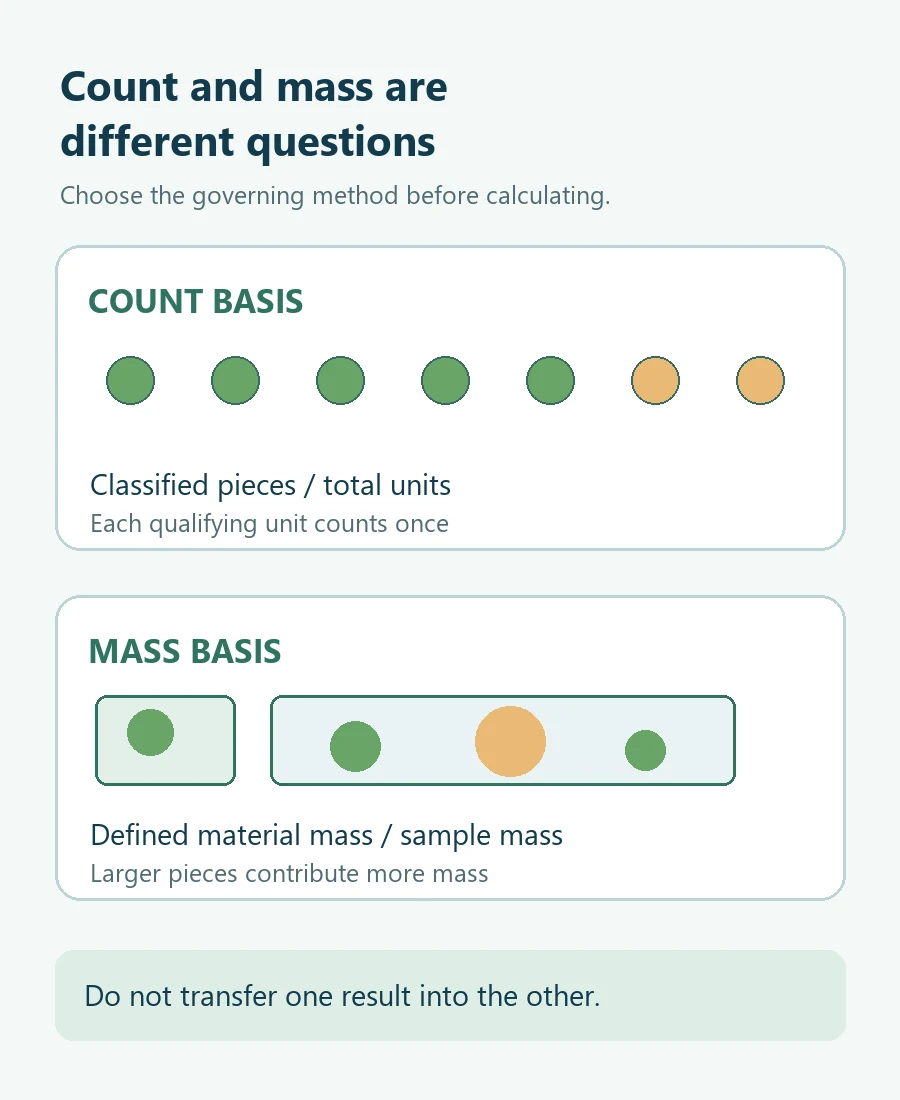
Method-basis diagram only; colored units are not an XMG result or acceptance limit.
The same sample can produce a count fraction and a mass fraction, but the results are not interchangeable. Counting gives each classified unit one count under the method’s rules. Weighing gives more influence to larger pieces. A few large fragments can contribute a substantial share of mass while representing a small share of counts. Many tiny pieces may have the opposite effect.
The published references illustrate why buyers should not copy one number into another system:
| Source | Example basis | Scope of the example |
|---|---|---|
| USDA AMS Frozen Peas Standard | U.S. Grade A allows no more than 7% pieces by count; its full grade decision includes other factors and rules | U.S. voluntary grade standard; only use when relevant or incorporated |
| Codex CXS 41-1981 | Defines pea fragments and gives a 12% by-mass tolerance for fragments on a 500 g sample unit, with further sample/lot rules | Applies to peas offered for direct consumption; its scope expressly excludes product intended for further processing or industrial use, so this is a terminology contrast, not an industrial-meal limit |
| Canadian Grade Compendium, frozen peas | Canada A and B use their own combined by-count allowances for broken peas, split peas and loose skins (7% and 10%, respectively) | Canadian grade wording only; apply the matching grade and any size qualification |
| XMG sweet-pea product page | Current commercial page states a maximum 5.0% by mass for broken, crushed or mechanically damaged pieces | XMG’s declared commercial reference; not a universal grade or evidence about a particular lot |
The table places examples side by side to show scope; it does not rank them or recommend a tolerance. The USDA example is count-based. Codex’s cited fragment tolerance is mass-based, but its own scope excludes peas intended for further processing or industrial use. Canada has separate definitions for “broken pea,” “split pea” and “loose skin,” with allowances expressed by count. XMG’s page states its damaged-piece figure by mass. Different classifications, samples, denominators and lot rules mean that the percentages cannot be compared as if they measured exactly the same thing.
A simple arithmetic example makes the distinction clear. If an inspector classifies 6 pieces among 100 total peas and pieces under a defined counting rule, the count fraction is 6%. The same material could have a mass fraction of 2%, 8% or another value depending on the sizes and weights of the pieces. A count result alone does not reveal the mass fraction; a mass result alone does not reveal how many units were affected. This is a hypothetical illustration only, not a test result or an acceptable limit.
When a specification gives a number, write the basis beside it: pieces by count or fraction by mass; sample unit; defect definition; whether detached skins are included; and how the lot is accepted. If the requirement gives only a vague phrase such as “low split rate,” resolve it before approving a sample. Do not infer that the XMG page’s mass limit is the same as a USDA or Canadian count allowance.
Plan a sample that represents the purchased form

Illustrative setup only; no measured XMG or customer portion is shown.
A small hand-picked cup may help identify possible defect types, but it does not necessarily represent a lot. Before opening packages, define the lot or production code, the package draw, the number of units to be assessed, whether packages remain separate or are pooled, and how the inspection sample is mixed. Select packages and portions without choosing only the cleanest or most damaged-looking material.
Keep whole-pea and crushed-form samples separate. The intended methods differ: a whole-pea inspection classifies natural units and detached fragments, while a crushed product may need a size or particle distribution definition. Do not apply a whole-pea “broken” count to a deliberately crushed product unless the contract explicitly defines such a test.
Record the sample state and handling conditions. Peas can stick together, thaw, soften or lose frost during handling. If the requirement is assessed on a frozen sample, document the time out of storage, container condition, separation method and any clumps that remain after the agreed handling step. If the buyer needs a cooked or finished-use trial, prepare that portion through the approved recipe route and keep it distinct from the frozen physical inspection. The current XMG page asks buyers to agree sampling basis and inspection scope; a consistent record helps carry that agreement from sample review into an order.
Useful fields include product form, lot/code, package IDs, draw method, sample weight or count, frozen condition, pooling rule, applicable standard or clause, operator, date, defect definitions, raw readings, calculation basis and disposition. If two reviewers disagree, retain both observations and compare the definitions before averaging or reclassifying anything. A retest rule should specify whether the team uses a retained sample, a new draw or separate package results, and how the outcomes affect acceptance.
Classify before calculating the defect rate
Use the governing definition to classify each pea or piece before calculating anything. For a USDA-style count, the record should distinguish qualifying “pieces of peas” from a unit that remains held together by its skin. Where the Codex direct-consumption standard actually governs, classify its fragment categories and weigh them on that standard’s basis; do not apply its stated tolerance to industrial prepared-meal ingredients. For Canadian grading, keep the separate terms and count rule visible. A visual checklist that collapses all cracks, detached cotyledons and loose skins into one unlabelled bucket will make the final percentage difficult to interpret.
If the contract also wants a buyer-defined mass fraction, state exactly what is collected and weighed. Are complete skin-split-but-connected peas included? Are loose skins included? Are fragments grouped with crushed material? Is the denominator the net product sample mass, the mass of only the peas, or another defined basis? Does the sample need to be frozen, tempered or prepared before weighing? These questions are not settled by the phrase “percent split.”
A buyer may decide to record both count and mass for internal comparison, but keep each as a separate line. For example:
- Count fraction under the named method: qualifying pieces ÷ all peas and pieces counted × 100.
- Mass fraction under the buyer’s written method: collected defined material mass ÷ stated sample mass × 100.
The first formula reflects the USDA method described above; the second is only a possible contract calculation when the numerator and denominator are defined. It does not reproduce a USDA grade result or a Codex result automatically. If a sample is tested more than once, keep the individual values and the repeat rule. Avoid reporting many decimal places when the method and sample size do not support them.
A common failure is changing the sorting definition after seeing the first result. Another is calling an entire pea “broken” because of a shallow skin crack even when the applicable rule distinguishes a still-connected unit. A third is weighing only easy-to-collect pieces while leaving loose skins or small fragments behind. Train reviewers against the same definitions, preserve example images if permitted, and note excluded or unclear material instead of hiding it inside a rounded percentage.
Run a controlled portioning trial
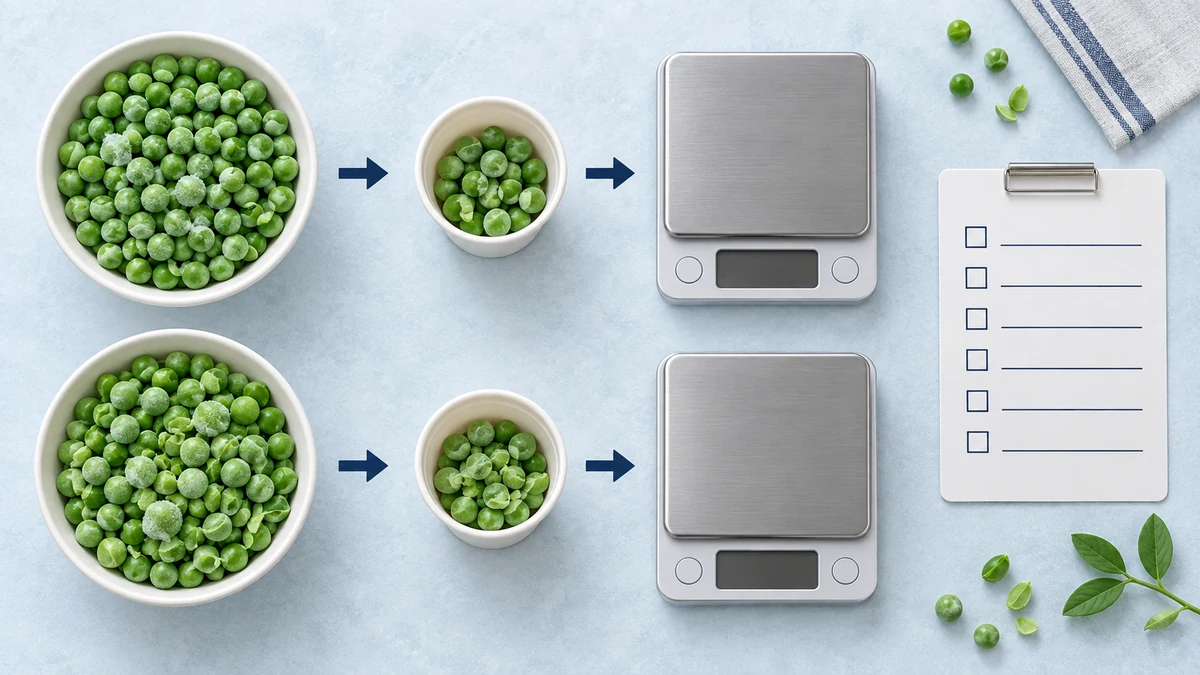
Conceptual buyer-side method; no XMG lot, replicate reading or performance outcome is represented.
The inspection rate and the performance of a scoop or feeder are separate questions. A lot can have an observable split fraction without that fraction changing weight-based dosing. It could matter more in a count-based recipe, a serving where whole peas are visible, or a process where small pieces collect differently. Run a trial only after the buyer defines what successful portioning means in the actual use.
Start with identified samples from the same source lot or explicitly record that candidates come from different lots. Keep the same frozen state, handling time, scoop or feeder, operator steps, target portion, vessel and collection procedure within a comparison. Set the number of replicate portions before the trial. If the process includes a cooking step, use the approved preparation for every candidate and record that test separately from frozen dispensing.
A practical sequence is:
- Define the question. Decide whether the trial checks average portion mass, portion-to-portion spread, pea count, visible fragment level, feed time, bridging or another buyer-selected outcome. A trial should answer a named question rather than invite a general “which is better?” judgment.
- Identify each material. Label the sample source, product form and any separated fraction. If the team has sorted whole units, skin-split-but-connected units and detached fragments for diagnosis, state clearly that the sorted fractions are not a representative lot by themselves.
- Set the controls. Fix the initial product temperature/state, mass or volume loaded, scoop or feeder, movement, operator, target portion and collection cups. If the buyer wants to test a different machine setting, run that as a second condition and change one factor at a time.
- Repeat portions. Collect the pre-agreed number of portions, tare each receiving vessel, and preserve the actual reading. Count peas or fragments only if that is part of the question. Record interruptions, bridging, clumps or manual adjustments.
- Compare under the same rule. Calculate average portion mass and the spread among portions if those metrics were selected. Compare target error, cycle time or defect composition only when the protocol defines the calculation. Keep sensory or appearance comments separate from numerical readings.
- Make a scoped decision. Report whether this sample and setup met the buyer’s stated criterion. Do not extend a short trial to an untested lot, equipment or recipe, and do not convert a preferred result into a commercial limit without agreement.
For a weight-based fill, a cup that delivers the target mass consistently may be acceptable even if one cup contains more small pieces than another; the buyer may still care about appearance or texture. For count-based dosing, a mixture of whole units and fragments can change the unit count for the same mass. In a visible side dish, the appearance of fragments may matter more than a small mass variation. In a soup base, the buyer may evaluate dosing and finished texture instead. The process owner should choose the response variables from the product’s role.
If a naturally occurring fragment fraction is too small to test on its own, do not inflate or simulate it and present the result as a lot outcome. The team can record the as-received sample and separately design a controlled exploratory test with an intentionally prepared comparison fraction. Such a test may help formulate a question; it does not estimate the commercial lot’s defect rate. Clearly label any prepared comparison as a method-development sample.
Use this sequence as a buyer-side method, then keep the conclusion tied to the identified sample, written protocol, recorded readings and defined approval basis. A supplier performance claim needs those records for the specific order.
Interpret results without turning a trial into an acceptance limit
Three decisions must stay separate. A regulatory or grade assessment uses the authority and method that applies in the destination or contract. A purchase specification uses the agreed commercial tolerance and sample plan. An application trial asks whether a named sample works in the buyer’s process. Passing one does not automatically prove the other two.
If a supplier report and buyer trial disagree, first check sample identity, product form, defect definitions, count or mass basis, frozen condition, package draw and portioning setup. If the inputs differ, the results are not a direct comparison. Do not average unlike measurements or silently revise a limit after seeing a result. Keep the original record, the reason for a repeat, and any approved change to the specification.
The useful conclusion is scoped: “Under this method and sample, the observed fraction was X by the stated basis; the repeated portion trial showed Y under the stated setup; disposition follows clause Z.” If the test was exploratory, call it exploratory. If a trial used only a sorted fraction, say it did not represent the lot. This language helps procurement, QA and production identify whether the issue is classification, sampling, application performance or a specification mismatch.
Build an order-specific whole-pea brief

Conceptual record sequence; no real lot or test values are supplied.
Before sample approval, record the named product form, intended use, destination market, incorporated standard or contract clause, defect definition, count-or-mass basis, acceptance number, sample plan and any portioning conditions. If the buyer wants a trial, also provide the target portion, utensil or feeder, number of replicates and selected response variables. Agree how the result will affect acceptance before the test begins.
What we can review for a sweet-pea order
XMG’s current sweet-pea page lists Whole and Crushed formats, gives its commercial size references, and states that the specification and inspection plan should define how split and damaged peas are assessed. For an order discussion, we can review the desired form, destination requirements and written inspection basis, then confirm suitable sample and specification options. We need the exact form, the clause or buyer definition, the calculation basis and the portioning use so the inquiry remains tied to the correct product and decision.
See the IQF frozen sweet-pea product page to discuss the listed forms and an order-specific specification. For a different question about tenderness instruments and sieve sizing, read our guide to pea tenderometer values and frozen-pea size grades.
Frequently asked questions
Does a split skin always make an IQF pea a broken piece?
No. The USDA grade standard says a pea held together by its skin is not a broken piece solely because its skin is split or cotyledons are partly crushed. Other standards have their own definitions, and a buyer specification can set its own method where applicable.
Are split IQF peas the same form as XMG Crushed peas?
No. XMG’s current page lists Whole and Crushed as separate forms. “Split” should be clarified as a defect state, an agreed particle description or another intended product before requesting a sample.
Can broken pieces be measured by both count and mass?
They can be recorded separately if the method defines the categories, sample and denominator for each. A count percentage cannot be inferred from a mass percentage, or vice versa, without the underlying observations.
Does a portioning trial set the acceptable broken-piece rate?
No. It can show how an identified sample behaves in a defined application. The acceptance rate and lot decision still need an agreed standard or written purchase specification.
Public references
- USDA AMS: Frozen Peas Grades and Standards [1]
- USDA AMS: Frozen Peas Standard (PDF) [2]
- USDA AMS: Frozen Peas Inspection Instructions (PDF) [3]
- FAO/WHO Codex: CXS 41-1981 Standard for Quick Frozen Peas (PDF) [4]
- CFIA: Canadian Grade Compendium, Volume 3, frozen-pea provisions [5]
Frozen Sweet Peas
Review our frozen sweet peas range, product forms and specification options.
View Frozen Sweet Peas →