


On this page
A pea tenderometer value is useful only when the report identifies the peas, their condition and the method that produced it. A reading on fresh peas before processing does not describe the same test as a reading on prepared frozen peas, and neither replaces size grading or an assessment of the cooked product. For frozen-pea selection, agree three separate things: a comparable measurement, a defined size distribution and acceptable eating quality in the intended application.
Read the value together with the sample state
A tenderometer measures the mechanical response of a sample under a defined instrument action. For example, the JBT Model 4011 brochure [1] describes moving knives acting against a stationary assembly, with the resulting reaction measured and displayed in tenderometric units. Its stated application covers fresh or scalded products. That scope matters before anyone loads frozen peas into a machine or compares a factory result with a receiving-laboratory result.

Illustrative assessment contexts: fresh raw material, a sample prepared under its analytical method, and a finished dish. These are separate purposes; the picture prescribes no preparation sequence, temperature or acceptance result.
Ask where the number sits in the process: incoming fresh peas, material after a stated heat treatment, or a frozen-product sample prepared by an agreed analytical procedure. Record that point in words beside the result. “Tenderometer: 98” leaves the most important comparison unresolved. “98 TU, fresh raw-material sample, method revision R2” identifies a different observation from the same number attached to cooked peas.
Do not invent a preparation procedure to make two reports look comparable. If the laboratory method requires conditioning, the procedure should define the sample treatment, timing, drainage and temperature control. If the supplied instrument method does not cover the proposed material state, obtain a suitable method before treating its output as an acceptance measurement.
A frozen-product buyer can legitimately need both a raw-material control and a finished-product check. Keep their purposes explicit: one supports decisions at an earlier production stage; the other assesses the supplied ingredient or its performance after preparation. They can be connected by identified production records without pretending that their numerical scales are interchangeable.
Keep the tested peas connected to the lot
Start the comparison with the sample identifier, product form and production lot. Where available and relevant to the program, include the pea variety or declared variety type, crop reference and processing date. The report should say whether it describes whole peas, a selected sieve fraction or some other defined material. A carefully measured subset can answer a narrow question while leaving the whole supplied distribution untested.
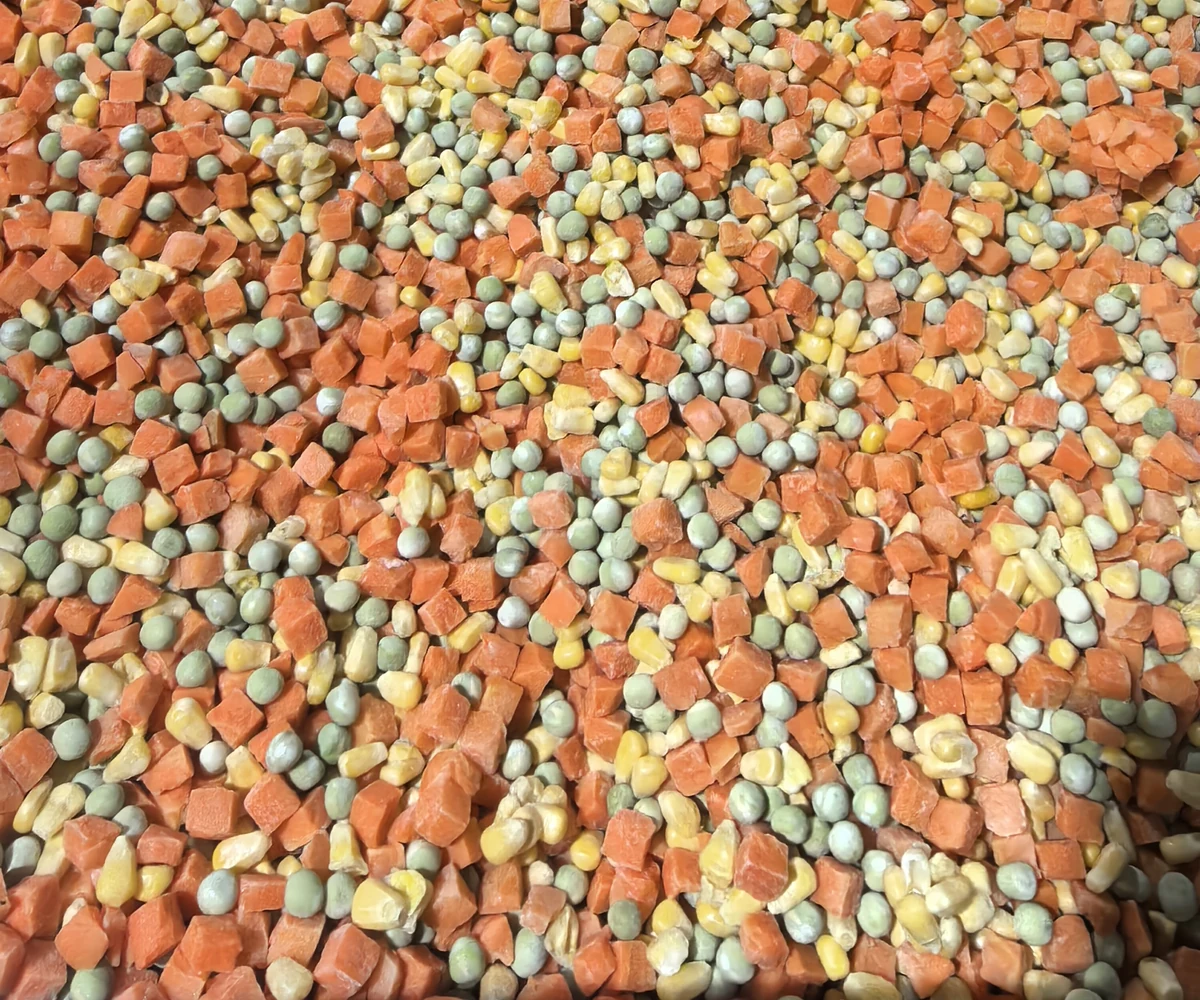
Peas, carrot pieces and corn in a mixed vegetable product. A measurement of the defined pea ingredient and an assessment of the whole blend describe different materials.
This becomes especially important for vegetable blends. A pea tenderometer result belongs to the identified pea ingredient and the specified sample preparation. Loading peas, carrot pieces and corn together would describe a different mixed material. If peas are separated from a supplied blend for analysis, document that selection and confirm that the method permits it; do not silently present the result as though it came from an unopened pack of pure peas.
Record how the analytical material was obtained from the commercial sample. Which packs contributed, how portions were selected and whether material was pooled are separate questions from how much fits inside a test cell. Increasing the number of instrument repetitions on one selected portion does not automatically improve coverage of a shipment.
The amount loaded must follow the actual method. A published cell volume is not a sample mass: a cubic decimetre and a gram measure different quantities. Avoid turning a volume field in an equipment brochure into a convenient weighing instruction. A laboratory should report the required loading basis and how it was controlled, rather than relying on an undocumented “full scoop”.
Keep any retained reference under its specified conditions and label it for its actual role. A production sample, a sensory reference and a material used to compare instruments may require different preparation and use arrangements. Sharing a product name does not make them equivalent references.
Check the instrument, units and calibration pair
The word “texture” on a report is not enough to identify its measurement. Confirm the instrument model, test cell, force transducer, program and output unit. A texture analyser can report force or other properties; it does not become a tenderometer simply because the tested food is peas.
The FTC tenderometer brochure [2] gives a useful model-specific example: its shear cell and TU loadcell are calibrated together, with their identities linked. It also distinguishes a TU-calibrated loadcell from other loadcells that report force. A value in newtons, a peak in tenderometer units and a work measurement are different outputs, even if they appear on similar equipment.

Conceptual component identities connect a test cell and loadcell to one pair record. The objects are illustrative, not a particular installed model or an actual calibration certificate.
For a supplier comparison, ask whether the calibration record covers the components actually installed during the test. A valid record for one pair does not by itself explain a result produced after a component was exchanged. The operator’s record should make that connection visible without requiring the buyer to infer it from a generic certificate title.
Instrument condition also deserves a place in a disputed-result review. [3] addresses controlled comparison samples, temperatures, repeat readings and cell maintenance. It notes that defrosted frozen peas are less consistent for its preseason comparison than fresh material. Those instructions belong to that standardisation scheme; its correction factors and tolerances should not be copied into an unrelated finished-pea contract.
In practical terms, obtain the current method and equipment records before negotiating a narrower purchasing limit. If two sites use different systems, establish how comparability will be demonstrated with suitable shared material and controlled conditions. Agreement between two displayed numbers is not a substitute for understanding what each system measured.
Preserve repeat readings and their spread
Request the individual valid readings as well as the reported summary. First clarify what “maximum” means: the peak during one instrument stroke is different from the highest result among several tests. Likewise, an instrument’s stored average can include earlier measurements unless its data set is identified correctly.
The JBT brochure describes an arithmetic-mean function for up to twenty recent tests. A buyer reviewing that output needs to know which sample identifiers those tests represent. A conveniently printed average should not combine different lots, sample states or method settings merely because their results remain in the machine’s memory.
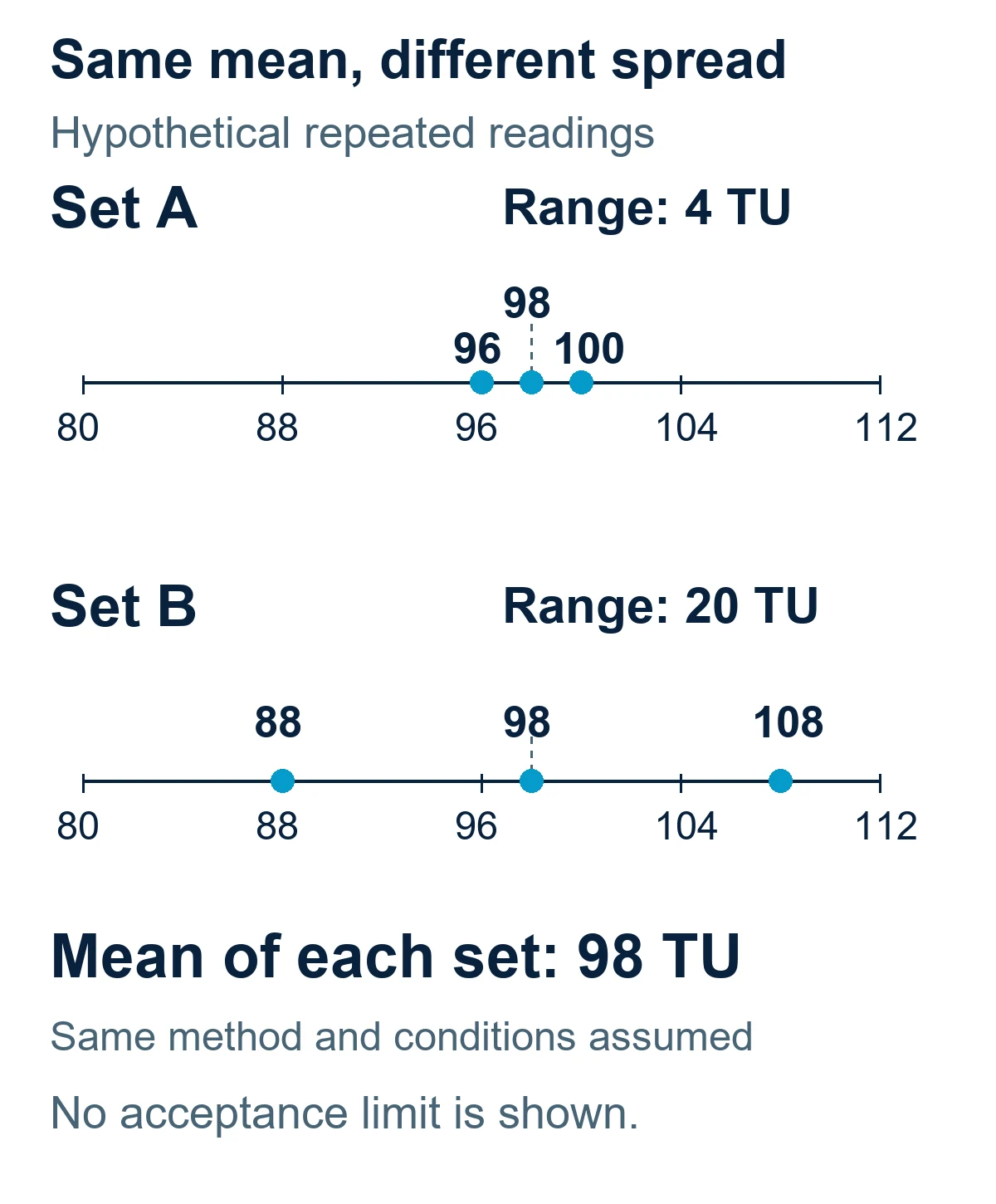
Hypothetical readings on common axes: A is 96, 98 and 100 TU; B is 88, 98 and 108 TU. Both means are 98 TU, but the ranges are 4 and 20 TU. This example defines no acceptance limit or lot-quality conclusion.
Consider a hypothetical comparison under the same method and controlled sample conditions. Set A contains 96, 98 and 100 TU; set B contains 88, 98 and 108 TU. Each adds to 294 TU, giving a mean of 98 TU across three tests. Their ranges differ: 4 TU for A and 20 TU for B. The shared mean therefore conceals a substantial difference in the observed repeat spread.
These invented values establish no acceptable range and do not prove that one lot is suitable. They show why the result file should preserve the readings behind a summary. A wider spread calls for investigation of the sampled material and test conditions before selecting an explanation. It is not evidence, by itself, of either instrument failure or inconsistent crop quality.
Define the repeat and exclusion rules before testing. Where an observation is invalidated for a documented procedural reason, retain the original entry, reason and replacement relationship. Do not remove an inconvenient reading simply because the remaining average fits a specification. The relevant acceptance rule should say how valid results are assessed and when additional investigation is required.
Specify size without converting it into tenderness
Size grading answers a geometric question. Tenderometer testing answers a mechanical question under stated conditions. Even when a particular purchasing program observes a relationship between them, a sieve result is not a conversion formula for TU, sweetness or skin tenderness. Keep each requested property in its own field.
| Reported field | What must accompany it | What it does not establish |
|---|---|---|
| Tenderometer value | Unit, sample state, method, equipment and valid repeats | A sieve size or complete eating-quality judgement |
| Size distribution | Sieve openings, sample preparation, fraction boundaries and percentage basis | A tenderometer value or sweetness level |
| Cooked sensory result | Identified sample, approved preparation and defined attributes | Compliance with every physical or analytical requirement |
| Named grade | Exact standard, edition, product scope and assessment basis | An interchangeable commercial or instrument classification |
A size term also needs its governing definition. The US frozen-pea framework in 21 CFR 158.170 uses round-hole sieve sizes and a distribution by weight, including limits on larger fractions. It is not simply a statement that every pea has one diameter. The official 2025 CFR edition [4] provides a readable published reference; the relevant provisions were also checked against the current eCFR text for this article.
For a destination-specific order, identify the applicable requirements and the agreed commercial size definition together. “Small”, a numbered sieve grade and a millimetre band should not be treated as interchangeable labels without checking their boundaries. Record whether the reported percentage is by mass or count, and how oversize, undersize, broken peas and any excluded material are handled.
When two offers declare different size systems, ask for their actual distributions before judging them equivalent. A single average diameter can hide the amount of larger material that matters to visual uniformity. The useful comparison is the distribution under a known method, followed by the separate texture and application results.
Keep USDA grade points separate from TU
The USDA standards for grades of frozen peas [5], effective May 28, 1959 and available through USDA’s current site, assess tenderness and maturity using their specified brine-flotation procedure together with tenderness of the cooked peas. The relevant factor points belong to that grading system. They are not tenderometer units.
Nor is an overall USDA grade determined by translating a tenderometer number into a letter. Other characteristics and the standard’s grading rules matter. A commercial brochure may use familiar letters for an illustrative purchasing classification, but those letters do not make its TU bands equivalent to USDA grades.
This distinction helps when reviewing certificates. If the purchase order names a USDA grade, request evidence assessed under that standard and its applicable inspection arrangements. If it names an agreed TU requirement, request the corresponding instrument method and sample basis. One document can contain both, but each conclusion must retain its own supporting assessment.
The US frozen-pea regulation also contains separate analytical quality provisions, including alcohol-insoluble solids and a brine-flotation criterion for the specified pea type. Their existence does not create a general conversion into TU. Select the correct method for the requirement being assessed, rather than substituting whichever measurement happens to be available.
Assess the peas in their intended finished use
The final product determines which texture differences matter. A visible pea in a vegetable side dish, a pea in a ready meal and a pea processed into a soup do not have identical appearance and bite requirements. State the intended role before deciding how much emphasis to place on intactness, skin perception, internal firmness or mealiness.
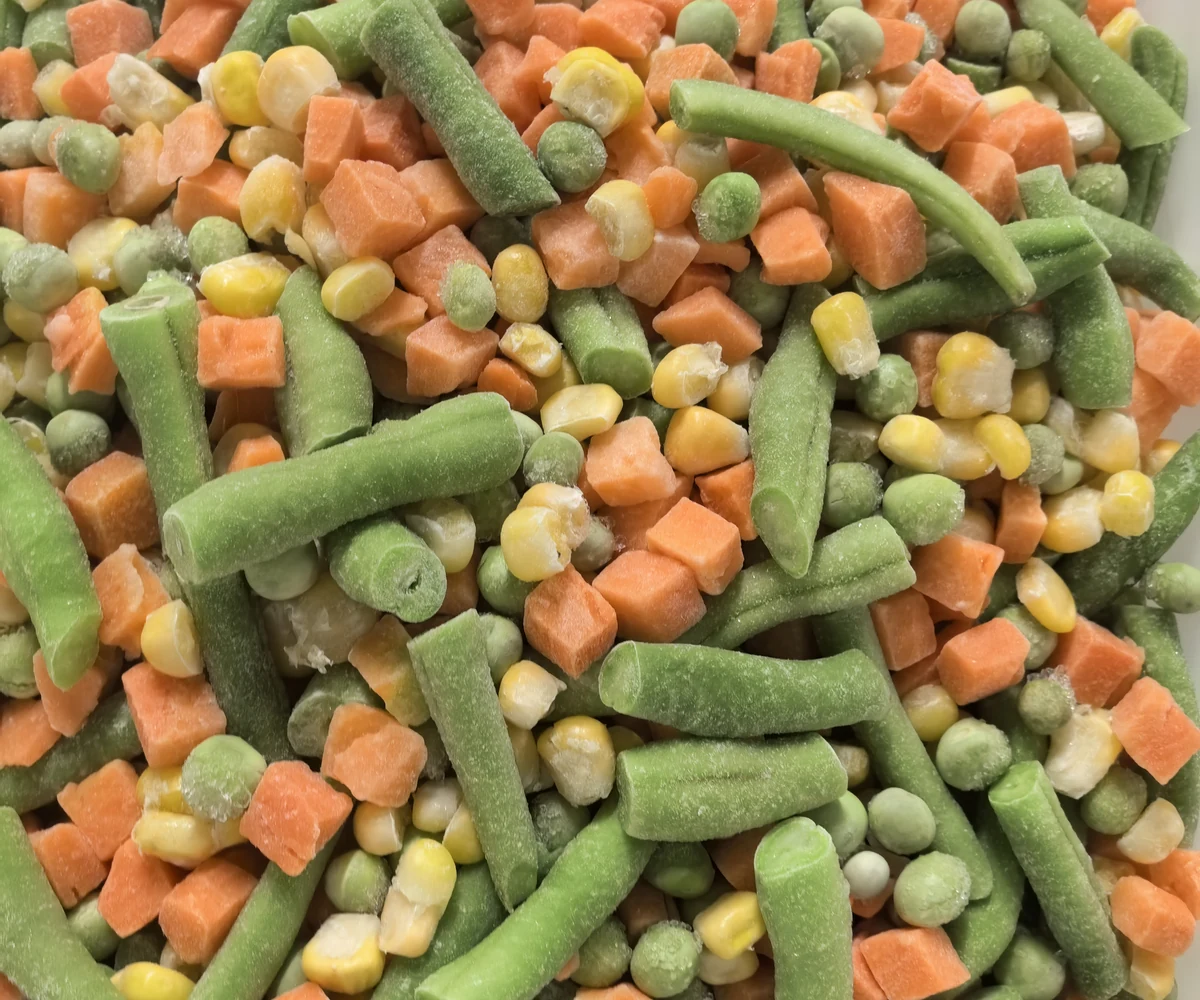
A pea-containing vegetable mixture shows the application context. Compare candidates through the approved cooking and serving route while keeping the mixture composition identified.
Use identified samples and the approved preparation relevant to that application. Record the actual cooking route, other ingredients and the point at which the product is evaluated. An initial comparison under identical conditions helps reveal differences between pea candidates. If the commercial process is then adjusted for one candidate, retain that as a separate trial with the changed conditions documented.
Assess attributes directly instead of asking only whether the peas are “good”. Useful observations can distinguish skin toughness, internal firmness, juiciness, mealiness, pea flavour and visible damage. Set definitions and reference descriptions that the reviewing team can apply consistently. A numerical instrument result cannot supply the team’s missing sensory acceptance language.
In a study of six commercial frozen-pea brands [6], Nleya and colleagues reported that physicochemical measurements explained part of sensory quality. The abstract supports using measurements alongside sensory assessment, not treating one value as a complete prediction. Its findings do not establish a universal ranking of retail and catering peas or a preferred size for every application.
For a blend, inspect the pea’s contribution within the mixture as well as any separately assessed ingredient sample. Keep the mixture composition fixed for a direct comparison; otherwise a changed proportion of peas or sauce can obscure the difference being investigated. Retain observations from the intended serving point where that is relevant and covered by the approved process.
Resolve conflicting reports before changing a limit
Suppose a supplier’s reported TU meets the written requirement, but the buyer finds the cooked sample too firm. Start by checking whether the report and sample belong to the same identified production material. Then compare the reported sample stage with the requirement, and review the buyer’s preparation against the agreed application trial.
Next examine method comparability: equipment configuration, calibration coverage, sample loading, temperature, program and the valid individual readings. A disagreement caused by different test conditions will not be resolved reliably by averaging the two laboratories’ final numbers. Nor should the original requirement be silently reinterpreted after a result arrives.
If the measurements are comparable but the application still disappoints, the purchasing requirement may not adequately describe the desired product. Review the sensory attributes and size distribution alongside TU, then design an identified follow-up comparison. Any revised acceptance basis should be approved explicitly and applied to the stated future scope.
Where product is awaiting a disposition decision, keep the original findings and the authorized decision in the lot record. A new trial or revised limit does not erase an earlier observation. Clear records allow the team to distinguish a measurement problem, an application mismatch and a specification change without inventing a cause.
Build a pea specification that can be repeated
A usable specification connects the required pea form, size definition and texture expectations to their respective methods. Include the agreed sampling basis, the stage at which TU applies, the reporting unit, repetition rules and the decision rule. Reference the approved sensory preparation separately, with the attributes that determine whether the ingredient suits the application.
Keep identifiers and revisions consistent between the specification, sample approval and lot report. The buyer should be able to see which version governed the test and whether a later change affected the product, instrument method or application preparation. Repeating a target number without those connections provides little protection against an unnoticed change in its meaning.
For repeat orders, ask for notification of changes that could affect the agreed basis, such as a relevant product form, test method or production arrangement. Review the particular change against the existing approval rather than assuming that either every change requires complete requalification or none of them matters. The aim is a measurement and product requirement that remain interpretable over time.
Frozen Green Peas
Review our frozen green pea forms, size and tenderness controls, packing options and inquiry requirements.
View Frozen Green Peas →References
JBT Marel: tenderometer product scope [7]; Model 4011 brochure [1]; FTC tenderometer brochure [2]; PGRO TU37, January 2025 [3]; USDA frozen-pea grade standards [5]; 21 CFR Part 158, official 2025 edition [4]; Nleya, Minnaar and de Kock, 2014, study abstract [6].
Current-law cross-check: 21 CFR 158.170, “Frozen peas”, with the relevant wording rechecked against the daily eCFR display current through September 16, 2026, on September 20, 2026. Instrument publications describe their own equipment; the repeated-value example and conceptual illustrations are explanatory.
