


On this page
Choose 6 mm or 10 mm frozen onion dice by what the finished product must do, then approve the actual cut distribution rather than the nominal number alone. A smaller proposed cut can disperse more evenly in a fine sauce or filling; a larger one can remain more visible in a soup or ready meal. Neither result is automatic. Onion layers, thin flakes, broken pieces, oversize pieces and frozen clumps all affect what reaches a doser and what the customer sees. A label such as “6 × 6” also leaves the third dimension and the allowable variation open. We turn either option into a written, measurable sample and order requirement before treating it as an approved specification.
- The 6 mm and 10 mm names in this guide are proposed nominal cuts, not a statement that both are currently available from XMG.
- Define the dimension, measurement orientation, distribution and limits for fines, oversize pieces and clumps.
- Compare frozen samples with the same sampling, handling and weighing method, then run them through the actual dosing and finished-product use.
- Keep the approved sample, signed specification and receiving inspection on one basis.
Choose by the finished product, then verify the supplied cut
We start with the question that changes the answer: where must the onion be visible, and where must it pass? In a smooth sauce, a small dice may integrate more readily and reduce the chance that one serving receives a conspicuous piece. In a chunky soup or ready meal, a larger dice may provide the visible onion identity a recipe needs. A filling or vegetable blend can sit between those extremes. The same cut can perform differently when the onion is added before a long cook, mixed into a chilled matrix, or deposited into a tray near the end of a line. The useful choice is a finished-product judgment, not a universal quality ranking.
Ask the development team for the intended appearance after its actual heating or holding step. Ask the production team for the narrowest practical passage in the ingredient path and whether the ingredient must flow from a frozen hopper, be weighed by a screw, or be handled manually. Ask QA what variation becomes a rejection rather than a normal part of an onion cut. Those answers let us request the right representative sample from an applicable partner route. They also prevent the common mistake of approving a clean-looking handful that has never passed through the buyer’s real equipment.
The photographs here show original frozen onion dice as product-form references. They do not establish a measured 6 mm or 10 mm grade. Visual texture is useful for recognizing onion layers and irregular pieces; it does not replace a scale, a defined category or a recorded sample mass. When we discuss a possible cut, we separate what is visible in a photograph from what has been measured and confirmed for an order.

A close view of unbranded frozen onion dice; cut size is not measured in this photograph.
Our current frozen onion product page describes diced, sliced and ring forms and makes the final cut and tolerance subject to the order specification. Its first published size reference is 10 × 10 mm. A request for 6 mm remains a proposed requirement until a suitable route, sample and specification are confirmed. A buyer should make that distinction in the first inquiry, particularly when changing a formulation that already uses a named cut.
What 6 mm and 10 mm mean in a buying brief
The two numbers normally suggest the face of a dice, but an onion is made of curved, layered tissue. A piece can have a roughly square cut face and a much thinner natural layer thickness. Another can be a double layer that is thicker than its face suggests. The USDA inspection instructions for frozen onions [1] describe diced style as approximately square pieces with a designated width measured in the greatest cut dimension. That is a useful technical reference for defining a method; it is not an automatic tolerance or contractual standard for an XMG order. We agree with the buyer which dimension to record and how.
For an industrial brief, write “proposed 6 mm nominal dice” or “proposed 10 mm nominal dice” and then add the unit, onion type, cut description and measurement basis. If the buyer means a true three-dimensional cube, say so and discuss whether that geometry is realistic for the onion variety and trimming path. If the functional need is only a maximum dimension for a depositor opening, say that instead. The second brief is often easier to verify than a loosely stated three-number cube. A purchasing note that contains only “6 × 6” can be misread as millimetres, a face size, a screen aperture or even a target without tolerance.
Swipe to read the illustration on a narrow screen.

Conceptual comparison of proposed nominal cuts, not a photographed supply lot.
| Decision field | Proposed 6 mm cut | Proposed 10 mm cut | What the buyer should confirm |
|---|---|---|---|
| Finished-product appearance | Finer visible points; may disperse more evenly | Larger pieces may remain identifiable | Appearance after the real recipe, cooking and holding step |
| Ingredient handling | More small pieces and fines may matter to a fine-dosing path | Oversize pieces or clumps may matter to a restricted opening | Actual hopper, screw, pump or depositor trial |
| Dimension language | Nominal 6 mm is only a starting name | Nominal 10 mm is only a starting name | Axes, measurement state, permitted range and calculation basis |
| Supplier status | Requires order-specific availability confirmation | Published first size reference on XMG’s onion page | Current partner route, sample and signed specification |
The table is a decision aid, not a claim that a smaller cut always cooks faster or a larger cut always survives intact. Time, process intensity, onion variety, initial state, recipe acidity and the surrounding ingredients can change the outcome. A controlled application trial should decide when those outcomes matter. It is also worth checking whether the buyer wants white, yellow or red onion; colour and pungency requirements can matter more than a few millimetres of cut difference in some products.
Measure a frozen sample without changing the basis
Begin with a sample plan that someone else can repeat. Identify the proposed product and lot, carton or bag positions, number of increments, total sample mass, handling temperature and whether pieces are measured frozen or after a specified tempering step. Keep the sample state consistent: a surface-thawed onion piece may bend, smear or separate into layers differently from a frozen piece. Likewise, a bag that has been knocked hard enough to break clumps may look more free-flowing than the product would at the dosing point. Record what was done before measuring.
For selected individual pieces, agree on the axis. One practical method is to record the greatest cut-face width and length, and thickness separately when thickness affects the use. A caliper can help, provided the operator does not crush the frozen piece and the jaws are applied in the same orientation. A sieve or screen can be useful for a mass distribution, but its aperture and shaking method must be named; it does not by itself describe thickness or every irregular shape. Neither a photograph nor a single average dimension captures the long tail of small fragments and large pieces.
Swipe to read the illustration on a narrow screen.
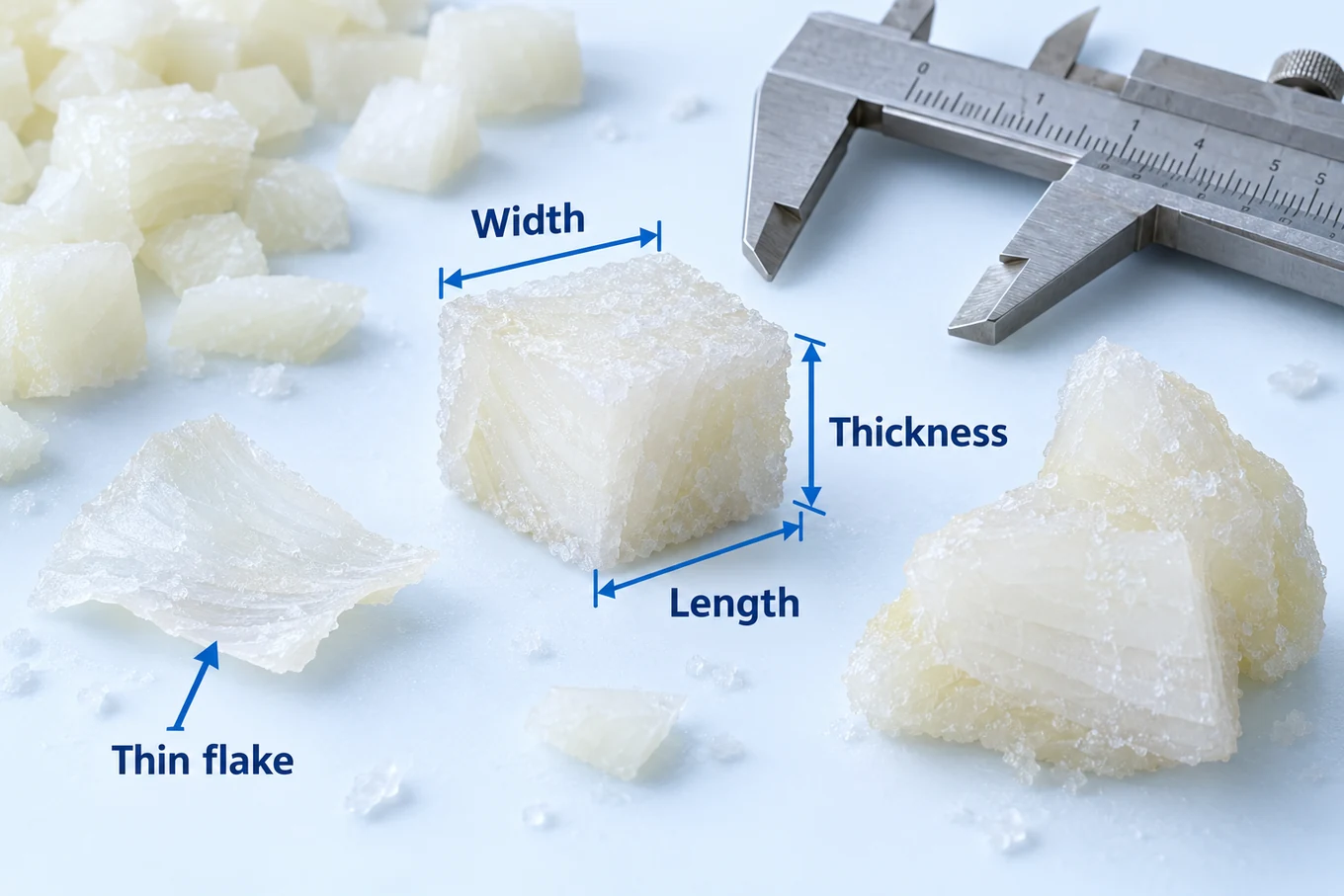
Illustration of measurement axes and a thin onion flake; actual tolerances require agreement.
Build categories that reflect the process. For example, the buyer may define “target-size pieces,” “fines,” “oversize pieces,” and “clumps,” each by a measurable rule. The numerical boundaries and allowable percentages should be negotiated from the line and finished-product trial; we do not invent a universal pass band for either proposed cut. State whether each percentage is by mass or by count. Counting can overemphasize many tiny fragments, while mass can hide a small number of large pieces that block a nozzle. For a restricted passage, you may need both a maximum dimension check and a mass-based distribution.
We recommend recording the raw observations before reducing them to one pass or fail number. Keep a table with each category mass, total sample mass, calculation, photographs beside a ruler and the operator’s notes on unusual pieces. A repeat measurement by a second person is useful when the method is new or the border between categories is unclear. If results change materially with normal operator handling, the method is not yet ready to govern a commercial lot. Improve the instructions before negotiating a tolerance.
Separate fines, oversize pieces and clumps
Fines are not merely “small dice.” They may be thin flakes, torn onion layers, chipped fragments or particles created during cutting and handling. Their influence depends on the recipe. A fine onion fraction can disappear visually, change the apparent onion distribution, or build up at a screen. Some products can use it without difficulty. The specification should therefore define the fraction that matters to the application instead of treating every small piece as a defect by instinct.
Oversize pieces deserve a different check. One long layered strip can pass a rough average-size assessment while still being visibly out of place or blocking a feed restriction. Measure the limiting dimension and decide whether oversize is a maximum individual piece rule, a percentage by mass, or both. Do not describe an onion layer as a perfect cube. State whether a connected multi-layer piece is one unit or should be gently separated before classification. The answer affects comparability between the approved sample and the received lot.
Frozen clumps are a handling observation and a size problem only if the method defines them that way. Record whether a cluster is separable with the intended ordinary handling or remains hard. Note the clump mass and maximum dimension before breaking it apart. A clump that breaks with light hand pressure is still relevant if the buyer’s line feeds directly from a frozen bag with no break-up step. Conversely, treating every temporary contact between IQF pieces as an oversized onion dice confuses product geometry with frozen handling. Set separate limits when both matter.
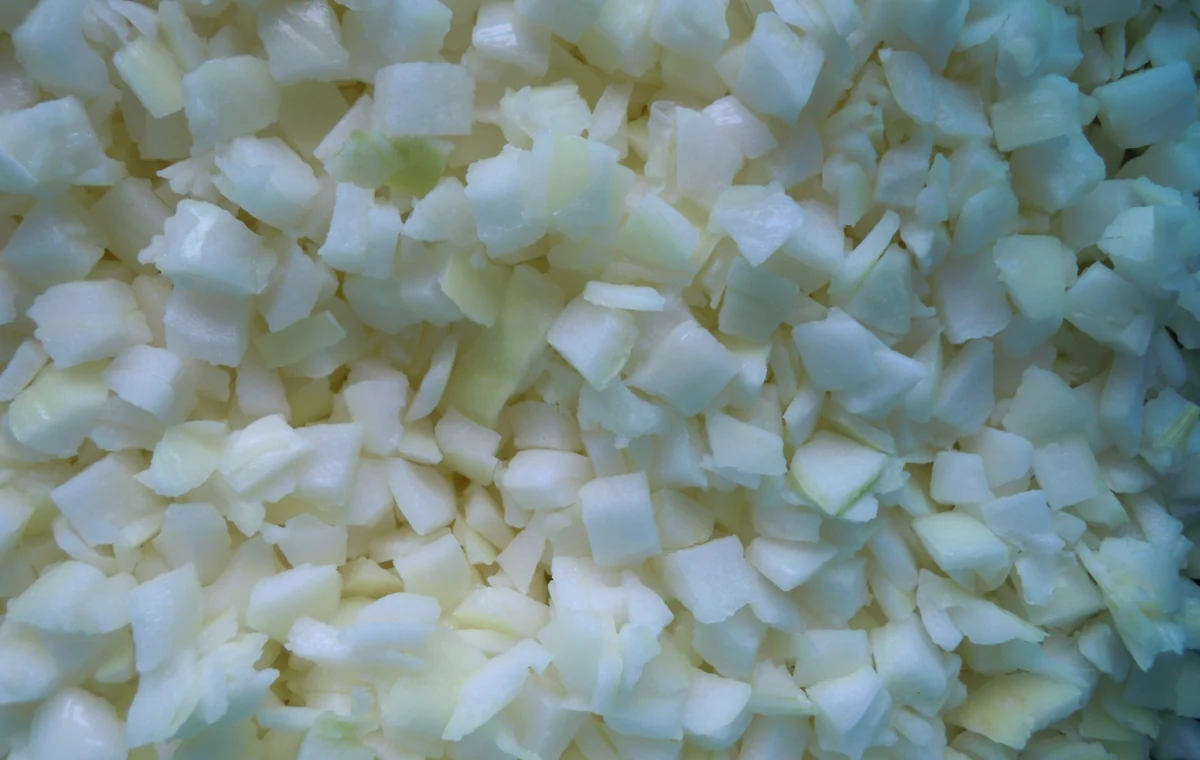
An unbranded product-form reference showing natural piece variation, not a graded lot result.
This is where an honest sample comparison is more valuable than supplier adjectives. Put the two proposed cuts on the same surface, at the same frozen state, with the same scale and sample mass. Look for a distribution, not the most photogenic pieces. We can coordinate the questions and sample identity with the applicable supply route; the buyer’s QA and production teams should then run the agreed measurements and line trial. Any acceptance limit belongs in the signed order-specific specification, with the sampling method beside it.
Run a matched dosing and use trial
The cut is chosen for a product, so the final choice must be made in that product. Compare the proposed samples at equal onion mass and with the same recipe, mixer, handling time, input temperature and fill setting. If the line uses a hopper or screw, do not pre-break clumps for one candidate and not the other. Observe whether pieces bridge, segregate, smear, stick to a surface or dose unevenly. Keep any machine setting change in the record; a different setting may be a workable solution, but it is not the same test condition.
Collect portions across the run rather than examining only the first tray. A cut that looks uniform in a bowl may separate from other ingredients in a mixed meal, leaving early portions fine-heavy and later portions coarse-heavy. We ask the buyer to decide what the finished portion must contain: visible onion count, distribution, mass or sensory presence. The chosen metric depends on the product. A sauce may need a smooth appearance and consistent flavour; a ready meal may need recognisable vegetable pieces. Do not turn those requirements into an invented universal number.
Then apply the actual cooking or reheating cycle. Assess visibility, texture and flavour only after the process the consumer or foodservice operator will use. A large nominal dice can soften significantly during a long cook. A small dice can remain distinct in a short heat step. The previous onion sauce article deals with pan yield and browning; the present decision starts earlier, with cut geometry and frozen-state feed acceptance. If both issues matter, keep the two tests separate so a size failure is not explained away as a cooking result.
It is reasonable to reject both initial samples. A buyer might find that the small proposal gives too many fines for a visible filling, while the large proposal occasionally blocks a narrow depositor. In that case revise the distribution, line step or cut request. The point of a controlled trial is to reveal those trade-offs before the specification becomes a purchase commitment. Document the reason for acceptance or revision, not just a yes/no verdict.
Write the approval and receiving rule
A usable specification connects the nominal cut name to an inspection routine. State the onion type and frozen form; the proposed nominal face size and measurement axes; the target range or distribution; definitions for fines, oversize pieces and clumps; the frozen sampling and handling method; the sample mass; and the acceptance calculation. Add the application trial result as a separate approval record, with any machine settings or recipe version needed to interpret it. Keep packing and destination requirements in the same order record. This is the level of detail that lets a later receiving team compare like with like.
Swipe to read the illustration on a narrow screen.

Authored process diagram: use the same categories and calculation at approval and arrival.
Here is a deliberately incomplete example of the fields, rather than a universal threshold: “IQF diced white onion, proposed nominal 10 mm; frozen pieces measured at greatest cut-face dimension; category limits for fines, target and oversize to be agreed after approved sample trial; clumps recorded separately before separation; representative increments from identified bags; report each category by mass and note any maximum individual piece relevant to the depositor.” The buyer and proposed partner route then fill in actual numerical limits and method details. Writing “mostly 10 mm” would be quicker but cannot settle a receiving dispute.
The approval sample should be identified by product, source route, production date or lot as available, packing and method version. A retained sample can be a useful visual reference, but storage and handling can change frozen appearance; the written method remains essential. At receiving, use the same categories, sample mass and calculation. Record deviations before a decision to accept, conditionally use, rework or reject, and assign who makes that decision. If production needs an exception, document which end use can tolerate it. Avoid silently broadening the cut tolerance for every future order.
If the buyer changes packing from a small sample bag to a larger bulk unit, check whether compaction and frozen handling affect clumps or breakage. A supplier sample that is gently packed for courier transit does not automatically describe the physical condition at container arrival. Similarly, an inspection of one carton does not prove every carton has the same distribution. Agree on lot definition and sampling frequency for the planned volume. This is a practical extension of our specification and sample approval approach: a good sample decision must survive the move to a commercial order.
How we coordinate a cut-specific supply brief
We can turn your finished-product requirement into a cut and sample brief for a suitable long-term partner factory route. First we clarify the onion type, intended appearance and limiting feed dimension. Then we ask which proposed cut, packing and production route can actually be supported for the order. We coordinate a representative sample and put the agreed measuring and defect categories alongside it, so your QA team can assess the product on the same basis it will use at receiving. Our role is to match and coordinate the supply and approval work; the applicable partner facility and order-specific documents establish the actual production details. That saves your team from buying a nominal number before it has confirmed a usable distribution.
Frequently asked questions
Is 6 mm always better for sauces?
No. A fine cut can disperse well, but its fines fraction, onion type, recipe and cooking path all affect the outcome. Compare equal onion mass through the real sauce process and decide from the finished product.
Does 10 × 10 mm mean every piece is a cube?
No. Onion layers create natural differences in thickness and shape. Define which cut-face dimension is nominal, what thickness matters, and how to count irregular or connected pieces.
Can a supplier photograph approve the cut?
It can show appearance, but without a scale, representative sampling and a written distribution it cannot establish a lot tolerance. Use it as a reference beside measured records, not as the only acceptance rule.
Does XMG currently offer both 6 mm and 10 mm onion dice?
Our public onion page lists 10 × 10 mm as its first size reference. We confirm any requested cut, including a proposed 6 mm cut, against the applicable partner route, sample and order specification before quotation or approval.
Send us the cut and application brief
We supply IQF frozen onion through order-specific partner routes and can help you resolve whether a proposed small or larger dice will suit your product. Send the onion type, intended use, proposed cut, the feed or appearance problem, quantity, packing and destination. We will review the brief, confirm suitable available options and coordinate the sample and specification questions that need a decision before ordering.
