


On this page
Grainy frozen cauliflower soup is not automatically a freezing problem. The roughness can come from incompletely softened vegetable tissue, an ineffective blend, clumped dairy proteins, or separated fat. Start by asking when the texture appeared. A puree that was rough before cream needs a different investigation from a smooth base that became grainy after milk, cheese or an acidic ingredient was added.
Cook the cauliflower according to its package instructions, then check the larger stem centres for the tenderness your puree requires. Blend with enough liquid and an appropriate batch load for circulation. If the vegetable base is smooth, add dairy cautiously according to the recipe and observe what changes. Test any rescue on a small portion: extra cooking, more blending and straining solve different problems, and none is a guaranteed repair for every grainy pot.
Quick answer: Identify plant fragments, dairy clumps and oil droplets separately. Check a cauliflower stem centre and the plain blended base before adding richness. Texture is an observation; it does not establish food safety.
First identify what the grains are
Spread a small cooled spoonful on a white plate. Look at the shape, colour and position of the particles rather than judging the whole pot from its surface. Tiny irregular white vegetable fragments can resemble dairy curds. A thin fibre gives a more specific clue, while shiny yellow patches suggest fat separation. These clues guide a test; visual inspection alone cannot identify every particle conclusively.
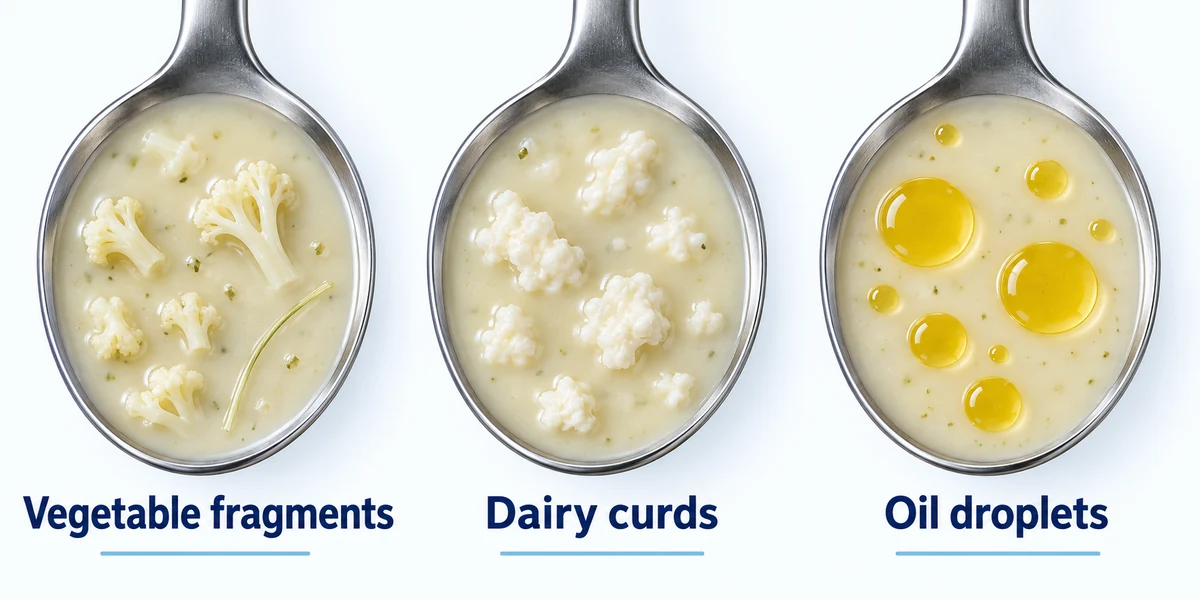
Conceptual diagnostic examples: plant fragments, protein clumps and separated fat require different checks.
Next reconstruct the sequence. Was the cauliflower-and-stock base already rough? Did the texture change immediately after dairy entered? Did it look satisfactory at first and deteriorate during a prolonged hold or after reheating? A simple record of those stages is often more useful than changing three ingredients at once. If you have retained a little plain base, compare it with the finished soup.
The word “grainy” can describe several mouthfeel complaints. A sandy feeling suggests many small particles. Strings suggest fibrous tissue. Large soft lumps may simply be pieces that never passed through the blades. A greasy surface can feel unpleasant even when the vegetable particles are fine. Describe the complaint narrowly before deciding that it needs more cream or a stronger blender.
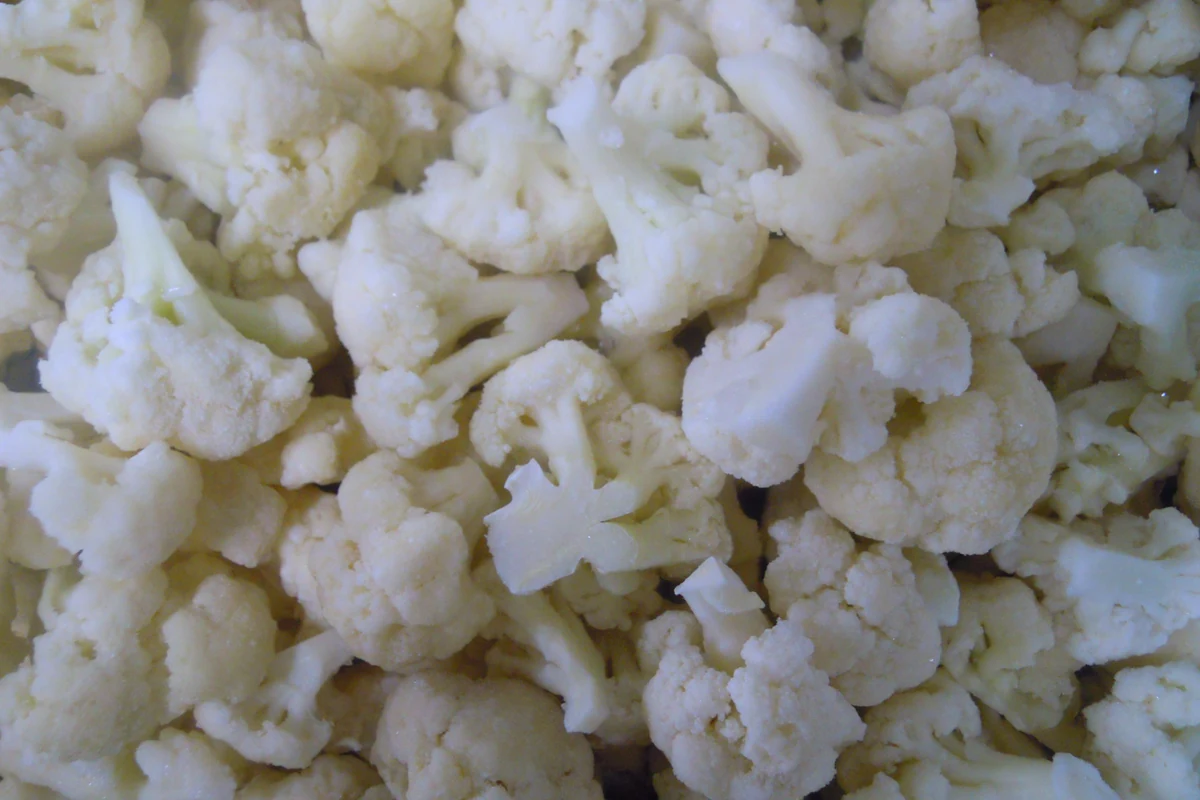
The vegetable form contains crown and stem tissue.
The frozen ingredient starts as recognizable florets with crowns and stems. Prepared smaller pieces have a different cooking and blending path from large florets. Our frozen cauliflower product page gives context for those forms. A smoother finished soup is an application decision, not proof that every large floret is a poor ingredient or that frozen cauliflower cannot be pureed successfully.
Tender enough to puree is a separate endpoint
A piece can be sufficiently cooked for a biteable vegetable dish yet remain too resistant for the fine puree you want. Check the larger stem centres rather than the softest crown in the pot. Carefully remove a representative large piece and press it with a fork. If its centre resists pressure while the outer crown falls apart, additional softening is a reasonable next test.
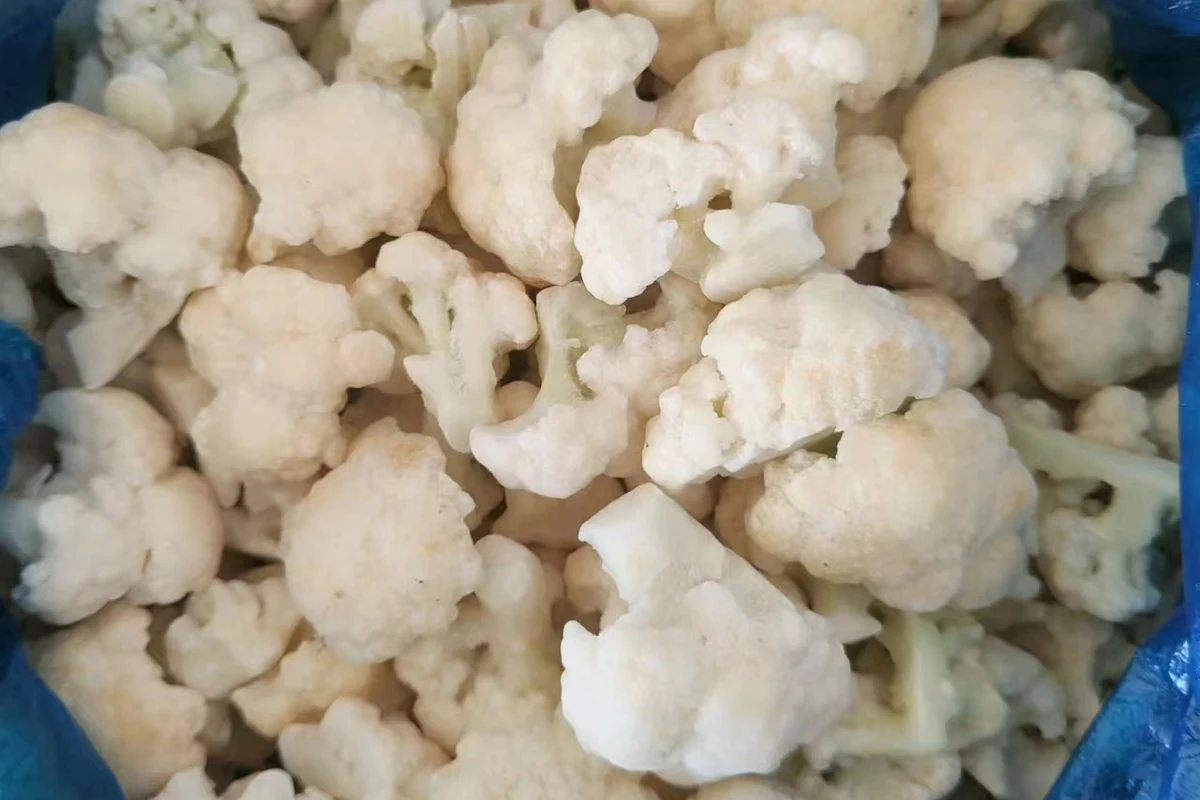
Check the larger stem centres before judging puree tenderness.
Mixed cut sizes complicate a time-based judgment. The smaller pieces may become soft before the thickest stems do. Stirring and enough cooking liquid help expose the pieces consistently, but they do not make every stem the same size. Follow the product’s instructions, then judge the puree endpoint from the relevant pieces. Do not use a generic recipe time as proof that all frozen cuts reached the same state.
Research on cauliflower thermal softening describes changes in cell membranes, cell cohesion and pectic structures. The useful kitchen implication is that softening is a change in the plant tissue, whereas blending mainly reduces and disperses that tissue. A blender can cut a resistant piece into smaller resistant fragments. It does not necessarily reproduce the texture of a stem that was adequately softened first.
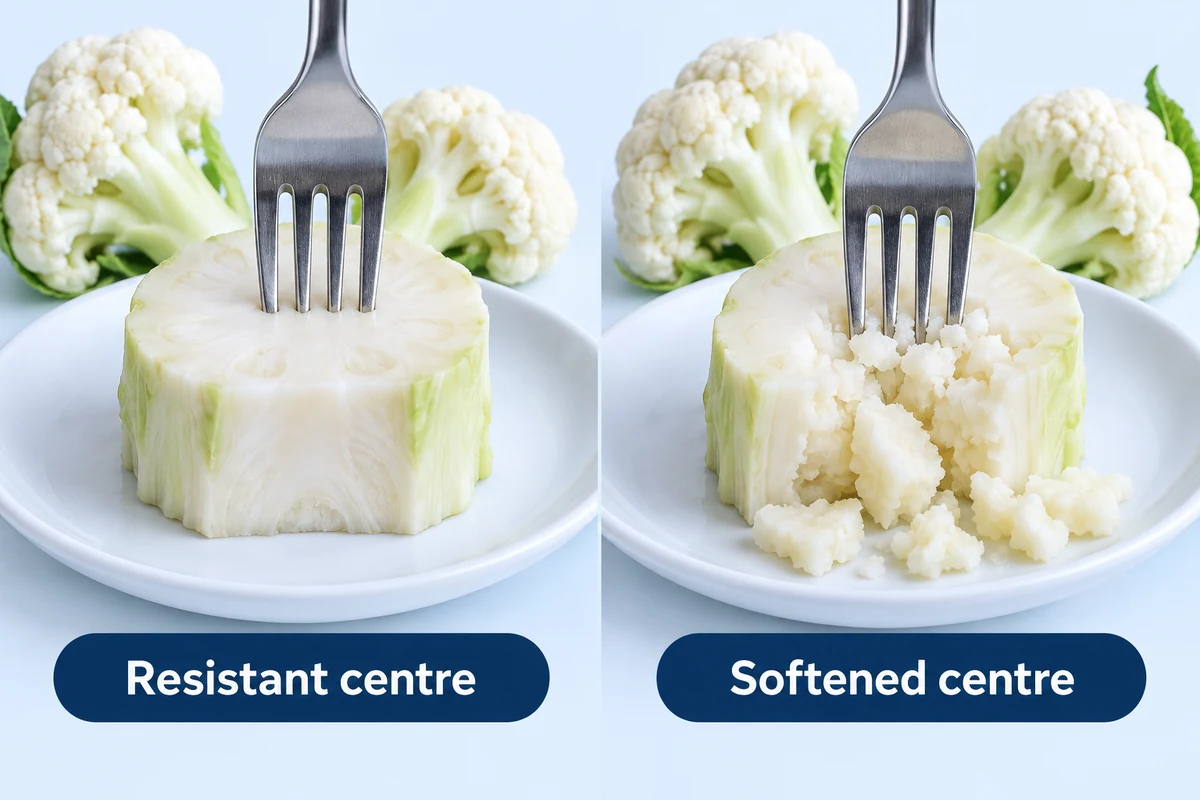
Conceptual comparison: a tender crown does not establish the state of a larger stem centre.
The study’s particular treatment conditions should not be converted into a universal soup instruction. Cooking method, piece geometry and the surrounding liquid differ. Likewise, do not continue simmering indefinitely just because a web page attributes all graininess to undercooking. Taste, aroma and appearance also change. Stop to check the physical centre and try a modest additional cooking step on a small sample if you need to distinguish that cause.
Give the blender a circulating mixture
A very thick puree can collect above the blade or remain in parts of the pot that an immersion blender does not reach. Extending blending time without changing the circulation may repeatedly process one area while leaving another rough. Observe whether the mixture moves through the blades. Adjust batch load or add a measured small amount of recipe liquid where the appliance instructions permit.
Keep the liquid adjustment separate from the particle judgment. Added broth can make a rough soup seem less dense without making its vegetable fragments finer. It can also make the mixture circulate better and thereby permit a more effective blend. Look and taste after each change, and record how much liquid was necessary. A thin puree and a concentrated puree cannot be compared fairly by thickness alone.
For an immersion blender, move through the pot in a controlled way and keep the guard properly submerged. For a countertop appliance, respect its batch limit and its hot-liquid instructions. Some sealed cup blenders are unsuitable for hot soup. Use the manufacturer’s method rather than improvising a vent or trying to hold a pressurized lid down. Safe equipment handling is part of the method, even in a small texture test.
A food processor, immersion blender and high-powered jug blender may leave different particle distributions. None supplies an automatic guarantee from its name alone. Cut size, tenderness, batch size, liquid and the actual blade action all matter. If a recipe uses a different appliance from yours, assess the finish instead of copying its time and assuming the same result.
Keep other particulate ingredients in mind. Onion skin, woody herb stems, nut pieces or poorly dispersed flour can contribute a roughness that cauliflower did not create. Remove ingredients intended only to infuse the soup before blending, and examine your thickener preparation. Changing the frozen vegetable cannot solve a particle introduced elsewhere in the recipe.
Check dairy and fat after the vegetable base
When the recipe allows, establish a smooth vegetable base before adding dairy. Hold back a small plain sample so you can compare it later. Add the finishing ingredient according to the recipe, stir, then inspect a cooled spoonful. If graininess begins at this point, investigate the finishing system before returning to the cauliflower cooking step.
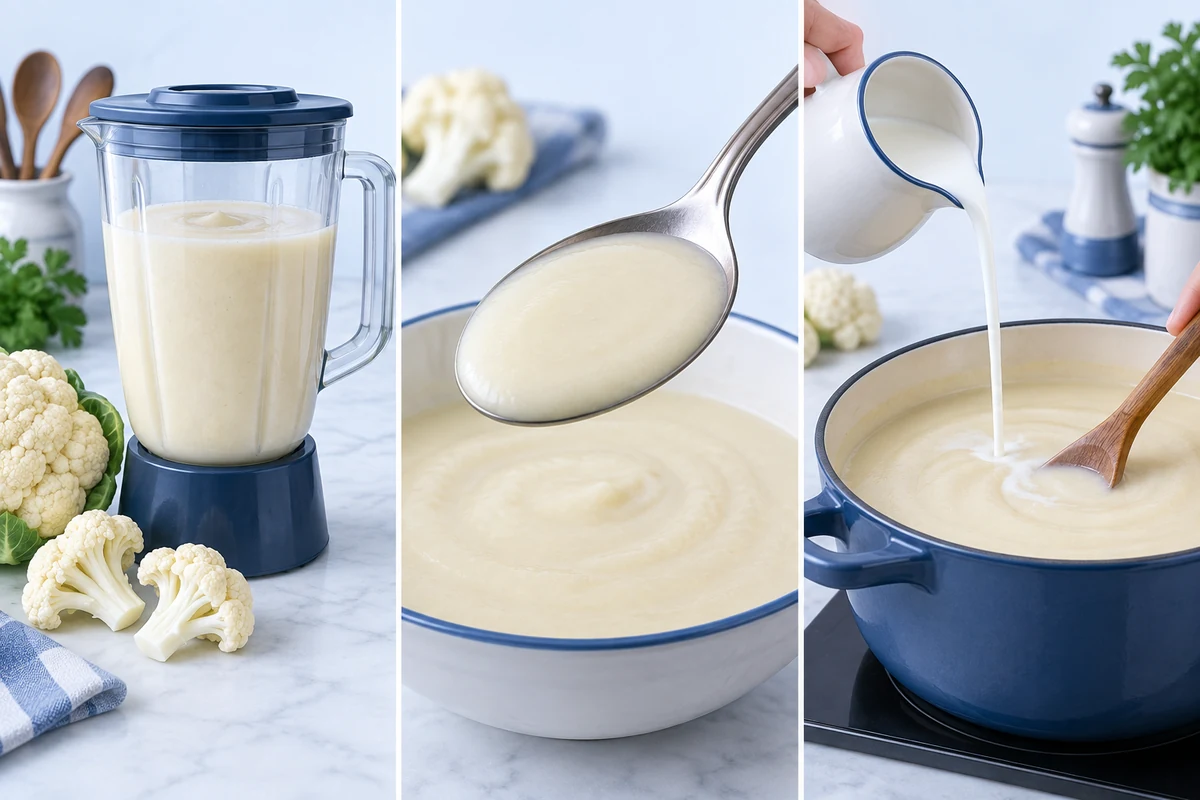
Conceptual sequence helps identify when a texture problem appears.
Milk proteins can coagulate under sufficiently acidic conditions; heating interacts with the kind of protein and the surrounding mixture. Cornell’s dairy education explains acid coagulation and the combination of acid and heat used to form curds. A soup is a different formulation from cheesemaking, so this does not give a single household curdling temperature. It does explain why acidic additions and a dairy finish deserve attention together.
Lemon juice, acidic stock additions and fermented dairy can change that balance. Cheese brings its own protein and fat structure. These ingredients are not interchangeable with heavy cream or plain milk in every recipe. Review the specified finishing order and avoid treating a dairy substitution as if it changes only flavour. A smooth cauliflower base can become a different physical mixture after the substitution.
Separated fat is another issue. Visible oil droplets are not the same thing as white protein clumps. Stirring or blending may disperse droplets temporarily, depending on the recipe, but dispersion does not necessarily restore the original stable texture. In contrast, breaking curds into smaller pieces does not mean their proteins have returned to the previous state. The practical goal is an acceptable soup, not a claim that every change has been reversed.
Do not infer safety from either smoothness or curdling. Texture change can have a culinary cause, and unsafe handling need not produce visible grains. Base a safety decision on ingredient condition, package instructions and the storage and handling history. If that history is unsuitable or uncertain, cosmetic repair is not the next step.
A small rescue test protects the whole pot
Take out a small portion and choose one test that matches your best explanation. If the vegetable centre was resistant, try additional cooking of that portion before another blend. If it was fully tender but the mixture did not circulate, adjust liquid or batch load. If the base was smooth before dairy, try gentle mixing or a suitable recipe-specific finishing adjustment on the sample.
| Observation | Likely area to investigate | Small-portion test |
|---|---|---|
| Firm stem fragments before dairy | Vegetable tenderness | Additional softening, then blend |
| Tender pieces remain away from blades | Circulation and batch load | Smaller batch or measured liquid adjustment |
| White clumps after acidic dairy finish | Protein coagulation | Assess a recipe-specific adjustment; do not promise reversal |
| Shiny oil patches | Fat dispersion | Gentle mixing and check whether separation returns |
Label the unaltered sample and the adjusted sample. Taste at similar safe serving temperatures, because an extremely hot mouthful hides useful texture detail. Record the improvement you actually perceive: fewer lumps, less grit, a smoother coating or a more even fat distribution. Also note any dilution, flavour loss or added richness that accompanied it.
A successful small test gives you a reason to consider scaling that specific adjustment, not proof that every pot needs it. Changes do not always scale linearly with vessel and blender load. Apply the adjustment gradually, check again, and retain the recipe quantities. If no acceptable repair emerges, the finding can still improve the next batch by showing where to change preparation or finishing order.
Strain only when the texture gain is worthwhile
A fine mesh can remove larger plant fragments. It may also retain dairy clumps, but removing them does not necessarily restore the soup’s intended composition. Try a small portion through your intended strainer and inspect what remains. If the passing soup tastes substantially better, measure what you recover and decide whether the texture gain justifies the retained material.
Include any liquid used to loosen the portion in that record. Washing soup through a strainer can raise collected volume while lowering concentration. A greater bowlful does not prove greater usable vegetable yield. Avoid pressing coarse fibres through aggressively if the purpose of straining was to remove them.
Straining is optional. A fine restaurant-style puree and a household soup with small soft vegetable flecks can both be successful. The serving expectation should determine the finish. If you repeatedly need to discard a large amount to meet it, revisit ingredient cut, stem preparation and blending conditions instead of accepting the loss without investigation.
For another texture endpoint, see cooking frozen cauliflower as intact pieces. Those pieces are meant to retain a bite. Soup pureeing deliberately moves toward a different endpoint, so a cooking method designed to avoid softness is not automatically suitable for a silky base.
Compare before and after reheating
If the soup will be served later, assess one safely handled reheat rather than only the first blend. Stir the stored soup before judging the sample. Record any liquid layer, thickening, oil droplets or new particles, then reheat according to appropriate food-safety guidance. Compare its texture at the intended serving temperature with the original notes.
Hold the comparison conditions steady: same portion, same vessel where practical, the same stirring approach and a recorded liquid adjustment. A reheated soup diluted with extra stock is not directly comparable with the original concentrated soup. If you change dairy type as well as reheating method, you have made two changes and cannot identify which caused the difference.
For repeat preparation, save a short description of the cut, larger-centre tenderness check, appliance load, liquid additions and finishing order. The specification and sample approval process explains how consistent ingredient descriptions support comparison. Your soup record adds the application conditions that an ingredient name cannot supply.
A useful final decision is specific: cook the larger centres further, improve circulation, keep dairy finishing separate, or strain for the intended service. “Frozen cauliflower makes soup grainy” does not identify a correction. Find the particles and the stage at which they appeared, then make the smallest change that addresses that evidence.
IQF Frozen Cauliflower
See product forms and specification information for this ingredient.
View IQF Frozen Cauliflower →References
- [1] Modeling Softening Kinetics at Cellular Scale in Cauliflower — research on tissue change under specified cooking treatments.
- [2] Cornell CALS: dairy coagulation principles — explains acid and heat in dairy protein coagulation.
