


On this page
Frozen mushrooms do not have to make a dish watery. First decide where their released liquid should go. In a soup or stew, it can join the cooking liquid. For a sauté, filling or topping that needs a drier finish, give the mushrooms their own space and let the visible liquid subside before adding a sauce, delicate vegetables or a crisp base. The change from wet bubbling to a drier sizzle is more useful than a fixed number of minutes. Check the package’s preparation instructions first: frozen mushrooms are sold in different cuts and may have been blanched, sautéed or otherwise prepared before freezing.
Quick answer: For a dry skillet dish, cook frozen mushrooms in a roomy, uncovered pan, watch the liquid they release, and wait until it has mostly evaporated before finishing them with fat and seasonings. For broth or sauce, keep that liquid if it suits the recipe. The product label and the final dish decide whether to cook from frozen or handle thawed pieces separately.
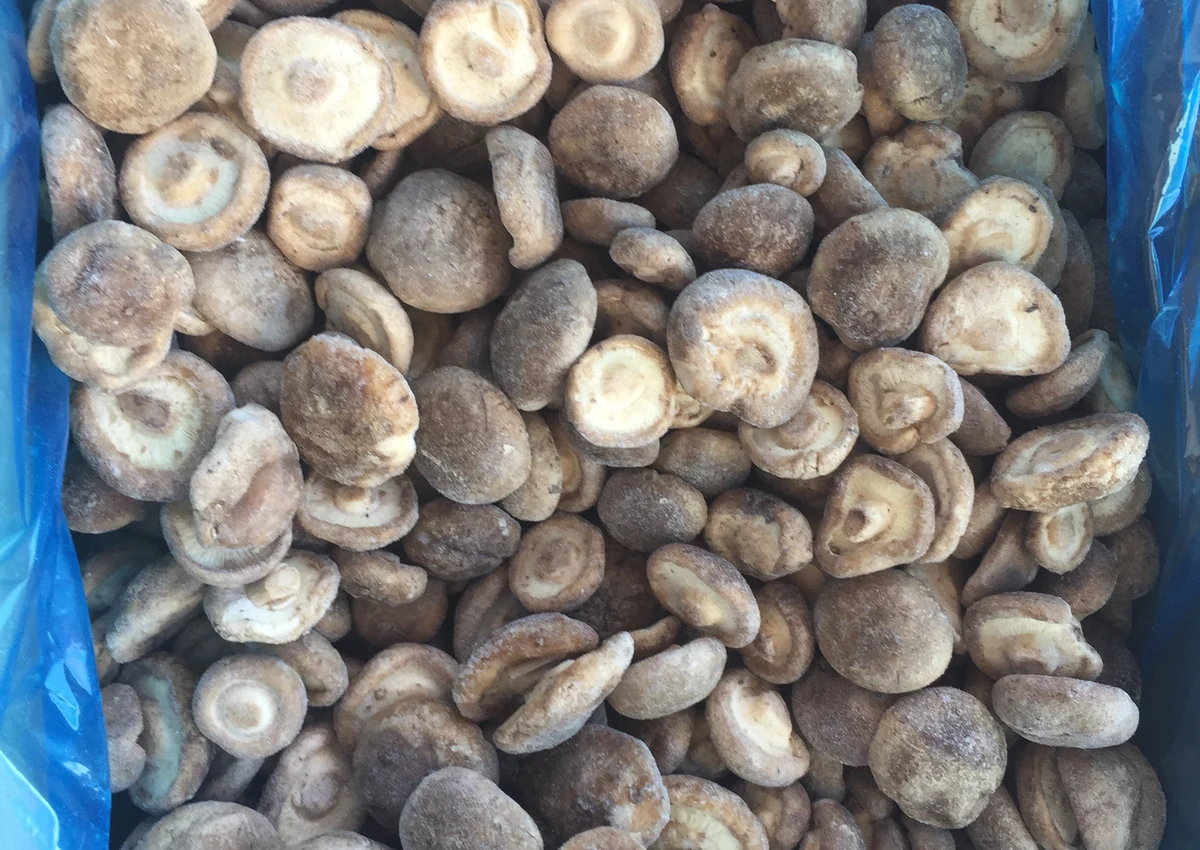
Whole frozen caps illustrate the incoming product form; check the pack directions and cut before choosing a pan method.
Why does liquid appear in the pan?
A frozen mushroom piece contains water within its structure and may carry some surface ice. When the piece warms, liquid can move out and collect in the pan. That is a normal cooking event, not, by itself, evidence that a particular bag is defective. The amount you see depends on the mushroom, its cut, its preparation before freezing, the load in the pan and how quickly the pan can evaporate the liquid. A shallow layer can disappear while you cook; a deep pile may leave the pieces simmering in their own juices.
Commercial frozen mushrooms do not all start from the same state. The USDA’s IQF mushroom purchase description [1] lists fresh IQF, blanched, fire-roasted or grilled, sautéed, and sautéed-roasted applications. It even distinguishes options intended for uses where moisture release is less welcome. That document describes specified purchasing options; it does not tell us how a particular retail or foodservice bag was made. Read the actual product name and directions instead of guessing from the word “frozen.”
The goal is not to promise that no drop of water will appear. The goal is to prevent free liquid from arriving at the wrong stage of your recipe. If you add cream before the mushroom liquid has reduced, the sauce may thin. If you put damp mushrooms on a pastry or pizza base, that liquid has somewhere fragile to go. If you add the same pieces to broth, the release may be entirely compatible with the dish. The handling decision follows the destination.
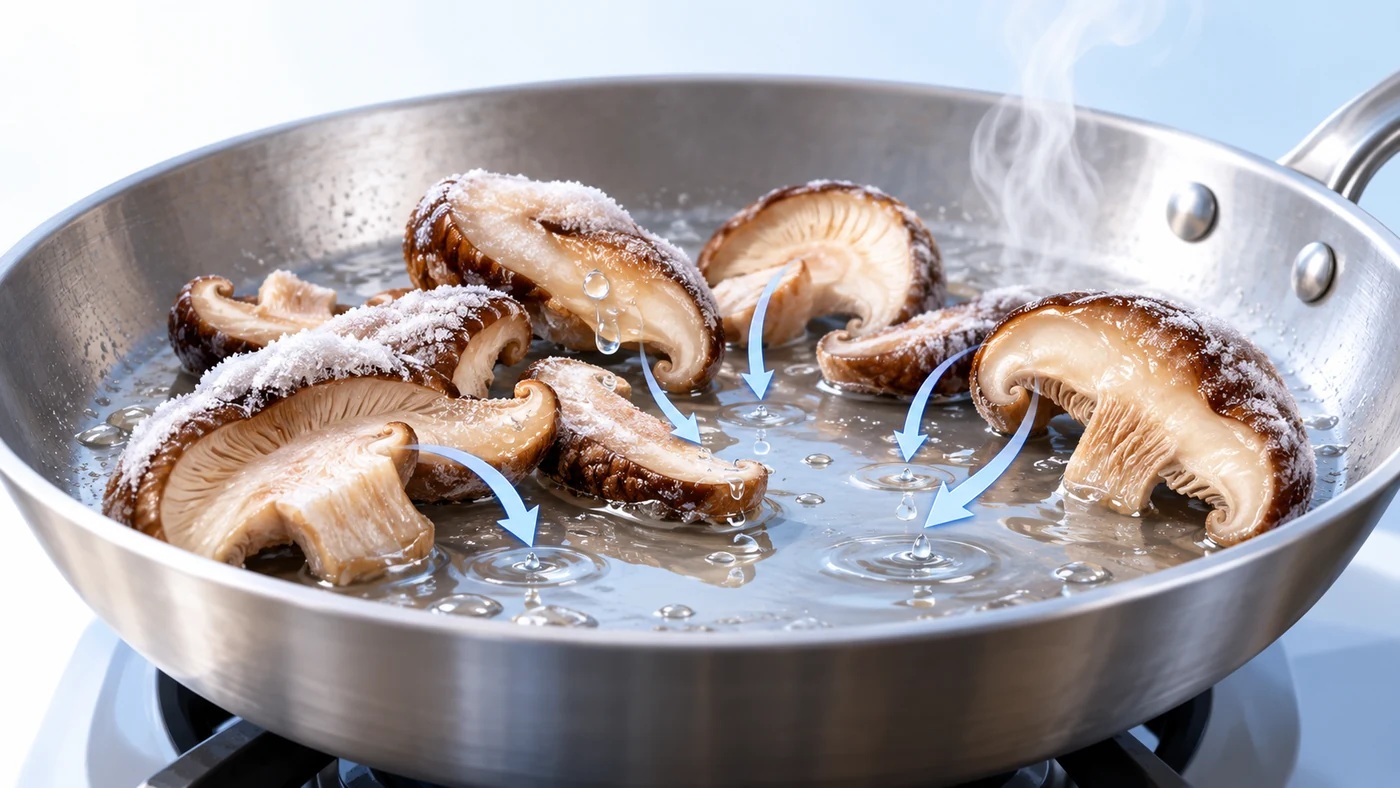
As frozen mushroom pieces warm, liquid may collect around them before it evaporates from an uncovered pan.
Decide whether to keep or remove the liquid
Before heating the pan, ask one simple question: Will a little more liquid improve this dish or weaken its texture? It is a more reliable starting point than a universal instruction to thaw or never thaw. The Mushroom Council’s IQF handling guidance [2] specifically allows frozen mushrooms to enter soups, stews and chile from frozen and says to heat them according to the individual use. A skillet topping has a different target. In that case, separating mushroom cooking from final assembly gives you control over the moisture.
| Final dish | What to do with released liquid | Useful cooking cue |
|---|---|---|
| Soup, stew or loose sauce | Usually let it join the recipe, provided the final consistency still suits the dish. | Judge the whole pot’s thickness after the mushrooms have heated through. |
| Sauté or drier filling | Reduce it in the mushroom pan before final seasoning or combining. | Puddles shrink; the pan sounds less like a simmer and more like a sizzle. |
| Pizza, pastry or crisp toast | Cook or drain separately before the pieces touch the base. | A spoonful placed on a plate does not leave a surrounding pool. |
| Cream sauce or omelet | Control the liquid before adding cream or eggs. | The mushrooms are moist but no longer sitting in free liquid. |
There is no virtue in reducing every drop if the liquid is welcome. A soup can take the mushrooms and their juices together. Conversely, a nearly dry pan may be worth the extra step for an omelet, flatbread or turnover filling. The table describes a texture decision, not a food-safety test or a guarantee that every product behaves alike.
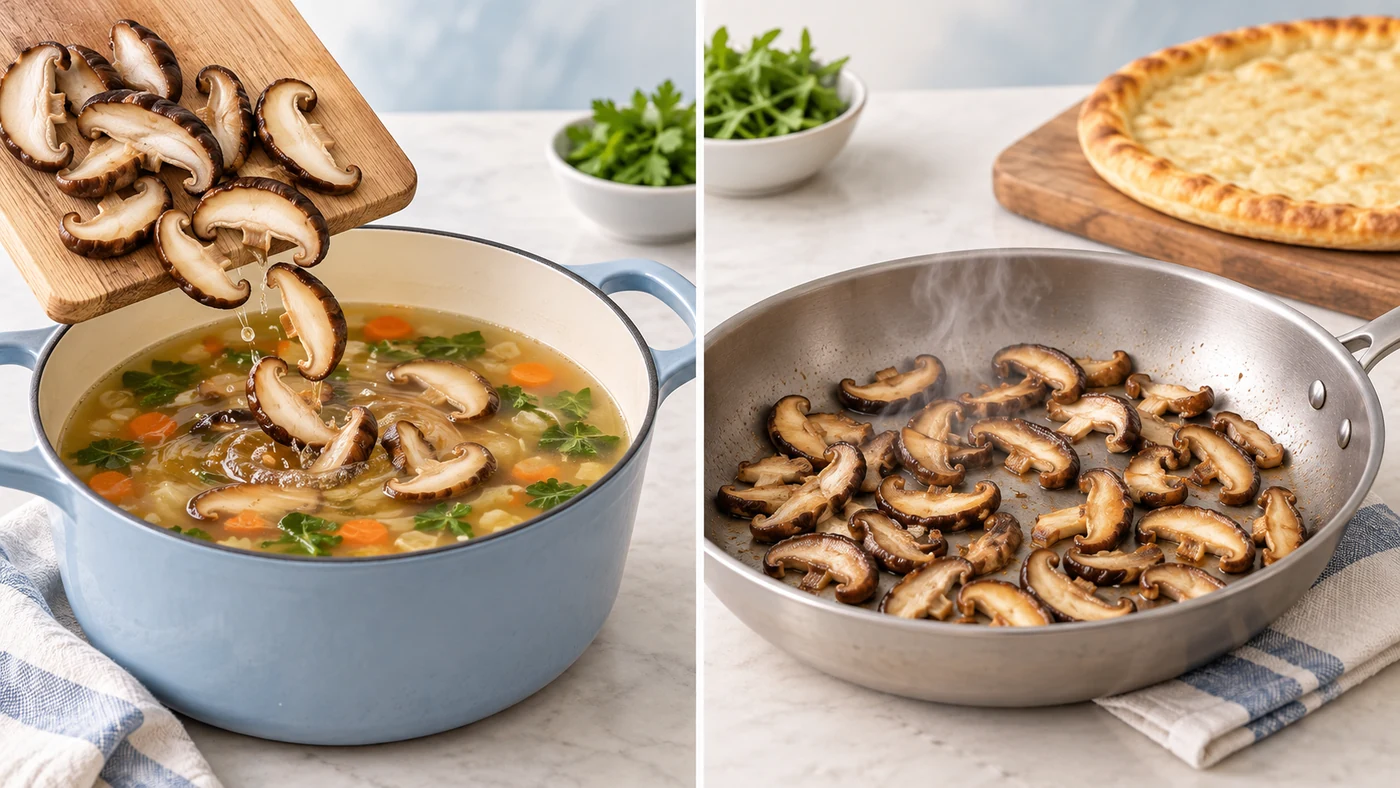
Soup can retain cooking liquid, while a crisp base often needs a separate, drier mushroom preparation.
A pan method based on what you can see
For a drier mushroom component, use the sequence below as a flexible method. It has stages rather than a promised cooking time because frozen slices, dice, caps and pre-cooked products behave differently. Follow any instructions supplied with the product. If it is seasoned or fully prepared, its directions may call for reheating rather than the full release-and-reduce treatment described here.
1. Read the label and choose a suitable pan
Check the cut, any declared pretreatment, and the cooking directions. Then choose a pan wide enough that the mushroom pieces can spread rather than form a thick heap. An uncovered pan gives escaping steam a route out. A small pan can work if you divide a larger amount into batches; piling more pieces on top does not create more evaporating surface. Leave room to move the mushrooms without spilling.
Do not wash an already prepared frozen product simply because it is a mushroom. Fresh-mushroom cleaning instructions do not automatically apply to IQF pieces. If a specific product instructs you to rinse or otherwise prepare it, follow that instruction and account for any added surface water. If the pieces are clumped, handle them as the package directs; forcing a frozen block apart with a knife is unnecessary for this cooking decision.
2. Heat and observe the release
Add the mushrooms according to the product directions and spread them across the pan. As they warm, you may see a puddle develop around the pieces. At this point, they are effectively cooking in that liquid. Stir enough to prevent sticking and expose wet surfaces; keep the pan uncovered if the intended result is dry. A lid traps steam and can be useful for another recipe, but it works against evaporation here.
There is no need to call this stage a failure. It is the point at which the cook can still decide what the recipe needs. For a loose sauce, you can move forward with the liquid. For a dry filling, let it continue to reduce. If the pan is so crowded that the bottom remains hidden under water, split the load into two rounds or transfer the pieces to a larger pan. Turning the heat up alone cannot compensate for an overcrowded cooking surface in every kitchen.
3. Wait for the liquid to subside, then finish
Watch the open areas of the pan. While free liquid remains, you will hear bubbling and see a shiny pool. As the pool shrinks, the sound and appearance change. When there is no surrounding puddle, you can add or adjust cooking fat if the recipe calls for a sauté, then allow the pieces some contact with the pan. If a browned edge is wanted, give the pieces space and time in contact with the surface; avoid stirring so continuously that nothing stays in place. Reduce heat if the pan or fat starts to scorch.
Season and add aromatics to fit the recipe rather than following a rule that salt or garlic must always enter at one exact minute. Garlic can burn while a pan is still reducing a large amount of liquid; cream or eggs can dilute if added too early. Herbs that should taste fresh can go in toward the end. The observable endpoint for a dry component is not that the mushroom is brittle. It is that it no longer carries free liquid into the next ingredient.

Watch for three visible stages: frozen pieces, a bubbling liquid pool, and a pan with little free liquid remaining.
For frozen mushroom pieces with a different cut, use the same questions, then adjust the pan load and finish. Thin slices expose more surface than large caps; small dice distribute through a sauce differently from larger pieces. These are practical differences to observe, not a basis for a universal heat setting or cooking time.

Frozen slices provide a distinct cut example; different shapes change how pieces can be spread and assessed in a pan.
Should you thaw frozen mushrooms first?
Not as a blanket rule. The intended dish, product preparation and label matter. Direct-from-frozen use is supported for certain IQF applications by the Mushroom Council’s guidance. It is particularly simple when the mushrooms will cook in broth or another wet medium. Some home-freezing advice, however, suggests thawing and blotting for applications such as a stir-fry or pizza. Those examples concern the writer’s preparation and are not a universal direction for every commercial bag.
If the package says cook from frozen, use that instruction. If it permits thawing and the finished dish is sensitive to free water, a separate drain-and-blot step may help you control liquid before assembly. That is a texture choice; it does not replace the product’s handling and cooking directions. If you prepared and froze the mushrooms yourself, remember whether they were raw, sautéed or otherwise cooked before freezing. A container of previously sautéed mushrooms may need only reheating and integration, while an uncooked frozen product will require cooking. Do not treat those as identical inputs.
One useful rule survives the disagreement: avoid thawing a bag just because a recipe says “mushrooms.” First see whether the recipe needs a moist ingredient or a relatively dry one, then read the product instructions. If you want a crisp base, handle the mushroom liquid before assembly whichever permitted route you choose. If you want mushroom flavour distributed through a soup, there may be no reason to discard liquid at all.
When the dish still gets watery
If the result is wet, trace where the free liquid entered the recipe. Repeating the same pan step more aggressively is less useful than locating the stage at which moisture moved into sauce, eggs or dough.
| What you notice | Likely cooking issue | Next adjustment |
|---|---|---|
| A pool remains after repeated stirring | The load is deep relative to exposed pan area, or the pan is covered. | Uncover and spread; finish in smaller batches if needed. |
| Brown patches appear but the dish is still wet | Some pieces contacted a hot surface while liquid remained elsewhere. | Distribute the pieces and judge the whole pan before combining. |
| Cream sauce thins after mushrooms go in | Mushroom liquid entered after the sauce was set. | Cook the mushrooms separately next time; combine when their free liquid is controlled. |
| Crisp base turns soft under the topping | The topping carried free liquid onto absorbent dough or bread. | Drain or reduce the mushrooms before assembly and avoid piling them thickly. |
| The mushrooms are dry enough but soft | Texture and free liquid are different questions. | Use a dish that welcomes a tender piece or choose a different product preparation. |
A watery appearance is a cooking observation, not a substitute for inspecting a product specification or testing a lot. Species, cut and pretreatment can all alter the result. If you are comparing ingredients for food production, the useful questions become which preparation was supplied, where released liquid goes in your process, and what finished texture you need. XMG’s separate guide to raw, blanched and sautéed frozen mushrooms addresses that commercial choice; this cooking method alone does not approve one preparation for every application.
Put the method into a real dish
Soup or stew: Follow the pack’s directions and add the frozen mushrooms where they can heat within the liquid. Judge final thickness after their moisture has joined the pot. Reducing a soup solely because mushrooms released liquid may remove more broth than you wanted. The Mushroom Council specifically includes soups and stews among its examples for adding IQF mushrooms from frozen.
Pasta sauce or gravy: If the sauce is deliberately loose, mushrooms can cook within it and you can adjust thickness at the end. For a concentrated, creamy sauce, cooking the mushrooms separately before adding the cream gives a clearer view of how much free liquid remains. Do not wait for the sauce to split or become thin before considering where the mushroom liquid will go.
Stir-fry or sauté: Treat the mushrooms as their own pan load first when possible. Once the visible liquid has reduced and the pieces are ready for the intended finish, combine them with vegetables that need shorter cooking. Adding everything at once can leave the entire pan steaming, especially if the vegetables also release water. If the product is already sautéed and frozen, check whether it needs full cooking or just reheating.
Omelet or filling: Cook the mushroom portion before it enters the eggs or pastry. Let the free liquid reduce, then allow the pieces to cool as appropriate for the recipe before enclosing them. A tender mushroom can make a good filling; a puddle carried into an egg mixture or pastry seam is the avoidable problem.
Pizza or flatbread: Pre-cook or otherwise manage the mushroom moisture before the topping touches a crisp base, as the product and recipe permit. Layer thickness and the base’s own baking conditions also matter. For the narrower question of toppings and crust, see XMG’s frozen-mushroom pizza moisture guide. A skillet that looks dry at one moment is a helpful cue, but it is not a guarantee that every assembled pizza will stay crisp.
The useful check before serving
For a dry dish, lift a spoonful of mushrooms onto a plate. Do you see a ring of free liquid forming around it? If so, either continue reducing in the pan or use a draining step permitted by the recipe. If not, the pieces are ready to combine according to the dish’s next step. For a wet dish, taste and adjust the whole sauce or broth after the mushrooms have heated through. This simple check addresses the actual problem—liquid reaching the wrong place—without pretending that all frozen mushrooms will have the same texture as fresh ones.
The most useful habit is to make the liquid destination explicit before you cook. Keep it in a broth when it contributes to the dish. Reduce or separate it when the next ingredient needs to stay thick, crisp or set. Read the product directions, give the mushrooms enough pan area for the chosen method, and let the visible result guide the finish.
Frozen Mushrooms
Browse our mushroom range and compare species, cuts and processing options.
Explore Frozen Mushrooms →References
- [2] The Mushroom Council, Storage and Handling: IQF Mushrooms↑.
- [1] USDA Agricultural Marketing Service, Commercial Item Description A-A-20376: Mushrooms, Individually Quick Frozen, Minimally Processed↑.
- [3] University of Missouri Extension, wine-cap mushroom cooking guidance (open-pan evaporation example for fresh wine caps).
