


On this page
Frozen raspberries can often go straight into a batter that was developed to use them. A controlled thaw is more useful when the recipe needs a separately prepared filling, a measured drained fruit portion or deliberate management of the released juice. The decision depends on the task, the recipe and the product’s cooking instructions. There is no single “always thaw” or “never thaw” rule that covers muffins, pies, cream fillings and decorations added after baking.
Decide what the raspberry must do in the finished food. A visible fruit pocket in a muffin, a red ripple through a loaf and a smooth filling require different handling. If intact berries matter, unnecessary mixing works against that aim. If the fruit will be cooked and broken down into a filling, preserving every hollow berry structure may add little value. Those choices can be made before opening a bag.
Start with the recipe task and the product instructions
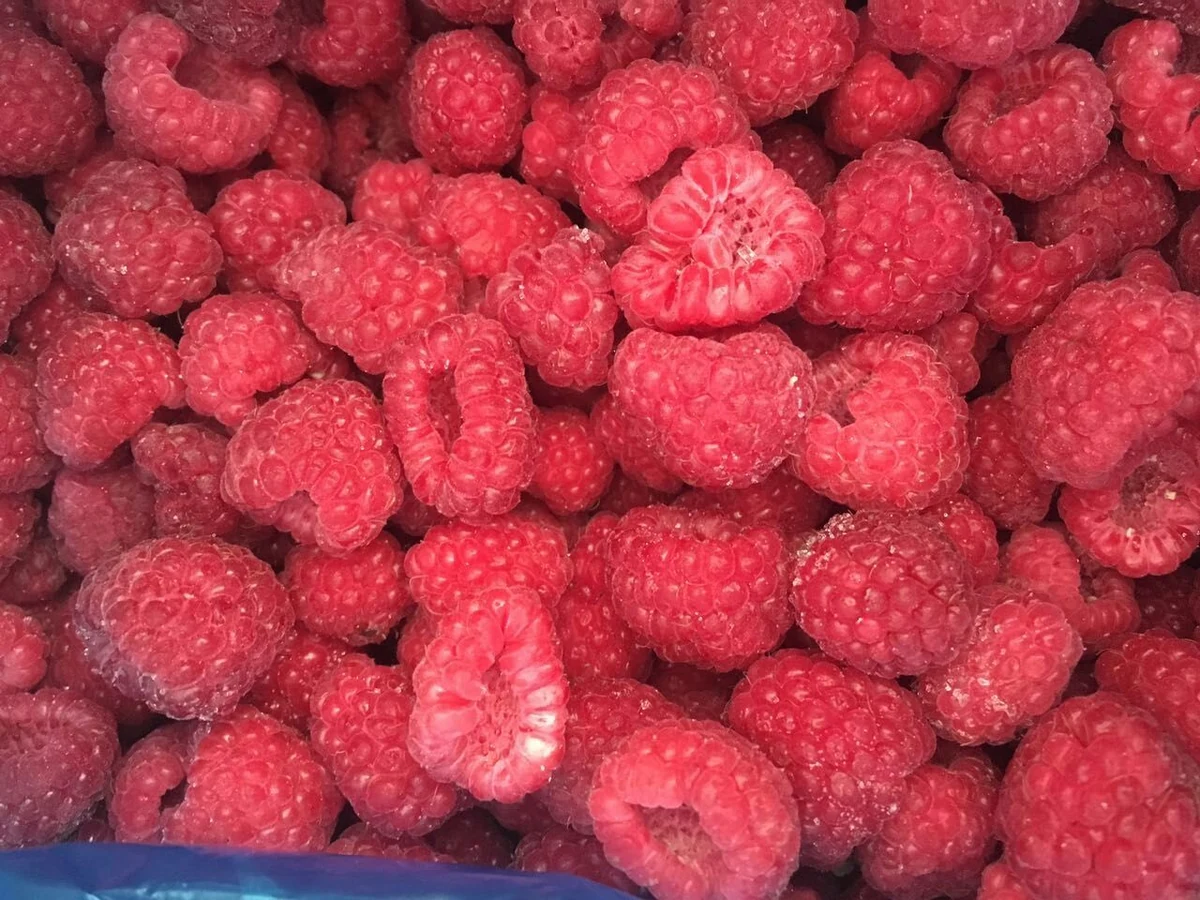
Whole raspberries show the hollow fruit structure and joined drupelets in this original product photograph.
Also identify the ingredient actually being substituted. Unsweetened whole raspberries, broken pieces, sweetened fruit and a prepared raspberry filling are different recipe inputs. Added syrup changes both the fruit-to-liquid relationship and the formulation. A crumble ingredient changes the distribution of pieces. Matching the word “raspberry” on two packs does not make their behaviour interchangeable.
| Recipe task | Route worth considering | What still needs checking |
|---|---|---|
| Distinct pieces in a sufficiently sturdy batter | Frozen addition near the end of mixing, where the recipe permits | Distribution, breakage, fruit pockets and the required cooking process |
| A filling cooked separately before assembly | The preparation state specified by the filling recipe | Whether all juice is included, concentration and cooling requirements |
| A recipe explicitly calling for drained thawed fruit | Controlled thaw with fruit and liquid recorded separately | Whether the stated fruit weight is before or after drainage |
| Fruit added after baking with no further heating | An ingredient and process suitable for that intended use | Product instructions and applicable food safety requirements before appearance |
This is a decision table, not a set of interchangeable recipes. A frozen ingredient that requires cooking cannot be made suitable for an uncooked topping simply by thawing and draining it. Resolve that requirement first. Then use the handling route that gives the recipe the intended fruit distribution and moisture balance.
When frozen raspberries can go straight into a batter
Direct frozen addition is a useful starting point when a recipe explicitly accepts frozen raspberries and the batter can carry the pieces. Prepare the other ingredients and equipment first, then take out the required fruit close to its addition point. That reduces avoidable handling while the berries soften. It does not remove the need to follow storage, preparation and cooking instructions.
King Arthur Baking’s raspberry chocolate chip muffin recipe [1] accepts fresh or frozen berries and places them into individual batter portions. Its loaf variation instead folds the berries into the mixed batter. These are useful examples of two addition methods within a named recipe. Neither establishes that every batter should receive frozen fruit in the same way.
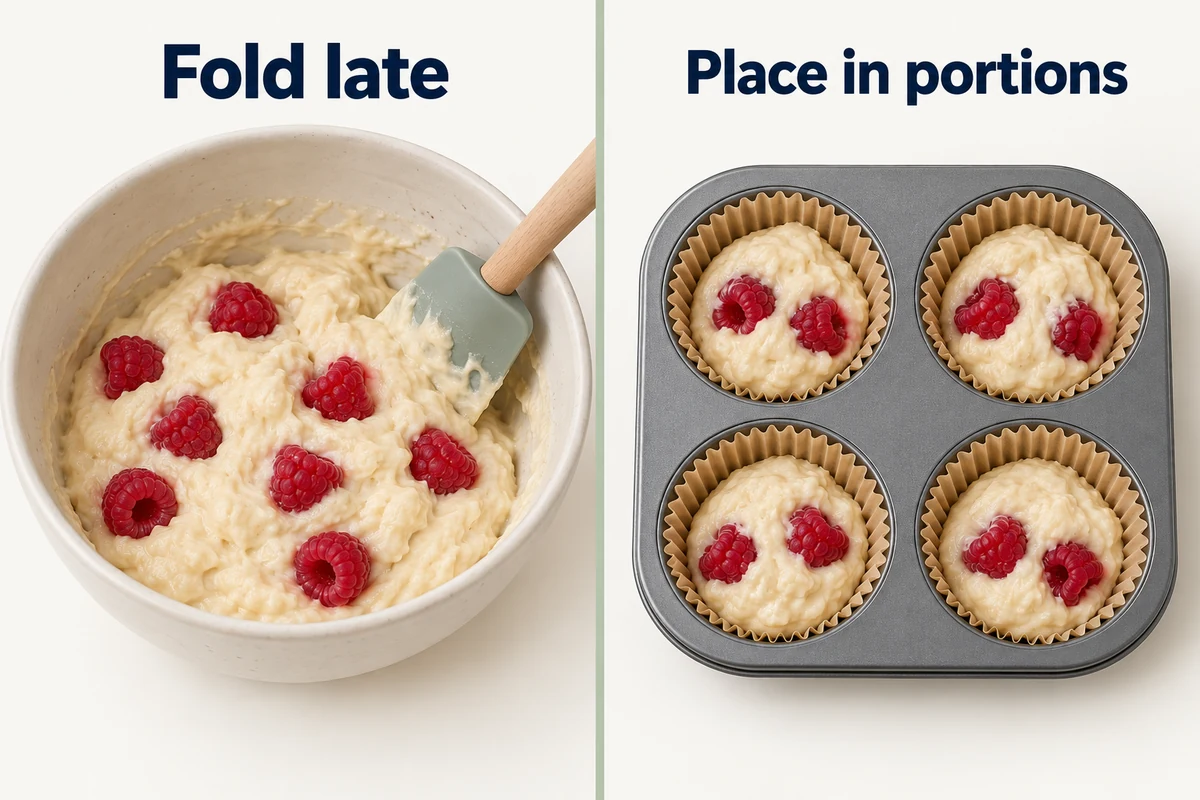
Conceptual recipe-dependent addition options. The portions and fruit quantities are illustrative, with no measured breakage, colour-transfer or baking result.
In a mixing-bowl method, finish the mixing that the base batter needs before introducing fragile fruit, unless the recipe gives a different sequence. Add the berries as late as the formulation allows and distribute them with the least additional handling needed. A bowl scraped repeatedly after the fruit goes in receives a different mechanical treatment from one folded a few times and portioned immediately. Record that distinction when comparing trials.
In a placement method, the fruit can be allocated to individual portions rather than circulated through the entire batch. This may help control where visible pieces sit, but it also creates a portioning task. Count or weigh consistently according to the recipe’s needs, and check more than the first few portions. Fruit resting on the surface, fully embedded fruit and a concentrated cluster in the centre are different arrangements to evaluate.
The Washington Red Raspberry Commission’s baking and pastry toolkit [2] also discusses gentle late addition and approaches for batters of different consistencies. Use those ideas to design a trial, rather than expecting any ingredient to remain entirely free of colour transfer. A lighter batter that shows raspberry colour can still be satisfactory; the question is whether it matches the intended finish.
Frozen fruit introduces a colder component into the mixture. Pan size, portion mass, fruit distribution and starting conditions therefore belong in the cooking assessment. Do not compensate by adding an arbitrary number of minutes to every recipe. Use a recipe and process appropriate to the product, and assess any change through the required cooking controls as well as texture. A good-looking outside does not settle what happened around the fruit inside.
When a controlled thaw and drainage help
A controlled thaw helps when the next operation needs the fruit in a softened state, when the recipe specifies drained fruit, or when the released juice must be measured and used separately. It can also make a filling operation easier to define: the recipe can say whether the juice is cooked with the fruit, concentrated separately or excluded. Thawing alone does not tell you which of those choices is correct.
For a refrigerated thaw, keep the fruit protected in a suitable food container and collect any juice that the recipe needs. Follow the product’s handling instructions and the applicable kitchen or production controls. The FDA’s safe food handling guidance [3] identifies refrigeration as a thawing method and advises against thawing food on the counter at room temperature. It does not provide one universal thawing duration for every raspberry pack and load.

Conceptual separation of fruit and juice after controlled thawing. Drawn quantities and fruit appearance are illustrative; the diagram specifies no thaw duration, drainage yield or food safety process.
Define the drainage step if it matters to the formula. State the equipment, the endpoint or duration used in the trial, and whether the fruit is left to drain or subjected to pressure. Gentle drainage and pressing are different operations. A change in sieve opening or handling can alter how much fruit material reaches the catch bowl. Record the method without treating it as an industry standard.
Illustrative accounting example: a trial starts with 200 g of frozen raspberries. After its specified thaw-and-drain procedure, it records 165 g of retained fruit and 30 g of collected juice, with 5 g unrecovered. These invented quantities demonstrate record keeping; they are not measured raspberry performance or an XMG yield claim. Retained fruit is 165 ÷ 200 × 100 = 82.5% of the original input.
The missing 5 g should remain “unrecovered” until its cause is known. Some material may be left on equipment or missed during transfer, but the record does not establish that it all evaporated. Likewise, the 30 g in the catch bowl is raspberry juice and possibly suspended fruit material. Calling it simply water conceals part of the ingredient being removed.
If one recipe uses 200 g of frozen fruit and another uses 200 g of drained fruit, they do not necessarily begin with the same amount of raspberries. The second quantity is measured at a later stage. Write the weighing point beside the ingredient amount: “original frozen input” or “retained after the defined thaw and drainage.” This prevents a changed fruit loading from being mistaken for an effect of thawing.
Decide where the collected juice goes. Returning all of it preserves more of the original ingredient input than discarding it, although transfer losses still need attention. Replacing discarded juice with the same mass of water does not reconstruct the same mixture: the juice carries raspberry components as well as water. Any compensation belongs in recipe development, with the resulting flavour, colour and texture checked again.
For a separately cooked filling, describe the ingredient state at the start of cooking and the state needed at assembly. A recipe that cooks fruit with its juice is different from one that folds drained fruit into an already prepared cream. Neither method should be inferred from the ingredient name alone. Record any reduction or thickening operation, the amount of filling recovered and the quantity deposited into each product. That keeps a change in filling concentration from being hidden behind an unchanged raspberry purchase weight.
Do not assume that drained thawed berries will look like fresh berries on a finished cake. King Arthur’s fresh-versus-frozen baking comparison [4] describes different raspberry outcomes in pie and cream-filling applications. The useful lesson is the importance of the application. A texture suited to a cooked filling may be unsuitable for a decoration expected to retain a fresh-fruit appearance.
Reduce breakage at the point of addition
Raspberries consist of small joined drupelets around a hollow centre. That structure is worth looking at before selecting a handling method. A whole berry can lose its intended shape when repeatedly stirred, compressed in a measuring cup or forced through a narrow transfer point. The practical objective is to avoid extra manipulation that adds no value to the recipe.

Whole raspberries and some separated pieces are visible on parallel metal bars in this original photograph. It shows product form, without identifying a measured handling trial.
Weigh the required amount in a suitable container rather than repeatedly transferring it between utensils. Have the batter and portioning equipment ready. If the recipe allows folding, use an implement that can move the batter without deliberately crushing the fruit. Wilton’s frozen-fruit baking guidance [5] likewise emphasises gentle incorporation. That is a handling principle, not a promise that whole berries will survive every mixing system.
Watch what happens after the bowl is mixed. A depositor, scoop, transfer hose or repeated scraping can change the fruit distribution before baking. A small hand-mixed trial therefore needs a second check if the production method uses different equipment. Keep a sample from the beginning, middle and end of portioning, and record whether the fruit remains evenly allocated or collects in certain portions.
A flour coating is sometimes proposed to manage fruit in batter. It is not a universal remedy for sinking, colour transfer or weak structure. Adding extra flour changes the formulation; taking flour from the existing recipe changes when that flour is incorporated. If a tested recipe specifies a coating, follow that method. If it does not, evaluate the change deliberately instead of assuming a spoonful is too small to matter.
Similarly, rinsing fragile frozen raspberries is not a neutral step: it introduces handling and a drainage question. Do not transfer a technique shown with firmer frozen blueberries to raspberries without checking the consequences. Washing or rinsing is also not a substitute for a required cooking step. Keep any product-specific washing direction separate from an attempt to improve the colour of the batter.
Compare the two routes without hiding a recipe change
A useful comparison needs a written question. “Which route gives the appearance we want in this muffin?” is answerable. “Are frozen raspberries better?” leaves the recipe, ingredient state and result undefined. Choose the finish being judged, then record enough of the process to explain the outcome.
For a first handling comparison, use the same raspberry product and lot, the same original fruit input, and the same base recipe. Treatment A might add 200 g of fruit while frozen. Treatment B might begin with a separate 200 g portion, thaw it under the agreed refrigerated procedure and return all collected juice to the recipe. These are hypothetical trial arrangements. They do not guarantee equal fruit recovery or equivalent heating.

Conceptual A and B handling routes. The text specifies equal original fruit inputs; the drawn portions are not measurements, and the bowls show no baking outcome or equivalent heating.
Calculate any unrecovered mass in B from its recorded input and recovered fractions, and record the actual fruit and juice additions. Keep the addition point, base-batter preparation, pan type, portion load and subsequent handling consistent unless one is the variable under investigation. Fruit state is intentionally different, so its temperature and time out of controlled storage should be recorded. Do not call the preparations identical.
| Trial record | What to write down | Why it affects interpretation |
|---|---|---|
| Fruit input | Product, lot, form and original frozen mass | A different grade or fruit loading changes the comparison |
| Thaw and transfer | Controlled conditions, retained fruit, captured juice, returned juice and unrecovered material | Separates fruit state from ingredient removal |
| Addition and portioning | Mixing point, handling method, portion mass and fruit placement | Shows whether mechanical treatment or distribution also changed |
| Cooking | Applicable process requirements, actual load and recorded controls | Texture assessment cannot replace the required cooking check |
| Finished assessment | Matched cooling or holding stage, cut-face appearance and defined texture observations | A warm sample and a fully cooled sample are different comparisons |
If a third treatment uses thawed fruit with the juice discarded, identify it as a separate formulation treatment. It changes both the handling route and what enters the batter. A drier-looking result could not then be attributed to thawing alone. This third route may still be useful, particularly for a recipe developed around drained fruit, but its question is different.
Assess several portions and compare them at the same chosen stage after baking. Photograph the cut faces under similar lighting, label each treatment and note where the sampled portions came from. Decide in advance what matters: distinct pieces, acceptable colour distribution, absence of an unwanted wet band, or a particular filling texture. Keep observations separate from explanations until the records support the cause.
Consider the order in which the trial batches are made. If A is always mixed first and B always waits while equipment is cleaned or reheated, holding time and equipment condition may also differ. Record those circumstances and repeat the comparison with a suitable arrangement that checks the suspected influence. Several muffins from one bowl show variation within that bowl; they do not replace an independently prepared repeat batch.
When selecting the preferred route, save the recipe version and handling record together. If the final choice deliberately discards juice or changes the addition method, write that change into the working instructions. A photograph of an attractive cut face is useful reference material, but it cannot tell the next baker which portion was weighed, what liquid was retained or when the fruit entered the mixture.
Keep cooking requirements separate from baking appearance
The handling decision is only part of the process. Before choosing a recipe route, read the pack and obtain any missing preparation information. For a food business, the intended use, applicable supplier requirements and food safety controls must be clear. Do not infer ready-to-eat suitability from the word IQF, a clean-looking berry or the fact that the ingredient will be placed near something hot.
The Food Safety Authority of Ireland recommends boiling imported frozen berries for one minute before consumption [6]. That is Irish guidance with a stated product scope. Freezing does not reliably remove the viral hazard underlying the advice. The recommendation should not be silently converted into an oven temperature or an assumed equivalent muffin-baking time.
Where heating is required, make sure the chosen recipe and production process meet the applicable requirements for that ingredient and use. Oven air temperature, crust colour and a toothpick texture check do not by themselves establish a berry-specific virus reduction process. A commercial process change that alters fruit temperature, placement or portion size needs appropriate assessment, even if the finished product still looks familiar.
Finally, distinguish fruit baked within a product from fruit added afterwards. A thawed berry placed on cooled pastry receives no benefit from the earlier baking step. If the desired decoration cannot accommodate the required treatment, choose an ingredient or prepared component suitable for that use. Solve that issue before optimising appearance; then document the approved handling route so the next batch follows the same decision.
Frozen Raspberries
Review whole-fruit and broken raspberry formats for batters and fillings. Share your fruit form, cooking requirements and sample brief so we can review suitable supply options.
View Raspberry Supply Options →References
Application sources describe their own recipes and handling contexts; FDA and FSAI guidance retain their stated scope. All trial quantities and comparison arrangements above are illustrative.
- [1] King Arthur Baking: Raspberry Chocolate Chip Muffins↑
- [4] King Arthur Baking: Frozen Fruit vs. Fresh Fruit in Baking, 2018↑
- [2] Washington Red Raspberry Commission: Baking & Pastry Toolkit↑
- [5] Wilton: How to Bake with Frozen or Canned Fruit, 2020↑
- [3] FDA: Safe Food Handling↑
- [6] FSAI: Berries — Advice to Boil Imported Frozen Berries↑
