


On this page
Lingonberries and American cranberries are different species, and a useful substitution depends on more than their shared red colour and tart flavour.
Compare the identified ingredients in the sauce or filling you intend to make, with sugar, added water, preparation method and cooking endpoint recorded. A gram-for-gram swap can be a trial starting point; it is not evidence that the flavour, texture or finished yield will remain the same.
Confirm the berry identity and ingredient form

Hold ingredient form, sugar and water records, cooking endpoint and application conditions equal before adjusting either formula.
Lingonberry is Vaccinium vitis-idaea. American cranberry is Vaccinium macrocarpon. Common names can blur that distinction: the US National Park Service’s Alaska berry guide [1] uses “low-bush cranberry” for lingonberry. A recipe using that regional name may already be referring to lingonberries, rather than asking for a substitution between the two species.

Whole cranberries show one ingredient form; confirm species and lot identity from records.
Check the botanical name in the ingredient documentation when identity matters. Also check whether the product is whole unsweetened fruit, crushed fruit, puree, juice or a sweetened preparation. A jar of lingonberry preserve and a bag of unsweetened frozen cranberries differ in more than species. The preserve already contains a formulation and a processing history that affect what it contributes to the new recipe.
| Ingredient description | What it identifies | What it does not settle |
|---|---|---|
| Lingonberry, V. vitis-idaea | The declared species | The lot’s sweetness, acidity, particle form or cooking behaviour |
| American cranberry, V. macrocarpon | A different declared species | An automatic sugar adjustment or equivalent sauce texture |
| Low-bush cranberry | A regional common name that can mean lingonberry | Identity without the regional or botanical context |
| Berry preserve, sauce or filling | A prepared product category | Fruit percentage, added sugar, water or thickening system without its specification |
Photographs help communicate the form being handled, but they do not authenticate a species. The two original product photographs in this guide show cranberries, one of the ingredients under comparison. They are not a matched visual test of lingonberries versus cranberries. Use the supplier’s identity records and any required verification to establish what enters the recipe.
For a development trial, attach the product name, lot and preparation state to each sample. If the ingredient arrives frozen, record whether it enters the process frozen, thawed with its juice retained, or thawed and drained. Otherwise, a liquid-removal step can be mistaken for a species effect before the actual cooking comparison has even begun.
Compare flavour, skins and seeds in the prepared fruit
Both berries can provide the tart fruit note wanted in a savoury condiment or sweet filling. That does not establish a fixed ranking for every lot. Judge the proposed ingredients after the preparation required for their intended use, and describe sweetness, sourness, bitterness and mouth-drying sensation separately. A sample described only as “too sharp” gives the next recipe adjustment little direction.
There is variation within each species. A 2006 USDA-ARS study by Finn and Mackey [2] compared ten lingonberry genotypes grown in Corvallis, Oregon, including chemistry measured from frozen 2003 fruit samples. Soluble solids, pH and titratable acidity differed among the samples. Those historical results support testing the ingredient; they are not present-day limits for a purchased lot.
A separate 2020 cranberry genetics study summarised by USDA-ARS [3] investigated reduced acidity in American cranberry germplasm. Its scope also argues against assuming that a species name supplies one fixed acidity. Neither study provides a universal instruction to reduce sugar whenever lingonberries replace cranberries.
Keep acidity measurements distinct from the sensory judgement. pH and titratable acidity answer different questions, and neither alone describes the entire flavour of a sauce. If those measurements inform the trial, agree the preparation, method and reporting basis. Our guide to pH and titratable acidity in fruit ingredients explains why one result cannot simply stand in for the other.
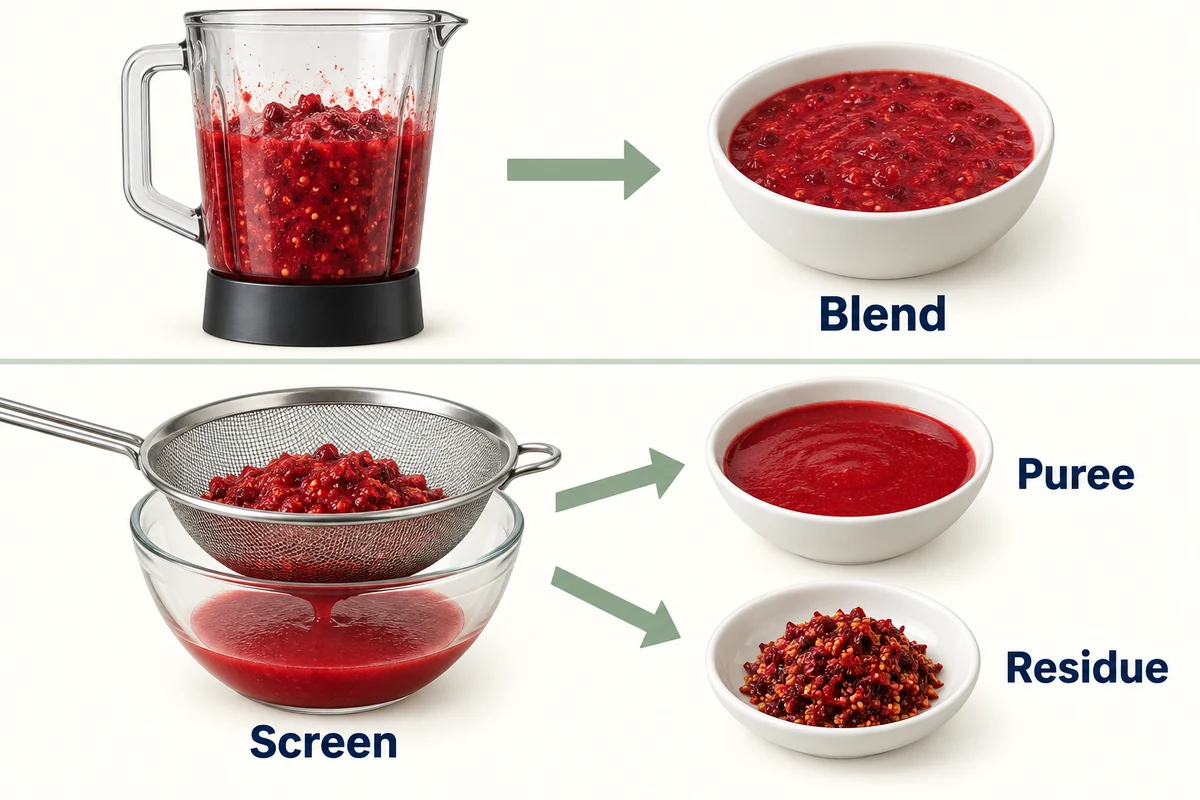
Blending keeps the mixture together; screening separates recovered puree from retained residue.
For texture, decide whether the application wants visible berry pieces, a pulpy sauce or a smooth filling. Blending and screening are different operations. Blending reduces the material in the vessel; screening separates material that passes through from material retained on the screen. A puree can therefore carry a different skin and seed fraction depending on how it was made, even when the ingredient name is unchanged.
The University of Alaska Fairbanks lingonberry publication [4] describes a cooked puree passed through a food mill or sieve to remove skins and seeds, as well as a separate uncooked blended preparation. These examples show why the processing description matters. They do not establish that every puree is seed-free or that a particular screen is right for your filling.
Evaluate visible skin fragments, seed sensation and remaining whole pieces in the final food. A fragment that is acceptable in a spooned sauce may be intrusive in a thin layer of pastry filling. If screening is chosen, record the retained residue and usable puree mass. Removing material can improve the intended smoothness while changing how much ingredient reaches the finished batch.
Keep the screening method consistent during the comparison. State whether a spatula presses material against the mesh, how the retained fraction is collected and whether any rinse water is used. A residue weighed while carrying attached puree is a wet process residue, not a measurement of dry skin and seed content. This distinction matters when someone later uses the result to estimate ingredient needs or compares it with a differently prepared sample.
Control sugar, water and the cooking endpoint
Begin with a written base formulation and a clear question. One trial can ask how the two berry ingredients behave under the same specified preparation. A later trial can optimise each formulation to a chosen sensory target. Keep those stages separate: changing fruit, sugar, water and cooking duration together may produce an attractive sauce, but it will not reveal which change produced the result.

A meaningful comparison records each input and the recovered output without assuming all mass loss is water.
Illustrative development example: separate trials each start with 500 g of their identified berry ingredient, 200 g of added sugar and 100 g of added water. The nominal input is 800 g per trial. These are invented quantities for explaining records, not a recommended sauce recipe, a preservation formula or measured performance of either species.
Suppose one trial records 720 g of recovered sauce and the other 640 g. Their recoveries are 90% and 80% of the recorded input. The same 200 g sugar addition divided by those recovered masses gives 27.78% and 31.25%. These are bookkeeping ratios of sugar added at the start to final recovered mass. They are not measurements of total sugar, retained sugar or soluble solids.
The berries contribute their own components, and some material may remain on equipment or leave in a removed fraction. The 80 g and 160 g differences between input and recovered product must not automatically be labelled water evaporation. Record captured residue, transfer losses and other removals where possible. Only an adequately defined mass balance can support an explanation of the difference.
Equal cooking time does not necessarily create equal concentration. Different loads, exposed surfaces, heating conditions and product behaviour can produce different end states. Record the actual process and final mass. If a soluble-solids reading is used, record the sample preparation and measurement conditions as well; it is a separate measurement from the amount of sugar tipped into the pot.
Choose the endpoint that answers the trial question. A fixed process tests behaviour under that process. Cooking each candidate to the same recovered mass makes a different comparison and can require different heat exposure. Matching a soluble-solids target is another comparison. None of these, by itself, proves that the sauces have the same gel structure, flavour or suitability for baking.
For a conventional jellied product, sugar is not only a sweetener. The National Center for Home Food Preservation [5] explains the relationship among fruit, pectin, acid and sugar, and distinguishes pectins intended for reduced-sugar products. Its guidance concerns jellied formulations. It does not mean that every serving sauce requires the same pectin or sugar level.
When a thickener is involved, identify the ingredient and follow its applicable directions. A change from one pectin system to another is a formulation change, not merely a sweetness adjustment. For a preserved product, do not change a tested formulation or thermal process on the strength of a sensory trial. A sauce that thickens nicely has not thereby demonstrated safe storage at room temperature.
Test the sauce at its actual serving conditions
A serving sauce should be judged in the way it will be used. A spoonable chilled accompaniment, a warm sauce poured over a plate and a sauce dispensed through a nozzle have different handling demands. State the service temperature or temperature range, portion size and holding conditions in the trial plan rather than describing all three as simply “good consistency.”
Prepare comparable samples using the chosen method and evaluate them at a matched stage. Use the same dish or spoon, the same portion amount and a defined observation period for a simple spread comparison. Record the observations as results from that procedure. A photographed spoon trail is useful, but it is not an instrument viscosity measurement unless an appropriate measurement method has actually been used.
If a viscometer or another instrument is required, specify the equipment, settings, sample preparation and temperature. Whole pieces and a smooth screened sauce may need different suitable methods. Avoid comparing an instrument number from one procedure with a visual flow score from another as though they were the same unit.
Taste the sauce with the intended food as well as on its own, after the required preparation. A condiment that seems strongly tart by itself may be deliberately designed for a rich savoury dish. Conversely, a sauce approved alongside a main course may be too assertive or too sweet in a delicate pastry. Describe the combination and serving amount so the judgement can be repeated.
Assess separation and texture after the intended hold, not only immediately after cooking. Record any visible liquid around the sauce, changed spoonability or altered skin sensation. Choose observation times that reflect the service plan. A single observation cannot establish a storage life, and a sample remaining visually attractive does not replace the food safety controls required for that period.
For repeated comparisons, code the samples so the tasting team does not rely solely on the expected reputation of each berry. Keep the preparation records available to interpret the results afterwards. Repeat a promising treatment in a separately prepared batch before deciding that an isolated result represents the routine process.
Give bakery fillings a separate application trial
Approval as a serving sauce does not establish suitability as a bakery filling. First distinguish a filling baked inside the product from one added after baking. A cooked fruit layer spread into cooled pastry has a different process history from the same mixture enclosed in dough and heated again. The ingredient and handling requirements must fit the selected route.

Whole frozen cranberries may need cutting, blending or screening according to the filling design.
For a bake-in trial, hold the pastry or dough formula, deposit mass, product dimensions, assembly method and loading pattern consistent. Record the filling temperature and distribution before baking. A thin layer spread across a base is different from a deep central deposit, even if the total fruit amount is the same.
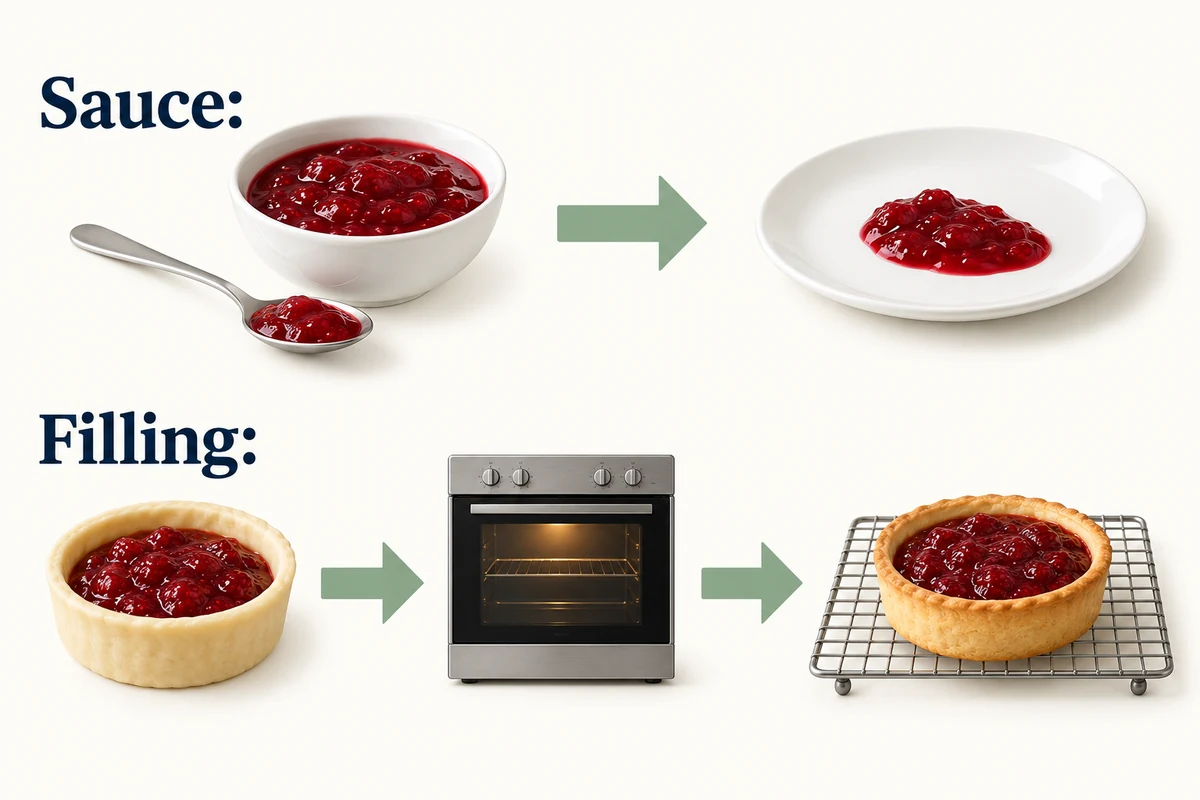
A sauce served from a bowl and a filling baked inside pastry face different process conditions.
Evaluate spread, leakage, edge contamination and the condition of the pastry around the filling. Then assess the cut face after the defined cooling stage. Fruit pieces can influence how evenly a small deposit is distributed, while a screened preparation changes the particle load. Do not assume that the smoother candidate will automatically retain its shape better during baking; that outcome requires the application trial.
| Observation | Serving sauce | Bakery filling |
|---|---|---|
| Flow or spread | Pouring, spooning or dispensing at service | Deposit shape before baking and movement during the intended process |
| Fruit texture | Whole pieces, skins and seeds in the portion | Particle distribution and bite in the filled product |
| Liquid separation | Visible separation after the service hold | Leakage or an unwanted wet layer at the pastry interface |
| Flavour balance | With the intended savoury or sweet dish | With the surrounding dough, cream or other filling components |
| Repeatability | Independent preparations and service checks | Independent batches and portions from different run positions |
Check more than one finished item. A leaking piece may reflect a sealing or depositing problem, so record where the filling was placed and how the item was assembled before blaming the berry. Compare items from equivalent positions or document the position as another variable. Keep photographs linked to the sample code and process record.
If the commercial product will be frozen, thawed or reheated after baking, include that actual sequence in the application evaluation. Do not infer its result from a freshly baked sample. The required food safety process and storage conditions remain separate from the visual and sensory acceptance points. Avoid extending a successful short trial into an unsupported shelf-life claim.
Record the limits of the substitution
A useful conclusion identifies the ingredient and the application in which it was acceptable. Record the berry identity, lot, form, preparation state and any skin or seed removal. Attach the recipe version, sugar and water additions, cooking endpoint, recovered mass and final assessment conditions. That gives the next developer enough information to reproduce the comparison.
Keep the original base trial beside the adjusted version. If the chosen cranberry recipe needs a different sugar addition or the lingonberry version uses a screened puree, state those changes explicitly. Do not describe the final result as an unchanged substitution when the formula or preparation has been redesigned. Both may be useful products, but the operational requirement is different.
Use the recovered quantity and the agreed deposit or serving mass to estimate the number of usable portions. Keep that calculation separate from the purchase weight of the berries. A candidate needing screening, a longer cooking stage or a larger serving amount can have a different ingredient requirement even when its price per kilogram appears comparable. Record actual labour and process observations if those factors affect the choice; do not estimate them from berry size alone.
Retain a reference sample or image at the same assessment stage where the working procedure allows it. Pair that reference with written observations. Colour, flow and particle appearance in a photograph depend on the sample and viewing conditions, so an image should support the record rather than replace the defined preparation and acceptance method.
Record what was not tested. A sauce approved for chilled service may not have been checked in a baked tart, and a filling approved in one deposit size may not have been checked in a larger pastry. Those limits make the result more usable: the team knows which changes require another trial instead of treating the species comparison as permission for every application.
Before routine use, align the ingredient description and finished-product information with the actual formulation and the applicable market requirements. Confirm any supplier preparation instructions and the required production controls. Identity, flavour approval and safe processing are connected decisions, but one cannot stand in for the others.
Frozen Lingonberries
Review our frozen lingonberry product form, specification and packing options for sauce and filling trials.
View Frozen Lingonberries →References
Research findings retain their original species, location, year and method scope. Application comparisons and quantities in this guide are illustrative; they are not preservation recipes or measured XMG product results.
- [1] US National Park Service: Wild Berries, Bering Land Bridge National Preserve↑
- [2] Finn and Mackey, 2006: Growth, Yield, and Fruit Quality of Ten Lingonberry Cultivars and Selections↑
- [3] USDA-ARS summary of Fong and colleagues, 2020: A Low Citric Acid Trait in Cranberry↑
- [4] University of Alaska Fairbanks: Lowbush Cranberries or Lingonberries, revised 2021↑
- [5] National Center for Home Food Preservation: Jellied Product Ingredients↑
