


On this page
The usable load for a frozen-food shipment is the amount that fits the container, stays within its equipment rating, and can travel legally and operationally through every agreed inland leg. A reefer’s maximum payload is only one of those checks. Road gross weight, axle distribution, chassis and tractor selection, rail restrictions, packing mass and usable loading space can produce a lower working limit.
Plan in packed-cargo weight before converting the result into net kilograms of food. Then have the responsible transport parties confirm the actual route and equipment. A ship booking or verified gross mass does not, by itself, authorize the same box to move on a particular road. The question to settle before ordering is: how much identified, packed product can this complete carriage arrangement accept?
We coordinate product, packing and shipment requirements for frozen fruits, vegetables and mushrooms. For a proposed full-container order, we would settle the weight basis and inland route before treating a target tonnage as firm. That prevents a quotation based on food weight from becoming a loading instruction that overlooks cartons, pallets or a constrained final delivery.
Keep food weight, packed cargo and vehicle weight separate
Start the load worksheet with definitions. Net food weight describes the ingredient purchased. Packed cargo includes the food and the packaging, pallets, securing and other materials carried inside the container. Packed-container gross mass adds container tare. A road combination also includes the relevant tractor, chassis and attached equipment. Each figure describes a different physical object, even when a booking screen calls several of them “gross.”

Corn portions show a frozen product form. Carton and pallet weights come from the confirmed packing record.
A corn order sold by net kilograms may arrive in bags inside cartons. If those cartons travel on pallets, pallet bases and unitizing materials use some of the available cargo allowance. Floor loading changes those materials and handling assumptions, but it does not remove carton mass. Keep the food quantity on the purchase order while calculating transport from the complete arrangement.
Ask each party to name its weight basis beside its figure. A warehouse receiving limit per pallet is neither a container payload nor a truck gross limit. A carrier’s rail allowance may use packed-container gross mass while an inland quotation uses cargo weight. Comparing those values without adjusting the basis can create an apparent margin that does not exist.
Use kilograms consistently in the internal worksheet, retaining the original units alongside any converted value. Where a document gives pounds, make the conversion explicit and preserve enough precision for the transport calculation. Rounding can be acceptable in an early estimate; the final evidence must use the precision and method accepted by the party making the decision.
Read the actual container plate before fixing the order
Confirm the equipment allocated to the booking. A description such as “40-foot high-cube reefer” identifies a broad type, not every dimension and mass characteristic of the box that arrives. Record its container number, maximum gross mass, tare and applicable payload information. Check the rating and current condition through the responsible equipment party rather than relying on a screenshot from another shipment.
Hapag-Lloyd’s reefer transport checklist [1] treats maximum container payload and the road limits along the route as separate controls. Apply that distinction to the allocated box: subtract its stated tare from its applicable maximum gross to identify the equipment payload basis, then compare the complete packed cargo with that basis. The result still needs the separate inland-route and axle assessment; it is not a net-food allowance.
Keep the equipment check separate from the order calculation. If the booked container changes, compare the replacement’s relevant limits and usable dimensions with the planned cargo. A substitute with sufficient weight capacity can still create a problem if the cartons, pallet height or loading arrangement no longer fit. The final plan should identify which details must be reconfirmed after substitution.
Avoid interpreting tare as a convenient standard deduction. Use the equipment-specific basis required for the calculation. If a document and the box markings disagree, return the issue to the carrier or equipment operator before loading. An unexplained difference should not be absorbed into a larger product allowance merely because it benefits the order quantity.
Check every inland leg, including the delivery road
Map the actual route from loading location to receiver. Include origin trucking, any rail movement, port handling, destination rail or trucking, border crossings and the road into the receiving site. A commercially attractive ocean route can become impractical when a heavily loaded container reaches a final road leg for which suitable equipment or authorization was never arranged.

The diagram scrolls horizontally on smaller screens.
Conceptual route comparison: an equipment rating and the complete inland route require separate checks.
Ask the contracted inland operator to confirm the packed cargo or container mass it will accept, its equipment assumptions, route restrictions and any necessary service arrangements. Record whether the confirmation applies to a named route and date or merely a general quotation. Keep the exact warehouse address in the brief: “delivery near the port” leaves too much room for an unreviewed final segment.
Maersk’s June 2026 Canada inland advisory [2] separates named truck, rail and cross-border movements. It also notes axle distribution for truck moves and the lower applicable limit at a rail interchange. This is a useful example of why a carrier matrix must be read with its route and mass basis; it is not a worldwide loading table.
When multiple operators handle the container, obtain a compatible answer for each interface. A rail provider’s acceptance does not settle the drayage move from terminal to warehouse. The shipment planner needs a workable path through all of them. If a heavier service is proposed, confirm availability, authority, price, equipment and any route conditions before increasing the order.
Include axle distribution and equipment selection
Total weight alone does not describe how a road vehicle carries the load. Carton placement, load centre, chassis configuration and the actual vehicle determine how mass is distributed. Ask the responsible haulier to review the proposed arrangement and confirm the relevant axle checks. We would not approve a loading pattern from a net-food figure alone.

The diagram scrolls horizontally on smaller screens.
Conceptual comparison with equal carton count. Actual axle loads require the responsible haulier’s assessment; neither arrangement is shown as legally approved.
As one jurisdiction-specific reference, 23 CFR 658.17 [3] addresses the US Interstate system and reasonable access. It specifies 80,000 lb gross, 20,000 lb single-axle and 34,000 lb tandem-axle limits, alongside the bridge formula and stated exceptions. These are vehicle controls, not permissible reefer food payloads. Other roads and circumstances need their own confirmation.
FHWA’s bridge-formula explanation [4] shows why axle spacing also matters. For a purchasing team, the practical action is to obtain the haulier’s equipment and route assessment, not to subtract an assumed empty-truck weight from one headline limit and announce a legal cargo allowance.
Equal packed-container mass can produce different transport outcomes if the vehicle or load distribution changes. A supplier may be able to change carton order or pallet layout, but any revised pattern must also preserve cargo support, securing and refrigeration requirements. Let the authorized operational parties resolve the combined plan. One improvement should not quietly defeat another control.
Build the packed-load calculation from the SKU list
Make one row for each product and packing configuration. Record units per carton, net food per unit, expected carton gross, carton count, pallet arrangement where used and the source of each figure. Mixed orders need separate rows because an average carton mass can conceal significant differences among fruit, vegetable and mushroom forms.

Different frozen product forms need their own packing and mass entries; appearance does not establish carton gross.
Broccoli pieces and corn portions illustrate this distinction. Their appearance does not tell you a carton gross or packing density. The offered pack specification supplies those inputs. If a packing sample is available, compare the measured and proposed figures and record the version used. A new liner, carton or pallet arrangement can change the transport calculation without changing the food’s net sale quantity.
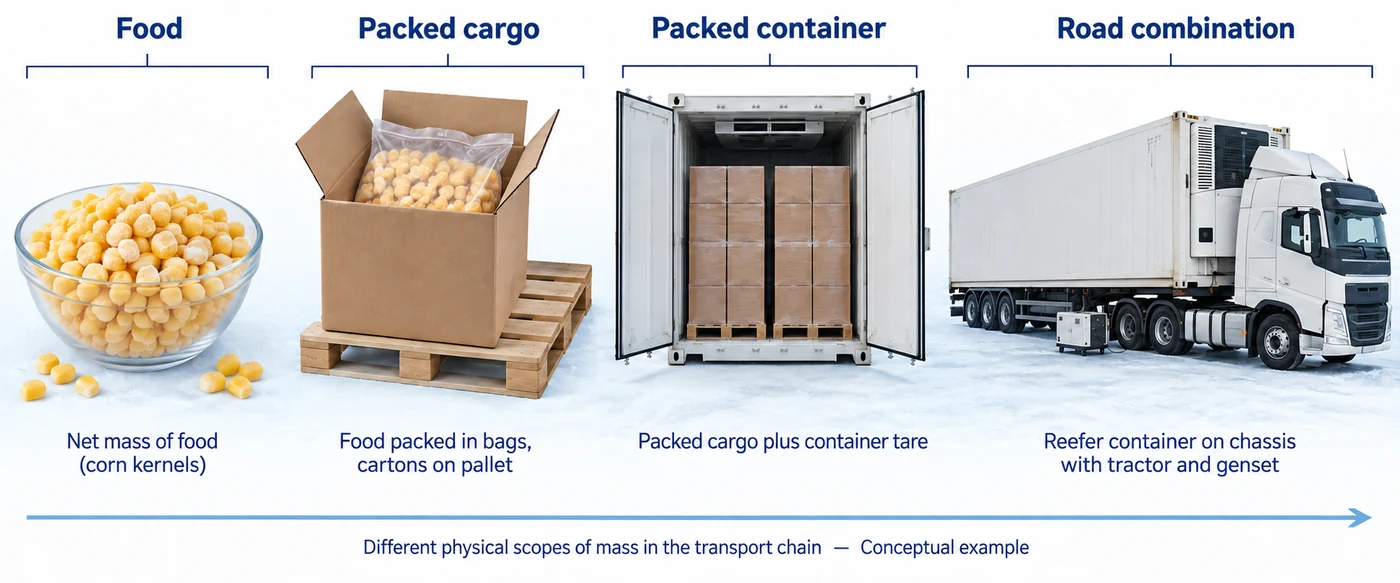
The diagram scrolls horizontally on smaller screens.
Conceptual mass scopes: net food, packed cargo, packed container and road combination describe different objects.
Calculate packed cargo from the rows, adding pallet and other loading materials once. Do not count pallet mass both within a supplier’s unit gross and again as a separate line. Equally, do not omit securing materials just because the product quotation did not mention them. State which values are estimates and which are confirmed so the final reviewer can see what remains open.
| Worksheet field | Question it answers | Evidence to retain |
|---|---|---|
| SKU and pack version | Which food and packing are being calculated? | Confirmed product and pack description |
| Net food and carton gross | How much product is bought, and how much cargo travels? | Weight basis and representative packing data |
| Pallets and other materials | What mass is outside the carton calculation? | Count, mass basis and loading arrangement |
| Equipment and route allowance | What accepts this packed load? | Equipment rating and responsible operators’ confirmation |
| Final count and verified mass | What was actually dispatched? | Loading count and applicable weighing record |
Test volume and the refrigeration air path
A mass calculation can pass while the proposed cartons fail the space check. Use external carton dimensions, the pallet footprint and overall loaded height where applicable. Account for the actual reefer’s loading envelope and air path. Nominal internal volume should not be treated as a bin that can be filled to every wall and ceiling.
The responsible loading party needs a practicable arrangement that respects equipment markings, product protection and carrier instructions. If the plan leaves unused floor or requires dunnage, include that arrangement in the review. Do not increase carton count by removing necessary clearances or placing cargo above the indicated load line.
We would compare the weight and geometry calculations before finalizing the quantity. A lighter, bulky order may be limited by usable space; a dense order may reach its confirmed mass allowance while leaving room. Both can be normal outcomes. The “full container” on a commercial brief should describe a workable load, not an instruction to maximize one dimension regardless of the others.
For the receiving-format decision, our guide to palletized and floor-loaded frozen food compares handling and receiving costs. Use that decision alongside the route-capacity calculation. A format that improves space use still needs an accepted unloading operation at destination.
Work through a labelled planning example
Consider a hypothetical single-SKU order with 2,000 cartons, each containing 10 kg net food. The proposed carton gross is 10.6 kg. The food purchase is therefore 20,000 kg, while those cartons total 21,200 kg. If pallets and other inside-container loading materials add 600 kg, the proposed packed cargo is 21,800 kg. These are illustrative inputs, not XMG packing specifications.
Suppose, solely for this example, that the inland operator confirms an allowance of 21,000 kg packed cargo for the stated route and equipment. The proposed plan exceeds that allowance by 800 kg, even though its net food weight is only 20,000 kg. The operator’s limit cannot be compared directly with the purchase-order quantity; the difference belongs to what physically travels.
One possible revision is 1,900 cartons on a recalculated arrangement requiring 580 kg of other materials. That gives 20,140 kg of cartons plus 580 kg, or 20,720 kg packed cargo, containing 19,000 kg net food. The arithmetic fits the hypothetical mass allowance. It does not establish axle compliance, physical fit, securing, equipment suitability or legal authorization. Those checks still belong to the actual transport and loading parties.
This example also shows why carton removal requires more than a subtraction. Removing product may change pallet count, floor coverage, lot allocation or receiver handling. Recalculate those fields and obtain the relevant confirmation again. A purchaser who needs the original net quantity could compare a different accepted service or shipment split, rather than asking the loading team to ignore the constraint.
For a mixed order, preserve each SKU’s net and gross figures instead of spreading the reduction proportionally across every product. Suppose a receiver needs complete retail assortments, while a manufacturing ingredient can move later. The useful revision may keep the assortment intact and move part of the ingredient line to another shipment. Check the commercial priorities with the buyer before deciding which cartons to remove; capacity arithmetic alone cannot select the right product mix.
Keep a short change record showing the original count, revised count, net quantity lost or deferred, packing change and operator reconfirmation. That gives procurement and the warehouse the same expected shipment. If the buyer still invoices or reserves the original quantity, a physically compliant revision can create a receiving discrepancy. Close the order, load worksheet and dispatch documents together after the revised arrangement is accepted.
Keep VGM and route approval as separate records
IMO’s VGM guidance [5] assigns the shipper responsibility for providing verified packed-container gross mass, and makes it a condition of loading onto a ship. Its described methods include weighing the packed container or calculating the components under the applicable approved method. VGM includes the container’s mass; it is not net food weight.
Keep the verified figure connected to the final container and actual cargo. Identify the method, responsible party, timing and transmission requirement agreed for the shipment. If the loaded count changes after an earlier estimate, the estimate should not remain the operational figure simply because it was already entered into a booking.
Route acceptance answers a different question: whether the specified equipment and movement can carry that load through the agreed path. Keep its confirmation beside the VGM record without presenting one as a substitute for the other. A correctly weighed container can still be unsuitable for an inland service that was booked on lighter assumptions.
Also distinguish a verified result from a planning allowance. The allowance sets the proposed load boundary; the final measurement describes the load actually made. Compare them on the correct basis and resolve any difference before the relevant dispatch or loading decision. Do not invent an enforcement tolerance to justify an exceedance.
Confirm responsibility before booking
Name the party arranging each transport segment, the party approving its load basis, the party executing loading and the shipper responsible for the required mass submission. Commercial delivery terms help allocate costs and obligations, but they do not replace the operational instruction. Put the actual carrier, forwarder or haulier contact into the shipment plan.
Set a revision trigger for changes that affect capacity: another product, pack version, pallet format, container, inland operator, port, delivery address or route. Reconfirm the relevant fields after a change. A brief approved for one arrangement should not silently follow a materially different shipment.
Before loading starts, the responsible parties should be able to identify the approved carton count, expected packed mass, equipment rating, usable arrangement and any remaining conditions. If an answer is missing, keep that part of the plan open. A clear unresolved field is more useful than a confident target tonnage with no accountable route approval.
At dispatch, reconcile the actual carton and pallet count with the approved version. Investigate differences rather than adjusting the worksheet to match a convenient number. A changed count can affect purchase quantity, the lot allocation, expected packed mass and receiving workload at the same time. Send the accepted final record to the parties using those fields, and retain the earlier estimate as a superseded planning record. This makes the next order easier to compare without turning the previous shipment into a universal capacity claim.
How we coordinate a workable frozen-food load
We match the product and packing brief to the proposed supply option, then coordinate loading and handoff requirements with the responsible facility and logistics parties. That helps connect the commercial quantity to the carton or pallet arrangement actually being considered. Our packing-options information is a starting point for defining the pack, rather than a universal weight allowance.
Through our cold-chain and loading coordination, we bring the buyer’s route, temperature and evidence requirements into the order discussion. The carrier or haulier confirms its own operational acceptance. We use those inputs to resolve supply and packing questions before a target quantity becomes the final loading brief.
Send your product and route brief
For frozen fruits, vegetables or mushrooms, send the product and pack, intended net quantity, destination address and proposed port or inland route. Include any carrier weight restriction already received, with its unit and mass basis. We will review the supply and packing brief and coordinate the outstanding loading questions with the relevant parties.
References
Sources retain their equipment, route and jurisdiction scope. Carrier guidance can change; confirm the booking-specific requirements for the movement being arranged.
