


On this page
At XMG Food, we help buyers coordinate the origin records and packing information needed for a bulk-to-repack programme. We connect product, partner-factory, lot and shipment questions so the destination repacker receives a clear starting file. The party performing the repack operation remains responsible for its approved process and output release.
A new bag with a readable code is only one part of the job. The record must also explain which original food went into it, what happened during handling, how much was produced and why the printed date is justified. This guide shows how to build that operational link for frozen fruit, vegetables and mushrooms.
Approve the repack operation before changing the pack
Describe what the destination facility intends to do. Splitting a bulk carton into smaller bags is different from blending several fruits, grading out defects, cutting again or adding ingredients. Each change affects the work order, product specification and records required. Start with the actual operation, rather than assuming that every activity can be approved as simple repacking.
Identify the responsible operator, site, quality approver and intended sale format. Confirm that the operation is allowed under the applicable local requirements and the facility’s approved food-safety arrangements. Set the product acceptance criteria, handling controls and evidence needed for release. The repacker should assess the relevant hazards and control measures for its own equipment and process.
We ask buyers to share the proposed output pack, destination, intended use and record needs early. This lets us coordinate the original bulk specification and available packing or lot information with the partner route. A request made after arrival may uncover a missing code field or packaging question when the repacker is already waiting to start.
Keep the commercial and technical approvals connected. The purchase order may buy one bulk SKU, while the repack programme produces several output SKUs. Identify that intended use in the buying brief where it affects supplied product characteristics or information needs. The origin specification should support the planned operation without implying that origin approval covers all destination activities.
Keep the original lot and create a linked output lot
The output code needs a permanent link to the original input lot. Preserve the supplier’s product name, original lot code, specification version, original production or packing dates supplied, applicable date limit, received quantity and shipment references. Record the destination receiving date and condition separately from the origin dates.
Then define an output lot suitable for the repack operation. It might correspond to a controlled run using one identified input lot, the same output material and the same operating conditions. Agree the rule in advance, including what starts a new output lot: an input change, line change, interruption, packaging change or other relevant process boundary.
Swipe to read the figure on a narrow screen.
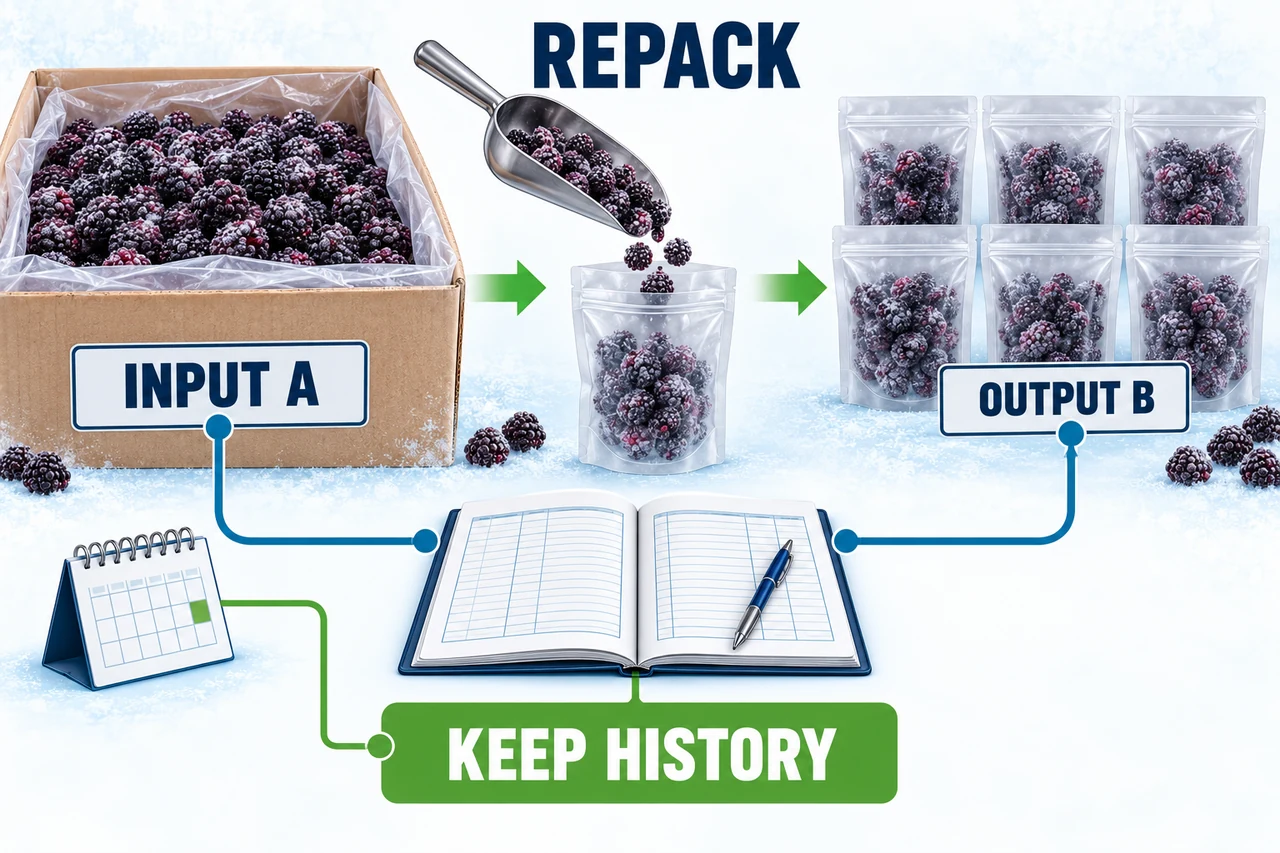
Conceptual repack illustration with fictional codes; retain original history in the output record.
Do not overwrite the input code with the new code in the stock system. Maintain both and a searchable relationship between them. A label showing output lot B should lead to the repack work order, input lot A and the origin records for A. The original code can remain in internal records even where it is not the code printed on the new consumer pack.
If one input lot becomes three output sizes, identify each output SKU and quantity. If several input lots contribute to one output run, record each contribution and assess whether that run definition is suitable. A broad code that merges unrelated stock can make a later incident much harder to isolate.
CFIA’s lot-code guidance [1] illustrates why a code needs to represent a defined set of production conditions. The exact applicable rule depends on the market and business activity. A date may form part of a lot code, but a date alone does not always distinguish all the food that needs to be traced.
Our traceability coordination starts with the product and codes visible on received packs. Tell us which fields your repack system needs so we can review the relevant origin-record request for the confirmed supply route.
Build a work order that the packing team can follow
The work order should describe the authorized input and expected output in operational terms. Include the input location and lot, allowed quantity, output product code, target fill, packaging material version, label version, new lot-code rule and date-coding instruction. Name the person who releases the input and the person who approves completed output.
Separate instructions from observations. The instruction says which material and code to use; the completed record shows what was actually used and printed. A planned quantity is not a production result. Leave fields for start and finish times, relevant handling checks, actual pack counts, material changes, interruptions, rejects and stock disposition.
| Work-order field | Why it matters during the run | Completion evidence |
|---|---|---|
| Input lot and quantity | Prevents unauthorized or unidentified stock entering the run | Issued quantity and actual input reference |
| Output pack and label version | Controls the approved pack being produced | Material identity and retained coded pack |
| Code and date instructions | Separates lot identity from the date basis | Legible examples of actual printing |
| Handling and inspection requirements | Makes the approved process executable | Recorded checks and deviations |
| Yield and disposition | Explains the destination of the input food | Packed, retained, held and loss quantities |
| Release authority | Prevents incomplete records from becoming saleable stock | Dated release or hold decision |
Make code examples unambiguous. Specify field order and how the operator distinguishes a production date, repack date and best-before or expiry date where these appear. Where a printed value comes from the original lot, identify the source record and transcription check. Where it comes from an approved calculation, retain that calculation.
Before starting, verify that old product and label material have been cleared from the relevant area and that the required input stock is correctly identified. The repacker should define its line-clearance checks within its own process. The records should show who checked the setup, not merely that a generic instruction existed in a folder.
Control frozen handling and packaging suitability
Opening bulk packs creates a handling stage that needs its own controls. The repacker should confirm the allowed exposure, product-condition checks, operating environment, transfer equipment and return-to-storage procedure. These limits need a product- and process-specific basis. A general claim that the room is cold does not establish that the handling plan is suitable.
Record what happens to the food during the run, including interruptions or abnormal exposure. Define who can decide whether affected material is usable, held for assessment or rejected. A later return to frozen storage does not erase the record of a handling deviation. Keep held quantities physically and electronically distinguishable from released output.
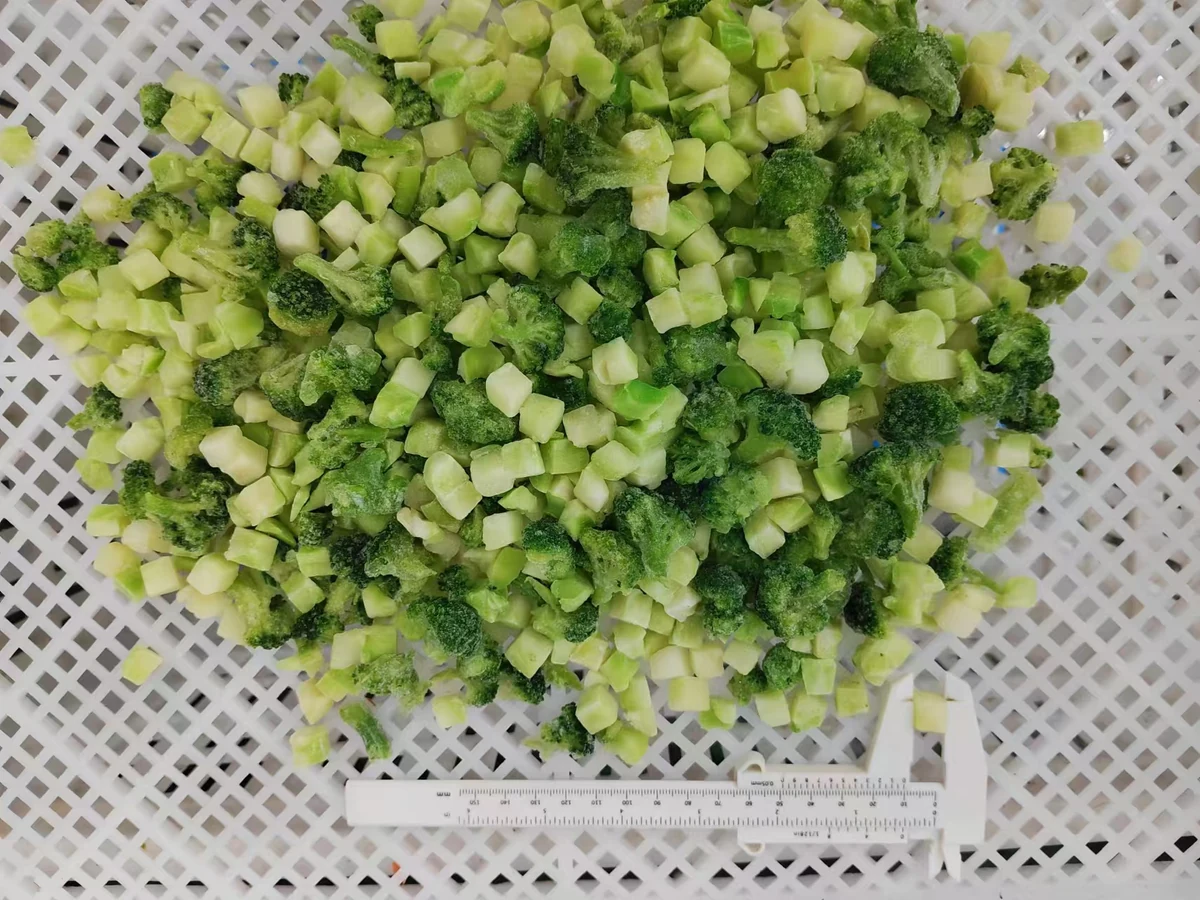
Visible product form only; the photograph does not validate handling conditions or a repacking process.
The new pack must be suitable for its intended food contact, frozen storage and handling conditions. Check fill dimensions, closure integrity, material compatibility and transport protection with the responsible packaging and quality parties. If the pack differs materially from the original, review whether the original shelf-life evidence remains applicable.
Also consider the characteristics needed for the buyer’s application. Whole berries, diced vegetables and mixed mushroom pieces may behave differently during filling and handling. Define the relevant acceptance checks instead of assuming that a smaller pack will preserve every original characteristic. The photograph here shows product form; it does not validate a handling temperature or packaging material.
We can coordinate the supplied product and original-pack information through our packing-options work. The destination repacker uses that input alongside its own process and packaging assessment. If your programme requires a particular bulk liner, code field or carton format, raise it before the order is confirmed.
Reconcile every kilogram and every output pack
Mass balance makes the record usable. Begin with the quantity actually issued to the run, then account for every destination of that food. Saleable packed output is one category. Retained food, held stock, rejected material and recorded loss need their own categories with clear units and disposition.
Here is a hypothetical example using food weight, excluding packaging. A repacker issues 1,000 kg of frozen produce. It produces 1,840 packs at an actual accounted fill of 0.5 kg each, giving 920 kg of packed food. It retains 35 kg for a defined retained-stock purpose, holds 30 kg for assessment and records 15 kg of loss. The total is 1,000 kg.
Swipe to read the figure on a narrow screen.
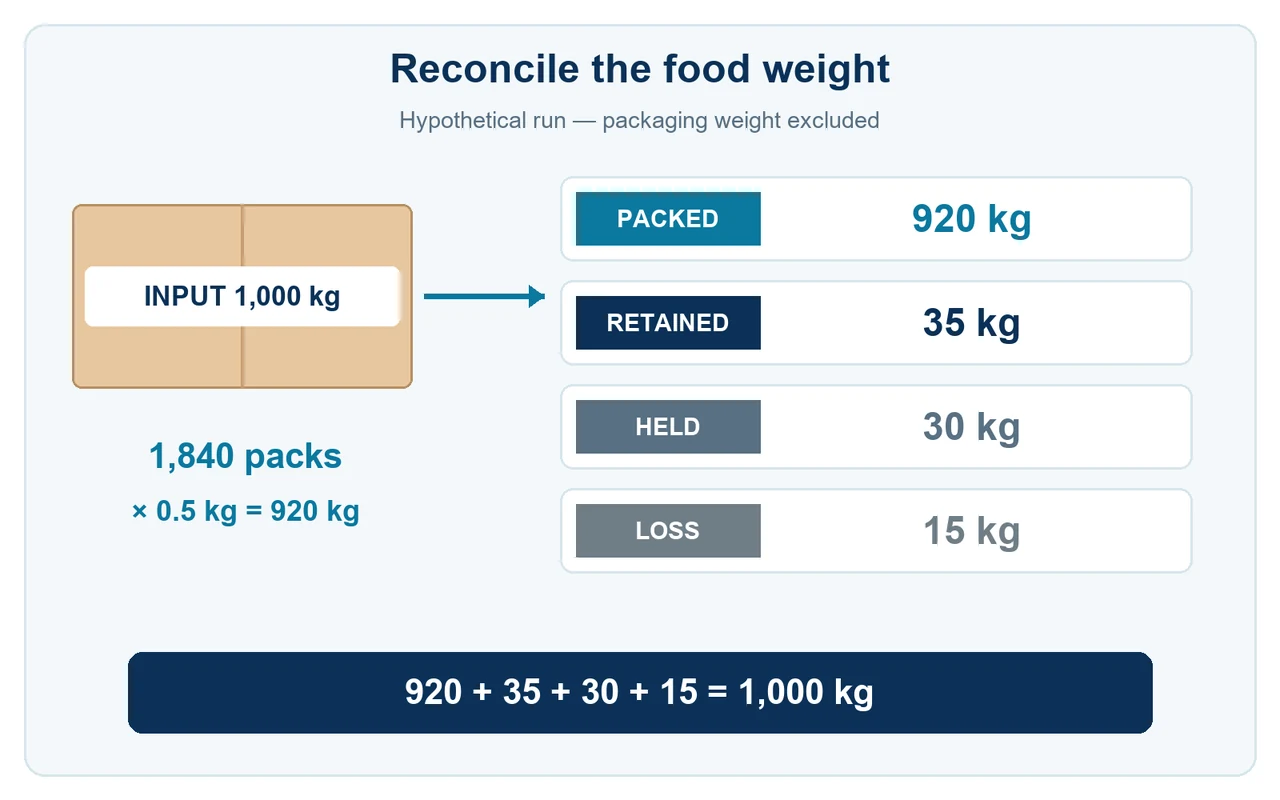
Hypothetical food-weight example: 1,840 packs at 0.5 kg account for 920 kg; every remaining quantity has a recorded destination.
| Food destination | Hypothetical quantity | Required record |
|---|---|---|
| Packed output | 920 kg | 1,840 packs × 0.5 kg, output SKU and lot |
| Retained stock or samples | 35 kg | Purpose, location, code and disposition |
| Held food | 30 kg | Hold reason, location and authorized next decision |
| Recorded loss | 15 kg | Loss category and handling/disposal record |
| Total input accounted for | 1,000 kg | Matches the quantity issued to this run |
These numbers teach the calculation; they are not an expected XMG yield or a universal loss allowance. In a real run, use the applicable weighing and filling records, including the treatment of overfill and measurement differences. Nominal pack count multiplied by target fill may not explain the actual weight issued.
Count packaging separately. Record pouches issued, usable packs produced, setup pieces, rejected packs and unused material returned. Packaging reconciliation helps identify a label or code error, while food-weight reconciliation explains the product quantity. One should not be used as a substitute for the other.
Set an investigation rule for unexplained differences. If the arithmetic does not close within the approved measurement basis, check weighing, stock issues, pack counts and disposition before release. Do not place the unexplained amount into “loss” solely to make the spreadsheet balance. The record needs to describe the operation that occurred.
Keep the shelf-life basis separate from the repack date
Repacking creates a new operation date, but the food retains its original production and storage history. Keep the original date information and the approved date limit accessible. The new label should follow the applicable market rules and a justified shelf-life basis for the actual output product and pack.
The key question is whether the original evidence remains suitable after the change. Opening the original pack, exposing the food, changing the barrier or closure, or changing the product through mixing or processing may affect that assessment. The responsible technical team should review the proposed operation and evidence before authorizing the output date.
Swipe to read the figure on a narrow screen.
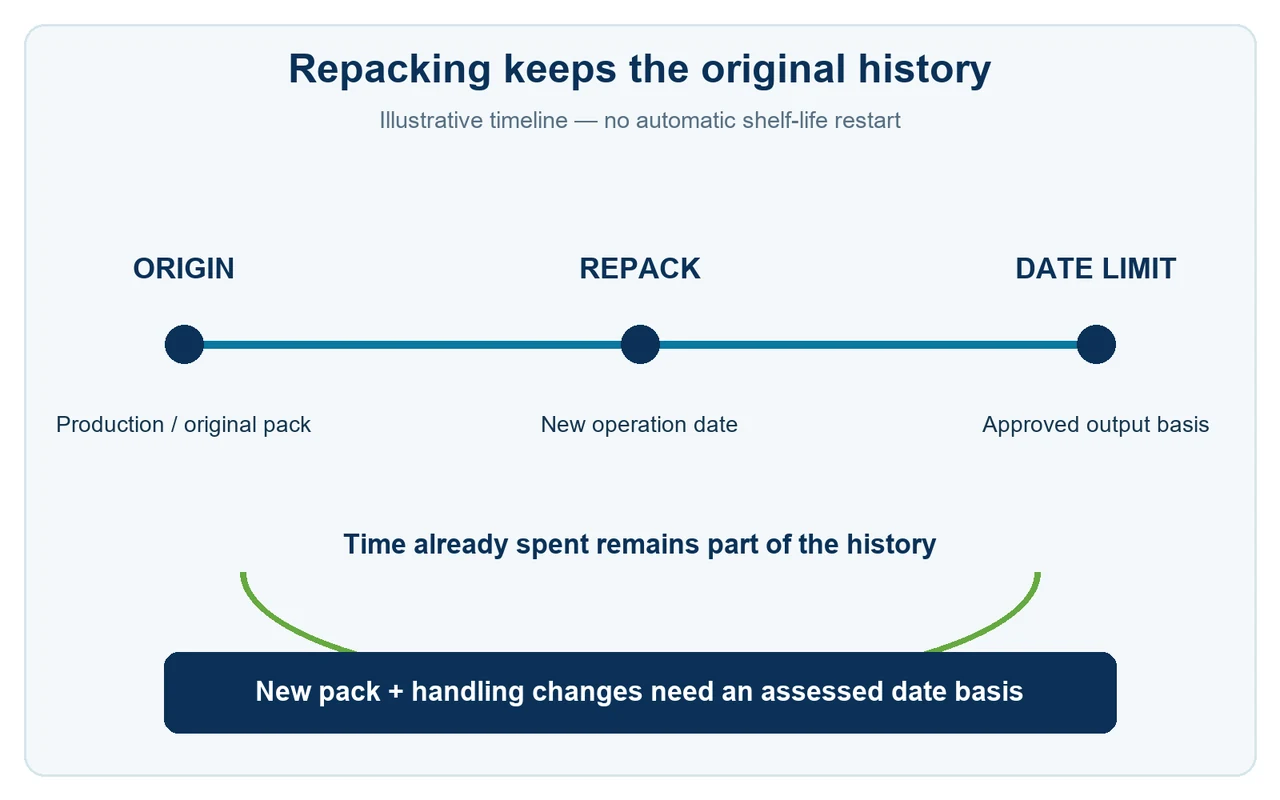
Illustrative timeline: repacking does not automatically restart shelf life; assess the new pack and handling conditions.
Do not automatically count a full original shelf-life period from the repack day. Even where the new pack is suitable, the time already spent in production, transport and storage remains part of the product’s history. A shorter authorized period may also be needed if the new conditions are more restrictive. A longer period requires an adequate basis, rather than a convenient printing instruction.
CFIA’s date-marking guidance [2] includes specific Canadian rules for foods repackaged by a retailer and the original packaging-date basis. Keep that retailer and jurisdiction scope clear; it is not a universal industrial-repacking rule. Confirm the rule relevant to your product, operation and sale format.
The release file should identify who approved the date, which evidence supports it and which assumptions must remain true. These could include the product formulation, handling controls, output material and storage conditions. If one of those changes, the date instruction may need reassessment before the next run. Keep any internal repack-date field clearly distinct from the market-required date printed on the finished pack.

Real frozen blackberries illustrate the input food; appearance does not support an extended date.
For a programme with several original lots, avoid treating the newest repack date as the age of all food inside. Retain the contribution of each input and the basis used for the output date. This becomes especially important when the programme mixes stock of different ages or histories.
Release the actual coded packs and linked records
The final check should look at completed output. Compare the actual pouch, label and printed code with the approved work order. Confirm product identity, legibility, closure and the applicable inspection results. Retain representative coded-pack evidence under the repacker’s defined procedure so the release record corresponds to what was produced.
Check the records in both directions. Starting with an output code, can the team find the work order, input lots, date basis and disposition? Starting with an input lot, can it identify all output lots and where each quantity went? This is an operational release check. The site’s separate mock-recall exercise can test wider retrieval and customer-contact performance.
If a field is missing, assign a specific correction or hold decision. A completed packing run is not necessarily released stock. Document the reason for any deviation acceptance and the person with authority to approve it. A commercial shipping deadline should not silently substitute for a technical release.
For markets with additional traceability requirements, check whether the food and operator fall within scope. FDA’s traceability-lot-code guidance [3] describes code assignment and transformation for covered foods and entities. Check the product form before applying that rule. FDA’s traceability FAQ [4] expressly excludes frozen fresh-cut fruit and vegetables from its Food Traceability List coverage. The operational lot links described here remain useful for a buyer’s own traceability programme. Your output coding and record system must meet the applicable requirements while preserving the input relationship.
Handle multiple inputs, holds and later corrections
If two input lots enter one repack run, record their quantities separately and establish the point at which the change occurred. Where exact separation is maintained, that information can help narrow affected output. Where materials are deliberately mixed, the output record must honestly show the combined input scope. Do not create a neat one-to-one code relationship that the operation did not preserve.
Held material needs a subsequent decision record. If it is later released, returned to another approved operation or disposed of, update its status and retain the original hold reason. Food that re-enters a later run needs its own input link, so it does not disappear between two mass-balance worksheets.
Correct records through a controlled revision. Preserve the original value, correction, reason and approver where the system allows. A corrected label or code may also require reconciliation of affected packs and notification to the relevant receiving party. If a safety or compliance issue arises, follow the applicable incident procedure rather than treating it as routine paperwork.
The UK food-incident guidance [5] illustrates the importance of identifying affected products and business customers promptly. The supplier/customer record principle also appears in the GB version of Article 18 [6]. The destination team should apply the requirements for its own market and activity; the origin traceability file is useful input to that response.
How we support the origin record and packing handoff
We coordinate the product, original lot, partner-facility and shipment information relevant to the confirmed supply route. If your destination repacker needs a particular code format, source-document reference or original-pack detail, we can review that requirement before the order is finalized. This helps your team build the input side of its work order with fewer unresolved fields.
We also review the supplied bulk-pack needs with the proposed partner route and coordinate the agreed origin inspection and document questions. We distinguish records available for the actual order from information that still needs confirmation. Our professional contribution is a clear handoff between the supplied food and the buyer’s repack programme, with product and lot identity kept visible.
The destination operation, handling validation, finished-pack date assessment and output release belong to the responsible repacker and market operator. We support those decisions with applicable origin information and coordinated questions. That division gives each team a defined task and a clearer route for resolving missing evidence.
Send us your bulk-to-repack requirements
Send the product and form, proposed original bulk pack, destination, output pack, quantity and timing. Include the input code fields, date information and supporting documents your repacker needs. Tell us who will perform the operation and whether the product will be split, blended or further processed.
We will review the applicable supply and packing options, coordinate the relevant origin-record questions and reply with confirmed information and open requirements. An early review helps the receiving team prepare its own work order and approval file before the bulk shipment arrives.
