


On this page
Test a resealable frozen-produce pouch after its original seal has been opened, using the intended frozen product and fill. Check whether a user can open it cleanly, remove a portion, keep product out of the zipper, close the full track and return the partly used pouch to the freezer. Repeat the intended use pattern and record what changes.
A zipper that closes on an empty sample is only an initial observation. The product can change the trial: large pieces need access, small fragments can reach the closure, and the remaining fill changes how the pouch is held. Film-barrier evidence and an intact production seal also answer different questions from this repeat-use check.
For products we supply, we can coordinate the proposed product, partner packing route, unit fill and sample brief before artwork is finalized. Tell us how the pouch will be opened and portioned; the filled-pack trial can then be tied to the correct product and pack revision.
A zipper must work with the opened frozen product
Define the use case before comparing zipper names. Is the pouch a small retail pack that may be emptied at once, or a larger pack opened repeatedly for portions? Will the user pour from the bag, reach in with a utensil or transfer all the contents into another container? These choices change the access, handling and reclosure questions worth testing.
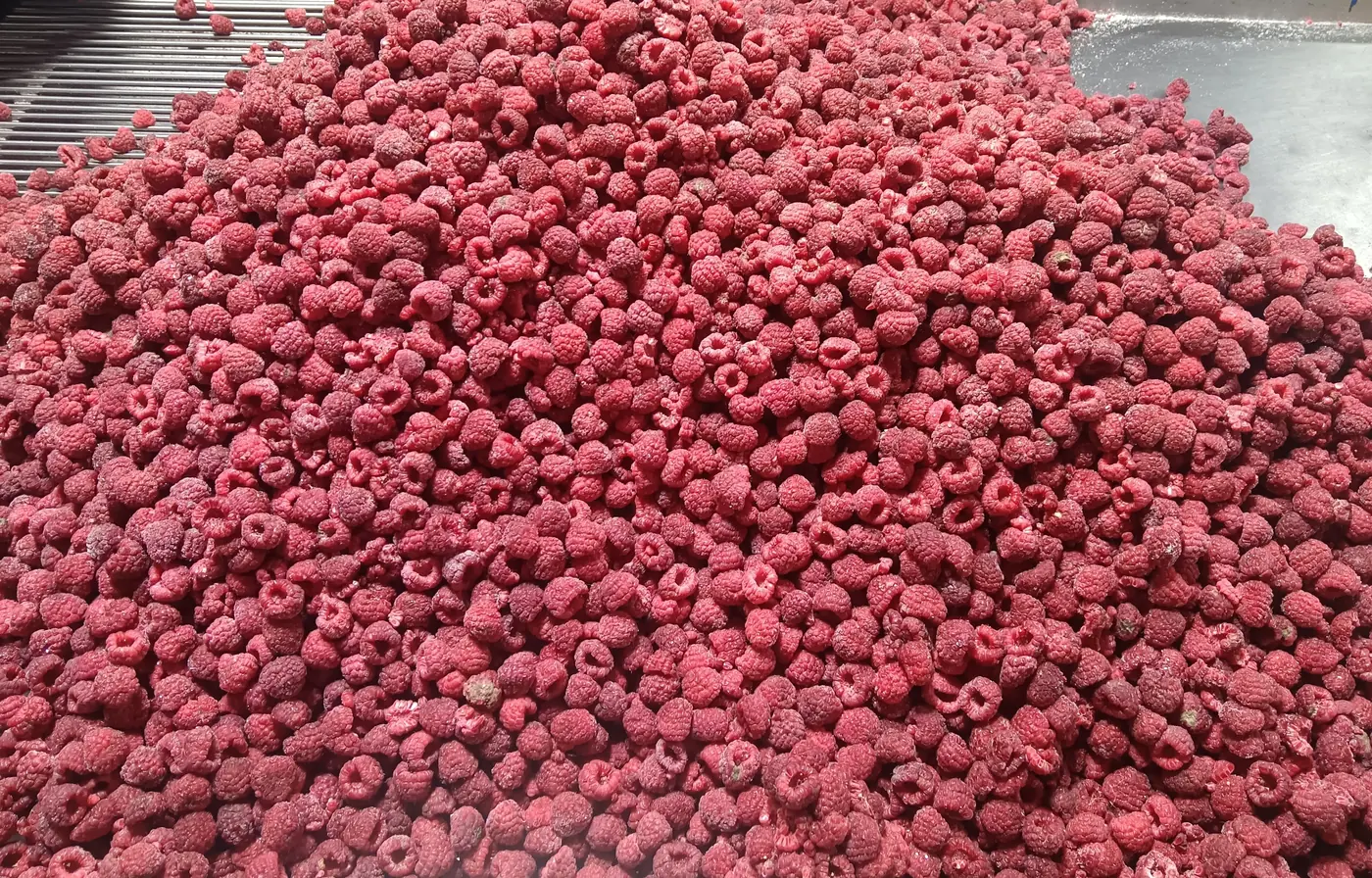
Whole frozen raspberry bodies are visible. The identified sample and written specification define the product offered.
The product form deserves the same attention. Whole berries, long vegetable pieces, irregular florets and fine fruit fragments interact differently with a bag mouth. A pouch that accommodates one product may need a different opening or footprint for another. Use the declared frozen form rather than a convenient substitute that pours more easily.
Start with the target net fill and the proposed dimensions. Then include a partly used condition, because the same bag is held differently when less product remains. Record whether the user can see and reach the zipper and whether folding or gripping the bag interferes with closure. These are observations about the physical pack, not assumptions based on a drawing.
A supplier’s closure feature can be worth considering, but it should become a trial question. Emmerson’s closure range [1], for example, distinguishes front-panel and bag-top access. That makes opening location a visible design choice. It does not establish that a particular option will work for your filled frozen product.
We would resolve product form, fill, access and the proposed packing route before treating a resealable design as ready for print. An attractive artwork file can hide a small or awkward opening. A physical sample makes that issue easier to identify while changes are still manageable.
Separate the first seal from the later reclosure
The unopened pack has an original seal made during packing. The consumer later opens that barrier and uses the zipper to close the remaining contents. Write these as separate approval questions. A good first seal does not prove easy reclosure; a zipper that feels secure does not prove the original production seal was sound.
Keep material barrier in a third field. It concerns the package material under its relevant assessment conditions. After-opening use also involves the opening, user action, remaining product and time outside the freezer. A material report cannot answer all of those questions on its own.
Our guide to moisture barrier and seal integrity addresses the film and sealed-pack comparison. Here, the focus is the partly used pouch. The records should complement each other: identify the material and initial seal evidence, then add the actual opened-pack usability findings.
A reclosed zipper should not be described as restoring the unopened heat seal unless appropriate evidence supports that specific claim. Likewise, “resealable” should not become an unsupported promise about storage life after opening. If an after-opening storage statement is proposed for the label, the responsible product and packaging teams need the relevant validation and market review.
Record the purpose of each sample. An empty pouch can help review artwork, dimensions and closure location. A filled frozen sample can support access, dispensing and reclosure observations. A laboratory test or a controlled storage study may answer another specified question. Keep each approval within the scope of the evidence collected.
Define a trial that follows real use
Begin with a short written trial brief. Identify product and form, sample pack construction, closure design, dimensions, target fill, sample revision and the intended opening pattern. State the handling and frozen-storage conditions that your team will use. If the sample differs from the proposed production material or packing line, list that difference before the trial starts.
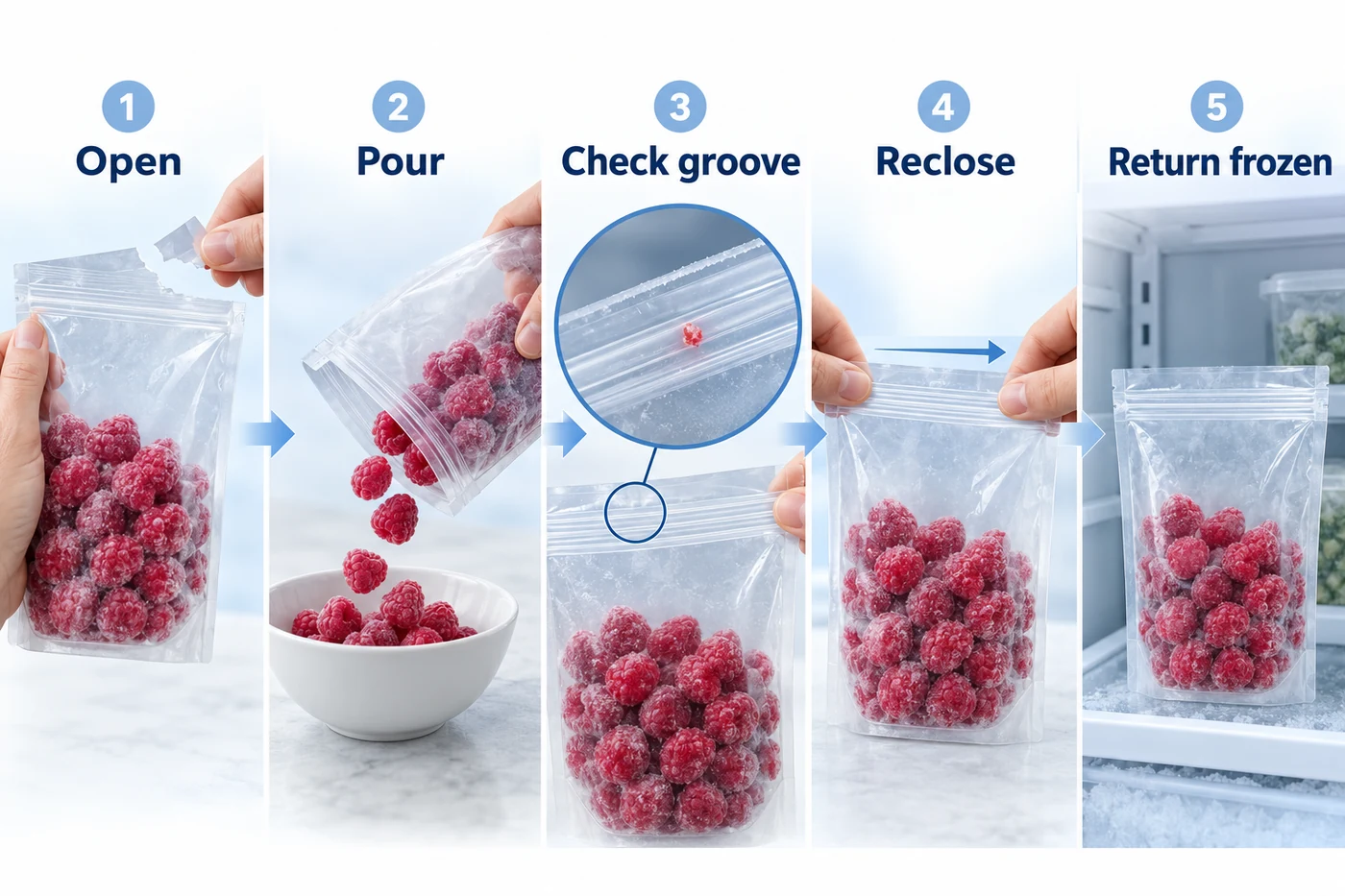
A proposed repeat-use sequence follows the actual filled pouch after opening. Define the intended conditions and acceptance fields for the trial.
Use a sequence that represents the intended user: remove the pack from frozen storage, find the opening feature, open it, dispense the planned portion, inspect the mouth and closure, reclose the pouch and return it to the intended storage condition. Document any instructions the operator was given. An unaided first attempt can reveal a different usability question from a carefully coached attempt.
There is no universal number of opening cycles that validates every frozen-produce pouch. Choose a cycle plan that reflects the product, pack size and intended use, then agree it with the responsible packaging team. Include the endpoints you need to observe rather than adding repeated cycles without a purpose.
Define acceptance before seeing the results. A buyer might require opening without damage below the intended tear path, usable access to the contents, complete track engagement after the specified closure action, and no observed product escape during an agreed handling check. Those are examples of fields to define, not universal limits or a substitute for a relevant test method.
Keep the test conditions comparable between options. Use the same product form and intended fill, the same handling sequence and the same observation method when the question is closure design. If both product and bag geometry change at once, the comparison may still be useful, but it concerns the whole pack combination rather than the zipper alone.
Record deviations as well as failures. If an operator clears the groove, folds the bag differently or uses a second closure attempt, keep that action in the record. A successful outcome achieved only after extra attention can still identify an instruction or design issue. Do not replace the first observation with the final successful photograph.
Observe the zipper with product at the opening
Look at where the product travels when the pouch is opened and tilted. Does it collect near the track? Do small fragments remain around the mouth? Can the operator see the full closure area, or is part of it hidden by a fold or the way the pouch is gripped? Record the location of the issue, not simply “zipper difficult.”
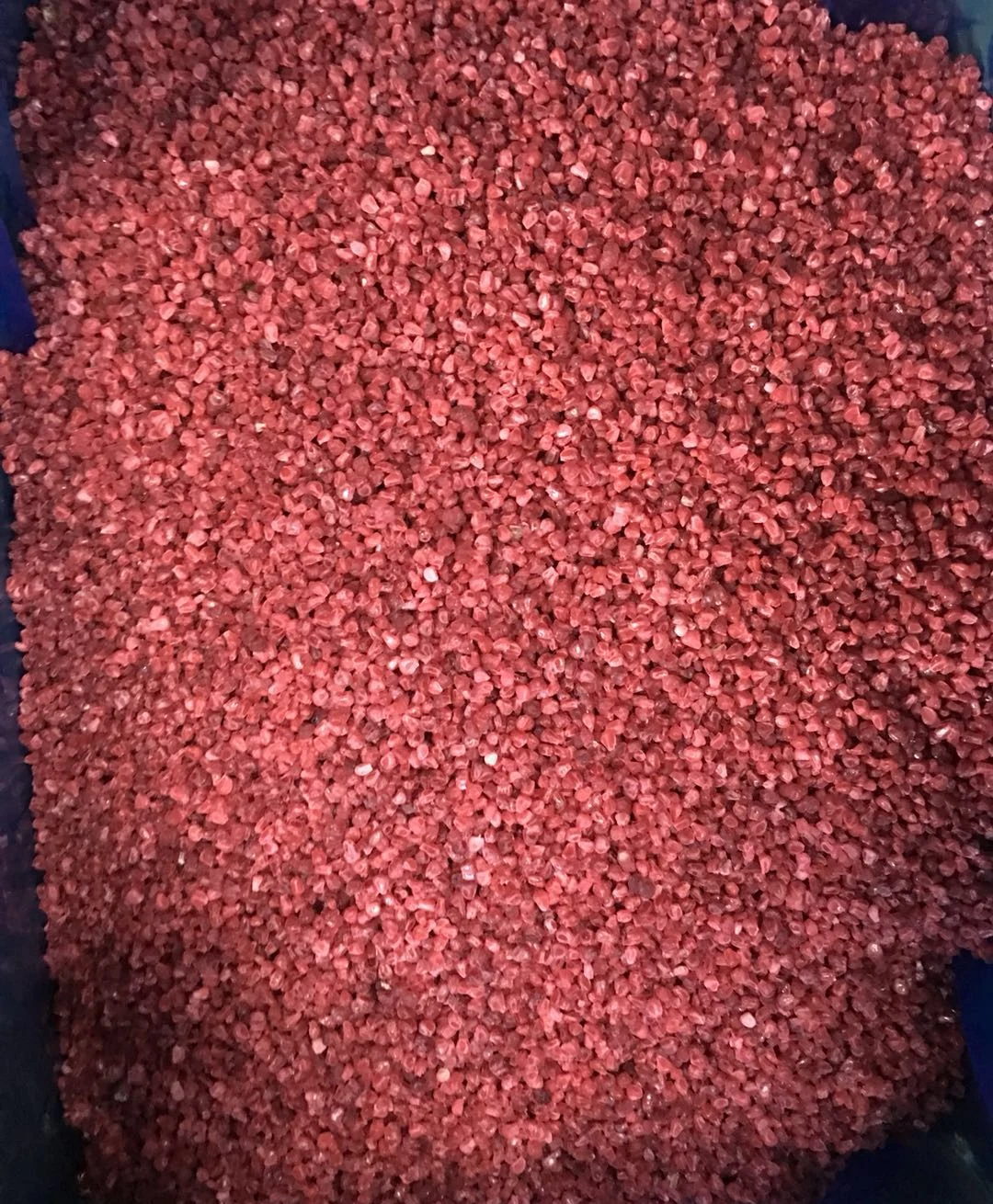
Raspberry crumble shows a different fruit form from whole berries. Choose the form around the intended application.
Fine product is a useful reason to test the actual contents. Fresh-Lock describes particle-resistant closure designs [2] for granular products. Such supplier information can help identify a candidate feature. It does not validate a particular frozen raspberry crumble, corn or mixed-vegetable pack under your intended handling.
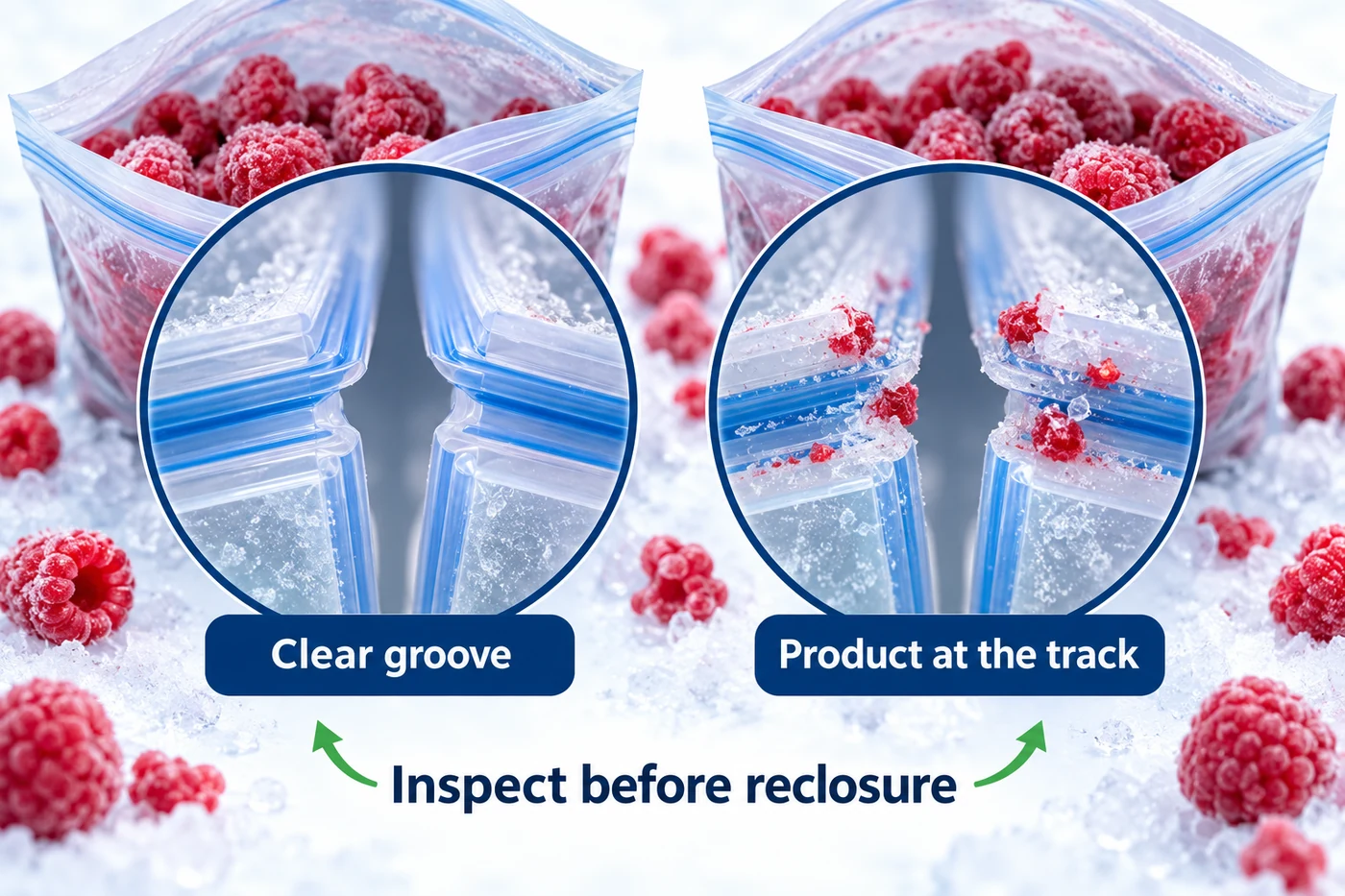
Both zipper tracks are open for inspection. Check where product remains before closing the full track; the illustration is not a leak-test result.
A visual closure check should follow the full track. Inspect the ends as well as the middle, and note whether a particle, crease or bag deformation prevents local engagement. A schematic zipper cross section can explain where to look, but the actual closure profile and test procedure belong to the selected material and packing route.
Some closure designs provide audible or tactile feedback. Fresh-Lock’s Multiplex product description [3] is one manufacturer example. Feedback may help a user recognize the closing action. Your trial should still establish what full closure means and whether the observed feedback corresponds to that condition on the filled sample.
If the trial uses a groove-clearing step, record how it is performed and whether that step is realistic for the intended user. Avoid creating a fragile approval in which the bag works only after a procedure absent from the label or expected use. Equally, do not treat a deliberately contaminated demonstration as proof of routine consumer failure.
Separate a handling observation from a leak conclusion. A visible unengaged section identifies a concern to investigate. A closed appearance alone does not establish a particular leak rate or barrier performance. Where those properties matter to approval, use the relevant specialist assessment rather than attaching a laboratory claim to a simple bench observation.
Check dispensing and return to the freezer
Opening and closing are only part of the task. The user needs to remove the product without damaging the pack, losing control of the portion or placing food into an inaccessible part of the mouth. Observe whether the intended fruit or vegetable form can pass through the available opening at the relevant fill levels.
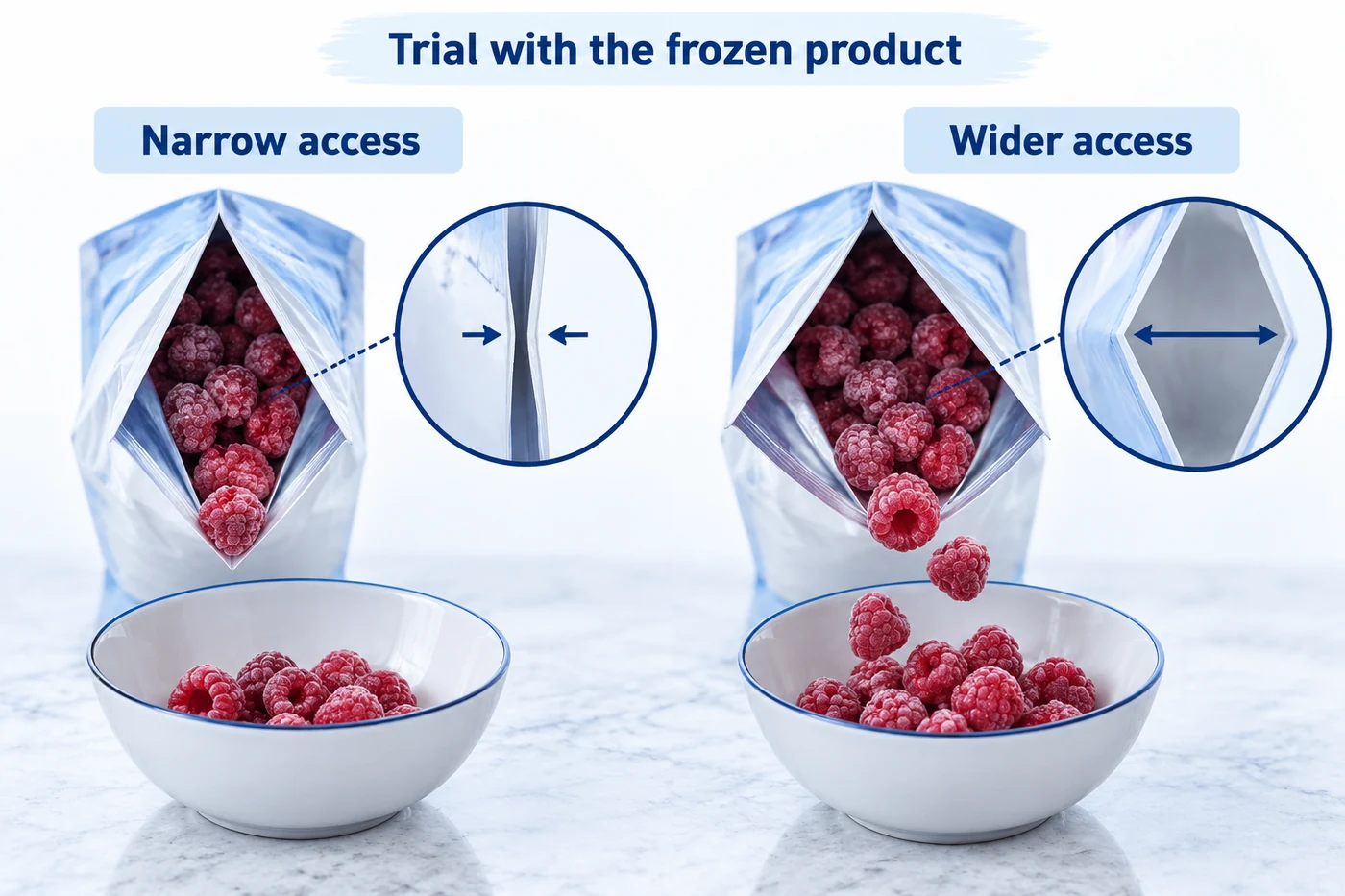
Conceptual opening alternatives show an access variable to test with the intended product. The image does not predict a flow rate or choose a winner.
Compare access geometry with the product’s actual dimensions and handling behavior. A wider mouth may provide more access, but it is not automatically the best overall solution. It can affect how the bag is held, the closure position and the packing configuration. Decide which option works as a complete filled pack.
Check the area above and below the zipper after the first tear. Enough usable material must remain for the intended grip and closing action. Record any tearing beyond the intended path, damage to the closure area or difficulty distinguishing the tear feature from the zipper. The specific design and its instructions should be reviewed together.
After removing a portion, observe how the partly filled pouch stands, folds or lies in the proposed storage arrangement. Note whether its shape makes the zipper easy to reach and whether ordinary handling reopens a section that appeared closed. Use an agreed handling check; do not call an improvised squeeze or inversion a standardized seal test.
Frozen handling should be described rather than guessed. Record when the pouch is removed, the condition during use and when it is returned. If the product has partly thawed during an intended or abnormal scenario, identify that scenario separately. A packaging trial does not decide whether food has remained safe or whether a thawed product should be refrozen.
If the programme requires assessment of frost, drying, appearance or quality during repeated use, define a suitable storage study with the responsible team. Keep those observations separate from initial usability screening. A short opening trial can reveal a practical problem; it cannot establish the complete life of the opened product.
Compare the findings before changing the pouch
Build a comparison around observations and decisions. Keep sample identity beside every result, including the material or closure revision. Without that link, a later change to the zipper, film, dimensions or filling process can leave the team approving a pack that was never actually evaluated.
| Trial field | Record | Possible follow-up |
|---|---|---|
| First opening | Ease of locating the feature; tear path; damage near the closure | Review opening feature, clearance or user instruction. |
| Portion removal | Product form, remaining fill, access and dispensing observations | Review mouth geometry and product-to-pack fit. |
| Product at the track | Type, location and persistence of particles near the groove | Compare a suitable closure design or handling instruction. |
| Reclosure | Full-track engagement, attempts and observed exceptions | Investigate profile, access, deformation or contamination. |
| Return handling | Partly filled bag condition under the agreed handling sequence | Confirm whether the issue needs another physical or specialist test. |
| Decision | Accepted fields, unresolved fields and current sample revision | Carry the approved scope into the production reference. |
Consider a fictional comparison between two pouches for the same frozen berry product. One opens easily but leaves product close to the track; another keeps the track easier to access but makes pouring less controlled. Rather than pick a zipper from those first impressions, record the trade-off and decide whether mouth geometry, closure position or dispensing action needs the next test.
Change one relevant variable where practical. If the concern is mouth access, trial a geometry revision while retaining the product and other defined conditions. If the concern is the closure profile, distinguish that revision from a simultaneous film or fill change. Document what changed so that the next result answers a clear question.
Check feasibility before approving the revised concept. Closure position, pre-applied zipper route, material, filling and sealing need to work with the proposed facility. Suppliers such as Antilia describe configurable pouch and zipper dimensions [4]; those choices remain a starting point for a specific pack proposal, not proof of compatibility with every frozen-food line.
The final record should say what has been approved and what remains open. For example, artwork appearance may be accepted while filled-product reclosure is still under review. That separation helps prevent a commercial deadline from turning a partial approval into full product-and-pack acceptance.
When the material, closure source, bag dimensions, product form or production route changes, review whether the earlier trial still applies. A familiar-looking pouch can conceal a meaningful physical change. Keep the revision and approval trail with the order so the same requirement can be checked again at replenishment.
Locate the first condition that changes the result
If a pouch recloses easily before dispensing but becomes difficult afterward, compare the mouth and track before changing the whole structure. Record where product accumulated, how the operator held the bag and whether the track was distorted. A photograph taken at the moment of the problem can be more useful than a final image of the pack after it has been cleaned and closed.
If the issue appears only at a low remaining fill, repeat that condition deliberately under the same defined handling sequence. The bag may be gripped or folded differently when it is nearly empty. If the issue appears at the first opening, focus on the tear path, access and closure placement. Those observations give the packaging team a specific design question to investigate.
A simple exception log can contain sample revision, use stage, remaining-fill condition, observed issue, action taken and final outcome. Include successful observations as well, so the team can distinguish an isolated handling event from a repeatable concern. Keep the language factual: “left end remained unengaged after first attempt” gives more direction than “poor quality.”
Assign the next decision to the party that can make it. The packing facility may need to confirm construction or line feasibility; the packaging specialist may need another test; the buyer may need to approve an instruction or revised geometry. Record the owner and the open question beside the sample revision so the next trial has a defined purpose.
How we coordinate a filled-product pack review
We coordinate retail and private-label packing for frozen products supplied through XMG Food. Our packing-options workflow brings product form, unit fill, material direction, pack dimensions, coding and outer-carton configuration into one review with the proposed partner facility.
For a resealable pouch enquiry, we can clarify the available packing route and the questions the physical sample should answer. That helps your team test the relevant product-and-pouch combination before final artwork and commercial confirmation. We supply the frozen product programme; empty packaging is not a separate XMG product.
We also coordinate sample identity, specification revision, buyer comments and approval scope. If a pack change is proposed after the trial, we keep that change visible for review. The practical benefit is a repeatable order reference tied to the pack your team actually assessed.
Send your product and pouch brief
Send the frozen product and form, target unit fill, preferred pouch or zipper reference, intended opening pattern and the issue you want to test. Add quantity and destination. We will review the product-to-pack requirement and coordinate suitable packing options and sample approval steps.
