


On this page
A plain frozen fruit or vegetable may be naturally free of gluten, but a gluten-free pack claim needs evidence for the complete product and its supply route. Brands should confirm the destination market, full ingredients, possible cross-contact, relevant controls and the exact wording before approving artwork. A photograph of clean-looking produce or a general factory certificate cannot settle those questions.
We would treat the claim as a specific product decision. Plain sweetcorn, seasoned sweetcorn and a vegetable mix containing a sauce are separate briefs. Evidence for one does not automatically cover the others. The practical aim is to connect the label promise to an identified SKU, production source, current specification and continuing controls.
A plain ingredient is the starting point for a claim
Begin with a precise product identity: the fruit or vegetable, its form, all ingredients, proposed production source and pack. A single-ingredient product makes the ingredient review simpler, but it does not remove the need to understand the production and packing route. The buyer still needs a clear answer to how the proposed claim will be supported.
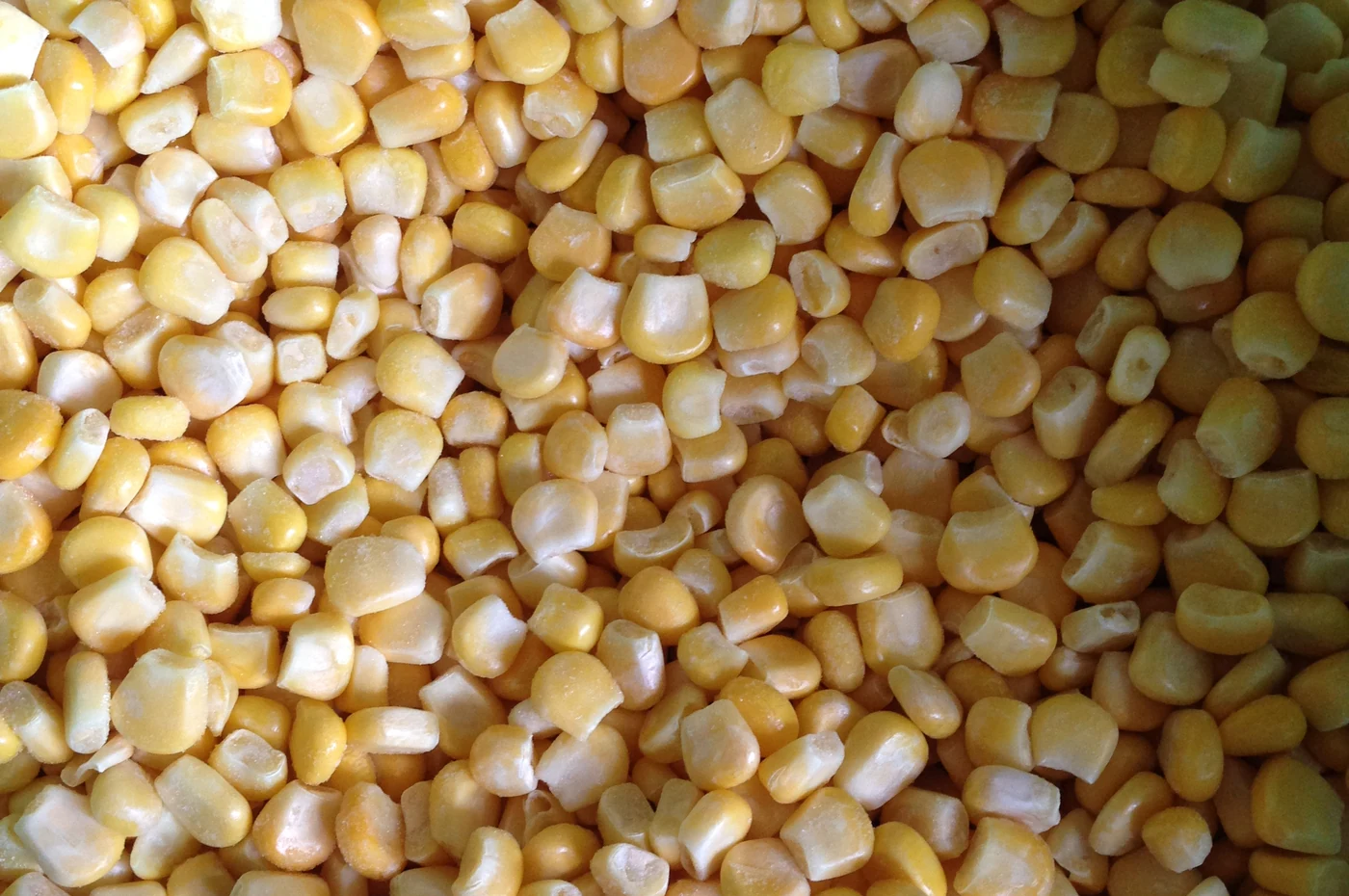
Plain sweetcorn form is visible. Ingredient completeness and gluten-free claim eligibility require product-specific evidence.
Consider a hypothetical retail bag of plain frozen sweetcorn kernels. The specification might identify sweetcorn as the only ingredient. That is useful information, but it is not a description of what shares the line, how utensils are controlled or which artwork has been reviewed. Those questions belong to the same approval file rather than being treated as unrelated procurement details.
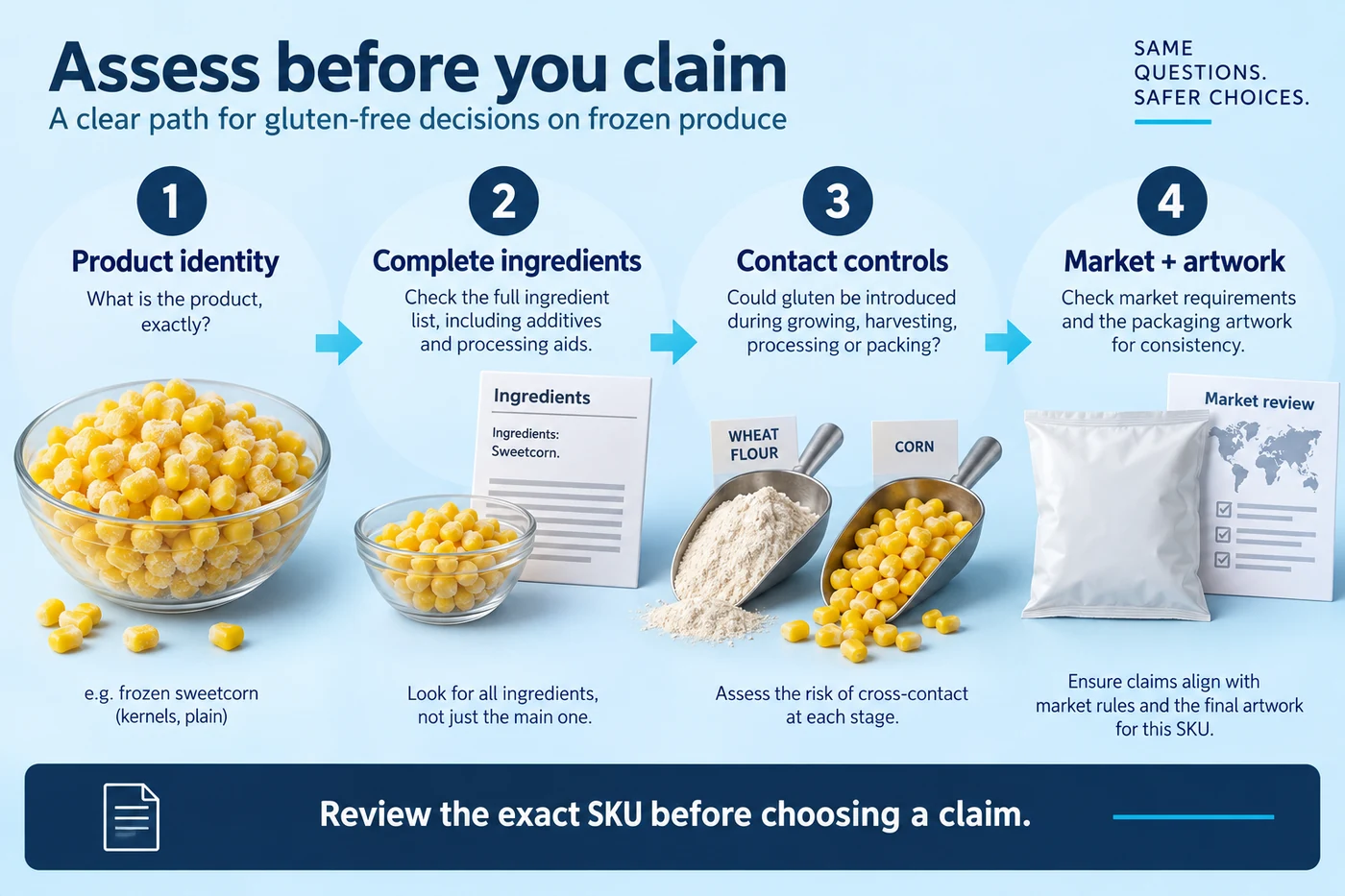
The diagram scrolls horizontally on smaller screens.
Conceptual decision path: identify the SKU, review complete ingredients and contact controls, then assess market wording and artwork.
At the enquiry stage, distinguish an ingredient statement from a finished claim. “No gluten-containing ingredients are intentionally added” describes a narrower position than a gluten-free promise on the final pack. Ask which statement is being offered and what evidence supports it. A buyer can then request the missing information without turning a general supplier answer into a stronger claim.
Keep the product code visible in that exchange. If a supplier handles several cuts, recipes or packing sources under one product family, a broad answer about “our frozen vegetables” can hide an important difference. The approval should identify the exact option that will be packed under the brand, along with the specification version to which the response applies.
Name the market before writing the pack wording
Requirements are jurisdiction-specific. For FDA-regulated packaged foods in the United States, the FDA gluten-free labeling Q&A [1] explains the voluntary claim’s ingredient restrictions and the requirement that unavoidable gluten be below 20 ppm. A product cannot intentionally include ordinary wheat flour and qualify merely because a finished result is below that level.
For EU foods within its scope, Regulation (EU) No 828/2014 [2] permits “gluten-free” where the food as sold to the final consumer contains no more than 20 mg/kg of gluten. The European Commission’s gluten-free overview [3] identifies the regulatory framework. Preserve that wording in the legal review. The US “less than” and EU “no more than” conditions should not be silently rewritten as one worldwide threshold.
| Brief field | What the brand should record | Why it matters |
|---|---|---|
| Destination | Named market and relevant product jurisdiction. | Defines which claim requirements apply. |
| Proposed wording | Exact phrase and all associated pack statements. | A summary in an email may differ from artwork. |
| Product identity | SKU, complete recipe, source and specification revision. | Prevents evidence being reused outside its scope. |
| Evidence decision | Controls and documents reviewed, outstanding questions and approval owner. | Shows why the claim was accepted. |
| Changes | Which ingredient, source, line or artwork changes need review. | Keeps the decision connected to continuing supply. |
Use this table to organize the brief, not to replace the brand’s destination-market label assessment. If one pack will serve more than one market, review each intended destination and the complete wording. A phrase translated from an existing pack may carry a different implication or conflict with other statements on the new artwork.
Keep customer requirements in a separate field from legal requirements. A retailer or a private certification programme may ask for additional evidence or a tighter commercial specification. That condition belongs in the agreement, but it should be described as that customer’s or programme’s requirement rather than as the general law for all frozen produce.
Check the complete SKU rather than the headline vegetable
Review every component of the finished SKU. Plain broccoli florets and broccoli with a seasoning sachet are different products. A vegetable medley may contain a sauce, coating or flavor preparation that does not appear in the product’s short sales name. Ask for enough ingredient detail to assess the actual recipe and the role of each component.
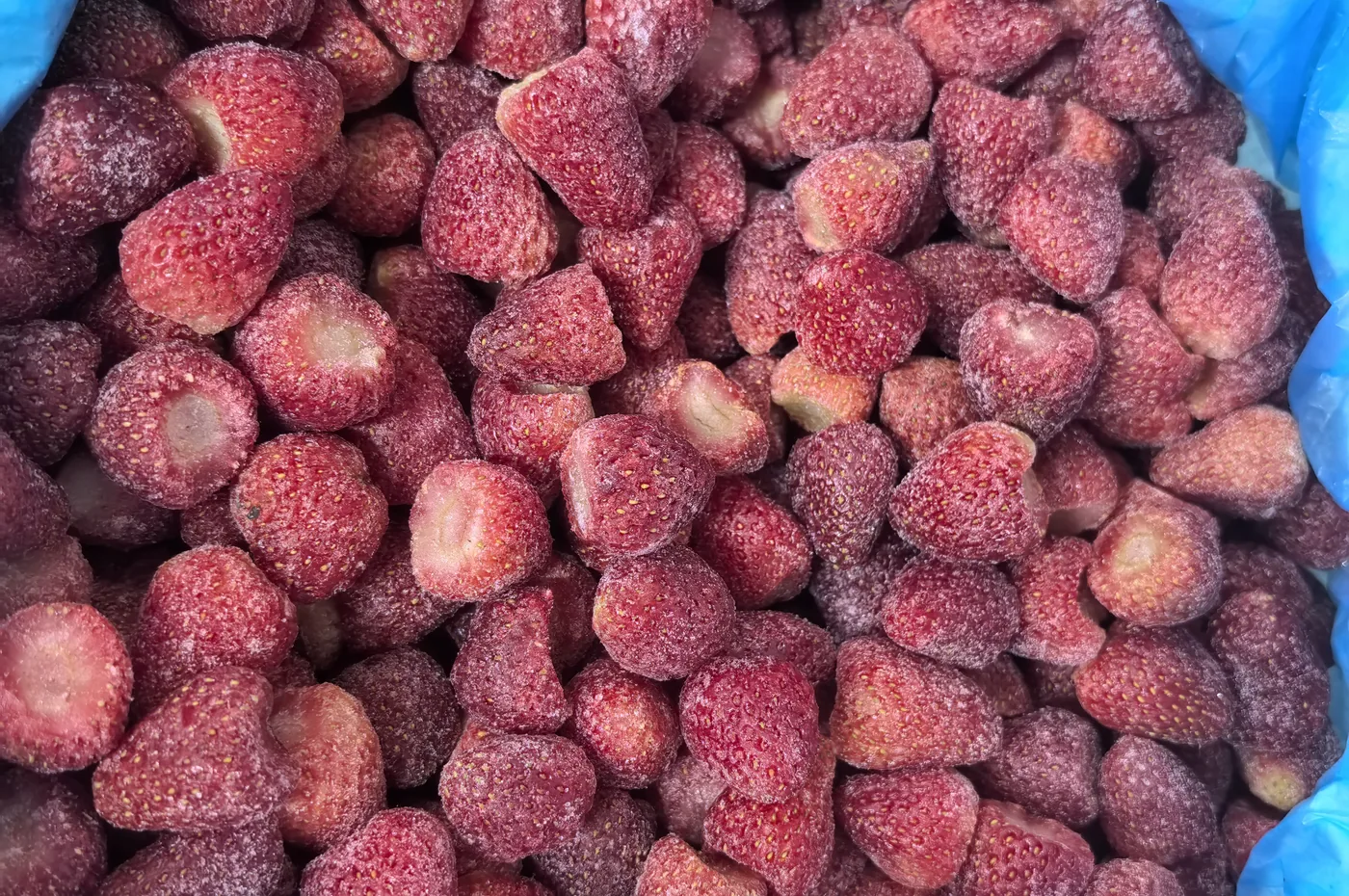
Whole strawberries show another product form. This photograph makes no laboratory, certification or claim-eligibility assertion.
The same discipline applies to fruit. Whole frozen strawberries, a sweetened fruit preparation and strawberries supplied as part of a dessert kit need their own reviews. The photograph here shows fruit form. It does not establish ingredient completeness, a laboratory result or eligibility for a gluten-free claim on any particular pack.
When a compound ingredient is involved, a one-line description such as “seasoning” may not answer the question. Request the relevant composition and supplier information through the responsible technical team. Identify whether the component is fermented or hydrolyzed, because that can change the evidence needed. Do not infer suitability from a familiar flavor name.
Gluten-free and wheat-free also ask different questions. The US definition in 21 CFR 101.91 [4] addresses wheat, rye, barley and their crossbred hybrids, with conditions for relevant derived ingredients. A wheat-only statement cannot substitute for the complete gluten review. Equally, another allergen does not disappear because a product is gluten-free.
Shelled edamame is a useful example for a mixed-product brief: soy is a separate allergen question. A brand needs to assess its ingredient declaration and applicable allergen statements independently of the gluten-free claim. FDA’s food-allergy overview [5] distinguishes major-allergen ingredient labeling from advisory cross-contact statements. These statements have different jobs.
For a proposed plain product, ask whether any recipe, packing or production-source alternative could enter supply without changing the headline description. If an alternate source is possible, decide how its evidence will be reviewed before use. “Same vegetable” is not enough to carry one source’s approval across to another route.
Trace possible contact through the production route
Ask where gluten-containing material could meet the product. Focus on the actual route rather than a generic questionnaire. Possible questions may concern incoming materials, shared transfer equipment, utensils, weighing, processing, rework and packing. A hypothetical utensil-transfer illustration makes one pathway visible; it is not a statement that such contact occurs at an XMG partner factory.

The diagram scrolls horizontally on smaller screens.
A hypothetical flour-transfer route makes a contact question visible. Separation and cleaning controls need assessment for the actual operation.
For a plain sweetcorn SKU packed at a site that also handles a wheat-containing preparation, we would ask how those operations are separated, which equipment is shared and how the relevant cleaning and verification decisions are made. The useful answer describes the controlled route for that product. “We clean everything” is too broad to show what was assessed.
A dedicated facility claim deserves clarification too. Dedicated to which products, ingredients and activities? Does it include receiving and packing, or only one room or line? CFIA guidance on allergen-free and gluten-free statements [6] explains, in its Canadian context, that dedicated facilities are not mandatory where adequate controls are in place. A shared site is therefore a question to investigate, not an automatic result.
Equally, a separate line should not close the review if the same utensils, rework route or packing area remain relevant. Ask the technical team to explain the boundaries of the control. Keep the answer connected to the exact product and source, with enough detail for the brand’s approver to understand why the proposed route supports its claim.
Choose verification questions that follow the risk assessment. An incoming-ingredient question may require supplier information; a transfer question may require equipment and handling controls; a packing question may require line-change procedures and review of the actual pack. Asking for the same document at every point can produce a thick file without answering the real concern.
Record unresolved questions plainly. If the line arrangement has been described but the relevant verification has not been provided, the status should reflect that gap. If the production source is not yet selected, label the assessment as provisional. A finished artwork proof should not make an incomplete supply assessment look complete.
Match the evidence to the product and question
Separate statements about ingredients, controls and analytical results. An ingredient declaration helps identify what is intentionally present. A control description explains how a route is managed. A test report gives information about submitted material under the stated method and reporting conditions. The strongest approval file connects the appropriate pieces instead of asking one document to answer everything.

The diagram scrolls horizontally on smaller screens.
Conceptual sampling diagram: submitted material and a suitable method define the result’s scope; no test result or lot certification is displayed.
When testing is part of the plan, identify the sample, product, lot and method. Ask the laboratory whether its method suits the matrix and the decision being made, and understand its reporting limits and uncertainty where relevant. “Not detected” without that context can be mistaken for proof of absolute absence. A result should retain its actual scope when summarized for artwork approval.
A hypothetical report for a submitted sweetcorn sample should be linked to the sampling plan and the production-control evidence. It should not be reused as a claim for every fruit and vegetable from the same supplier. Nor should an old sample report be treated as evidence for a materially changed recipe or production source without another assessment.
FDA does not impose a blanket requirement that manufacturers test every starting ingredient or finished food to use the claim; the manufacturer remains responsible for compliance. That distinction, explained in its gluten-free Q&A [1], matters when setting the commercial verification plan. A buyer may agree additional testing, but should state why and how it supports the defined requirement.
Fermented or hydrolyzed components need particular attention. The US regulation includes specific record requirements [4] because conventional testing cannot adequately determine gluten in these products in the same way as intact gluten. Have the responsible technical team assess those provisions for the actual component and finished food. A familiar test result should not be stretched across a method limitation.
Before accepting a report, check whether the product description and dates agree with the approval file. If a laboratory sample is identified only as “vegetable mix,” ask how it connects to the quoted SKU. If the method or result wording is unclear, seek an explanation from the relevant technical party. A sound result can be applied incorrectly when its sample identity is lost.
Separate certification from claim eligibility
A private certification programme can be part of a brand’s evidence and commercial requirements. It remains a defined programme with its own scope and rules. For example, GFCO describes its certification process [7] as a programme for eligible products and operations. Do not convert a programme name into a promise that every product or production source is covered.
Ask for the actual scope: covered product, brand or licence arrangements, relevant site, validity and permission to use the mark on the proposed artwork. If the supplier presents a food-safety management certificate, assess what that certificate demonstrates. It is not automatically a gluten-free product certification or permission to print a private logo.
For a hypothetical retailer brief that requires a particular scheme, a legally supportable gluten-free claim may still be insufficient to meet the commercial brief. The approval record should show that additional condition separately. Conversely, the presence of a certification mark does not remove the need to review the intended-market wording and the product supplied under the brand.
Our guide to verifying a food-safety certificate uses a related principle: confirm the issuer, validity and actual scope before treating a document as relevant. For gluten-free artwork, also confirm the rights and product coverage associated with any private mark. A logo file alone answers none of those questions.
Avoid phrases such as “FDA-certified gluten-free” when the evidence is simply a product assessment against FDA rules. Name the regulatory requirement and, if used, the separate private certification accurately. Precise language helps the buyer understand the basis of the claim and prevents a routine technical file from sounding like regulator endorsement.
Close artwork and supply changes together
Approve the final artwork against the current product file, including the claim, ingredient declaration and any relevant advisory wording. An email approval of one phrase does not necessarily cover the pack as a whole. Keep the final version, destination, product code and approval owner together so packing instructions can refer to an unambiguous decision.
For a hypothetical plain sweetcorn retail pack, the closing review might confirm the selected source, current ingredient declaration, agreed contact-control evidence, verification plan and exact gluten-free wording. If a seasoned variant is added later, it needs a separate review. Reusing the plain-product artwork decision merely because both bags show sweetcorn would miss the changed recipe.
- Lock the product and market scope before confirming the claim.
- Resolve ingredient and production-route questions with the responsible technical team.
- Review supporting documents and any analytical evidence within their stated scope.
- Confirm private certification coverage and mark rights if required.
- Approve the complete artwork and connect it to packing instructions.
- Define changes that require review before the next supply is accepted.
Change triggers may include a different ingredient supplier, a new compound component, revised rework practice, another packing site or altered artwork wording. Agree relevant notification expectations in the specification process. The brand can then assess a change before it becomes a pack claim or an unexpected substitution in a delivery.
Keep acceptance conditional where a fact remains unresolved. If the source has not been confirmed or required evidence is still pending, the claim should remain pending too. That gives procurement a clear next action rather than forcing it to choose between an unsupported approval and a vague request for “more certificates.”
At order handover, connect the approved artwork to the packing instruction and product specification. If more than one bag design exists, identify which version applies to the order. A correct claim assessment can still be undermined by selecting the wrong film or applying an old label. The receiving brief should make those identities clear enough for the buyer to recognize a mismatch without having to repeat the complete technical review.
Retention and review arrangements should match the brand’s requirements and the applicable rules. Decide who keeps the supporting file, how a relevant change is communicated and who can authorize a revised artwork or source. A questionnaire returned during initial onboarding should not be the only place where a continuing claim decision exists. The working record should remain accessible when procurement, quality and the packing team need to resolve a specific order question.
How we coordinate a frozen-produce claim brief
We source frozen fruits, vegetables and mushrooms through partner factories and coordinate product-specific requirements with the proposed supply route. Our specification and sampling work helps identify the product, ingredients, sample and packing brief that your team needs to review.
We coordinate relevant product and food-safety documents for that source and clarify retail and private-label requirements before packing decisions are closed. This is product-specific coordination; we do not claim a universal gluten-free certificate, dedicated site or test coverage for every product we source.
Send the product and market brief
Send the product and form, complete recipe where applicable, destination market, exact proposed claim, preferred packing and any customer certification or testing requirements. We will review the supply brief and coordinate the relevant specification, sample and document questions for your team’s approval.
References
Sources checked on 7 October 2026. Each source retains its product, study, jurisdiction or programme scope.
