


On this page
The country where frozen produce grows, the country where it is processed or packed, and the country from which it is dispatched can be different. A shipping address alone does not establish the origin statement that belongs on a retail label or customs document. Start with a traceable record of those locations, then apply the rules for the product, destination market and declaration you actually need.
For a straightforward order, all three locations may be in one country. Cross-border sourcing, mixed ingredients and overseas packing make the distinction more important. We ask buyers to identify the required declaration early because an origin question left until artwork approval can delay an otherwise ready order. This guide explains how to organise the evidence; it does not assign a legal origin to an unidentified shipment.
Three places, three different questions
Growing location answers where the crop was cultivated and harvested. Processing or packing location answers where the specified operations took place. Dispatch location answers where the consignment began the shipping leg recorded in the logistics documents. Treat them as separate fields even when the entries are identical.
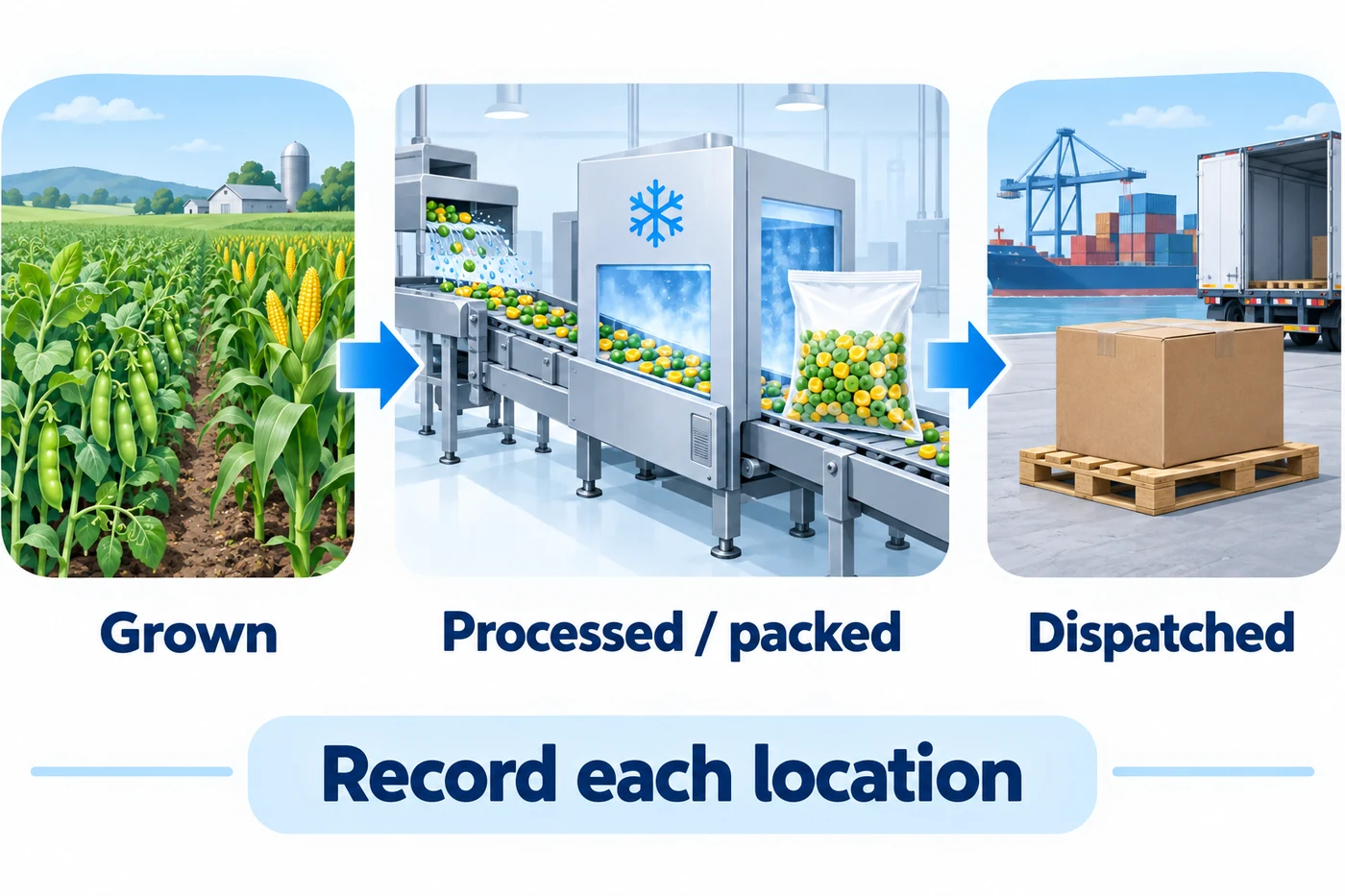
Conceptual locations explain three different geographic facts. They do not assign a legal origin to a shipment.
Consider berries grown in Country A, processed and packed in Country B, then released from a warehouse in Country C. That chain contains three geographic facts. None should be silently substituted for another. The address of a trading company in Country C does not show where the berries grew; a factory address in Country B does not establish what a particular destination market calls the finished product’s origin.
The word “processed” also needs more detail. Washing, sorting, cutting, blanching, freezing, mixing, packing and making a composite food are different operations. A record that says only “processed abroad” leaves the reviewer unable to decide whether the relevant rule treats that operation as significant. Describe what happened and where, rather than choosing the country name first and trying to justify it afterwards.
A photograph helps identify the food and its visible form. It cannot prove geographic origin. The same blueberry variety or corn kernel can be grown in several countries, and a clean factory image cannot link a photographed batch to the lot on an invoice. Use images for product understanding and records for the origin chain.
Build the chain from crop to shipment
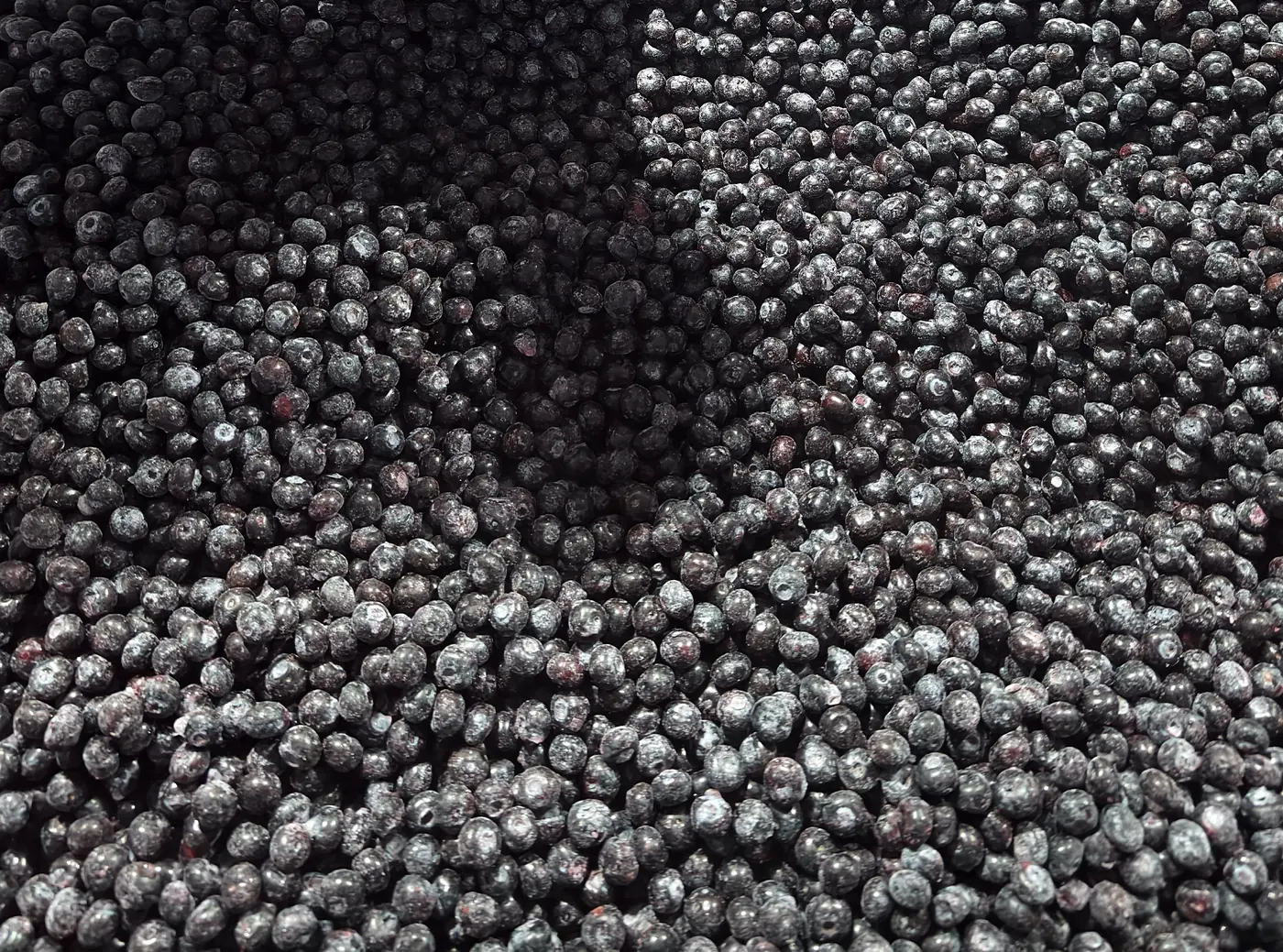
The photograph shows blueberries and their visible form. It cannot establish a growing country, facility ownership or the history of an order.
A useful origin file follows the product forward. Begin with the ingredient identity and grower or intake records, connect those to the processing lot, then connect the finished lot to packing and dispatch records. The level of detail should support the declaration being made. A broad annual sourcing summary may help explain normal supply, but it is a poor substitute for an order-specific record when that order’s origin is disputed.
Keep the supplier and facility roles explicit. The grower, processor, packer, exporter and dispatch warehouse can be different organisations. Their names and addresses help establish who performed each operation. They do not automatically make each organisation the manufacturer or make its registered office the place where processing occurred. When a commercial seller coordinates several facilities, ask which location handled the goods in this order.
The link between records matters as much as the documents themselves. An intake reference should connect to the production lot; the production lot should connect to the carton code; the carton code should connect to the packing list or shipment allocation. If several incoming lots are combined, the finished lot needs an ingredient link to each relevant source. A folder full of unrelated certificates can look substantial while leaving this basic connection unresolved.
Record dates and quantities when they are relevant to that connection. These can help reveal whether a declared supply could account for the finished quantity and whether the paperwork belongs to the correct production period. A quantity mismatch is a reason to investigate, not automatic proof of a false declaration. Processing loss, stock carried forward, partial dispatch and several finished lots can explain differences if the records show how.
Keep a current version for the order, with supporting source records available to the responsible reviewer. A change of grower region or packing location should trigger a review of affected documents and artwork before dispatch. It should not remain hidden in an internal purchasing email while the customer receives last season’s declaration.
Why the same facts can require different declarations
Country-of-origin rules are not interchangeable across markets or food categories. Some focus on the crop; others distinguish where a food was produced, substantially transformed or packed. The required words and the category in which a product falls can therefore change the answer. Check the current destination rule rather than copying the wording from a previous customer’s label.
For the United States, the USDA Country of Origin Labeling programme [1] includes fresh and frozen fruits and vegetables among its covered commodities. The programme has retailer, commodity and processed-food boundaries, explained in its consumer questions and answers [2]. “It is frozen” is not a sound reason on its own to assume a product falls outside those requirements. Equally, one should not assume every composite frozen food is treated like a bag of a covered commodity.
Canada illustrates why the exact product category matters. The CFIA guidance for processed fruit or vegetable products [3] states that imported prepackaged products in that category must declare the country of origin, identifying the country in which the product was packaged under the cited provision. That is a specific requirement for that category. It should not be rewritten as a universal Canadian rule for every fresh food, every origin claim or every customs purpose.
Australian guidance distinguishes “product of”, “made in” and “packed in”. The NSW Government’s country-of-origin claims guidance [4] describes “made in” in relation to the last substantial transformation and explains that operations such as slicing, freezing or repacking do not by themselves qualify. Its explanation of “product of” considers significant ingredients and production processes, while “packed in” identifies packing. These phrases should not be selected merely because one looks more attractive on a pack.
These examples show a method, not a global lookup table. Confirm the applicable food category, the type of transaction, the proposed statement and the relevant market before deciding what evidence is sufficient. Ask the importer or qualified adviser to resolve a classification or interpretation issue that changes the declaration. Retain the decision and the facts on which it was based, so a later artwork revision does not reopen the same question without context.
Separate customs, retail and preference questions
An origin statement can serve several purposes. Retail information tells consumers about a food under the applicable labelling rules. A customs origin declaration supports import formalities under the relevant customs framework. Preferential origin concerns whether a shipment meets the requirements for a particular trade preference. A request for one should not be answered with paperwork intended only for another.
For example, a buyer asking whether a consignment can claim a reduced duty needs more than the place of dispatch or a general supplier declaration. The reviewer needs to identify the preference being claimed, the product and the applicable origin conditions. Whether a specific consignment qualifies is an order-specific assessment. We do not treat the presence of an origin certificate as a promise that any requested preference applies.
Likewise, a label reviewer should not infer the approved retail wording from a transport document. A bill of lading identifies shipment information; it does not answer every question about cultivation and processing. A supplier’s statement may provide facts needed for review, but the final wording must still be checked against the destination’s requirements.
| Question | Useful starting information | What still needs confirmation |
|---|---|---|
| Where did the crop grow? | Ingredient sourcing and lot-linked intake records | The link to the finished product in the order |
| Where was it processed or packed? | Facility, operation and production or packing records | The exact operation and the relevant dates or lot |
| Where does the shipment depart? | Dispatch warehouse, booking and transport records | Whether that location has any relevance to the requested origin declaration |
| What wording belongs on the label? | Product category, destination and proposed statement | The current retail rule and the reviewer’s approval |
| Does a trade preference apply? | Product classification, agreement and consignment evidence | The applicable origin conditions and accepted proof |
The same commercial file can contain evidence useful to several reviews. Keeping the questions separate makes reuse safer: the reviewer can see which facts are shared and which conclusion depends on a particular rule. If a customer simply requests “COO”, clarify whether they mean a country statement, a certificate, label wording or support for preferential treatment before preparing the file.
Mixed products need an ingredient origin record

Origin A, B and C are illustrative placeholders. Mixing the components does not erase the sourcing records.
A vegetable blend may contain peas, carrots and corn sourced through different chains. A single line reading “origin: Country A” can conceal the information needed to review that blend. Begin with the components, their identities and their growing locations, then record where the blend was made and packed. Apply the relevant final-product rule after that record is complete.
Keep the formula revision beside the origin information. If a blend changes from two ingredients to three, the old component record may no longer describe the product. Even when the ingredient list stays the same, sourcing can change between seasons or lots. An origin statement copied from an earlier specification should be rechecked when the supply chain changes.

Sweet corn is one identifiable blend component. Colour and shape do not establish its geographic origin.
Do not confuse an ingredient’s commercial description with origin evidence. “Sweet corn”, “IQF peas” or a cultivar name explains aspects of identity or processing. It does not identify a growing country. A country mentioned in the supplier’s company name, marketing material or shipping address is equally insufficient to establish the crop’s location.
Where several sources of the same ingredient are combined, ask how the finished lot preserves that information. The appropriate declaration depends on the applicable rule, but the underlying record should not pretend there was only one source. An honest component table provides a clearer starting point than a simplified statement that later has to be withdrawn.
For customer review, a compact table can list the ingredient, supplier reference, growing country, processing country, packing location and finished-lot link. Include the statement’s scope and date. If a column is not yet confirmed, mark it for resolution rather than filling it from a dispatch address. This is especially useful for seasonal substitution and products made with customer-specific formulations.
An illustrative cross-border order review
The following example is hypothetical. It shows the questions to ask and does not describe an XMG shipment or determine a legal origin. Suppose frozen peas and carrots grow in Country A, corn grows in Country B, and a plant in Country B mixes and packs the ingredients. A warehouse in Country C then dispatches the cartons to the buyer.
The buyer first needs the finished product defined: a three-ingredient frozen vegetable blend, with the actual formulation and processing operations recorded. The supplier provides lot links for the peas, carrots and corn, plus the mixing and packing records. The dispatch documents identify Country C. The file now distinguishes crop sources, manufacturing activities and logistics without assigning them the same meaning.
Next, the buyer states the destination market and the purpose of the request. A retail label review asks which declaration applies to that product category and wording. A customs review asks its own origin question. A preference request identifies the relevant agreement and conditions. The plant’s location in Country B is an input to those reviews; it is not a substitute for them.
Before printing, the approved declaration is checked against the component record and formula revision. Before dispatch, the invoice, packing list and any required origin document are checked against the same finished lot. If the corn source changes before production, the team reopens the affected assessment rather than assuming the old wording remains valid.
The practical lesson is to keep factual collection and rule interpretation connected but distinct. Complete records let the responsible reviewer make a supported decision. They also make it easier to explain why a declaration changes for a new market or formulation, without suggesting that the physical product’s history has changed.
Check documents against the same lot and product

The generic Lot A identifiers show a record link. These are schematic documents, not issued shipment evidence.
Start with the product description and lot identity. Compare the agreed specification, production or packing reference, invoice, packing list and origin statement or certificate required for the order. Descriptions do not always use identical wording, but they should refer to the same food and presentation without creating an unresolved contradiction.
Check the parties and their roles. A seller on the invoice can differ from the packer or exporter, but the chain should explain that relationship. Check country names in their actual context: an exporter address, port of loading and statement of origin are different fields. Treat a discrepancy between those fields as a question to resolve, not an invitation to change all of them to match the port.
Then check the document’s scope. Does it refer to the shipment, the finished lot, the product generally or a particular ingredient? Is it a supplier declaration or a document issued or endorsed through the procedure required for that destination? A valid general record can still be insufficient for a request that needs consignment-specific information.
Where the buyer requires originals, particular wording or issuance timing, establish those requirements before booking. Our guide to export document originals, copies and timing addresses that coordination separately. The origin file should support the required document, while the order checklist confirms who prepares it, when it can be issued and how the buyer receives it.
Resolve a discrepancy before artwork or dispatch
If two records disagree, pause the affected decision and trace the difference. It may be a clerical error, a changed ingredient source, a document prepared for another lot, or a misunderstanding about what “origin” means in that field. Find the underlying record and responsible party before issuing a corrected statement.
Keep a version history. A correction should identify what changed, why it changed and which documents or artwork it replaces. Let the people responsible for the customer specification, label and shipment use the same approved version. Sending a corrected certificate without checking already printed packaging leaves a preventable inconsistency.
We find that early, specific requests are easier to fulfil than broad demands at the end of production. “Please confirm the growing country of each ingredient and the finished packing location for this lot” tells the supplier what evidence to collect. “Please send origin” can produce several different documents, none of which answers the buyer’s actual question.
When the disagreement involves the legal interpretation of a rule, escalate that issue to the importer, competent authority or qualified adviser responsible for the destination review. Supply the product identity, operations and chain records together. Avoid seeking an answer based on a country name without the facts that make the rule applicable.
How we coordinate origin information for your order
At XMG Food, we coordinate frozen-product specifications, packing requirements and export-document preparation around the agreed order. For an origin request, tell us the product and ingredient composition, destination market, required declaration or document, and packing format. We can then identify the information needed from the supply chain and confirm the document arrangements before artwork or dispatch.
Use our export documentation page for the document scope and our specifications and samples page when the product definition still needs agreement. If your request involves a mixed product, include the intended formula and any customer restrictions on growing or processing locations.
A quotation should not be treated as approval of a country-of-origin claim or trade preference. We confirm the order facts and coordination requirements; the destination review must settle the applicable wording and eligibility. Getting those responsibilities clear early helps prevent late changes to printed packs and shipping paperwork.
Discuss your product and documentation requirementsReferences
- [1] USDA Agricultural Marketing Service: Country of Origin Labeling↑ and [2] consumer questions and answers↑.
- [3] CFIA: labelling requirements for processed fruit or vegetable products↑.
- [4] NSW Government: country-of-origin claims↑.
- [5] Finnish Food Authority: labelling of the country of origin of foods.
