


On this page
After a warehouse freezer failure, hold potentially affected stock and identify the exposure before authorizing any release. Map the incident to pallet locations, lot identities and stock movements, then reconstruct the temperature timeline with its gaps. A recovered room temperature, a still-frozen carton or a normal smell does not by itself establish the history of every lot.
The release decision belongs to the authorized food-safety and quality process for the product, facility and destination requirements. There is no universal safe outage duration for commercial frozen produce. Useful evidence connects the affected inventory to the incident, distinguishes air from product measurements, and records what supports each disposition—including what remains unknown.
Hold the stock before deciding which lots are affected

The first inventory action is a controlled hold. Block picking and dispatch in the warehouse system, identify the physical stock, and tell the relevant operators which locations or products are included. A verbal instruction can be lost between shifts. The hold should remain visible wherever a pallet can be moved, selected or loaded.
Where the initial exposure boundary is uncertain, a broader precautionary hold can prevent accidental release while the investigation narrows the scope. Record why the boundary was chosen and who can revise it. Narrowing a hold is a decision requiring evidence, not merely a response to limited warehouse space or delivery pressure.
Preserve stock identity before relocating pallets to functioning refrigeration. Record the old and new locations, the time, pallet identifiers, product names, batch references and quantities. Maintaining suitable storage protects the stock from further deterioration; it does not erase the earlier exposure. Keep recovery actions and historical assessment as separate records.
Also check transactions already in progress. A pallet may have been allocated, staged near a door, loaded onto a truck or sent to another site before the hold appeared in the system. Those movements belong in the investigation. If potentially affected food has left the facility, use the applicable incident and notification procedures rather than treating the remaining warehouse balance as the complete scope.
Consumer advice is often the first information found online. The FDA’s power-outage guidance [1] is written for household food and water safety. Its domestic-freezer time estimates do not provide a commercial warehouse release rule. Different product loads, equipment, door use, temperature histories and intended uses prevent that shortcut.
Map the exposure to locations and inventory movements
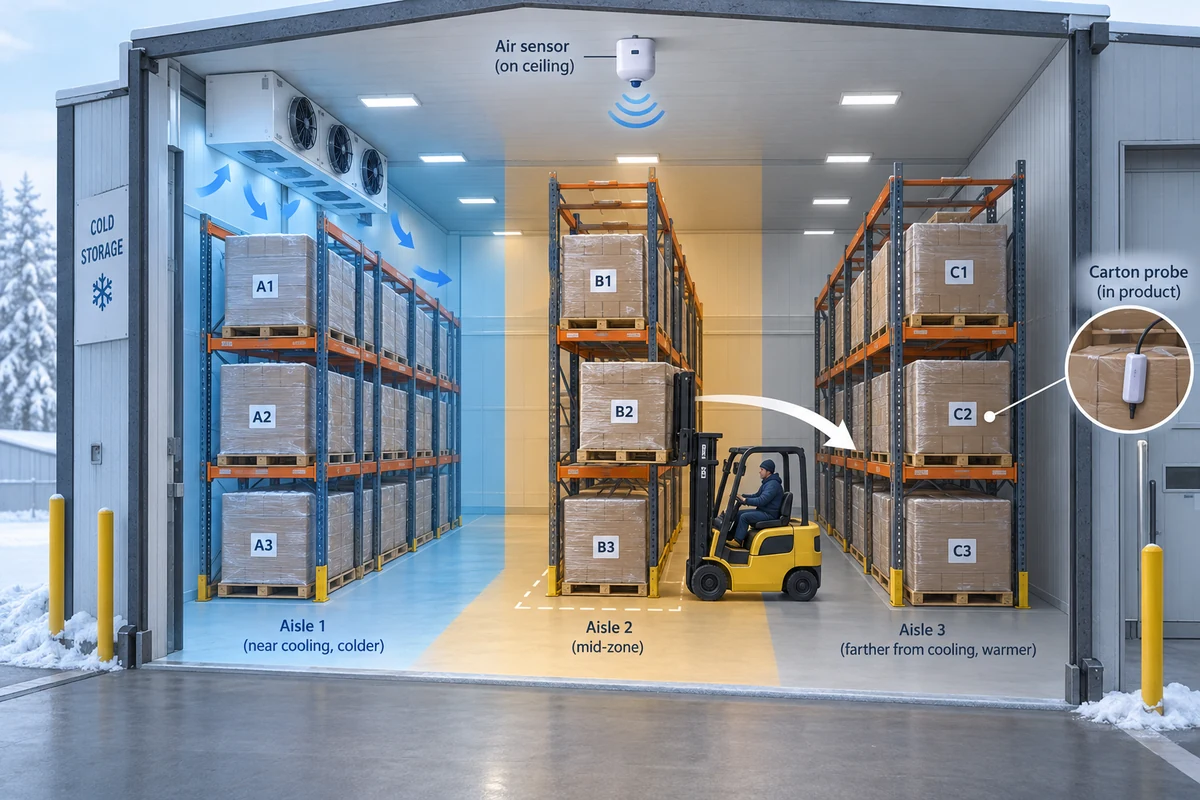
Start with the facility’s actual zones: room, aisle, rack, level, pallet position and adjacent loading or staging areas. Add the equipment affected by the failure. A whole-site power loss, a single evaporator fault and a control-system error can have different exposure patterns. Confirm the incident type rather than assuming that every alarm means the same event.
Join this map to inventory at the relevant times. A present-day stock list does not show where a pallet was when the failure began. Use receiving, put-away, transfer, picking and loading records to reconstruct its locations. Where records are incomplete, mark the uncertainty; do not fill a gap with the location where the pallet was eventually found.
One production lot can occupy several warehouse positions. Conversely, a single position can hold cartons from more than one lot. Keep those relationships visible. The useful assessment unit may be a defined subset of a lot tied to location and exposure, but only if identification and segregation genuinely support that distinction.
A hypothetical example shows the problem. Lot A occupies two rack positions; one pallet is moved to an unaffected room during recovery, while the other remains near a frequently opened door. Their current temperatures may be similar once refrigeration recovers. That does not prove that their earlier conditions were the same. The movement times and exposure records are needed before combining the evidence.
Separate “potentially exposed” from “demonstrably unaffected.” The latter requires a defensible basis, such as an independently functioning zone and reliable inventory evidence. Absence of an alarm in a location with no suitable monitoring is not the same as evidence that temperature remained within the applicable control conditions.
Record the logic used to include or exclude each location. A map becomes useful when another reviewer can follow that logic and reconcile it to named stock. A coloured warehouse diagram alone is insufficient if it cannot be connected to pallet and lot records.
Reconstruct a temperature timeline with uncertainty
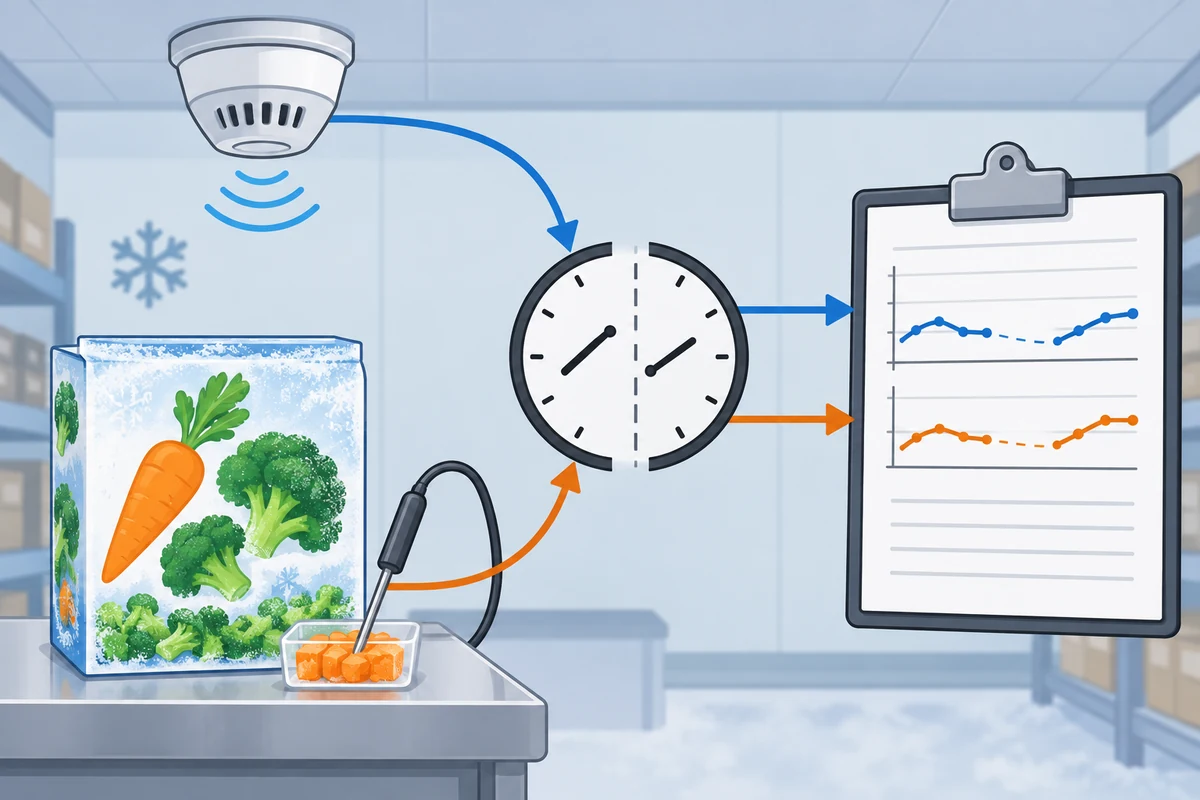
Collect the original monitoring data before systems overwrite or aggregate it. Preserve alarm records, sensor exports, refrigeration status, maintenance observations, power-event information and relevant operator logs. Keep the raw data as well as the chart used for discussion. A smoothed daily average can hide an excursion that matters to the assessment.
Distinguish when power failed, when cooling stopped, when an alarm was raised, when somebody responded, when equipment restarted and when the environment recovered. Those events need not share a timestamp. An operator’s first observation may occur well after the actual fault began. Mark a bounded uncertain interval when the onset cannot be established exactly.
Check clock alignment. Monitoring software, warehouse transactions and maintenance logs may use different time zones or clock settings. A five-minute mismatch can incorrectly place a pallet move before or after an excursion. Correct the interpretation with documented offsets while retaining the original records, rather than editing raw timestamps until a desired sequence appears.
Air measurements describe the air at the sensor. Product measurements describe the material at the sampling point and time. They have different thermal responses and cannot be substituted casually. The existing guide on air temperature versus product temperature explains this distinction in a transport context; it remains relevant when reviewing warehouse evidence.
Review sensor location, calibration status, logging interval and whether the device continued working during the outage. A sensor beside a cooling outlet may not represent an exposed pallet by the door. A current probe reading after recovery cannot reconstruct the peak temperature during the failure. Each measurement needs its context beside the number.
Where modelling is used, have the responsible specialists establish an appropriate product- and configuration-specific basis. Do not draw an assumed product-temperature curve beneath an air-temperature chart and label it measured evidence. Estimated behaviour and observed measurements should remain distinguishable in the incident file.
Gather product evidence without erasing the incident
Build a sampling plan appropriate to the question and the exposure map. Convenient cartons near the aisle entrance may be accessible but unrepresentative. Include the relevant products, positions and exposure groups as directed by the responsible quality team. Record how the selected samples relate to the held inventory.
Document the time, location, pallet and batch identity for each observation. Photographs should show the identification as well as the condition being discussed. Keep original files and record whether the stock had already been moved or cooled again. A photograph taken after recovery has a different evidential meaning from one taken at the first response.
Visible ice, clumping, free liquid, damaged packaging or changed texture can help identify quality concerns. Their absence does not prove that the stock avoided unsafe conditions. A product may have been refrozen before inspection, and a surface observation may not represent the interior. Do not let a neat-looking sample substitute for an exposure assessment.
Any product-temperature measurement should use the facility’s appropriate method and suitable equipment, with the sampling point described. “Temperature checked” is too vague to assess. State whether the reading was between packs, at a surface or within product and why that method was chosen. Preserve the result, measurement time and limitations.
A laboratory test can answer the questions it is designed to answer within its sampling and analytical limits. A negative result from a small sample does not automatically validate every held carton or reconstruct a missing history. Decide the evidential question before commissioning tests, then interpret their results within the overall risk assessment.
Keep retained samples and chain-of-custody records where the investigation requires them. Their handling can affect later observations. Record storage and transport conditions and any destructive testing, so a later reviewer can distinguish an incident effect from changes introduced after sampling.
Separate a safety assessment from a quality assessment

Food-safety assessment asks whether the affected food can be released under the applicable requirements and intended use. Quality assessment asks whether it still meets the agreed product specification and performance expectations. Both matter, but a satisfactory texture test does not establish safety, and a safety disposition does not automatically mean the product meets the customer’s quality contract.
Identify the product correctly. Raw frozen berries, blanched vegetables and a ready-to-eat finished food can require different considerations. The intended preparation matters, but cooking instructions should not be invented after an incident to justify an unsupported release. Use the established specification, food-safety plan and customer requirements.
The FDA’s FSMA questions and answers [2] discuss different facility activities and conditions, including holding unexposed packaged foods that need time and temperature control. Applicability depends on the actual operation. A general article cannot assign the same legal duties or acceptance criteria to every warehouse in every destination market.
The FDA preventive-controls overview [3] describes corrective actions that evaluate affected food and prevent entry into commerce where safety cannot be ensured. It also distinguishes monitoring, corrective action and verification. That framework reinforces the need for a documented decision rather than release based on a single favourable observation.
For quality, choose tests relevant to the product’s intended application. Free-flowing pieces, drip, colour, flavour, texture and cooked yield can matter differently for a smoothie ingredient and an intact garnish. Compare against the agreed specification or a suitable retained reference where available. Label the test preparation so the observations can be interpreted.
Customer concessions, insurance discussions and commercial losses belong in the incident record, but they do not replace the authorized safety decision. If a proposed alternative use or rework is considered, it needs its own valid assessment and authorization. Do not describe it as an automatic route to recovering the stock’s value.
Document an authorized disposition and reconcile quantities

A disposition should identify exactly which stock it covers, the evidence reviewed, the remaining uncertainty, the decision, any conditions and the person with authority to approve it. “QA approved” without scope or a linked assessment can leave warehouse staff unable to distinguish released cartons from the rest of the hold.
Record released, retained, transferred, reworked where authorized, or disposed quantities separately. Include any stock already dispatched and any samples removed. The totals should reconcile to the incident inventory. Unexplained differences can reveal a missed movement or a hold that was not applied consistently.
For example, an illustrative hold of 1,000 cartons could later be reconciled as 600 released under a documented decision, 250 still held and 150 disposed. These are hypothetical quantities, not recommended disposition proportions. If the system then shows another 20 cartons in staging, the discrepancy needs resolution before the incident can be treated as closed.
Change warehouse status only for the stock covered by the approval. Confirm that physical identification, inventory controls and dispatch instructions agree. A partial release is especially vulnerable to error when a lot code remains shared across released and held subsets. Use the facility’s controls to preserve the approved distinction.
Retain the decision package with the source evidence and the final inventory reconciliation. A clean summary is useful, but it should point to the monitoring data, movement history, observations and reports on which the decision depends. Record subsequent corrections transparently so the original basis remains understandable.
Strengthen the records before the next incident
The investigation often exposes weaknesses in normal controls: a sensor without useful coverage, an alarm sent to an unavailable contact, poorly recorded pallet moves or a hold that does not block loading. Translate these findings into specific corrective work, with responsibility and verification rather than a general promise to be more careful.
Review what the monitoring system can actually demonstrate. Relevant sensor placement, suitable recording intervals, maintained equipment and accessible historical data improve an investigation’s evidence. Backup power arrangements also need to match the equipment and operational plan; the presence of a generator alone does not prove that cooling and monitoring continued.
Practise the inventory join. Can the team identify which pallets occupied a room during a chosen interval? Can it trace a moved pallet to its original location and lot? Can it block dispatch across shifts? These questions can be checked before an incident, when missing information is easier to address.
Keep contact and decision responsibilities current. Maintenance staff restore equipment; warehouse teams control stock; authorized food-safety and quality personnel assess disposition. Clear responsibilities reduce the chance that a successful repair is mistaken for approval to release the food.
Any emergency transfer should preserve lot identity and suitable conditions. Planning the destination and documentation in advance helps prevent a rushed recovery from creating a second traceability problem. After the event, verify that corrective actions were completed and that they solve the recorded problem.
Before closing the incident, review whether the retained record can answer three separate questions: which food was potentially exposed, what evidence supported its disposition, and where every quantity ended up. A repair invoice answers an equipment question, while a dispatch report answers an inventory question. Neither alone answers whether the release was justified. Keep the documents connected through the incident reference and stock identities.
Include a handover note for unresolved stock or actions. Name the responsible person, the next evidence needed and the condition for changing the hold. This prevents an investigation from fading out when the immediate operational disruption ends. A still-held pallet should remain controlled and identifiable until its own documented disposition, even if the refrigeration fault has been repaired and other stock has been released.
Coordinate product records with XMG Food
For frozen fruit, vegetable and mushroom supply, we coordinate product specifications and available batch and export information with our partner factories. During a buyer’s investigation, those records can help connect the stock identity to its agreed product form and handling basis. We can confirm what supply information is available and identify gaps for your authorized quality team.
Send the product and lot reference, the incident interval, and the specifications or records you need. We will coordinate the relevant available information; the warehouse’s authorized food-safety and quality process remains responsible for the release decision.
Review cold-chain supply coordinationQuestions about a freezer failure
Can we release stock once the room reaches its setpoint again?
Recovery shows the current condition of the room, not the complete history of the food. Keep the affected stock under hold until the authorized assessment supports its disposition. Include the earlier exposure, product context, inventory scope and evidence gaps in that assessment.
Does a still-frozen carton prove that every carton is acceptable?
No. One carton may differ in position, exposure and thermal behaviour from other stock. Its current condition cannot establish every pallet’s history. Use a suitable evidence and sampling plan, and distinguish quality observations from the food-safety decision.
Is there a single number of outage hours we can use?
No universal duration applies to commercial frozen produce. The FoodSafety.gov consumer chart [4] and UK consumer power-cut advice [5] have their own household context. They should not be imported as a warehouse acceptance specification.
What if the records cannot establish the exposure?
Keep the uncertainty explicit and maintain the appropriate hold while the authorized team decides how to proceed under the applicable requirements. Do not replace missing records with a favourable photograph, a current room reading or a guess about when the fault started.
References
Applicable commercial obligations and disposition criteria must be established for the actual operation, product and destination.
