


On this page
Choose frozen sweet corn kernels when the kitchen needs a measured ingredient for soups, salads, rice dishes or mixed sides. Choose corn on the cob when the cob itself is part of the serving experience. For many foodservice orders, that means a defined cob section rather than a full ear. Compare the number of acceptable servings and the kitchen work required before comparing prices per kilogram.
Both forms can fit the same menu, but they solve different jobs. Kernels can be distributed through a dish; cob portions are normally counted and plated as individual units. The cob contributes purchased weight without being the edible kernel portion. A useful quotation therefore needs a declared form, portion basis and preparation route.
Choose the form around the way corn is served
Start with the plate or bowl that the customer receives. A scoop of corn in a rice bowl needs consistent distribution and a manageable portion weight. A grilled side needs a recognisable cob portion that fits the plate and can be handled comfortably. A soup formulation may need kernels dispersed through the liquid, or a different prepared corn form if the recipe requires a smoother body.

Original product photograph of loose frozen kernels. It shows product form, not a measured edible yield or quality grade.
Write the menu requirement before selecting a product name. “Corn side” leaves open whether the buyer expects a loose portion, one short cob section or a whole ear. It also leaves open whether corn is the main vegetable component or a small inclusion. Those differences affect portion tools, service speed, packaging and the amount of material consumed per order.
Use “sweet corn” explicitly. Purdue Extension distinguishes yellow, white and bicolour sweet corn and describes several sweet corn types. Colour alone does not establish the required sweetness or bite. Keep the declared colour and corn type with the form description so that a kernel sample and a cob sample are not compared as though their only difference were the presence of the cob.
At XMG Food, we supply frozen sweet corn as kernels, cob sections and crushed pieces. Kernels suit applications that distribute corn through a dish, while cob sections support portioned foodservice uses. A request for full ears needs its own product and packing confirmation. We would check the exact form before treating it as an available substitute for sections.
Consider how the customer will eat the dish. A cob portion can suit a menu built around a handheld or visibly plated side. Loose kernels may fit a bowl, spoon service or a dish where each mouthful should include corn. Test the intended utensil and packaging with the actual portion. A portion that looks attractive on an open plate may be awkward in a narrow takeaway container.
If the distributor serves several customer groups, define separate requirements where necessary. A catering tray and an individually packed meal do not have the same portioning constraints. One product may cover both uses, but that should be demonstrated through preparation and service trials rather than assumed from a broad “foodservice grade” description.
Compare edible portions and saleable servings
Keep three quantities separate: purchased product weight, usable edible material and acceptable menu servings. Kernels are supplied removed from the cob, but the final usable quantity still depends on the agreed preparation and any rejected material. With cob sections, the purchased product includes the cob, and service may be counted by pieces rather than edible mass.
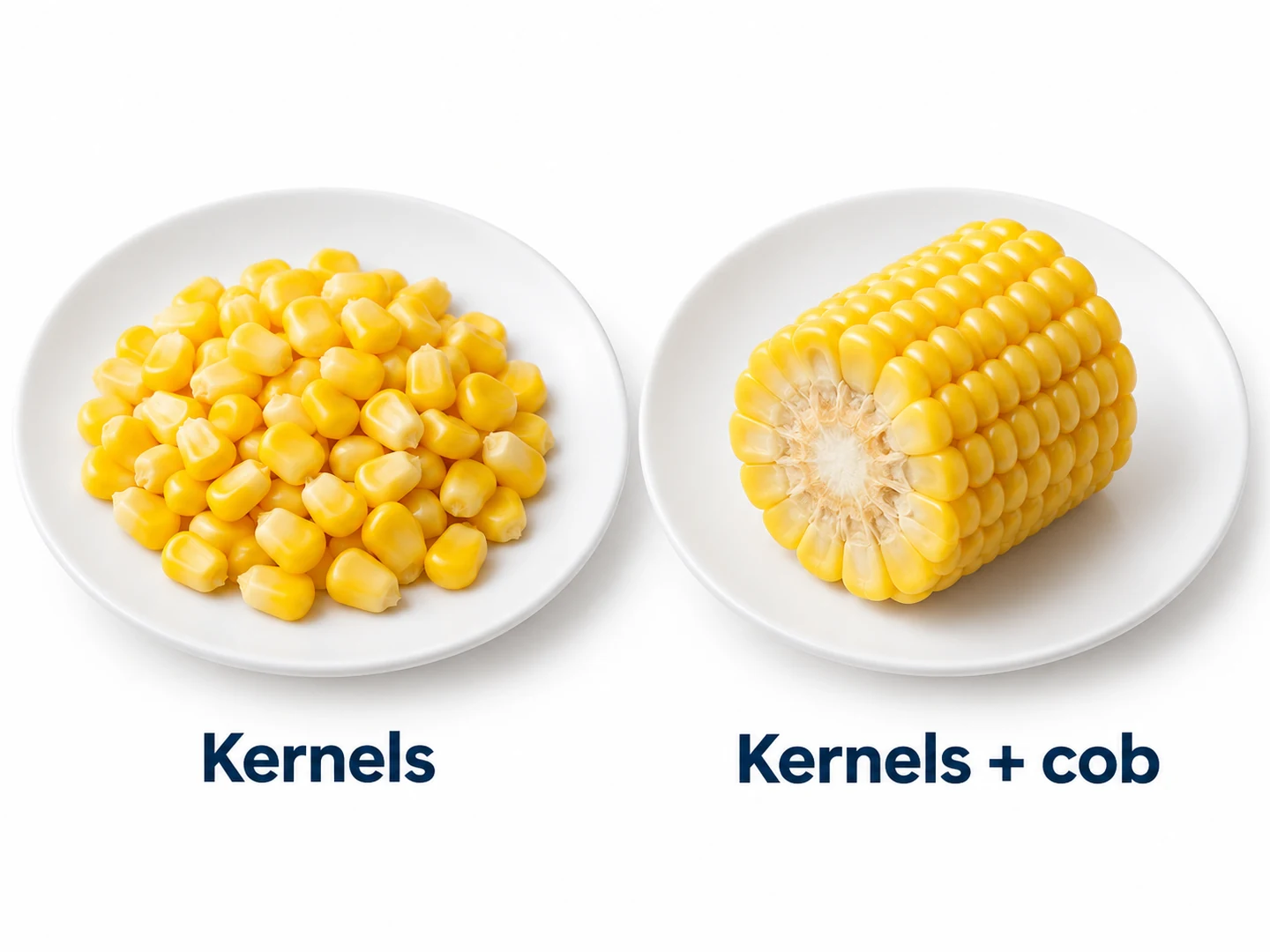
Illustration: a cob portion contains both kernels and cob. The plates do not represent equal weights or equivalent servings.
For a loose corn side, record the prepared quantity available for portioning and the target amount per serving. In a hypothetical trial, 1,000 g of frozen kernels produces 920 g of usable prepared kernels. At 80 g per serving, that is 11 full portions with 40 g remaining. The arithmetic is useful for planning; 92% is an invented example and must not become a supplier yield promise.
For cob sections, count acceptable pieces after the agreed preparation. A hypothetical case contains 60 sections, of which three do not meet the buyer’s agreed serving requirement. At one section per serving, the case provides 57 acceptable servings. At two sections per serving, it provides 28 complete servings and one remaining section. These are different menu costs even though the case price is unchanged.
Do not use cob section count as a measure of edible kernel quantity. Two sections can have similar lengths but different diameters or kernel development. If edible mass matters to the contract or menu plan, agree a method for assessing it on a representative sample. State whether that assessment occurs before or after preparation, and account for any material removed during the method.
Likewise, do not borrow a fresh ear yield from a household guide and apply it to a commercial frozen section. The supplied cut, maturity, variety and preparation conditions may differ. Obtain the case count and product specification, then run the relevant kitchen trial. Use external guidance to frame the questions, not to fill missing supplier data with a convenient number.
Compare cost on the chosen serving basis. If the illustrative case costs 18 currency units and provides 57 acceptable one-section servings, the corn cost is about 0.316 currency units per serving before other costs. If the menu uses two sections, the 28 complete servings cost about 0.643 each when the remaining section is not allocated elsewhere. Record how usable remainders are handled rather than hiding them in rounding.
Specify kernels and cob sections separately
A kernel specification should identify corn type, colour, size description, treatment and the condition expected on delivery. It should also distinguish the observations that affect the intended use: broken or cut material, discoloured pieces, unwanted vegetable matter and the ability to portion the product under the agreed handling conditions. Define the sample and reporting basis for each criterion.
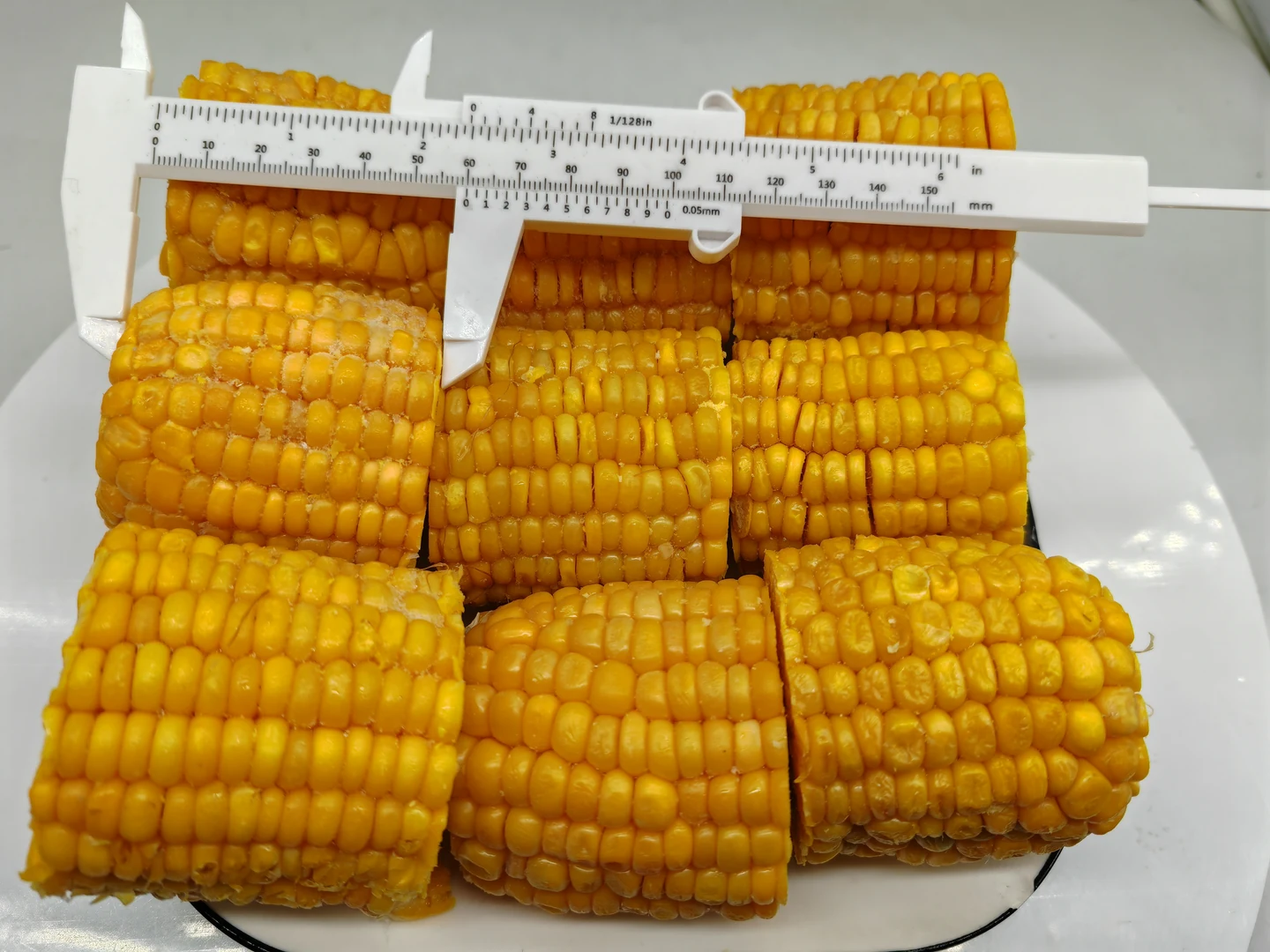
Original product photograph showing corn sections and a caliper. It does not certify an instrument check or establish a lot size tolerance.
A cob specification needs additional geometry. Confirm whether the product consists of full ears, trimmed ears or sections, then define length and any relevant diameter requirement. Record how uneven ends, incomplete kernel coverage, damaged areas and loose kernels will be assessed. If the customer buys by piece count, agree how the count relates to the declared net weight and packing format.
The USDA publishes separate grade standards for frozen whole kernel corn and frozen corn on the cob. The kernel guidance includes tenderness, colour, flavour and defects. The cob guidance also considers size uniformity and development. These distinctions help organise the buyer’s questions, but an agreed commercial specification still needs to identify the actual product and the standards, if any, incorporated into the order.
The USDA cob standard dated April 8, 2021 provides specific style definitions. It distinguishes trimmed and natural styles and uses defined length categories. Those terms belong to that standard. They should not replace the buyer’s required section length or be treated as a universal menu portion. Write the dimensions needed for the application and confirm them through the sample approval process.
| Purchase question | Frozen kernels | Corn on the cob or sections |
|---|---|---|
| How is the serving measured? | Prepared weight or an agreed portion tool | Piece count, with dimensions and edible basis where required |
| Which form details matter? | Kernel identity, size and fragmentation | Ear or section style, length, diameter and cut ends |
| Which visible findings need recording? | Discolouration, unwanted material and damaged kernels | Kernel coverage, damaged areas and section condition |
| What must the kitchen trial establish? | Usable quantity, distribution and bite | Acceptable portion count, handling and bite at service |
Sweetness and tenderness still matter for both forms. UC Davis discusses variety and maturity in its sweet corn factsheet, including distinctions between conventional and supersweet material. That context supports identifying the material being compared. It does not justify assigning the same performance to every frozen lot. For a dedicated assessment method, use our guide to comparing sweetness and texture in frozen sweet corn.
A caliper or ruler in a photograph gives context for the pictured product. It does not establish a lot’s complete size distribution or certify that the instrument was checked. For approval, request the measurement method and sample record that correspond to the stated requirement. Keep representative photographs as supporting evidence alongside the numerical results.
Test preparation through the end of service
Agree the preparation route for each supplied form. Follow the product instructions and the kitchen’s established food safety controls, then assess whether the result meets the menu brief. Do not transfer a household fresh corn cooking time to a commercial frozen batch. Equipment, load, product geometry and starting condition all belong in the trial record.

Illustration of the stages to assess. It is not a cooking instruction, holding limit or record of a supplier trial.
For kernels, record how the product is added, mixed, drained if relevant and portioned. Note whether the kitchen uses a full bag or weighs smaller quantities. Observe the distribution through the dish and whether the chosen scoop delivers the intended amount consistently. A scoop volume is a handling method; verify the portion weight under the actual serving conditions rather than assuming every scoop weighs the same.
For cob sections, record piece size and the number prepared together. Check whether the available baskets, trays and utensils can handle the proposed format. Assess the portion at the point of service, including bite, visible damage and ease of plating. A section that survives preparation but breaks during transfer can still be unsuitable for a menu that requires an intact piece.
Include the normal holding stage. A first sample taken immediately after preparation may not represent the last portions served during a busy period. Assess defined points within the operation’s permitted holding procedure, using the same observation method and serving conditions. Record the actual times; do not turn the trial into an instruction to extend holding beyond the kitchen’s approved limits.
For takeaway or delivered meals, use the intended container and the realistic service sequence. Look at fit, movement, visible liquid and the condition of the corn when the meal is opened. Keep the rest of the meal consistent so that a changed container fill or a different sauce does not obscure the comparison. The packaging trial should reflect the customer’s use, not just a photograph taken at packing.
Record preference with a reason. “Kernels easier” might mean faster weighing, less plate waste or a better fit in the dish. “Cob preferred” might mean the portion looks more substantial or matches the menu description. Identify the actual observation and the operating conditions. Purchasing can then decide whether the benefit matters enough to justify a separate product code or packing arrangement.
Repeat important comparisons with independently identified material. Multiple plates from one preparation show within-batch serving variation; they do not establish consistency between supplier lots. Record the lot reference, sample condition and method so that a later trial can be compared with the original approval. Where the evidence is limited to one sample, keep that limitation visible in the decision.
Check packing, freezer space and kitchen handling
Choose bag size around the kitchen’s batch and portion routine. A large bag may work for a central kitchen that uses the full quantity at once. A smaller service operation may need a different pack to reduce repeated handling of an open bag. Confirm the available options for the quoted product, including how opened product should be identified and handled under the site’s procedures.

Illustration of different portioning methods. Bag contents and tools do not establish commercial pack weights or service speed.
For kernels, assess whether the product can be dispensed using the intended weighing or scooping method. Record any clumps or other condition that interferes with portioning under the agreed handling conditions. Avoid judging the entire delivery from one attractive handful. The acceptance method should cover a representative sample and distinguish product condition from damage introduced during the trial.
For cob portions, check whether bags and cases support counting without excessive handling. Confirm how pieces are arranged, the expected variation in count if sold by weight and how damaged sections will be recorded. A “portion pack” description is incomplete unless it states whether the pack contains a fixed number of pieces, a fixed net weight or both.
Compare storage using actual case dimensions and the amount of menu service each case supports. Weight alone does not establish freezer space efficiency. A case with a lower price per kilogram may contain fewer useful servings for the intended menu or occupy a different amount of space. Use the proposed packing specification rather than assuming a universal space advantage for either form.
Include the practical receiving information: product code, form, net weight, lot identification and the documents agreed for the order. Keep the receiving team informed if two corn formats have similar outer packaging. Clear identification helps prevent kernels intended for a mixed dish from being substituted for a counted cob portion during a rushed service period.
Plan demand by the menu unit. For kernels, estimate the required prepared quantity and work back through the measured application yield. For cob portions, estimate acceptable pieces and reconcile that with the packing basis. Keep a separate allowance for documented operational variation. Do not inflate the supplier’s quoted count or assume that every theoretical portion will be saleable.
Build a quotation that the kitchen can use
Send the supplier the menu application, form, target portion, expected volume, packing preference, destination and shipment timing. For kernels, include the colour and corn type requirement and any size or fragmentation criteria. For cob sections, add the required dimensions and whether the buying and serving decisions depend on weight, count or both.
Ask for a sample that represents the proposed supply option. Keep its product code and specification revision with the kitchen trial record. If the sample is a reference form with differences from the eventual order, identify those differences before approval. A successful test of one section size does not automatically qualify another size for the same equipment or plate.
Separate the supplier’s commitments from the kitchen’s results. The supplier can confirm the agreed product, packing and document scope. The buyer’s trial establishes the preparation yield, acceptable menu portions and service performance under its own conditions. Bringing those records together gives a more useful purchase decision than asking the supplier to guarantee every outcome in an unshared recipe.
Before ordering, compare the candidate against the actual menu requirement one final time. Confirm the ingredient or portion cost, the work needed to prepare it, the packing fit and the unresolved acceptance criteria. Our foodservice supply coordination starts with these practical requirements so that product and packing discussions support the kitchen’s use.
Keep the approved form and serving basis available for repeat orders. If a substitute changes the corn type, cut, treatment or packing, review the affected part of the application trial before accepting it. Record the replacement decision against the approved specification and trial, so the kitchen can identify which product and preparation instructions apply to the next delivery.
Frozen Sweet Corn
Review our frozen sweet corn range, product forms and specification options.
View Frozen Sweet Corn →References
- [1] USDA AMS: Frozen Whole Kernel (Whole Grain) Corn Grades and Standards.
- [2] USDA AMS: Frozen Corn on the Cob Grades and Standards.
- [3] USDA: United States Standards for Grades of Frozen Corn on the Cob, April 8, 2021. Product, style and length definitions.
- Suslow TV and Cantwell M: Corn (Sweet). UC Davis Postharvest Research and Extension Center produce factsheet, August 1997. Variety and maturity context.
- [4] Purdue Extension FoodLink: Sweet Corn. Colour and sweet corn type context.
