


On this page
Frozen pumpkin cubes can work in curry, but keeping every piece intact and using the pumpkin to thicken the sauce are different aims. Begin with the cut and preparation directions on your pack. Build the sauce first, add the cubes at a suitable stage, and judge a large piece through its centre rather than using surface colour or one fixed cooking time.
A little breakdown can give a curry a rounded body. Too much can erase the contrast between sauce and pieces. The useful question is how much intact pumpkin you want in the bowl after the dish has been finished and served. That endpoint should guide the pot method, including how often you move the pieces.
Choose the balance of pieces and sauce body
Decide whether pumpkin is the main visible vegetable, a softer accompaniment, or part of the sauce itself. A curry served over rice can accommodate some dispersed pumpkin while still showing several distinct pieces. A bowl where the cubes are the main feature needs a method that preserves their boundaries. Neither result is automatically better; they serve different eating experiences.

Pumpkin chunks illustrate the starting piece form; the image does not establish pre-cooking or blanching history.
If you want both a thick sauce and intact cubes, do not assume that the same portion of pumpkin must perform both jobs. A separate puree or a small deliberately broken-down portion can contribute body while the remaining pieces are treated more gently. Keep the ingredient list and flavour of that added puree consistent with the dish rather than treating any orange vegetable puree as equivalent.
We would set the desired bowl texture before comparing another pack. Otherwise, one sample can look inferior because it softens into a sauce that the recipe never intended, while another is praised only because it stays firm. Write a short description of the target: distinct tender pieces, some softened edges, and a sauce that coats the other ingredients without becoming a solid mash.
Confirm the pumpkin cut and preparation state
Read whether the product contains raw, blanched, partly cooked or fully prepared pumpkin, and follow its actual cooking directions. A freezer bag does not reveal that information through appearance alone. If the directions do not cover your intended pot method, obtain clarification before treating the cubes as a ready-to-eat addition. Freezing is a preservation step, not a universal kill step.
Check the piece dimensions as well as the nominal cut name. A pack described as cubes can contain variation in thickness, sloping edges or larger pieces. Those differences matter when several pieces must reach a tender centre before smaller ones have dispersed. A visibly icy clump also behaves differently from loose pieces because it initially enters the pot as one mass.
Keep the original packaging information with the trial notes. Record the product identity, cut, processing state and instructions, then note how you adapted the method within those directions. A successful curry from one product cannot establish the preparation requirements of a second pack. It is especially unhelpful to compare a cooked frozen inclusion with a plain frozen ingredient without acknowledging the difference.
Compare cubes on more than their colour
Colour helps you describe a pumpkin sample, but it does not establish its maturity, sweetness, dry matter or eventual tenderness. Similar orange pieces can behave differently in the same sauce. Cut dimensions, variety where known, processing and the actual cooking conditions give a better starting description than a photograph of the colour alone.
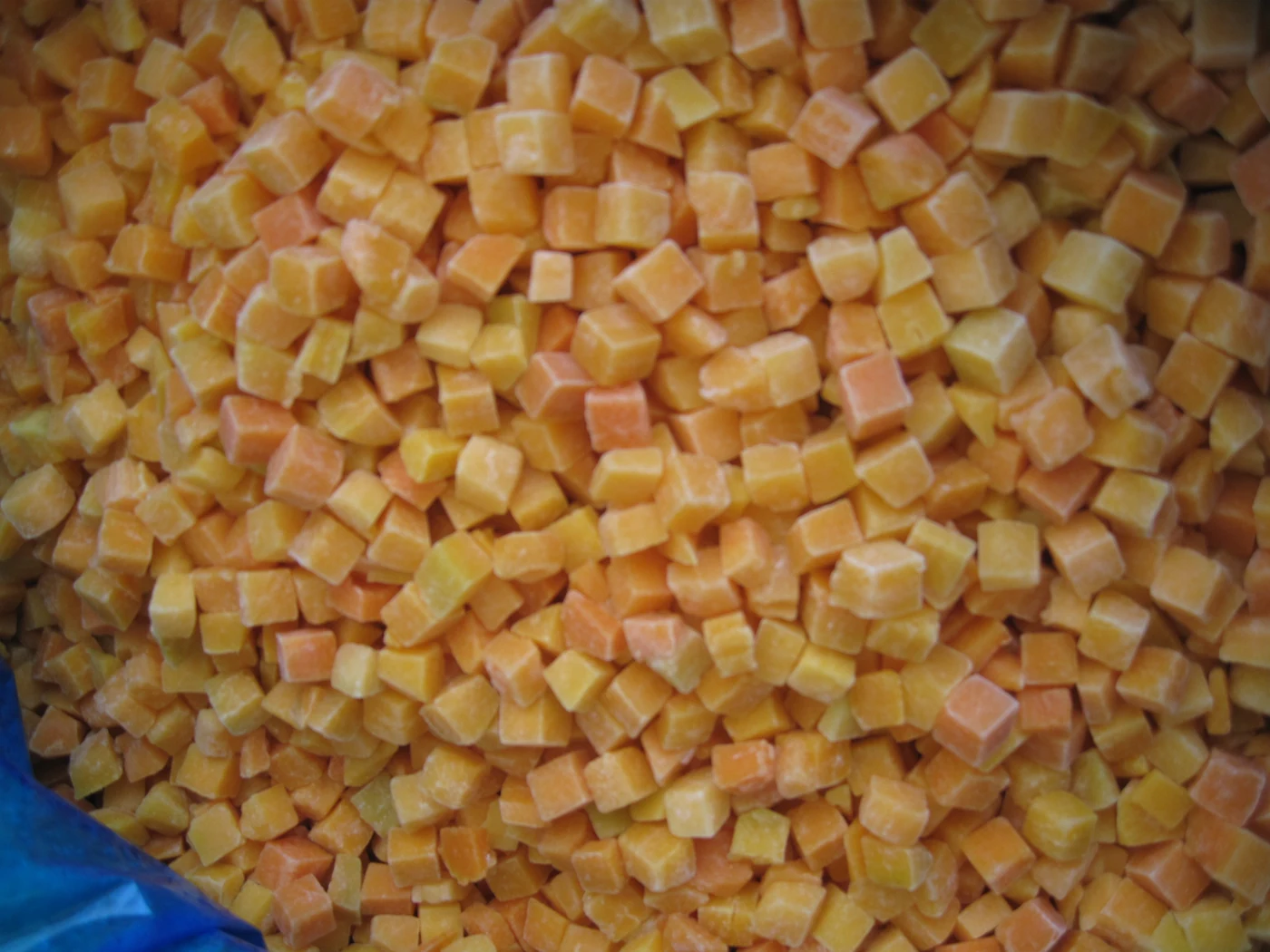
Visible cube surfaces and cut sizes support the product-form discussion, not a measured curry softening result.
The University of Minnesota’s freezing guidance [1] explains why frozen produce may soften: ice formation can damage cell structure. That helps explain a limit on expecting a fresh-like piece. It does not tell you how quickly a particular pumpkin cube will collapse in a particular curry. Cooking and handling add further changes, so a pack still needs an application check.
Look at the range of pieces in a portion, not just the neatest cube you can find. If you are choosing between cuts, separate the questions of centre tenderness, edge breakdown and sauce contribution. Our pumpkin dry-matter and cooked-yield guide addresses a related ingredient comparison. Curry adds a distinct question: how the pieces survive within an already seasoned liquid and the serving method.
Add pumpkin to a sauce that is already taking shape
Cook the aromatics and develop the main sauce before asking tender pumpkin to wait through those steps. The exact sequence depends on the recipe, but adding every ingredient at the beginning can keep the cubes in the pot longer than their role requires. Build a base with the intended seasoning and liquid, then use the pack directions to plan the pumpkin stage.
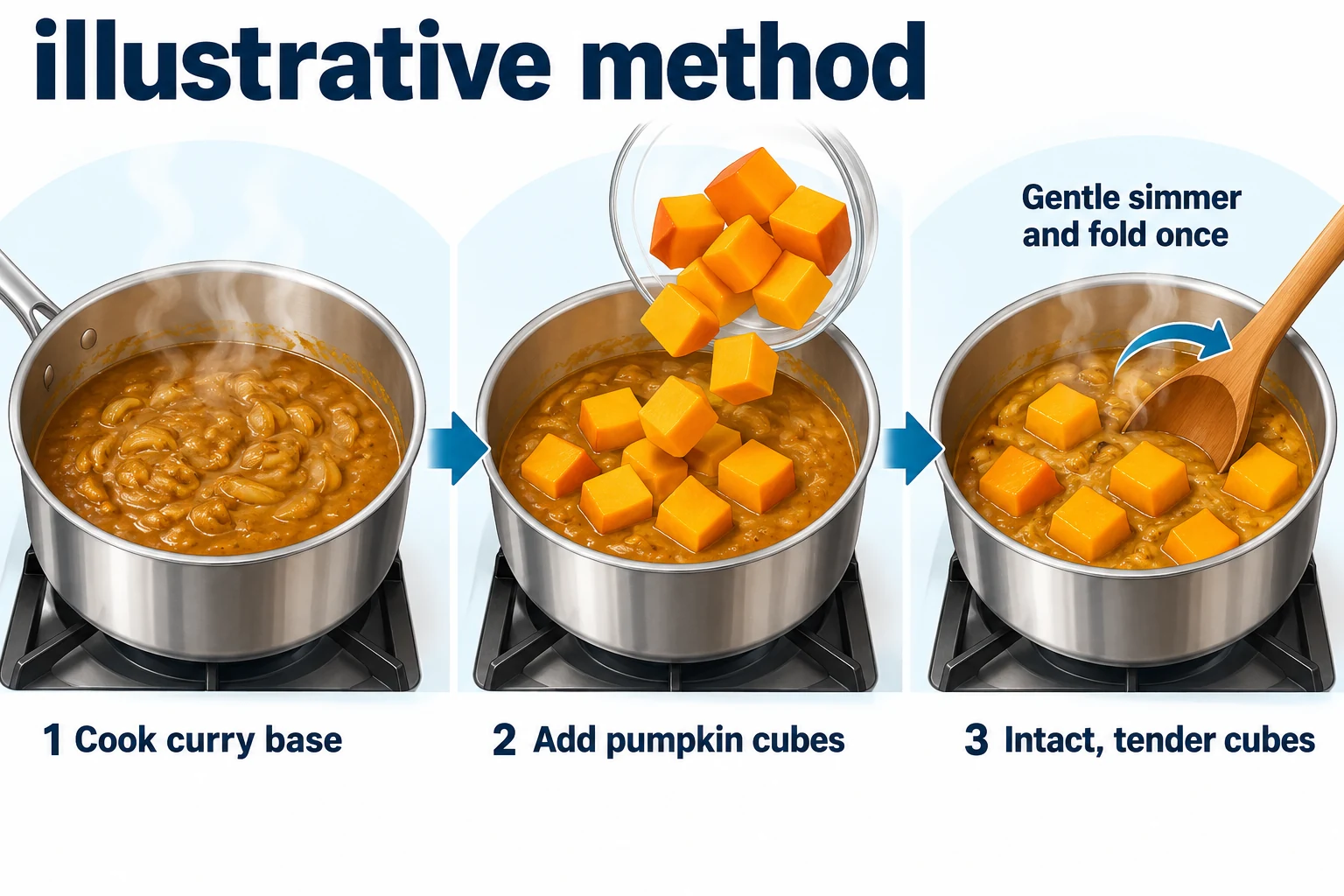
Illustrative method: build the curry base, add pumpkin cubes and handle gently. The drawn tender cubes are a target to check, not a proven outcome or cooking time.
Swipe to view the diagram on smaller screens.
Allow for the liquid introduced with the frozen portion. If the sauce is already thin, adding more liquid at the same moment can extend the reduction needed later. Avoid correcting that by aggressively boiling the whole finished curry after the pieces have reached their preferred texture. Instead, think about the starting sauce concentration and the ingredient sequence together.
Add pieces in a way that lets them separate without forceful scraping. A heavy clump may need more attention than freely flowing cubes. Keep the pan large enough to move the sauce around the pumpkin without repeatedly crushing it against other ingredients. This is a practical handling choice, not a promise that all frozen pumpkin will remain intact.
Fresh-pumpkin recipes can suggest a sequence, but their timings are tied to their own cut, variety and starting state. A recipe using skin-on fresh chunks is not a timing chart for smaller peeled frozen cubes. Use that recipe’s logic where it fits and assess your actual product. The point is to arrive at the intended centre and sauce together. See Peter Kuruvita’s pumpkin curry [2] and Budget Bytes’ pumpkin curry [3] for recipe examples.
Use a gentle simmer and fewer handling steps
Once the pumpkin is in the liquid, distinguish mixing the sauce from pushing the pieces around. An occasional gentle fold may distribute the ingredients sufficiently. Frequent vigorous stirring can knock softened edges away, particularly when pieces rub against the spoon, pan wall or firmer vegetables. Watch what your movement is doing rather than stirring because a timer says to do so.
Choose a heat level that supports the recipe without unnecessary turbulence. A rolling boil throws pieces against each other and can reduce the liquid faster than you intend. A gentle simmer is often a more manageable starting point for a curry that needs visible pumpkin, subject to the product’s preparation requirements. The observation remains the actual centre and the state of the sauce.
Check a representative large piece with a clean utensil. If its outside yields but the centre remains firmer than you want, do not conclude that the whole batch is done because the edges are soft. Conversely, continuing simply to match a published minute count can over-soften an already tender portion. A recipe time is a guide to a particular method; your endpoint still needs inspection.
Leave room for the final additions. Coconut milk, cooked legumes, greens or other ingredients may need a later stage, depending on the recipe. If pumpkin has already reached the target before those additions are ready, lift it gently while completing the base where the method allows. Keep any holding and recombination within the handling requirements for the dish.
Thicken the sauce without destroying every cube
A thin sauce and tender pumpkin require a different response from a thin sauce and underprepared pumpkin. In the first case, more vigorous whole-pot cooking can destroy pieces that are already satisfactory. In the second, the remaining preparation may naturally change both the pumpkin and the liquid. Diagnose the combination before choosing a correction.

Illustrative method: separate puree can add sauce body while cubes retain a distinct piece role. No measured thickening ratio or uniform skin specification is implied.
Swipe to view the diagram on smaller screens.
If the method allows, lift fully tender pieces with a suitable utensil and reduce the sauce separately, then return them gently. Another approach is to build the sauce with a separate pumpkin puree from the start. These are preparation options to evaluate, not a recommendation to leave cooked ingredients waiting indefinitely. Keep the process appropriate to the dish’s handling plan.
Use a ladleful to inspect what the sauce actually contains. Some thickness comes from dispersed pumpkin; other body may come from coconut milk, a thickening ingredient or the rest of the recipe. Record which ingredient changed if you are comparing another version. Adding puree, starch and extra coconut milk together makes it difficult to know which correction produced the result you preferred.
Do not turn a successful appearance into an invented composition claim. A sauce that looks fuller has not thereby demonstrated a higher dry-matter value or a better pumpkin variety. The cooking observation supports a dish decision. If you need ingredient measurements for a commercial specification, they require their own defined evidence and method.
Judge pieces at the end of service
Inspect the bowl after the finishing steps, not only a cube removed halfway through cooking. A piece may retain its outline in the pot and then break when a deep ladle presses it against other ingredients. Another may look untidy but give a pleasant tender bite. Include the utensil and serving motion in the check because they are part of the actual experience.

Illustrative serving check: examine centre tenderness, piece boundaries and broken fragments. Appearance alone cannot establish doneness or a measured texture result.
Swipe to view the diagram on smaller screens.
Take a forkful containing both a piece and sauce. Ask whether the centre is suitably tender, the edges still have the intended definition, and the sauce carries the flavour without concealing every piece. Rice, bread or another accompaniment changes how the same sauce is experienced. Compare on the accompaniment you actually plan to serve.
If the recipe includes a holding stage, evaluate that defined stage rather than assuming an immediate tasting predicts it. Record the conditions used and inspect again before serving. This guide does not assign a universal holding interval. A kitchen needs the applicable food-handling requirements as well as a quality endpoint, and sensory appearance cannot replace those requirements.
Compare two packs in the same curry base
Make a single base, then divide it into comparable vessels where practical. Keep the pumpkin amount, piece description, starting state, heat arrangement and intended endpoint recorded. A comparison in two different sauces tells you about two dishes, not just the pumpkin. Use the same tasting and serving method so the handling difference does not decide the result by itself.
Compare observations separately rather than declaring one pack the winner after one glance. Centre tenderness, intact-piece proportion, edge breakdown, released liquid and sauce body can move in different directions. A sample suited to a smooth curry may not suit a bowl built around distinct chunks. That is an application fit question rather than a universal grade of ingredient quality.
The following observations form a proposed trial sheet, not results from a kitchen test we have performed. Record them in plain words first. If your team later introduces numerical ratings or a rejection limit, define those ratings before using them to decide an order or compare suppliers.
| Observation | How to compare | What it cannot establish alone |
|---|---|---|
| Centre tenderness | Check similarly large pieces at the defined endpoint | Safety or a universal cooking time |
| Piece boundaries | Inspect after the same ladling action | Variety or maturity from appearance |
| Sauce body | Taste on the same accompaniment | Measured dry matter or puree yield |
| Handling resistance | Use the same spoon and movement | Performance in every curry recipe |
Repair a thin sauce or unevenly cooked pieces
When a few centres remain too firm, look for cut variation or pieces that stayed clumped rather than assuming that every cube needs the same extra stage. Where the preparation method permits, give those pieces the remaining cooking they require without subjecting already tender pieces to unnecessary movement. Adjust the next batch’s separation and cut choice if the problem repeats.
When the sauce is thick but the pieces are not ready, check whether the starting liquid was too concentrated for the preparation stage. Add the appropriate recipe liquid cautiously and continue within the product directions. Constant scraping of a drying pot may damage the softened edges before the centre catches up. A different starting base can be a better correction than more stirring.
If almost every piece has dispersed, decide whether the current dish still meets your intended use. You may have made a sauce-led curry rather than a chunk-led one. Record that result honestly, then change one relevant factor in the next attempt: cut, preparation state, addition point or handling. More orange colour will not reconstruct lost cubes.
For another batch, review the available frozen pumpkin forms alongside the dish requirements. Choose on the basis of the actual cut and preparation state, then repeat the same final-bowl check. A curry with a satisfying sauce and distinct tender pieces comes from coordinating those conditions, rather than asking colour or a single timer setting to make the decision.
