


On this page
Choose unroasted frozen sweet peppers when you want to develop the pepper flavour within your own sauce process. Consider roasted peppers when a declared roasted flavour is part of the brief and the supplied ingredient can deliver it consistently. Neither description tells you enough about peeling, blanching, retained juice or the behaviour of the finished sauce. Compare those details before treating the two products as interchangeable.
A red pasta sauce, a smooth soup base and a sauce with visible vegetable pieces can favour different pepper preparations. The useful question is whether the ingredient reaches your target flavour and texture at a repeatable finished yield. A darker sample or a lower price per frozen kilogram does not answer that question.
Define raw, unroasted and roasted in the specification
Start by replacing the word “raw” with a processing declaration. A supplier may use it to distinguish peppers from a roasted product, while a developer may understand it to mean unblanched. Those are separate statements. Ask whether the peppers are unroasted, whether they have been blanched, whether the skin has been removed and whether anything has been added before freezing. Record the answers against the product code being sampled.
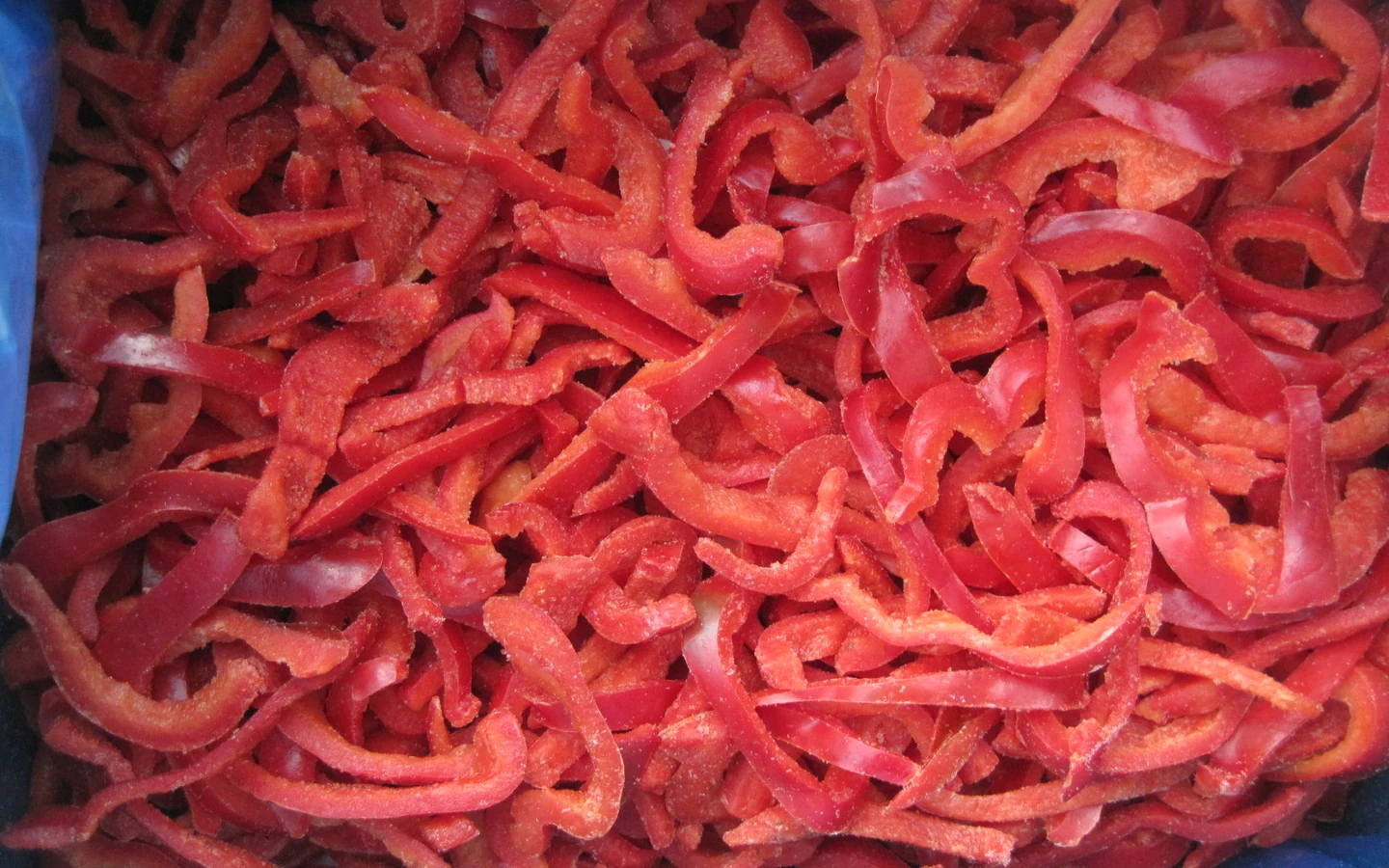
Original product photograph of red sweet pepper strips. Appearance alone does not establish the blanching or roasting declaration.
The USDA frozen sweet pepper standard illustrates why this distinction matters: its product description allows peppers that may or may not be blanched. Its listed whole, halved, strip and diced styles are unpeeled. That document is useful for understanding the scope of a particular specification; it does not automatically define a peeled roasted ingredient or establish that any frozen pepper is ready to eat. Keep the intended cooking use explicit.
A practical purchase description separates colour and cut from treatment. “Red sweet pepper strips, unroasted, unblanched, skin on” conveys a different requirement from “red sweet pepper pieces, roasted, peeled.” Each still needs its own dimensions or size description, ingredient declaration, packing arrangement and acceptance conditions. If the supplier uses a different processing term, resolve that difference before approving the sample name.
Check the packing medium as well. Pepper flesh packed with its own released juice cannot be compared fairly with drained flesh unless the recipe accounts for the liquid. Added water, oil, salt or other ingredients change the formulation question again. Do not infer their absence from a photograph of clean red pieces. Obtain the actual product declaration and keep it with the sample record.
At XMG Food, our listed frozen pepper range includes unblanched peppers in different colours and cut forms. A roasted requirement needs a separate review of whether a suitable supply route can be confirmed. We would establish the treatment and product details before presenting an option as comparable.
Set the flavour target in the sauce
Describe what the pepper must contribute to the finished recipe. “Roasted flavour” might mean a recognisable cooked pepper note with limited bitterness, a stronger smoky impression, or a background note that supports tomato. These are different briefs. A sample that performs well in a strongly seasoned sauce may dominate a mild cream sauce. Agree which recipe will decide acceptance.

Illustration of two treatment styles. It does not imply that every roasted pepper is peeled or that appearance measures flavour intensity.
A 2023 sensory study by Uppili and colleagues developed a vocabulary for fresh and preserved peppers using trained panellists and commercial samples. The authors associated roasted red bell pepper products with descriptors including smoky, burnt and cooked tomato. The study supports using more specific language than “good roasted taste.” It does not establish a preferred intensity for your sauce or prove how a particular frozen lot will perform.
Separate aroma, flavour and aftertaste during the trial. A pepper can smell strongly roasted when warmed on its own yet contribute a less distinct note after dilution with other ingredients. Conversely, an unwanted burnt aftertaste may remain noticeable in the complete sauce. Record the observation in the actual sauce, including the serving temperature and the time between preparation and assessment.
Keep colour as a separate assessment. Roasted flesh may look different from unroasted strips, but brown or black areas do not measure aroma intensity. A developer should not approve flavour from a photograph or use the darkest sample as the automatic reference. Retain descriptive notes alongside a controlled sample or other reference that the team can use consistently.
Run the first comparison without changing the seasoning to rescue either option. Otherwise, a difference attributed to pepper treatment may come from a changed salt, acid or spice level. Once the original difference is understood, a second trial can adjust the recipe deliberately. Record those adjustments so purchasing knows whether the selected pepper is a direct replacement or part of a reformulation.
Where the sauce will be held, packed or reheated, assess the agreed endpoint as well as the fresh kettle sample. A customer buying a chilled meal may never encounter the sauce at the moment the developer first tastes it. Use the customer’s real preparation instructions and your established food safety controls; this comparison is not a substitute for validating the finished product’s process.
Separate peel, char and particle observations
Peeling is an independent specification choice. Roasted peppers can be supplied with different skin removal requirements, and “roasted” alone should not be interpreted as “fully peeled.” For a smooth sauce, small membranes may matter more than the original piece shape. For a sauce containing visible vegetables, the developer may care more about recognisable flesh pieces and their bite.

Illustration: record skin, seeds and flesh as distinct fractions. No defect tolerance or actual inspection result is shown.
Inspect retained skin, seeds, core material and pepper flesh as distinct findings. A single entry labelled “bits” gives the supplier little information to investigate. Note what was observed, where it was found and whether it remained visible after the agreed blending or screening process. Photographs help identify the finding, but they need a stated sample basis if they are used to support an acceptance decision.
Charred material needs its own agreed description. Do not group every darker area with loose skin, and do not assume that every dark particle is an acceptable consequence of roasting. Where the identity or condition of material is uncertain, refer it for the appropriate quality assessment. The sauce development team can record appearance and sensory effects without guessing a cause from colour alone.
For a screened sauce, collect and describe the material retained by the actual screen used in the trial. Record the screen specification, preparation method, input mass and retained mass. The result belongs to that method. A different aperture, mixing sequence or preparation endpoint can give a different retained fraction, so a percentage without these details is difficult to use in a supplier discussion.
| Sauce requirement | Observation to record | Purchase detail to resolve |
|---|---|---|
| Smooth texture | Visible membranes and retained material after the agreed preparation | Peeling requirement and identification of residual skin |
| Visible pepper pieces | Piece survival, bite and distribution at serving | Cut form, treatment and acceptable fragmentation |
| Roasted character | Desired aroma and any unwanted burnt aftertaste | Treatment description and sensory reference |
| Clean ingredient identity | Seeds, core material or unidentified findings | Separate defect descriptions and assessment basis |
A fruit morphology study by Guerra and colleagues examined roasting quality and waste within a particular Spanish roasted pepper production context. It is a reminder that input material and peeling performance can be connected. Its abstract is not a basis for assigning a universal peeled yield to other varieties, factories or frozen products. Ask for evidence from the proposed ingredient and the method relevant to your sauce.
Compare liquid, solids and sauce consistency
Begin with a mass balance before deciding that one pepper is “watery.” Record the frozen input, the material entering the sauce, any liquid separated and any material discarded. Then record finished sauce output. These quantities describe different things. A drained ingredient yield does not by itself establish sauce yield, and released liquid is not automatically waste.
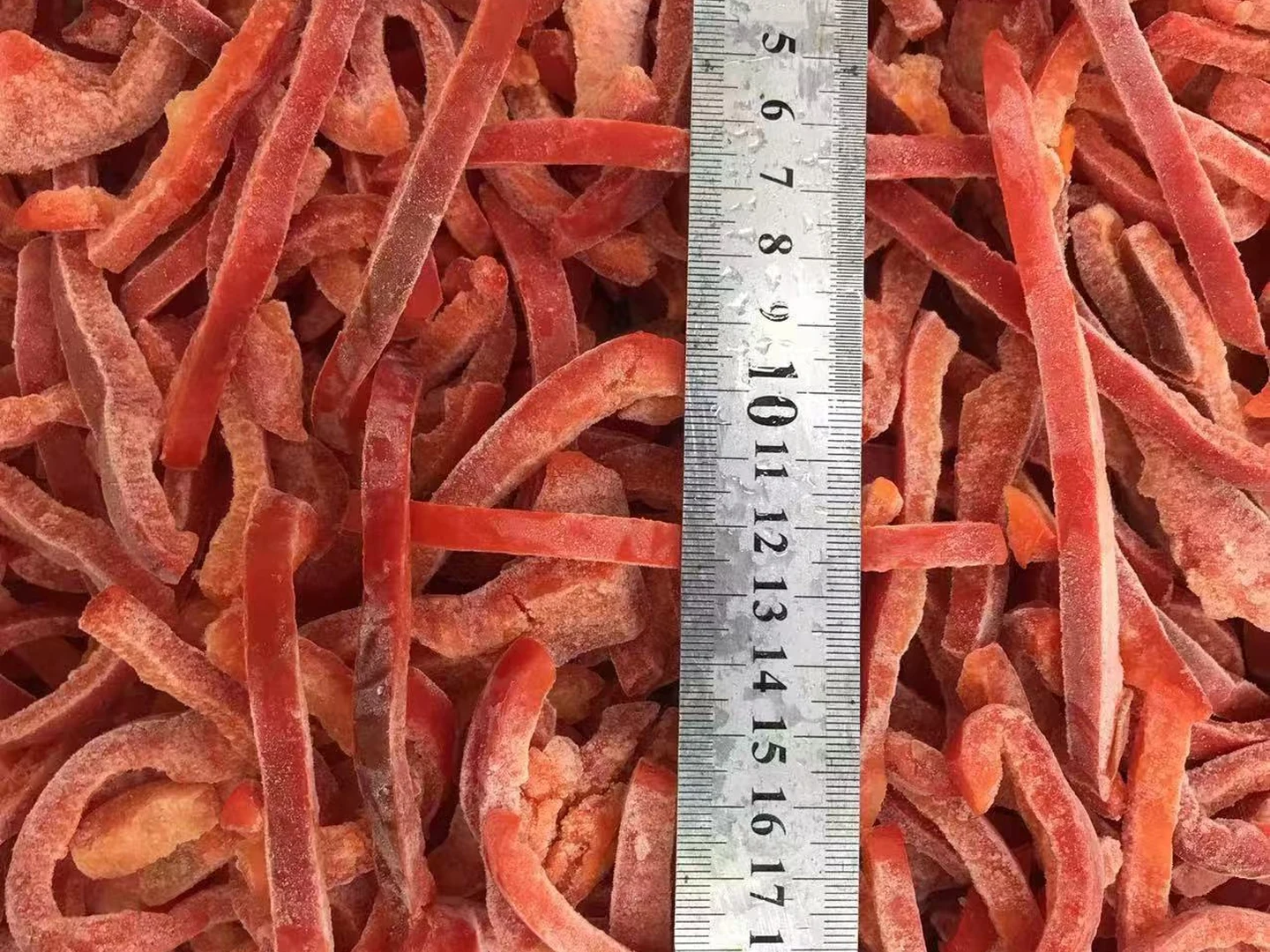
Original product photograph. The ruler gives visual context; this is not a certified size assessment or a fixed cut-length claim.
Consider a hypothetical 1,000 g pepper sample that separates into 850 g of flesh and 150 g of liquid under an agreed method. If the recipe uses both fractions, all 1,000 g enters the sauce. If the recipe discards the liquid, 850 g enters before any later processing losses. Calling the first case a 15% ingredient loss would be misleading. The example demonstrates accounting, not an expected commercial pepper yield.
The separated liquid may carry flavour and other ingredient components; do not treat it as interchangeable with an equal mass of plain water without testing. If one trial retains it and another discards it, record that as a formulation difference. Likewise, compare any declared added medium with the ingredient list and the actual handling method used by the kitchen or production line.
Compare incoming cut forms as well. Strips, dice and irregular roasted pieces can enter the mixer differently, even when the recipe uses the same frozen mass. Document the cut and the preparation sequence before comparing the final sauce. A photograph beside a ruler provides context for the sampled pieces, but it is not a substitute for a defined size assessment across a representative sample.
Define consistency at a stated temperature and observation time using the method appropriate to your product. A visual pour test, a controlled flow measurement and an instrument reading are not interchangeable records. Choose one method that can distinguish relevant differences, document it and use it consistently. Record separation or visible particles separately when they affect acceptance.
A soluble solids reading also needs its own interpretation. Do not label it total pepper solids or assume that it explains viscosity on its own. If the formulation decision requires dry matter or another analytical quantity, agree the appropriate method with the technical team. Avoid turning a convenient reading into a claim it was not designed to support.
The UC Davis bell pepper factsheet describes firmness and water loss in fresh produce. Those observations can inform raw material discussions, but they do not establish the cause of liquid release from a supplied frozen product. Evaluate that product under its declared treatment and your controlled preparation conditions before assigning a processing explanation.
Run two fair formulation trials
Use one trial to answer whether the peppers can be substituted in the existing recipe. Use a second to answer which option works best when the recipe is adjusted to the agreed target. Both questions are commercially useful. Mixing their results in one comparison can make a preferred option look cheaper or more consistent than the evidence supports.

Illustration of two trial questions. The bowls show comparison routes, not measured sauce results or equivalent viscosity.
In the direct substitution trial, use the same pepper input mass and keep the other ingredients, batch size, equipment, preparation sequence and assessment endpoint fixed. Declare how any associated liquid is handled. Record flavour, particle behaviour, consistency and finished output. If the original process is unsuitable for the alternative ingredient, record that limitation instead of silently changing it halfway through.
In the adjusted recipe trial, allow documented changes to reach the target sauce. These might include a revised pepper proportion, liquid addition, blending stage or preparation sequence. Each change needs a reason and a recorded quantity or condition. The outcome is a candidate recipe with its own cost and process requirements, rather than proof that the original ingredients were equivalent.
Use coded samples for sensory assessment where practical, and avoid giving assessors the purchase price before they record their observations. Keep the serving order and sample temperature controlled. The purpose is to reduce avoidable influences on the comparison. A small development trial still needs subsequent confirmation at the scale and operating conditions that will supply the customer.
Repeat the comparison with independently identified samples where the decision depends on consistency. Two bowls drawn from the same preparation do not show variation between production lots. Record supplier product code, batch identity, sample receipt condition and preparation date. If an important result changes, review the material and method before declaring one treatment intrinsically unreliable.
Make the result actionable. “Sample B preferred” is incomplete without the recipe version, the attributes that drove the preference and any outstanding issue. A useful decision might state that a particular peeled roasted sample met the flavour brief after a documented recipe adjustment, while residual skin still requires agreement. That gives purchasing a concrete condition to resolve before an order.
Choose the purchase basis for repeat sauce production
Compare cost at the point your business sells or uses the sauce. The pepper price per kilogram is one input, alongside usable material, other recipe ingredients, preparation work, screening losses and finished output. Keep actual quotations separate from development assumptions. A lower frozen ingredient price can still require extra work, while a higher price may not produce a worthwhile sensory benefit.
For example, suppose an ingredient costs 3.00 currency units per purchased kilogram and an agreed process uses 0.85 kg of flesh from that kilogram while discarding the remaining fraction. Its pepper cost is about 3.53 currency units per kilogram of used flesh, before other costs. If the recipe uses all fractions, that calculation does not apply. This is an illustrative purchase basis, not a market price or a forecast of yield.
Agree the receiving check separately from the application trial. A warehouse sample can verify product identity, packing and the agreed visible criteria, while the sauce trial examines performance under a defined recipe. State which checks occur on every delivery and which require periodic or change-triggered application review. Keep the retained sample identification connected to the delivery record so that a later complaint can be compared with the correct material.
Include production handling in the commercial comparison. A kitchen using full bags per batch has different weighing needs from a line drawing small amounts repeatedly. Confirm bag size, portioning method and any agreed handling instructions with the supplier. These details affect whether the approved ingredient can be used consistently by the staff and equipment that will make the sauce.
Use the approved recipe trial to write the pepper purchase specification. Include treatment and peeling declarations, colour and cut, ingredient composition, packing format, agreed defect descriptions and the preparation method used for assessment. Attach the sensory reference or written target where relevant. Identify which criteria are supported by supplier documents and which were established in your own application trial.
Then identify what would trigger another trial. A change in treatment, peeling requirement, added medium or supplied cut can affect the basis of approval. A proposed replacement should be compared against the approved product description rather than accepted because it still carries the name “red pepper.” We can coordinate those specification questions through our product specification and sampling process.
Before the first commercial order, close the remaining questions in writing: the exact product being supplied, how its sample relates to production, the recipe version approved by the buyer and the records required with delivery. This gives the supplier a defined requirement and gives the sauce team a usable reference when subsequent batches arrive.
Frozen Peppers
Review our frozen peppers range, product forms and specification options.
View Frozen Peppers →References
- [1] USDA Agricultural Marketing Service: Frozen Sweet Peppers Grades and Standards.
- [2] USDA: United States Standards for Grades of Frozen Sweet Peppers, effective March 13, 1959. Product and style definitions.
- [3] Uppili B, LaFountain LJ and Johanningsmeier SD: A sensory lexicon to characterize the quality of fresh and preserved peppers. Journal of Food Science, 2023;88(12):5216–5235. Abstract consulted.
- Guerra M, Gómez RM, Sanz MA, Rodríguez-González Á and Casquero PA: Effect of Fruit Weight and Fruit Locule Number in Bell Pepper on Industrial Waste and Quality of Roasted Pepper. Horticulturae, 2022;8(5):455. DOI: 10.3390/horticulturae8050455. Author abstract reproduced by DOAJ consulted.
- Cantwell M: Bell Pepper. UC Davis Postharvest Research and Extension Center produce factsheet, April 1996. Fresh produce context.
