


On this page
Frozen green peas and dried split peas are related foods, but they are not direct substitutes. Frozen green peas are tender peas preserved after vegetable harvest. Dried split peas are mature dry pea seeds divided into halves. The difference is much greater than whole versus broken: maturity, water content and the way the ingredient behaves during cooking all change.
A clear broth or rice dish that needs separate green peas will usually change substantially if dry split peas replace them. A thick pulse soup built around cooked split peas will also change if frozen green peas are used instead. Both can make good food, but they reach different textures through different preparation routes.
Do not use a universal weight-for-weight swap. Dry split peas take up water during preparation, while frozen green peas arrive as a moist vegetable ingredient. Choose according to the final structure you want, then use a recipe designed for that form or deliberately redesign the liquid and cooking stages.
A tender vegetable and a dry pulse
Garden peas are harvested for vegetable use while their seeds are tender. Dry peas are collected after the seed and pod have matured and dried. Utah State University Extension’s pea-growing guide [1] makes the harvest distinction explicit. A shared pea family explains the relationship, while the harvest endpoint explains much of the cooking difference.
Commercial vegetable and dry-pulse crops may also be selected for different characteristics. It is too simple to imagine that every retail split pea is a frozen garden pea that somebody left out to dry. Cultivar, maturity and processing all belong in the description. The useful kitchen distinction is the ingredient’s actual state, not an assumption that two bags must have come from the same crop variety.
Green colour is not a reliable shortcut. Mature dry peas can be green as well as yellow, so a green split pea is not necessarily an immature vegetable pea. Similarly, a frozen green pea is not a dry pulse merely because its skin has cracked. In a frozen product, broken or skin-split peas describe condition within the vegetable ingredient, not the identity of a packet of dried split peas.
Keep edible-pod peas separate as well. Snow peas and sugar snap peas are used with their intended edible pods. Ordinary green shelling peas are the seeds removed from the pod. Purdue Extension’s green-pea guide [2] distinguishes these forms. A recipe that requests one does not automatically accept either of the others.
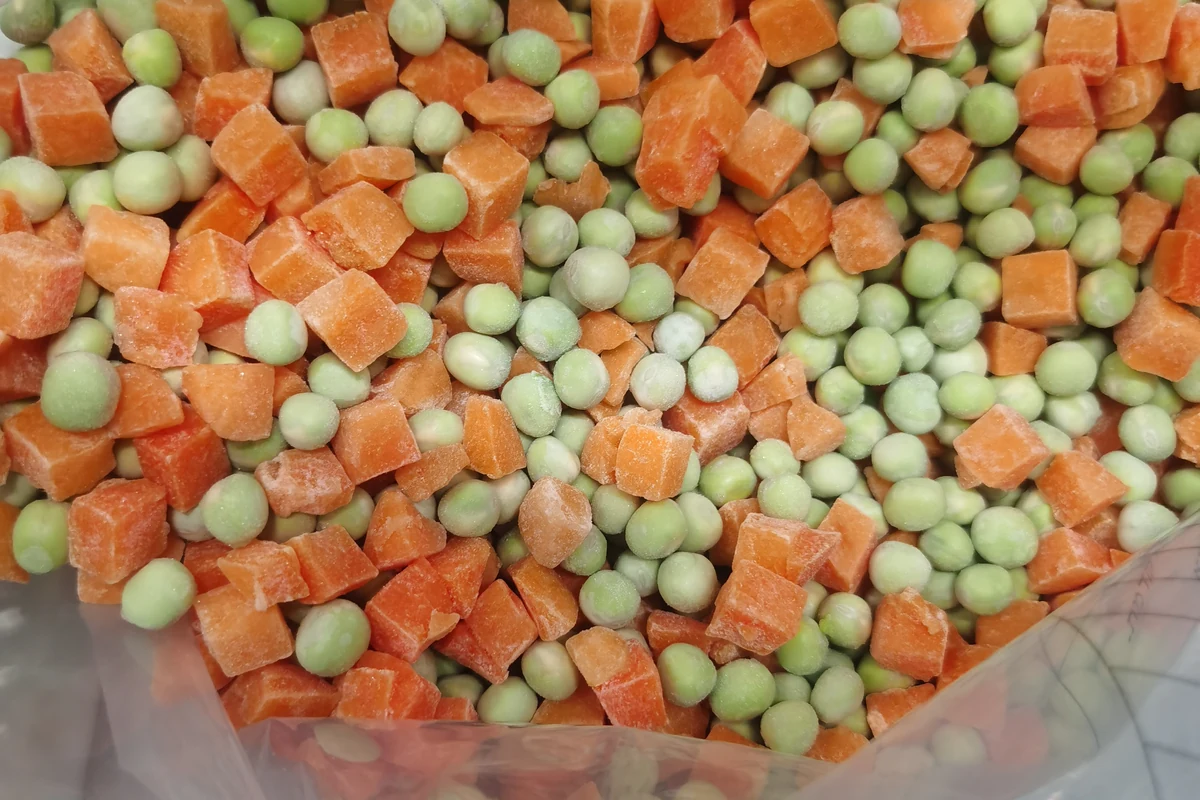
This frozen mixture includes peas and carrot pieces; it is neither a plain-pea product nor a dry pulse.
What drying and splitting change
Drying changes the starting water content and storage form of a pea. Splitting exposes the two seed halves and changes the geometry presented to the cooking liquid. A split pea is a pulse ingredient that must be hydrated and cooked to its intended endpoint. A frozen vegetable pea starts from a different structure, even when both foods end up in a saucepan.
During preparation, dry split peas take up water and soften. With suitable cooking, the pieces can lose their separate identity and contribute a thick body to a soup or purée. Whole frozen green peas tend to offer discrete vegetable pieces when prepared for that purpose. Blending can change either result, but blending a moist vegetable is not the same operation as cooking a dry pulse until it softens.
Presoaking is another common point of confusion. Dry split peas generally do not require the overnight soak associated with some other dry legumes. The dry-pea guidance from the pulse industry [3] describes that distinction. Follow the pack or a tested recipe for the particular ingredient; “no soak required” still means that appropriate cooking is needed.
Do not interpret a suggested cooking time as a guarantee for every bag, pot or recipe. The amount of liquid, cooking equipment and desired endpoint matter. The practical observation is whether the pulse has reached the texture the dish requires. Frozen vegetable peas need their own product directions, rather than a borrowed pulse-cooking schedule.
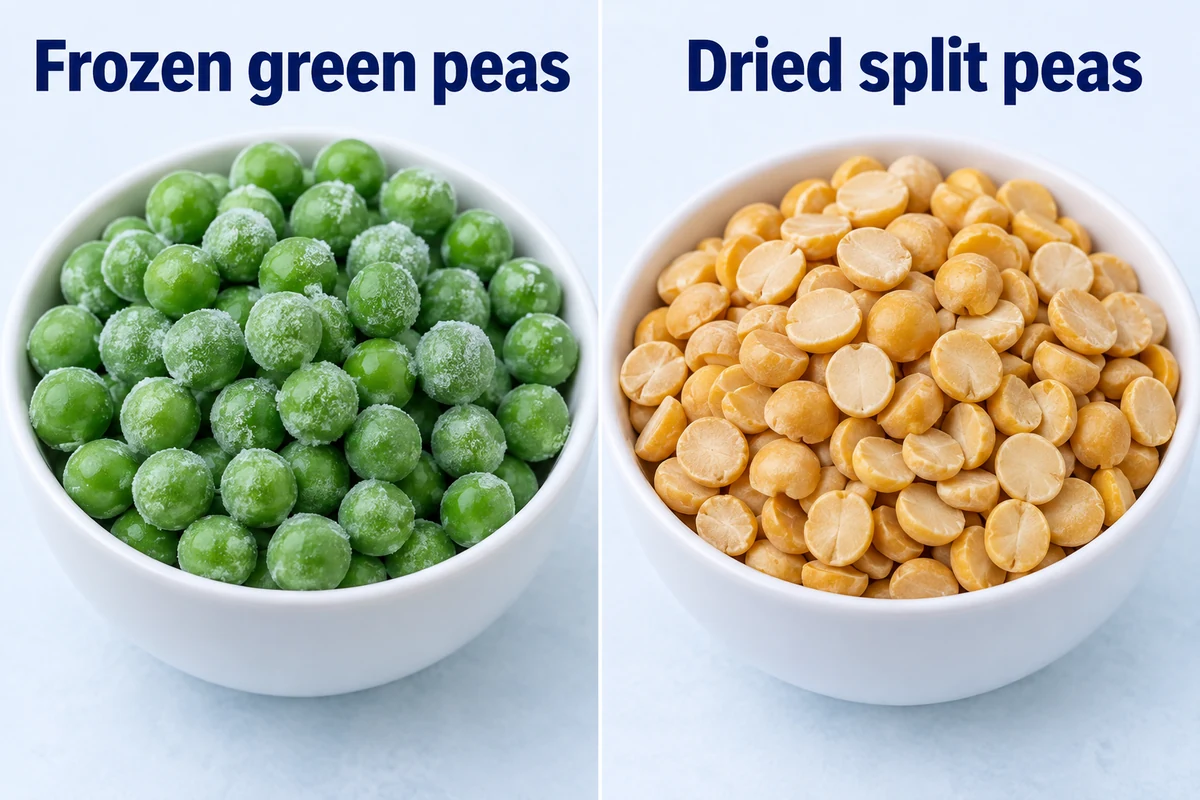
Yellow split peas illustrate a mature dry pulse; green split varieties also exist.
Why weight is a poor substitution rule
A weight of dry split peas describes largely dry material. A weight of frozen green peas includes the water within the vegetable. Those are different starting points for a recipe’s water and solids balance. Replacing the same number of grams does not keep the concentration or the finished volume constant.
The dry pulse also draws water into its developing cooked structure. If it replaces green peas in a recipe with very little free liquid, the dish may need a completely different preparation. Adding extra water without considering the other ingredients can then create a second problem: meat, vegetables, seasoning or sauce may reach their endpoints before the pulse does.
The reverse substitution changes thickening. If a split-pea soup depends on cooked pulse material to provide body, frozen green peas may create a lighter vegetable soup unless the recipe is reformulated. A blender can make it smoother, but it cannot make the raw-material states equivalent. The desired result may be delicious while still being a different dish.
| Recipe requirement | Frozen green peas | Dried split peas |
|---|---|---|
| Starting form | Moist tender vegetable seeds | Mature dry seed halves |
| Desired separate pieces | Suitable for whole-pea dishes | Depends on cooking; may soften into the body |
| Liquid planning | Follow the vegetable recipe and product directions | Provide the liquid needed for pulse preparation |
| Direct replacement by weight | No universal equal-weight conversion | |
For a redesigned recipe, measure the ingredient in the state actually used. Record dry input separately from cooked, drained output. If prepared split peas are being added to a finished dish, say so explicitly. That is more useful than a note that simply says “peas,” because it establishes whether hydration has already happened.
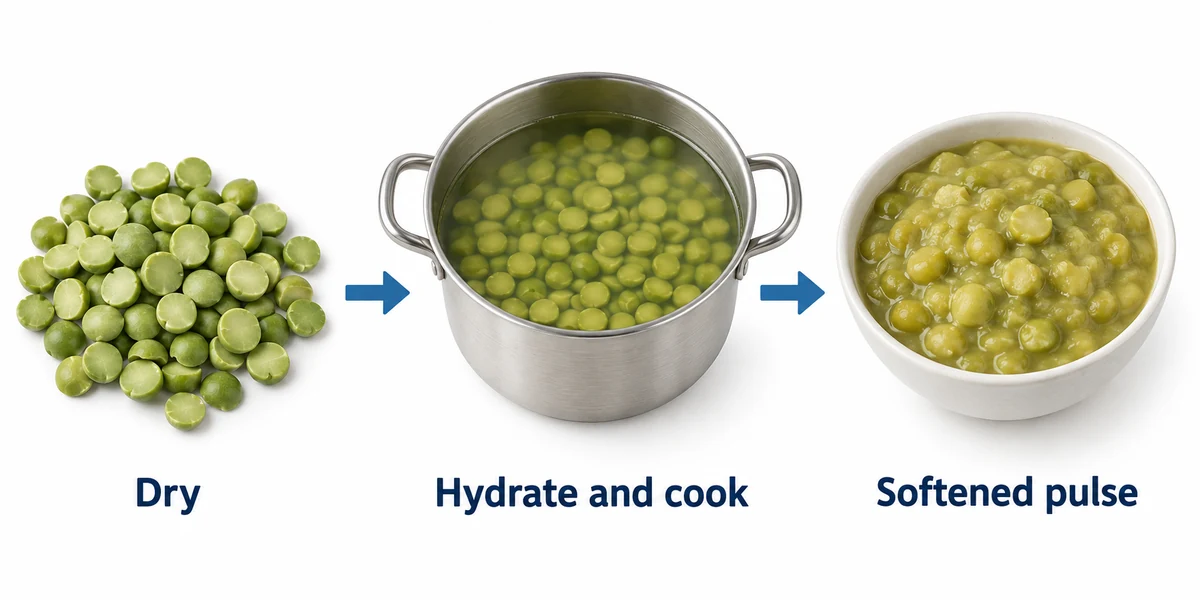
Illustrative preparation sequence; no soak rule or universal cooking time is implied.
Choose by the texture the dish needs
For a clear broth, stir-fry, rice dish or vegetable filling, individual whole peas can provide visible green pieces and a distinct bite. Dried split peas introduce a different appearance and cooking demand. They are not a quick addition that can be expected to behave like a frozen vegetable near the end of preparation.
For a thick soup, dhal-style preparation or pulse purée, cooked split peas can contribute to the main body. University of Maine Extension’s guide to dry legumes [4] describes their culinary use. Frozen green peas can also be used in smooth soups, but the recipe must account for that vegetable ingredient rather than assume an identical pulse structure.
Colour and flavour belong to the decision too. A soup made with yellow split peas will not look like one made with green vegetable peas. Green split peas also do not guarantee the bright green appearance of a tender vegetable preparation. Decide whether colour is an important part of the dish before treating it as a minor difference.
A useful first step is to describe the endpoint in plain words: “clear broth with separate pea pieces,” “thick soup with a soft pulse body” or “smooth green vegetable purée.” That description tells you which ingredient and preparation deserve consideration. A general category such as “pea soup” is too broad to establish interchangeability.
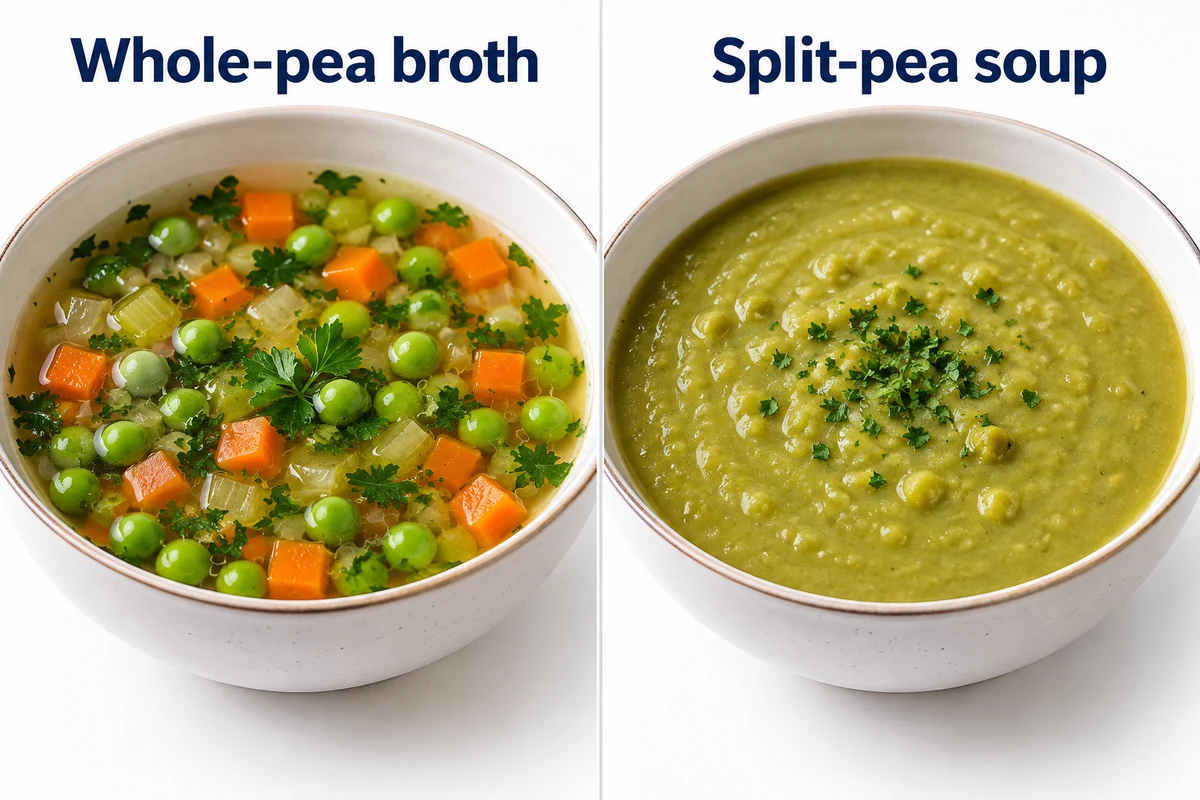
Whole vegetable pieces and a cooked pulse body are different culinary endpoints.
When a recipe can be redesigned
A flexible soup or stew may accommodate a change of pea ingredient, provided the change is treated as a new formulation. Start by deciding which qualities must stay: a particular thickness, visible whole pieces, a colour, or the role of peas as a small addition rather than the main food. Then choose a preparation route that supports those qualities.
One practical option is to prepare the dry pulse separately according to its directions before considering it as an addition. This prevents the original dish’s cooking schedule from being silently assigned to the dry ingredient. It still does not provide an equal-weight substitute. The prepared pulse brings its own moisture and texture, which need to fit the rest of the dish.
For the opposite change, use a vegetable-pea recipe as the starting point. Assess the liquid and final texture rather than adding frozen peas to a split-pea formula and hoping the body remains the same. Keep any thickening adjustment explicit. Otherwise, a starch or other added thickener may conceal the fact that the pea ingredient now has a different role.
Small trials are useful when a dish must meet a repeatable appearance. Keep the base seasoning consistent, record the prepared form, and compare the result at the intended serving temperature. This is a suggested method, not a claim that two particular products were tested here. If the alternative meets your goal, retain the revised recipe instead of calling it a universal substitution.
Read the complete frozen product name
A frozen bag may contain plain green peas, peas with a sauce, or a vegetable mixture. These are different ingredient statements. Peas visible among carrot cubes are still green peas, but the mixture as a whole is not a packet of plain peas. Replacing a specified amount of peas with the same amount of a blend changes the other vegetables and the amount of pea material supplied.
The photographs of pea-and-carrot mixtures illustrate that naming boundary. They show a frozen vegetable combination, not dry split peas and not a pure-pea product. The visible carrot content must remain part of the recipe decision. A cook may want that combination, but it should be chosen deliberately rather than inferred from the presence of green peas.
Similarly, “split peas” on a dry-pulse packet does not have the same meaning as “split or damaged peas” in a description of a frozen vegetable’s condition. One names a processed dry ingredient; the other describes the integrity of vegetable peas. Context makes the distinction clearer than the shared word “split.”
Our frozen green-pea product page describes the vegetable forms. A clear product and sample description helps distinguish ingredient identity from condition. Cooking guidance for soup made with frozen green peas answers a separate question once the ingredient has been selected.
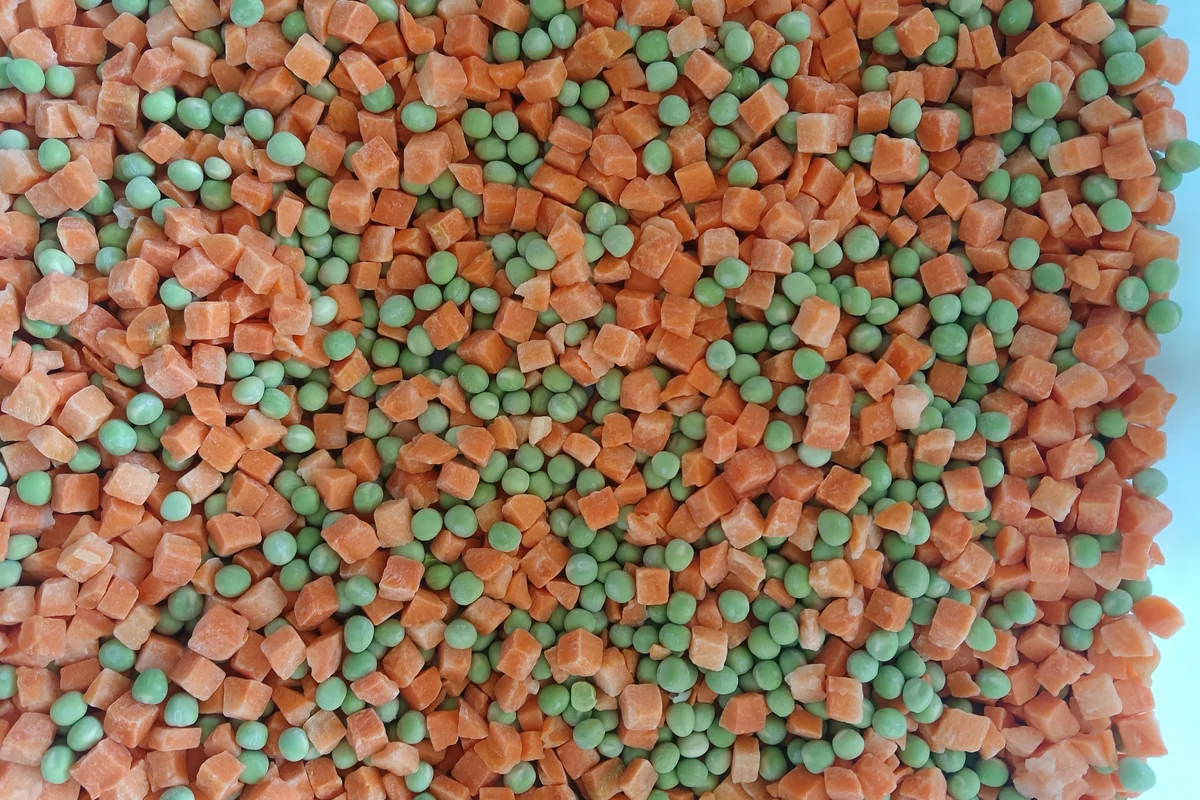
The complete ingredient identity matters: using a blend also adds its other vegetables.
Practical comparison without a false ratio
Begin by reading both packs and identifying the food state. Keep dry split peas, prepared split peas and frozen green peas as separate descriptions in your notes. Check whether the frozen product is plain or mixed, and whether any additional ingredients affect the proposed dish.
Next, write the texture target. If you need whole green vegetable pieces, evaluate that result directly. If you need a thick cooked pulse body, evaluate softening and body. Prepare each ingredient according to the relevant instructions, then compare the finished dish rather than treating appearance in the packet as a cooking forecast.
Finally, record any recipe changes. Extra liquid, separate preparation or a different finishing method are part of the new recipe. They should not disappear from the instructions once a small trial succeeds. The reliable conclusion is that an ingredient fits a particular revised dish, not that every frozen-pea recipe accepts dry split peas.
For more explanations of ingredient form, visit Food Knowledge and the frozen vegetable range. Write the ingredient into the recipe as ‘frozen green peas,’ ‘dry split peas’ or ‘cooked split peas,’ with any draining step beside the quantity. A prepared pulse and a dry pulse should never share an unexplained ingredient line.
For the frozen product forms discussed here, see our IQF Frozen Green Peas page.
View product forms →