


On this page
Frozen green onions need two separate checks when they are going into a sauce. First, can the selected cut be separated and taken from the pack while still frozen? Second, does the intended portion actually enter the sauce and spread through it under your mixing and cooking conditions? A loose-looking pack can still be dosed unevenly, while a few light contacts between pieces may separate before weighing. Name the type of clump you see, keep the product frozen during the initial observation, and test the ingredient in the sauce application before deciding whether the format works.
Quick answer: Record loose pieces, separable clusters, persistent fused masses and loose ice separately. Weigh the target green-onion portion, add it at the planned stage, then compare the amount delivered and its distribution in the finished sauce. A product-specific clump rule and a sauce-dose check answer different questions; neither should be replaced by a general claim that all IQF pieces must be perfectly separate.

Product photograph: frozen cut green onion in an open liner. The image shows form only; evaluate separation and dosing against an agreed sample.
Free flow is an ingredient property; dosing is an application result
“IQF” describes a preparation designed to keep pieces individual, but frozen packs are handled, stored and portioned after freezing. The useful operational question is not whether two pieces ever touch. It is whether the chosen cut can be separated in the frozen state by the action your specification allows and then portioned predictably. The Codex standard for quick-frozen vegetables [1] describes free-flowing units in terms of whether they can easily be separated while frozen. Its scope excludes products indicated for further industrial processing, so that definition is helpful language for a sauce buyer, not an automatic legal or numeric clump limit for every sauce ingredient.
Even if the pack pours, the sauce may not receive the intended amount. A light, fluffy cut can remain in a scoop, funnel or feed point. A compressed cluster can arrive as one sudden slug. Fine pieces may spread under one mixing sequence and gather under another. These are reasons to test the actual dosing step for the intended recipe. The result depends on the cut, package, target portion, sauce viscosity, addition point and the way the batch is mixed or held.
For a buyer, there are therefore three decisions: does the frozen ingredient meet the agreed free-flow presentation, can the intended mass be delivered consistently, and is the distribution acceptable in the finished sauce? Put them in separate fields. A pass on one field should not silently stand in for the other two.
Name the frozen state before assigning a cause
Spread a representative portion where you can see the pieces without warming them deliberately. Some pieces will be loose. Others may have light points of contact that break with the agreed gentle action. A persistent fused mass is different: it remains together after that action and may need more force, a longer interruption, or a separate handling decision. Loose frost or visible ice should be recorded on its own. Calling all four conditions “clumps” makes a supplier conversation less precise.
| Observed state | Question for the frozen check | Question for sauce use |
|---|---|---|
| Loose cut pieces | Do they separate and pour under the agreed pack-handling action? | Does the intended weighed portion reach the sauce? |
| Light, separable contacts | How many remain together after the agreed gentle separation? | Does normal portioning break them apart before addition? |
| Persistent fused mass | Does the mass remain intact; how is it counted or weighed? | Could it enter as a concentrated slug or interrupt the feed step? |
| Loose frost or ice | What is ice rather than vegetable material? | Does added free water matter to the sauce formula? |
Do not infer a temperature excursion, thaw-and-refreeze event, food-safety failure or production fault from a photograph of a cluster alone. More evidence would be needed to identify a cause, such as pack condition and relevant handling or temperature records. First describe the presentation in a way that supports a repeatable ingredient and application decision. If there are separate package-integrity, temperature or traceability concerns, investigate them through the appropriate quality process rather than using a sauce trial as a safety clearance.
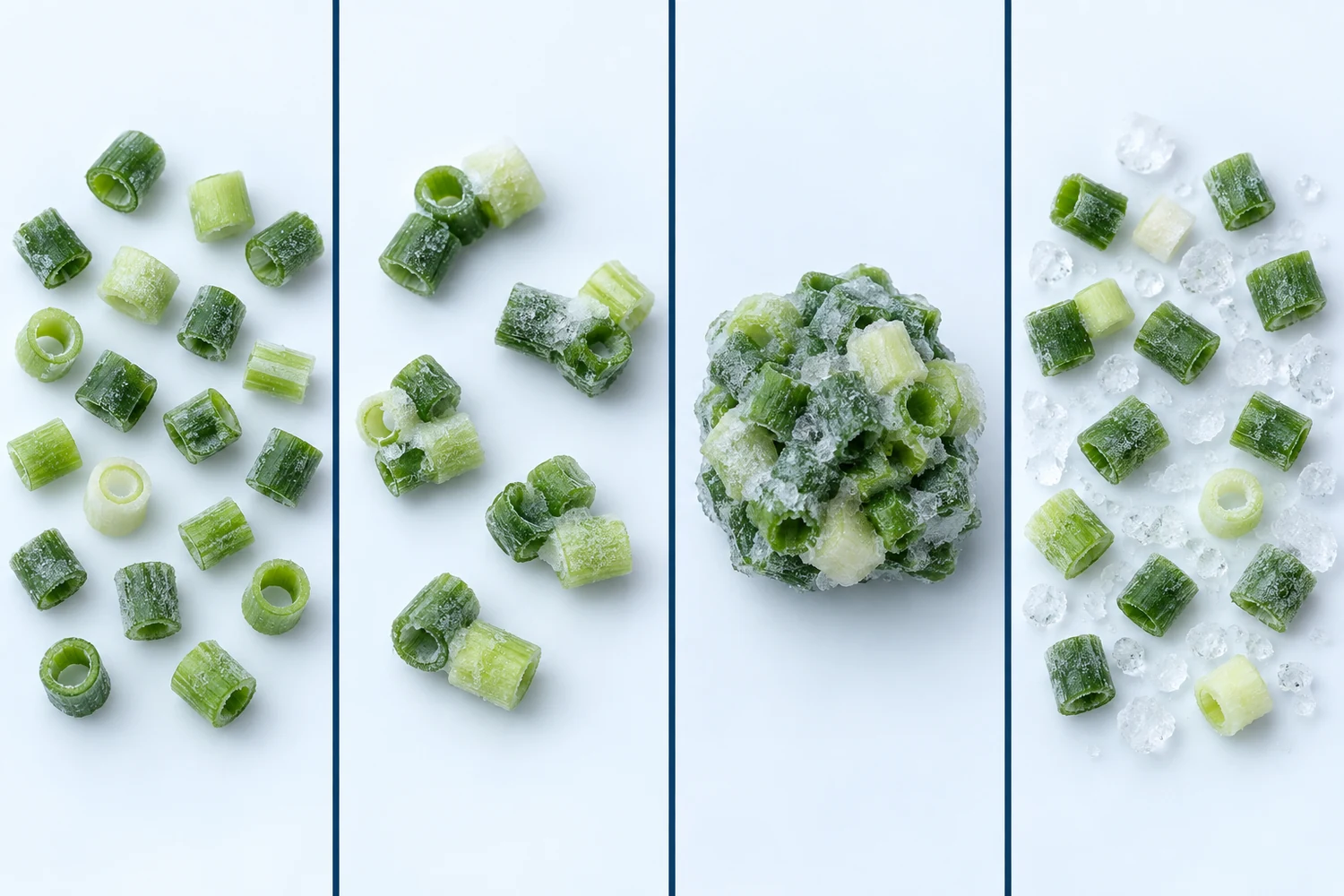
Illustration: loose pieces, light contacts, a fused mass and separate ice can call for different handling checks. This is a concept, not a tested lot.
Cut and pack presentation change the test
A fine dice, short ring, diagonal cut and strip will not occupy a scoop or travel through a feed point in the same way. They also look different after mixing into a sauce. Our IQF green onions range lists these forms and the product checks to confirm for a quoted item. The exact cut and written specification should lead the discussion. A clump condition stated for one offered product is not a universal allowance or proof of how it will behave in your sauce.
Start by naming the form that the recipe needs. A visible green ring may be wanted in a clear sauce, while a finer cut may distribute differently in a dense base. If the white-to-green mix changes, the colour you see in a spoonful can change even with the same total onion mass. That issue belongs to a separate component-ratio decision; our white-to-green ratio guide explains how to keep that comparison consistent. For this clump and dose check, hold the selected cut and ratio basis steady instead of treating a colour difference as evidence of a flow problem.
Pack size and the way the bag is opened matter too. A small kitchen pouch may be poured by hand. A bulk bag may be scooped or transferred to a hopper. In each case, record the action that a normal user is allowed to take. A requirement that clusters separate with one gentle manual action is different from one that assumes repeated crushing. A customer’s product specification from Frucom for one chopped spring-onion SKU [2] uses hand separability as its own clump rule. That shows how explicit the agreement can be; it does not set the rule for XMG or any other SKU.

Product photograph: cut green and pale onion sections. The pictured caliper does not establish a size tolerance; confirm the cut in the purchase specification.
Check a representative frozen pack before the sauce run
A small handful from the top of one opened bag can be misleading. The check should identify which packs or locations were sampled, when they were opened, the frozen condition at observation, the cut being examined and the handling action used. If a temperature is part of the acceptance method, measure and record it under the agreed procedure. Do not write down a default number and imply it was observed. Work promptly enough that the test remains a frozen-state check rather than a thawing demonstration.
Spread a measured portion and note how much is already loose. Apply the specified gentle separation action once, then record what remains together. Keep loose frost in a separate observation. Photograph a representative cluster beside a scale or another clear size reference if its dimensions affect handling. Most importantly, define the denominator: pieces, mass, packs, or another agreed basis. A statement such as “some clumps” cannot be compared with a specification written as a mass fraction.
For two candidate suppliers or two package formats, hold the observation method steady. Comparing a carefully separated sample from one bag with an untouched sample from another tells little about product difference. The sampling pattern should also represent the commercial pack you plan to use, not only a convenient display sample. The purpose of this exercise is to create a shared record for the ingredient decision; it is not to recreate a full quality-control investigation in a saucepan.

Illustration: inspect a representative frozen sample for pieces, contacts, clumps and ice before agreeing on a handling limit.
Then test the dose where the sauce is made
Once the frozen-state presentation is documented, run an application check that matches your intended sauce. Define the target onion mass per sauce mass or batch, the chosen cut, the point of addition, the mixing method and the cooking or hold sequence. Weigh what is taken from the pack and what actually reaches the vessel if your process has a transfer point. The difference matters: a correct scoop weight does not prove the entire scoop entered the sauce.
At the addition point, watch whether the pieces enter in a steady stream, several small portions, or one concentrated mass. Do not change the sauce mass and mixing intensity between samples if you want to interpret an ingredient difference. A thick cold sauce, a hot fluid sauce and a filling can pull the pieces apart differently. Those are legitimate applications, but each needs its own stated method. Use a scaled trial only if its dose, mixing and timing meaningfully represent the full process; otherwise report it as an exploratory kitchen check.
After mixing, examine the portion of sauce that the customer will encounter. Are the green-onion pieces spread acceptably, or are they concentrated in a few spoonfuls? Does a fused mass remain visible? Does the sauce take on extra free water or a change in texture that matters to the formula? If the sauce is filled into several units, sample at more than one point in the run so a good first scoop does not conceal a later dosing interruption. Record the observations under the same labels used for the frozen ingredient check.
There is no single green-onion dose, mixing duration, dispenser setting or distribution score that fits every sauce. Those values belong to the recipe and equipment being qualified. The useful output of a trial is an agreed decision: which cut and pack can be handled with the intended portioning action, and what finished appearance or distribution is acceptable.

Illustration: compare the portion picked up, the amount transferred and distribution in the chosen sauce during a buyer-specific trial.
Interpret a poor result without guessing the cause
If the frozen sample separates well but the sauce has a concentrated patch of onion, examine the addition and mixing step. If a persistent frozen mass remains intact and arrives as one slug, the ingredient presentation may be part of the problem. If the measured portion is short despite a loose ingredient, look at transfer loss or the dosing method. More than one issue can coexist. Record what happened at each stage before asking a supplier to change the product.
| Result observed | Question to isolate | Next record to keep |
|---|---|---|
| Pack separates, sauce has green-onion pockets. | Was the addition point or mixing sequence adequate for this sauce? | Dose, addition point, mixing time and distribution photographs. |
| Frozen mass remains intact after agreed action. | Does its size or mass interrupt portioning? | Pack identity, frozen sample, mass/size and separation action. |
| Target scoop weight exceeds amount delivered. | Where was material retained or spilled in transfer? | Weight before and after the transfer point. |
| Distribution looks uneven because colour varies. | Is the white-to-green ratio or cut changing what is visible? | Cut and ratio basis as well as actual onion mass. |
A favourable result in one sauce is not an assurance for every sauce. Viscosity, heating and hold conditions can change what the onion pieces do after addition. Likewise, a frozen-state check that meets the agreed presentation rule does not replace a finished-product check. Keep the two records linked, and decide whether the result calls for a different cut, a revised portioning method, a product-specification clarification or further investigation.
Write the requirement so another team can repeat it
A useful buying brief names the ingredient form, target cut, white-to-green balance if it affects appearance, package format, intended sauce and dose basis. It defines what counts as a clump, the frozen-state condition and permitted separation action, and how any remaining material is counted or weighed. It then states how the application will be checked: target and delivered onion mass, sauce mass, addition point, mixing and hold sequence, and the acceptable distribution or visible-piece result. These fields are more actionable than “free flowing for sauce use” by itself.
Do not copy a number from an unrelated onion specification or a Codex annex for another vegetable. The current XMG product page can provide a starting product specification for the quoted green-onion form, but the buyer and supplier still need to agree the actual acceptance basis and sauce outcome. If a first sample exposes a disagreement, keep the sample identity and observation method visible in the next revision. That makes a second sample genuinely comparable instead of merely new.
Separate quality and handling questions as well. A hard block or loose ice may call for review of pack integrity, cold-chain records or product condition. A sauce trial can show that a cut does or does not dose well under a stated method; it cannot, by itself, prove why a frozen block formed or clear an unrelated food-safety concern. Escalate those questions through the applicable quality process with actual records.
Frozen Green Onions
Review our frozen green onions range, product forms and specification options.
View Frozen Green Onions →References
- [1] Codex Alimentarius, Standard for Quick-Frozen Vegetables, CXS 320-2015, §2.4↑. Its scope does not automatically cover products for further industrial processing.
- [2] Frucom, customer specification for one IQF chopped spring-onion SKU↑. Its clump wording is specific to that product.
