


On this page
A green bean’s color after reheating or hot holding cannot be predicted by one universal time rule. The useful answer depends first on the service route: are you cooking frozen beans and holding them for service, or cooking them earlier, cooling them, reheating them, and then holding them? Those are different heat histories and should be recorded separately. Keep the food-safety process required by your jurisdiction and the product label fixed; compare color only within that approved process. For a meaningful decision, test representative portions from the same lot at defined checkpoints, under consistent viewing conditions, and score texture separately from appearance.
A foodservice or prepared-meal team can then ask a specific question: does this bean form remain acceptable in our actual menu and service system? An answer from one trial does not guarantee the same result for another lot, recipe, appliance, batch size, or holding setup. Incoming frozen appearance and cooked-service appearance also require separate decisions.
Start with the service route

Conceptual comparison of two service routes; follow applicable safety rules and record actual conditions in your own trial.
Write down the sequence before preparing samples. A cook-from-frozen route may move directly from frozen product through cooking to hot service. A cook-cool-reheat route adds a cooling interval, storage conditions and a second heating stage before service. If a product is thawed or partially prepared according to its label, record that as its own route. Do not treat “reheated” as a complete description of what happened to the beans.
For each path, mark the points when a portion can be sampled: incoming frozen product, the end of the first cook, the end of reheating when applicable, and the planned service checks. If a serving pan is replenished in small additions, note the additions and their times rather than describing the entire pan as one uniform batch. A fresh portion added late has a different time-temperature history from beans that have remained in the pan from the start.
Reheating and hot holding also serve different purposes. Reheating is a process step; holding is the time after that step while food waits for service. The applicable requirements depend on the local food code, the establishment’s approved procedures and manufacturer directions. The FDA Food Code is a model offered for adoption by jurisdictions, so its current edition does not automatically replace the rules that govern a particular kitchen. Color inspection cannot determine whether food is safe, and a dull-looking sample is not a reason to bypass a required control.
Why the same beans may look different after service
Green vegetables contain chlorophyll pigments, and heat processing can change measured pigment and color. The visible result also reflects more than temperature alone. Bean maturity, cultivar, cut, blanching and freezing history, lot variation, product condition, batch depth, water or steam contact, recipe ingredients and time between preparation and inspection may influence what a person sees. Sauce, oil, acid ingredients and surface moisture can also alter appearance or the way light reflects from the bean.
A 2021 study of vacuum-packed frozen cut green beans examined thermal pasteurization and subsequent chilled storage. It measured chlorophyll and instrumental color under that particular process. That is useful evidence that processing and storage conditions matter, but it is not a direct test of ordinary foodservice reheating or steam-table holding. A study of fresh retail beans prepared by different cooking methods has a different starting product and process again. Neither supplies a universal color limit for a frozen bean served in your kitchen.
If a bean appears more olive after a longer service interval, that observation belongs to the product, recipe, equipment and conditions tested. It does not prove that all frozen green beans will behave the same way, or identify one cause by itself. If the intended use includes a sauce or acidic ingredient, test the actual recipe. Do not extrapolate from a plain bean trial to a formulated dish.
Separate incoming quality from the plate

Approved XMG product-library image shows the frozen cut form before service preparation.
Frozen-product grade or purchase specification describes the incoming ingredient against stated criteria. The USDA Agricultural Marketing Service standard for frozen green and wax beans includes appearance and related product-quality characteristics in its grading context. It does not establish what a finished portion should look like after a kitchen’s cooking, reheating and holding steps.
For procurement, retain both questions in the approval record:
- Does the frozen product meet the agreed incoming specification for form, condition and defects?
- Does a representative prepared portion meet the menu’s agreed appearance, texture and serving requirements after the actual process?
A lot can satisfy its incoming requirements and still be a poor fit for a particular recipe or service route. The reverse is not a reason to ignore a product specification. Keeping the decisions separate makes supplier discussions clearer: one record concerns the received product, and another concerns the prepared application.
Build a matched comparison
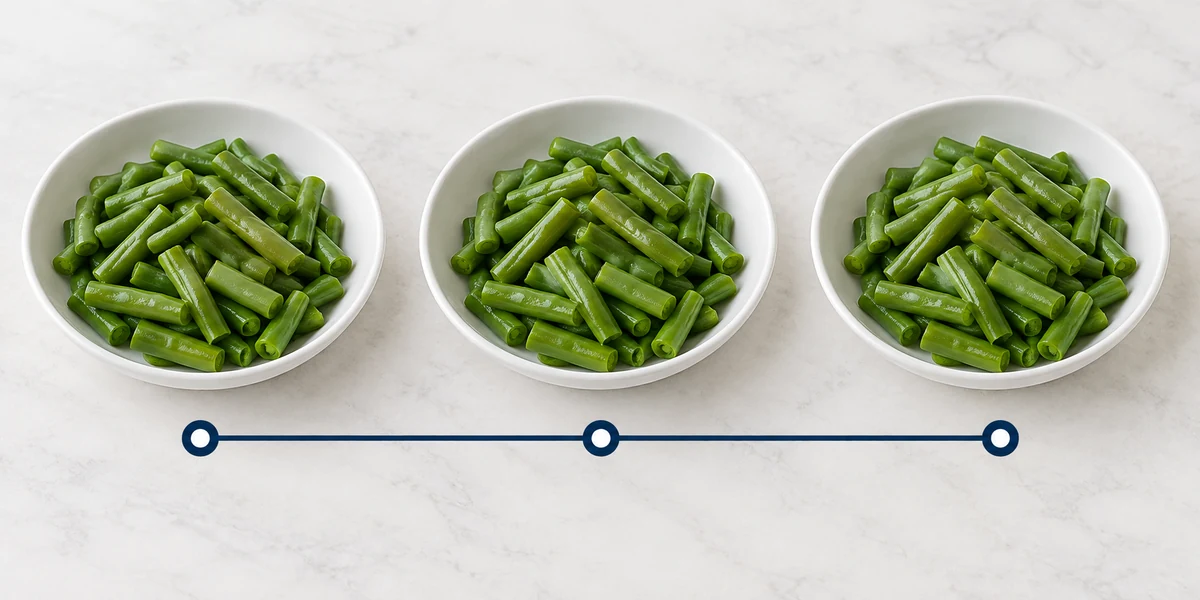
Conceptual checkpoints; the image does not record actual color change.
Start with the same lot and bean form. If whole beans and cut beans are both under consideration, compare them as separate products; their size and exposed surface differ. Keep the package state and preparation route consistent. Weigh a representative portion and record the batch size, cooking vessel, equipment, load depth, liquid or steam conditions, recipe and operator. Record the manufacturer’s preparation instructions and the food establishment’s applicable procedures alongside the trial record.
If you are investigating one suspected cause, change only one variable at a time, and only within the product instructions and approved food-safety procedure. For instance, a team might compare two normal service-pan replenishment patterns while holding the recipe, lot, equipment and planned checkpoints constant. That comparison can help locate a workflow difference. It should never mean extending a process beyond an approved limit or reducing a required control to preserve color.
Repeat each route using comparable portions. Replicates help reveal whether an apparent difference is consistent or simply reflects uneven pieces, a small sample, or ordinary lot variation. A single attractive bowl is not a robust acceptance decision. If the test must represent a large kettle, tray or steam table, the sample should reflect that equipment and load rather than an unrelated small home-cooking method.
A practical record can include the following fields:
| Record field | What to capture | Why it matters |
|---|---|---|
| Product | Lot, whole or cut form, package condition | Defines what was evaluated |
| Route | Cook-from-frozen or cook/cool/reheat; recipe | Makes heat history interpretable |
| Equipment and load | Appliance, vessel, batch weight, depth | Allows a repeat under comparable conditions |
| Checkpoint | First cook, reheating if used, planned service checks | Separates stages with different exposure |
| Appearance | Descriptive color terms and image under fixed conditions | Keeps the observation visible and repeatable |
| Texture | Firmness, softness, skin separation or water release | Prevents color from standing in for bite |
| Service context | Portion, sauce, replenishment pattern, serving interval | Connects the sample to the actual menu |
The table is a blank method, not a measured result. Add only observations that someone actually made, and identify the person, date and conditions if the record will support a purchasing or quality decision.
Make visual checks more consistent
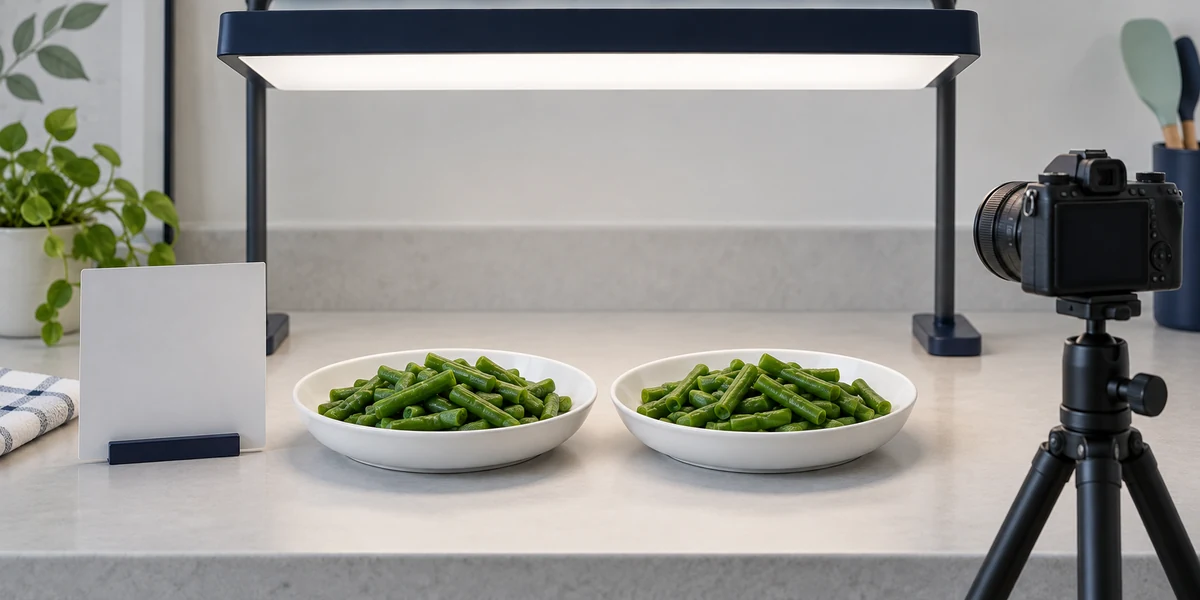
Conceptual setup demonstrates consistent light and viewing angle, without test data.
Human color judgment is easily affected by the room and the sample. Compare portions under the same neutral light, against the same background, at a similar distance and viewing angle. If photographs are used, keep the camera position, exposure and white balance consistent. Avoid mixing a phone image taken under warm kitchen lighting with a second image taken by a window. A change in lighting can look like a change in the product.
Use clear descriptive categories that fit the application, such as bright green, dull green, olive-toned, yellowing or browned. Agree the terms before reviewing samples. These are practical descriptors, not official grades or instrument readings. If two reviewers disagree, record both assessments rather than silently combining them.
A calibrated colorimeter can add instrumental data where the business needs it and has a repeatable method. Document the instrument, calibration, sample preparation, surface selection and measurement basis. L, a and b* values only become useful for comparison when the method and sample conditions are controlled. A photograph is a visual record under its capture conditions, not an instrumental color reading; neither method supplies an acceptance threshold until the buyer defines and validates one.
Assess texture separately. A bean may keep an acceptable green appearance but become too soft for a crisp side dish. Another preparation may have a suitable bite but release more water into a tray than the menu can tolerate. Record firmness, skin separation, moisture and serving appearance as distinct outcomes. A color score alone cannot tell you whether the product fits the full application.
Compare the two common service routes carefully

Generic service context, not an XMG lot photograph or trial result.
Cook from frozen, then hold for service
This path evaluates a direct preparation followed by service holding. Use the product’s stated preparation method and the establishment’s approved controls. Take one observation at the end of cooking and later observations at the actual points the team cares about, such as when the first portion is served and during planned service checks. If product is replenished, identify each addition so older and newer portions are not confused.
This route can help a team decide whether the ingredient suits a continuous-service menu. It does not show how the product would behave after storage and a later reheat. If the menu will use only direct cooking and service, there may be no reason to build a second route into the product approval. Test the intended use rather than every imaginable process.
Cook, cool, reheat, then hold
This path adds additional processing stages and records. Use only a procedure permitted by the applicable rules and approved operating plan. The initial cook, cooling, storage, reheating and subsequent service checks should remain separately identifiable. If several pans or batch sizes are used, state which one was sampled. A single observation after the final heating step will not reveal whether a difference appeared during the first cook, after storage or during the later hold.
Results from this route should not be merged with cook-from-frozen results. The two paths involve different handling and heat histories, so they answer different questions. A recipe or prepared meal may also introduce sauce and other ingredients that change the final appearance. Include them when they are part of the real application, and label the record accordingly.
The 2026 FDA Food Code describes a model system for retail and foodservice safety that jurisdictions may adopt. Check the local requirements applicable to the facility and the product instructions for the actual operation. A color trial is not a substitute for the establishment’s food-safety validation or monitoring records.
Agree acceptance before tasting

Conceptual blank record sheet; no XMG test values or trial result are shown.
Decide what “acceptable” means before looking at results. For a prepared-meal buyer, the standard might involve a recognizable green appearance at the serving point, a suitable bite, limited free liquid and a consistent portion. A cafeteria may care about the first service and the end of a planned service period. A manufacturer may evaluate appearance after a defined packing and reheating sequence. The acceptance criteria should reflect the customer and meal rather than an abstract idea of the brightest possible green.
Separate a required condition from a preference. A declared product specification, label instruction or approved safety procedure must be met. A preferred appearance can then be compared within those constraints. If the preferred appearance is not achieved, the team can examine the recipe, bean form, service route or agreed criteria without altering a safety requirement.
Review matched samples side by side and keep the record tied to the lot and test conditions. If the difference is small, repeat the comparison before making a supplier or menu decision. If results differ substantially by lot or form, update the approval discussion so that the buyer is not relying on one sample to represent an unbounded range.
Investigate an unexpected color change
First check whether the samples were truly comparable. Look for a different lot or cut, uneven batch loading, unrecorded replenishment, a changed sauce or acid ingredient, inconsistent lighting, different camera settings, or a gap between preparation and inspection. Check whether one sample was wetter or had been stirred more. Any one of these can change how a bean looks without identifying a single pigment mechanism.
Next, locate the stage where the appearance diverged. Compare frozen input to first-cook output, then first-cook output to the later checkpoint. In a cook-cool-reheat path, keep the cooling and storage record separate from the reheat and hold record. If the difference appears only after a later stage, the team has a narrower process question to review with its responsible quality or food-safety lead.
Repeat a controlled comparison before changing several things at once. Use the same lot, portion size, recipe, equipment and viewing setup, then adjust one permitted operational factor. Preserve the approved process. If the instructions, local requirements and desired appearance seem to conflict, ask the responsible quality professional and supplier to review a representative application; do not improvise a safety control.
What the evidence can support
Published green-bean studies examine different questions: cooking method in fresh material, thermal processing and chilled storage in frozen cut beans, or nutrient and antioxidant recovery during warm holding. Those findings are useful background, but they do not combine into a validated prediction of color for every frozen green-bean product in every service system.
One catering study of industrially blanched and frozen tip-cut beans reported changes in measured antioxidant or nutrient recovery after warm holding. Its measured outcomes were not a visual color acceptance scale. It should not be cited as proof that a specified holding period makes beans turn olive. Likewise, a frozen grading standard is not a finished-plate standard, and a recipe-specific institutional heating instruction applies to its stated use rather than all commercial kitchens.
Describe the process, observe the product under consistent conditions and tie the decision to the application tested. Where the business requires numerical color limits, establish them with a documented method and representative product data rather than borrowing a number from a study with a different product or process.
Frequently asked questions
Does frozen green-bean grade predict color after hot holding?
No. An incoming grade or purchase specification addresses the frozen product in its stated context. The cooked portion also reflects its recipe, process, equipment, service interval and viewing conditions. Evaluate these as separate acceptance decisions.
Should a kitchen change its approved heating process because the beans look dull?
No. Keep the applicable safety procedure and product directions in force. Record the appearance, check that the comparison was controlled and ask the responsible quality or food-safety lead to review any conflict between the expected result and the approved process.
Are reheating and hot holding one test?
They should be recorded as separate stages. Reheating describes a process step; holding describes what happens afterward before service. A team may need to assess both if its actual meal route includes both.
Frozen Green Beans
Review our frozen green beans range, product forms and specification options.
View Frozen Green Beans →References
- [1] FDA Food Code 2026. The FDA presents the Food Code as a model for adoption by jurisdictions; consult the code that applies locally.
- [2] USDA AMS: Frozen Green Beans and Frozen Wax Beans Grades and Standards. Incoming frozen-product grading context.
- Qu et al., Food Control (2021), [3] doi:10.1016/j.foodcont.2021.107936. Frozen cut beans treated by thermal pasteurization and evaluated during chilled storage.
- de la Cruz-García et al. (1998), [4] doi:10.1016/S0963-9969(98)00046-5. Cooking methods and pigment measures in fresh green beans.
- Miglio et al. (2010), [5] PubMed 20394008. Warm-holding study of industrially blanched/frozen vegetables; reported nutrient/antioxidant recovery rather than visual color.
