


On this page
A cabbage-like or sulfurous smell from cooked frozen cauliflower can come from the cauliflower itself. Heating changes its aroma chemistry and releases volatile compounds into the steam. How noticeable that smell becomes also depends on the cultivar, the product’s earlier processing, the cooking method and where you smell it: above a hot pot, inside a covered container or on the plate.
A sulfur note is not, by itself, proof of spoilage or a freezing fault. Equally, a familiar cauliflower smell cannot establish that a product is safe. For a normal cooking-aroma problem, start with the pack instructions, avoid unnecessary cooking and holding, and compare methods using the same bag. If the product has an unexplained unusual odor, damaged packaging or uncertain temperature history, handle that as a separate safety question.
The useful goal is a cauliflower dish with an aroma and texture you enjoy. Trying to remove every trace of vegetable aroma can lead to excessive cooking, heavy seasoning or a misleading conclusion about the ingredient.
Sulfur is part of cauliflower aroma
Cauliflower belongs to the Brassica group, alongside cabbage and broccoli, but its flavor should be considered on its own terms. An earthy, cabbage-like or slightly pungent cooked smell can be characteristic. The word sulfurous describes a sensory impression; it does not identify one chemical and does not measure its concentration.

In a primary study of eleven cooked cauliflower varieties [1], researchers combined a trained sensory panel with chemical and odor analysis. They identified allyl isothiocyanate, dimethyl trisulfide, dimethyl sulfide and methanethiol as important odorants associated with the sulfur impression. The varieties differed, so even a carefully cooked sample need not smell exactly like another cauliflower crop.
That finding gives a sound reason to expect some sulfur aroma. It does not provide a kitchen test for those compounds, a maximum acceptable smell or a universal result for every frozen bag. A photograph of white florets cannot tell you their volatile composition. Nor does a strong smell automatically mean a large nutritional benefit. Aroma, chemical composition and safety are different measurements.
Several compounds contribute to the smell
One part of the explanation involves glucosinolates, sulfur-containing compounds in Brassica tissue, and the enzyme myrosinase. Tissue disruption can bring the system into contact, creating breakdown products. Heat then changes the reaction environment through enzyme inactivation, chemical breakdown and movement of compounds into water or air. Other sulfur chemistry also contributes, so the entire smell should not be reduced to one glucosinolate-to-one-odor pathway.

The cauliflower steaming and boiling study by Hwang [2] helps show why cooking conditions matter. Its glucosinolate analysis found differences among uncooked, steamed and boiled samples. Those treatments were specific laboratory preparations. They were not a comparison of all household cooking methods, and the chemical results were not a measured ranking of how pleasant each frozen product would smell.
Smell depends on volatile compounds reaching the nose, not just on the amount remaining in the vegetable. A compound can leave the food and become noticeable in steam; other compounds may diminish during cooking. Some aroma notes can stand out more when surrounding notes weaken. This makes the claim that longer cooking always creates more of every sulfur compound too simple.
A primary study of raw and cooked Brassica volatiles [3] illustrates that limit. Its comparative analytical profiles changed with cultivar, freezing and cooking, and the total sulfide result did not increase uniformly across vegetables. The researchers also described limitations of their headspace extraction method. A relative chromatographic peak area is not the same thing as a person’s judgment of a plated meal.
Frozen form changes the cooking starting point
A frozen cauliflower bag starts with cold pieces, often in a form that has already undergone blanching. Check the actual product information instead of assuming that every frozen floret is raw, fully cooked or ready to eat. Earlier heating can change enzyme activity, while freezing and thawing alter the physical state of the tissue. Those stages form part of the history of the ingredient.

Piece size changes how quickly the food heats. A small broken piece, a compact floret and a thick stalk can reach their desired texture at different times. If you keep a mixed batch heating until its largest piece is very soft, the smaller pieces may receive much more cooking than they need for the dish. Compare similar pieces when deciding whether time, rather than the bag, is the main aroma variable.
The amount in the pan matters as well. Adding a large frozen load can cool the cooking environment and introduce water as the frost and tissue liquid warm. A schedule that worked for a small amount may then produce a longer moist stage. This is a practical heat-and-load problem, not evidence that the ingredient has developed a dangerous sulfur compound.
For product-form context, our cauliflower range distinguishes the ingredient forms you might encounter. Use the instructions for the selected product when cooking. For the separate question of retained water and intact-floret texture, see cooking frozen cauliflower without soggy pieces.
Steaming and roasting create different sensory settings
Steaming surrounds the food with moist heat. It can leave a clean white surface and a recognizable cauliflower aroma, especially when the basket or container is opened. Roasting offers a different opportunity: once enough surface moisture has evaporated, exposed areas can brown and contribute a different flavor impression. Neither method guarantees that every sulfur note disappears.

A crowded roasting tray may behave more like a moist cooking environment than you expected. Pieces touching closely, a deep pile or a large release of water can delay surface drying. The oven setting alone therefore cannot tell you whether the cauliflower is actually roasting at its surface. Look at the tray, the wet areas and the food, rather than using the word roasted as proof of a result.
A published fresh-cauliflower roasting recipe [4] emphasizes spacing florets in one layer to encourage browned edges. That is a useful practical comparison point. Its exact cooking schedule belongs to its fresh ingredient, portion and equipment; it should not be copied as a guarantee for your frozen bag.
Choose a method for the intended dish. Pale, tender pieces may suit a white sauce where browned edges would be unwelcome. Roasted florets may suit a plate where toasted flavors are part of the appeal. A cauliflower puree has another sensory setting because every spoonful contains dispersed tissue and liquid. Treat these as different foods to evaluate, not as a competition with one universally correct winner.
Judge the food, the steam and the room separately
The first burst above an opened pot is a different observation from the smell of a small serving on a plate. A covered headspace can accumulate vapor; lifting the lid releases it close to the nose. The room then has its own ventilation and distance conditions. A complaint that the kitchen smells strong does not necessarily describe what the finished food tastes like.
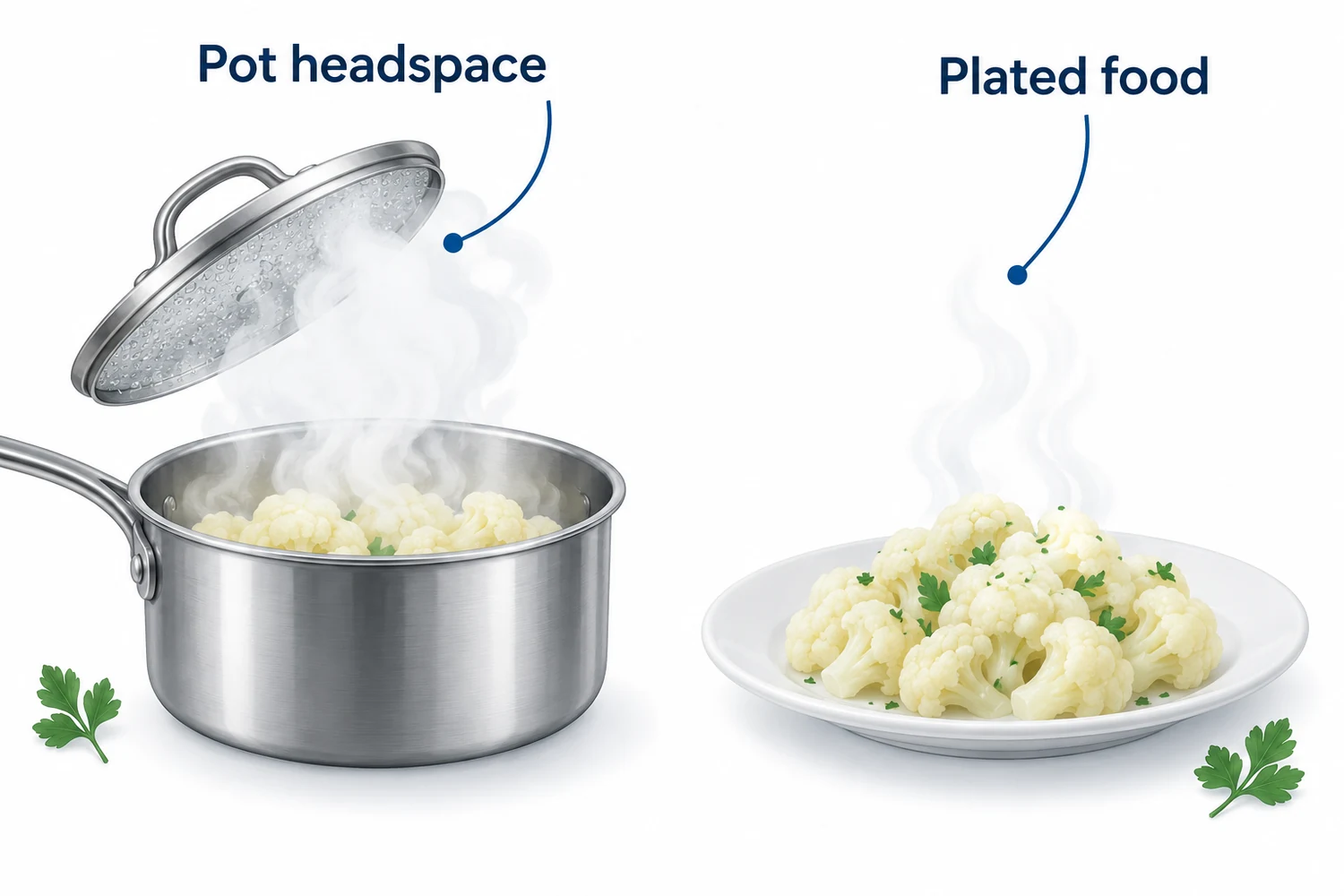
For a useful sensory comparison, serve both samples at similar temperatures and assess them after a similar interval. Do not judge one directly above boiling steam and the other after it has cooled across the room. Avoid inhaling directly over a hot pot: move the lid safely away and let the steam disperse before observing the food.
Also separate smell intensity from dislike. A person may recognize a moderate cauliflower note and find it unpleasant, while another accepts it. Writing down specific descriptions such as cabbage-like, toasted, sour or stale is more informative than calling every disliked smell bad. These descriptions guide the next cooking comparison, but they still cannot certify safety.
Reduce unwanted aroma without hiding a problem
Begin by removing avoidable extra heating. Follow the pack’s preparation directions and check the thickest relevant piece as the dish approaches its desired texture. Once the food is properly prepared, continuing to cook merely because the room smells of cauliflower can damage the texture without solving the sensory complaint.
Keep cooking and service close together when your recipe allows it. A dish that is heated, held, reheated and then kept covered has a more complicated aroma history than one prepared for immediate service. In a kitchen trial, record those stages. Otherwise an ingredient may be blamed for a change created by the service method.
Seasoning can change the balance of the dish. Herbs, spices, a little acidity or a browned topping may make a normal cauliflower note more welcome. Test them after you understand the plain base, so you know whether the change addresses taste, aroma or both. There is no need to present lemon juice, vinegar or another ingredient as a chemical guarantee that removes all sulfur volatiles.
Heavy seasoning is not a repair for an unexplained odor. If a bag or dish raises a separate safety concern, do not mask the smell, taste it repeatedly or extend cooking in an attempt to prove it acceptable. Keep that decision outside the recipe-adjustment exercise.
Run a useful comparison at home or in a kitchen
Use one bag that has been stored and handled according to its instructions. Divide comparable pieces into equal portions, leaving the rest frozen as directed. Choose one question: for example, whether a different tray load improves the aroma you perceive at service. Changing time, seasoning, piece size and cooking method together may produce a nicer dish, but it will not explain which change helped.
Record the frozen portion mass, approximate piece size, equipment, water or oil added, cooking endpoint and serving interval. Describe the steam separately from the plated sample. A simple note sheet is enough. This is a proposed comparison method, not a report of an XMG cooking experiment or a promise of a particular result.
If you compare moist cooking with roasting, accept that the surface, moisture and flavor will differ together. Keep the ingredient and serving conditions matched as far as practical, then explain the remaining differences honestly. Repeat the preferred method with another portion before deciding that it reliably solves the problem for your equipment.
A useful outcome is more specific than less smell: the florets are tender at service, the cabbage-like note is acceptable on the plate and the method works at the required pan load. That gives you an actionable recipe decision without pretending to identify chemical concentrations by nose.
When an unusual smell needs a separate safety decision
Aroma is only one observation. Examine the package instructions, storage history, any thawing event, damage and the condition of the product. A freezer failure or uncertain warm period needs an appropriate time-and-temperature assessment. An odor that differs unexpectedly from the usual product deserves attention even if the florets still look white.
FoodSafety.gov’s power-outage guidance [5] explicitly advises against tasting food to determine whether it is safe. Its handling charts address particular foods and conditions; a normal cooked cauliflower smell does not override them. Follow the applicable product and official guidance rather than inventing a smell-based pass/fail rule.
For a commercial lot, retain the bag identification and describe when the odor appeared: on opening while frozen, during heating or after holding. Those are useful investigation details. A complaint about cooked aroma, an uncertain temperature history and a damaged package may require different evidence. Keep the lot out of service while an unresolved safety concern is assessed by the responsible person.
For ordinary cooking, the most useful adjustment is often modest: a suitable load, the required cooking endpoint and a method that gives the flavor you want. Cauliflower can remain recognizably cauliflower without dominating the dish.
Explore the product forms behind this application.
IQF Frozen Cauliflower →References
- Engel et al.: Flavor-active compounds potentially implicated in cooked cauliflower acceptance↑
- Hwang: Effect of cooking method on cauliflower compounds↑
- Wieczorek and Jeleń: Volatile compounds of selected raw and cooked Brassica vegetables↑
- fresh-cauliflower roasting recipe↑
- FoodSafety.gov: Food safety during power outage↑
