


On this page
Approve frozen baby corn for a ready meal at the point the customer will eat it. A low broken-tip count in the incoming IQF carton is useful, but it does not tell you how many cobs will remain intact after mixing, tray filling, meal freezing and reheating, or whether the surviving pieces will still have the intended bite. We recommend one defined trial through the complete meal cycle, with the same baby-corn form, recipe, tray, heat path and assessment method for each candidate.
Count damage already present in the frozen ingredient separately from damage added during meal production. Assess bite at a fixed service point, after the meal has been frozen and reheated. A supplier sample may pass the incoming grade and fail the finished application; that result should prompt a specific conversation about form, handling or thermal exposure rather than a vague request for “crisper corn.”
Define the finished meal before choosing a sample
Start with the meal, because “ready meal” describes many heat environments. A baby-corn cob in a thin curry sauce, a dry rice tray and a densely filled noodle compartment will receive different moisture and heat exposures. The intended serving method matters too. A meal sold frozen for microwave reheating should be tested through that route. A meal reheated by a catering kitchen and held before service needs the holding interval in the trial. A sample that looks attractive just after production may not be the one that survives distribution and service.
Specify the ingredient form. XMG’s baby-corn page lists whole, halved, sliced and diced options. A planned half or slice has a cut surface and should not be scored as a broken whole cob. Whole cobs give a strong visible inclusion but can be more conspicuous when the tip breaks. Smaller cuts may be easier to distribute, yet the aim of this guide is finished bite and integrity, not the separate question of tray dosing variation.
Write down what the eater should notice. Is the cob supposed to have a clear, tender bite against soft rice? Is a slight core resistance acceptable, or will a fibrous centre be rejected? How many intact visible pieces are required for the meal to look as specified? These are application targets. They cannot be inherited from another manufacturer’s recipe or from a broad statement that baby corn is “crunchy.”
Record the base recipe version, sauce level, tray size, baby-corn portion, other vegetables and assembly order. Small changes can alter contact and heating. If two candidate samples are compared, the meal matrix needs to stay the same. If you are still comparing whole and cut formats, treat that as a separate form trial first, then test the preferred form across suppliers or lots.
Separate incoming defects from new breakage

Conceptual stage comparison; the pictured pieces do not represent measured XMG results. Swipe to see the full illustration on a narrow screen.
There are three useful inspection points. At frozen receipt, count whole cobs or declared cut units and classify existing fractures. After mixing and tray filling, sample trays before meal freezing to see what assembly added. After the validated reheat and normal service hold, count again. This sequence tells you where the loss occurred. A single after-reheat count cannot distinguish a weak incoming product from an aggressive mixing step or a handling problem after the meal was packed.
Define the counting unit before touching the sample. For whole baby corn, an “intact” unit might mean one cob with its main body and tip attached. A short detached tip, a longitudinal split and a crushed section can be separate categories if they affect appearance differently. For diced baby corn, “intact” means an agreed piece shape within the declared cut, not an imaginary whole cob. Photograph reference examples so inspectors classify the same way.
Keep the denominator stable. Record the number or mass of declared units entering a known number of trays. If you count intact cobs in ten trays after reheating, compare them with the actual starting count for those trays, not with a catalogue photo or the theoretical number expected from a mass ratio. This is especially important when variable cob size changes the number of pieces in a fixed-weight portion.
Incoming grade and application yield belong in adjacent columns. Our separate frozen baby-corn size and broken-tip inspection guide deals with receiving measurements. A supplier’s incoming specification can set a broken-piece tolerance, but that tolerance does not predict an automatic post-reheat result. For example, a published customer specification for cut IQF baby corn [1] lists its own broken/damaged allowance. It is evidence that the field can be defined, not a limit to copy into an XMG order.
| Stage | What to record | What the observation can tell you |
|---|---|---|
| Frozen incoming sample | Form, size range, baseline intact units and existing fragments | Whether the proposed ingredient meets its receiving grade |
| After assembly and filling | Intact units, new fractures and tray positions | Whether handling before meal freezing adds damage |
| After reheat and service hold | Intact visible units, fragments, bite and location | Whether the finished meal meets the eating and presentation brief |
Do not hide planned cut pieces inside a “damage” total. Conversely, do not count two halves of a broken whole cob as two intact units just because both remain visible. Record the classification rule with the result.
Run one controlled freeze-and-reheat cycle

Conceptual process sequence omits universal time or temperature settings. Swipe to see the full illustration on a narrow screen.
Use a representative lot and enough trays to see ordinary process variation. A single hand-assembled tray is a useful early feasibility test, but not a repeatability assessment. In a comparison, allocate candidate samples to matched trays and positions so one candidate is not always near a hotter edge. Keep the baby-corn mass, meal composition and assembly tools consistent. If the line doses by volume, measure the actual delivered mass as well; volume can be deceptive when whole-cob size differs.
At receipt, sample from multiple cartons or locations according to the team’s normal sampling plan. Keep lot identity intact. Inspect frozen material while it is still in the state in which the line receives it. If your real production method includes tempering, record its conditions and apply the same method to both candidates. A sample handled gently on a laboratory bench should not be assumed to survive a conveyor, mixer or portioning head unchanged.
Assemble the meal in the real order. If baby corn enters a hot sauce before filling, its first heat exposure belongs in the trial. If it is deposited frozen into the tray, do that. Count and photograph a set of trays before final meal freezing. Avoid repeatedly excavating the same tray and then using it for the final quality judgement; create separate inspection trays or use a documented, non-disruptive observation method.
Freeze the assembled meal under the programme’s normal conditions, store it for a defined test period, then reheat according to the actual validated label or foodservice instruction. This article does not prescribe a universal time or food-safety temperature for a mixed meal. Your technical team must validate the full product’s heating instruction. For quality comparison, record appliance, power or setting, tray orientation, starting state and standing time. Test the expected operational variation, such as microwave position or realistic fill spread, after the first controlled comparison.
Assess the served meal at a specified time after reheating. If customers stir before eating, include that step; if catering staff hold it warm, include the typical hold. Handle samples similarly during inspection. A cob that breaks when lifted by tongs may matter in a plated foodservice meal; a fragment hidden in a dense sauce may matter less visually but still affect bite and perceived quantity.
The baby-corn blanching study [2] establishes that different pretreatments can change measured product properties. It does not establish a reheating programme for a particular meal or a guaranteed intact-piece yield. Use its lesson to ask for the relevant partner-process details, then let the meal trial decide which approved ingredient works.
Judge bite at the point of service

An original whole-cob sample shows the form whose post-reheat integrity is counted.
Evaluate texture while the sample is at a defined serving condition. Hot food cools and changes during a panel session, so random tasting order can masquerade as a supplier difference. Present coded pieces from comparable tray locations at a similar temperature and interval after heating. Ask assessors to describe the first bite, the centre and any lingering fibre perception separately. “Tender” and “crisp” are not interchangeable; a meal may need a firm snap, or it may need a soft cob that still holds its shape.
Include the intended sauce on at least one tasting portion. An isolated cob on a white plate can reveal structural differences, but the consumer eats it with the meal. A thick, savoury sauce can change perceived firmness and obscure a rough fibre note. Use isolated pieces for diagnosis, not as the only approval basis.

Conceptual cutaway references immature cobs and does not show actual meal trial evidence. Swipe to see the full illustration on a narrow screen.
Write a small descriptive scale before tasting, with sample references if possible. For example, assessors can classify an unacceptable mushy outer layer, an acceptable tender core, and an unacceptable woody or fibrous centre. These are qualitative reference categories, not universal numeric specifications. If the programme requires instrumental texture measurement, agree the probe, orientation, sample temperature and number of units. The instrument can track repeatability, but the customer-facing decision still needs the sensory and visual context.
It helps to record heterogeneity. One tray may contain tender cobs in sauce and dry cobs exposed on top. That is a formulation or heat-distribution signal, not necessarily a defective carton. Sample several positions rather than choosing the best-looking piece. If the centre is too firm while outer tissue is already soft, another reheat minute may not solve the problem without harming appearance; investigate form and prior treatment as well as final heat.
Calculate usable intact-piece yield
Choose either a count basis or a mass basis, and state which one you used. For a meal marketed on visible whole cobs, count basis is often intuitive: intact cobs after service divided by cobs entering those trays. For cut baby corn, a mass basis may be more stable when piece size varies, but it requires separating baby corn from sauce and other vegetables by an agreed method. A rough separation can itself damage the pieces, so describe that handling and use the same method for all candidates.
Consider a hypothetical illustration, not a result from XMG or a published lot: if 120 agreed whole cobs enter a set of trays and 96 remain intact at the service assessment, the observed intact-cob share is 96/120, or 80%. If ten cobs were already fractured at frozen receipt, record that separately. The before-and-after categories matter more than the illustrative percentage. Another team might accept some tip loss for a chopped curry and reject it for a premium visible-vegetable tray.
A whole cob that survives visually but is inedibly fibrous should not count as fully usable for a meal whose promise includes tender bite. Keep a second “usable serving” measure that combines the visual and sensory acceptance criteria. Conversely, do not discard a planned cut that has a normal visible edge simply because it cannot pass the whole-cob rule.
If the trial produces a target, validate it against production variation and multiple representative lots before making it an order term. Write the sample size, preparation, denominator, categorisation and point of assessment beside the number. An unexplained percentage makes comparison difficult and disputes more likely. The customer specification should state the acceptance method, not merely the attractive result from the best development tray.
Diagnose failures without guessing the cause
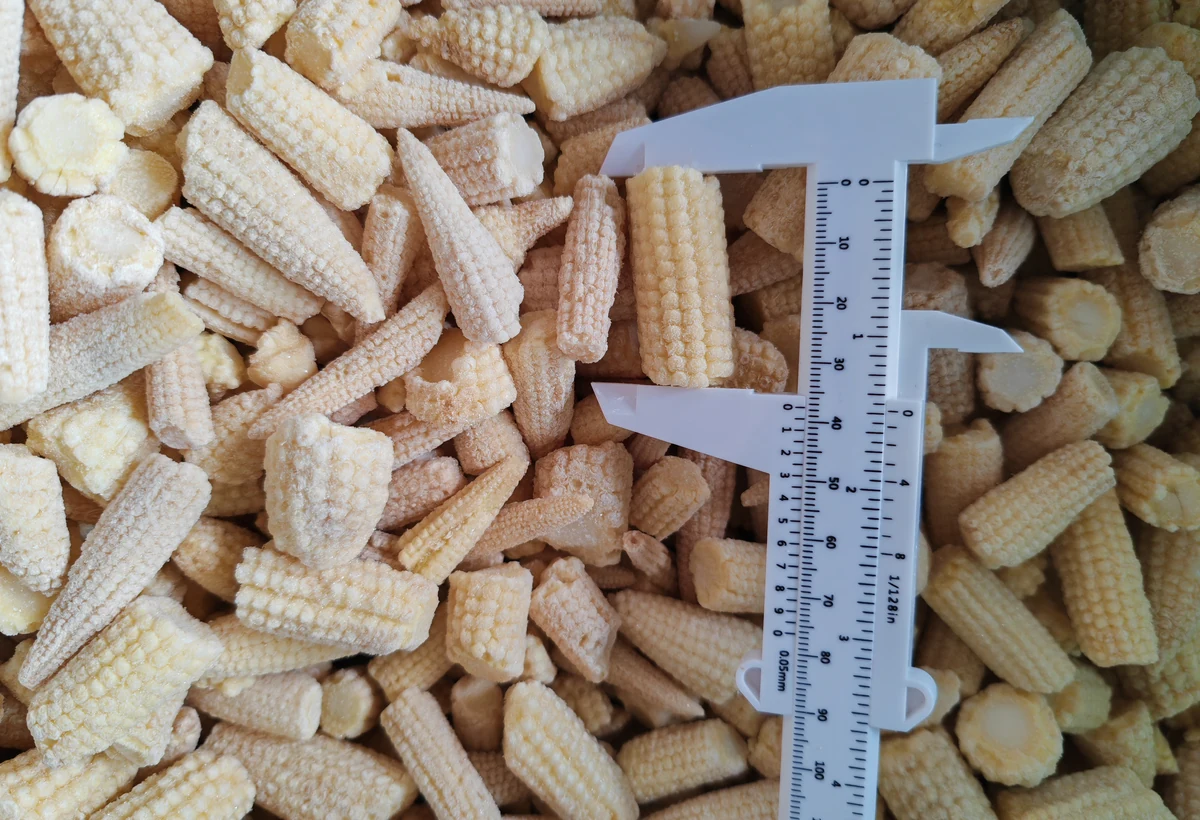
This original cut-form image helps separate planned cuts from unintended fracture.
If many units were already fractured at receipt, review the incoming grade and handling history first. If they were sound at receipt but fragmented after assembly, look at mixing speed, drop height, portioning head and tray placement. If most damage appears only after reheating, compare the meal’s moisture and heat path. These observations narrow the next test, but none proves a single cause without further comparison.
The form and maturity of baby corn can alter bite. A longer, thicker cob has a different centre-to-surface relationship from a short cut piece. Keep dimensional ranges and form in the record. Supplier pages may describe baby corn as crunchy or tender, yet those adjectives have little meaning without a cooking method and a service interval. A whole IQF baby-corn technical sheet [3] shows how a characteristic tender texture can be stated; it does not tell us how a specific meal will perform.
Pretreatment is another question to verify. A partner factory may blanch baby corn before freezing, but the actual method and degree need order-specific confirmation. The study of different baby-corn blanching methods [2] did not measure your sauce, freezing cycle or microwave. Do not request a study’s time/temperature as a procurement setting merely because it produced a favourable laboratory observation. Describe the undesirable endpoint and seek a representative alternative sample.
The other meal components can be responsible too. A hard vegetable in a sauce that looks watery may point to uneven heating or ingredient location. A soft cob beside scorched rice may point to tray geometry. A high fragment count in one factory run but not a controlled hand trial may point to mechanical handling. Make one narrow change in the next trial while holding the rest fixed. That keeps a reformulation from masking an incoming quality issue.
Review frozen storage and thaw incidents where they are documented, without treating every texture change as a cold-chain failure. The useful evidence is the actual lot, process record and stage-by-stage sample condition. Avoid turning a finished-meal failure into an unsupported allegation about the supplier’s blancher or freezer.
Put the result into a supplier approval record
The final document should connect incoming ingredient requirements to the actual meal. Record the declared form and cut range, starting broken/damaged classification, pretreatment statement where confirmed, sampling plan, tray recipe/version, assembly method, freeze/storage conditions, reheat instruction, service interval, sensory references and intact-piece calculation. Attach photographs that show the expected frozen and served condition under stable lighting.
Name which results are supplier obligations and which are buyer process controls. The supplier can offer a defined incoming form and grade, while the meal manufacturer controls its mixing, filling and reheat. A finished-meal result can still be an approval criterion, but it should use a mutually understood reference method rather than imply that the supplier controls every later step. This distinction makes corrective discussion more useful when a new lot does not behave as expected.
Set triggers for reapproval. A different cob form, a changed cut-size band, a declared pretreatment change, a new sauce, altered tray depth or a new heating instruction can invalidate a prior trial. Some changes need only a targeted confirmation; others deserve the full cycle. Keep the first approved result as a reference, then compare later lots under the same method before deciding that an observed difference is material.
We can use XMG’s sampling and specification process to align the proposed ingredient with your trial record. For this topic, the useful inputs are the baby-corn form, the finished meal and reheat path, and the acceptance language for bite and visible pieces. We can coordinate the applicable partner’s product and processing details without presenting a generic published specification as your contract.
Discuss Your Trial with XMG Food
Send the product form, intended use and trial criteria; we will review the brief and confirm suitable frozen produce and supply options.
Send Your Trial Brief →