


On this page
Frozen and dried wood ear mushrooms can serve the same dish, but the buying comparison starts at the plated portion, not at the weight printed on two different packs. Dried pieces require a controlled rehydration step. Frozen pieces remove that step from the kitchen but still need a product-specific thawing and cooking procedure. Neither form should be called ready-to-eat without evidence from the actual supplier and label.
For foodservice, ask three questions: How much usable wood ear reaches a portion? What handling steps and time are required before service? How do the pieces behave after the dish’s real cooking, holding and delivery route? A representative paired trial answers those questions more reliably than a generic dry-to-frozen conversion ratio or a promise that one form is always crunchier.
Identify the form before comparing weights

Original product-form photograph: a caliper shows the cut format; the image is not a current lot measurement or dry-product yield record.
Start with the precise item being quoted. Record the name, declared species where available, cut form, pre-treatment, pack size, lot code, storage instructions and cooking instructions. “Wood ear,” “black fungus” and “black mushroom” are used in trade, but the offer still needs a clear product description. Whole pieces, strips and dice do not give the same number of visible pieces in a serving. If a frozen offer contains a mix of sizes, ask whether the grade defines a piece-size distribution.
Do not assume the frozen item is cooked. Some frozen vegetables and mushrooms are blanched or otherwise pre-treated, but the extent and food-safety meaning vary by product. Check the actual label and supplier specification. If it says to cook before use, the kitchen should cook it under its validated process. If the chef wants to serve wood ear cold, that use deserves separate confirmation of product status, handling and local food-safety requirements. A frozen ingredient is not automatically a ready-to-eat salad component.
Dried wood ear comes in compact, low-moisture pieces that take up water during soaking. The delivered mass therefore cannot be compared directly with a frozen pack containing its own water and possible surface ice. A cost per kilogram comparison can reverse when the denominator becomes usable, prepared pieces per portion. The amount of water taken up varies with the species, cut, drying history, soak conditions and draining method. We do not publish one multiplier as though it applies to every purchase.
The XMG IQF frozen black fungus page is our relevant product route. We do not present dried wood ear as an XMG supply offer in this comparison. Dried product can still be the buyer’s incumbent benchmark. Bring its label and preparation record into the trial so the frozen candidate is compared with what the kitchen actually uses.

Conceptual illustration: weigh both candidates through preparation and compare the served portion; no yield ratio is claimed.
Compare usable portions, not pack weight

Original product-form photograph: frozen strips in a liner, not a plated foodservice trial or a dried wood ear offer.
Choose one real menu application, such as a stir-fry, soup garnish or chilled prepared side, and define the intended serving mass and visible piece count. Draw representative samples from the proposed frozen pack and the current dried pack. Record unopened pack weight, frozen sample weight and any free ice or broken fines according to the agreed method. For the dry form, record dry weight before sorting, then weight after controlled hydration and draining. Note any hard stems or damaged pieces discarded. Avoid counting soak water as usable yield.
Use one clear draining protocol. A lightly shaken strainer, a long draining period and a pressed sample will produce different wet weights from the same dry input. Record vessel, sieve, drain time and whether pieces were squeezed. Weigh the cooked and plated portion as well. The kitchen pays for an ingredient that becomes a menu component, not for the largest possible water uptake in a laboratory bowl. If the product is later cooked in a sauce, measure what remains recognizable and desirable after that step.
One simple worksheet has separate columns for delivered mass, preparation loss, prepared usable mass, cooked mass, portion count and preparation labour. Put the frozen and dried paths side by side. Do not fill missing fields with catalogue averages. A sample trial may reveal more breakage in one cut or more trimming in another, but that finding belongs to the tested lots and process. Repeat when the grade, supplier, cut or menu method changes.
Piece count can matter as much as grams. In a noodle bowl, the visual distribution of strips may be the reason for using wood ear at all. In a soup, small irregular pieces may be acceptable if every serving receives a similar amount. Ask the chef to record both serving mass and appearance. If two packs have the same wet weight but one produces many small fragments, they may not be interchangeable in the finished dish.
Our comparison illustration shows the two paths reaching comparable prepared portions. It is a concept, not an XMG yield test. Use the actual kitchen scale and recipe to establish the ratio for each product under evaluation. The purpose of the picture is to remind the team to follow both ingredients to the same endpoint before discussing price.
Control the dried-form soaking step
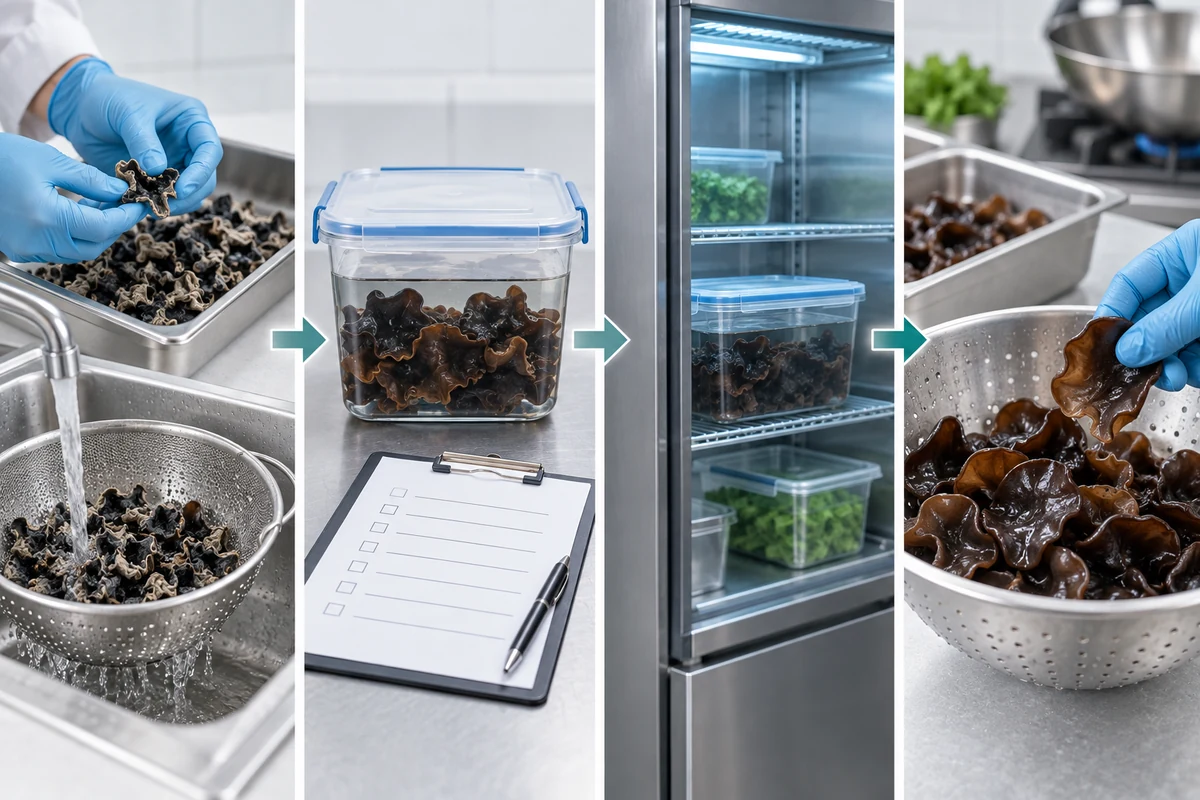
Conceptual illustration: use the actual product instructions and kitchen food-safety plan; this is not a validated soak record.
Rehydration is a food-preparation step, not a passive wait. Use clean food-grade equipment and water, wash or rinse according to the product instruction, record the starting time and temperature, and protect the container from cross-contact. The Hong Kong Centre for Food Safety advice on soaking dried foods [1] warns against extended room-temperature soaking and generally recommends no more than two hours at room temperature. If a longer soak is needed, refrigerate it and use the product promptly. Local food-safety procedures and the actual product’s instructions remain controlling for the kitchen.
Do not choose a soak time solely because it makes the dried product look larger. Hydration may be uneven: an outer fold can soften while a thick stem stays firm. Check the pieces at the intended time and decide whether any trimming is required. Record any water changes, wash steps or draining procedure. If one shift soaks overnight at room temperature and another uses refrigeration, their texture and safety conditions are not comparable. A standard operating procedure should make the process repeatable across staff and sites.
One reason for care is the history of illness associated with badly controlled soaked fungi. The Hong Kong CFS bulletin on bongkrekic acid [2] notes that this toxin can be heat-stable. Cooking is therefore not a rescue step for a product held under unsafe soaking conditions. Discard suspicious or improperly handled material under the kitchen’s food-safety plan rather than attempting to cook away an unknown risk. This is a reason to control time and temperature, not evidence that a properly managed dry product is inherently unsafe.
At the same time, the microbiology should not be oversimplified. A 2024 original study of rehydrated wood ear [3] reported that inoculated Salmonella and Listeria survived, but did not grow on the tested samples under its reported conditions. That experiment does not prove every restaurant soaking practice is safe, nor does it establish that every soaked batch amplifies those two organisms. We follow the official handling advice and the kitchen’s controls while treating the study as a limit on overbroad claims.
Record who started and ended the soak, where the container was held, and when the drained product went into cooking or service. Batch labels matter in a busy kitchen. An unlabeled tub of hydrated wood ear in a shared refrigerator is hard to tie back to a supplier lot or a preparation time. The handling log is part of the real process cost and the food-safety evidence, so include it in the form comparison.
Handle the frozen form on its own terms
Frozen wood ear avoids the dry-product hydration stage at the foodservice site, but it brings freezer-space, receiving and thaw/cook requirements. Check the cartons for integrity and lot identity. Document the product temperature condition on receipt under the kitchen’s procedure. Follow the supplier’s storage and cooking directions. If the product is intended to go directly from frozen into a hot dish, test that path. If it needs thawing, define how and where thawing happens, how thawed liquid is managed and how long the product can be held before use under the approved procedure.
Ice glaze, free surface ice and clumping affect portion control. A frozen bag may contain separate pieces that can be dosed into each portion, or pieces may be stuck into blocks that require breaking and create fines. Inspect a representative bag at normal operating temperature. Note the pack’s free-flow behaviour and whether the kitchen can deliver the declared amount consistently on a busy service line. The result should be recorded for the offered lot and cut, not turned into a universal frozen-versus-dried claim.
Thawed water is not automatically a defect. Some water release is expected when ice melts; the meaningful question is whether the actual dish becomes diluted or oily sauce is disrupted. Weigh or measure liquid under a defined method if it affects the recipe. In a stir-fry, the chef may need to adjust pan loading to avoid steaming. In soup, the impact may be negligible. A product can be technically acceptable while requiring a different process setting to deliver the same plate.
Do not transfer the dried product’s safety instructions mechanically to the frozen item, or vice versa. The hazards and supplier processing histories differ. Ask whether the frozen product is raw, blanched or fully cooked; request the specification and cooking guidance rather than inferring status from its appearance. Record any allergen, cross-contact or microbiological requirements specific to the intended market and use. A cold-service application deserves particular attention because it may not include a final heat step.
Taste and score the same finished dish

Conceptual illustration: score the real dish at service, without declaring either form a winner.
Use the same recipe, portion size, equipment and service route for both candidates. Keep the sauce, other vegetables and seasoning fixed first. Then make a second trial if one form needs a legitimate process adjustment, such as a different addition point or pan load. Record that adjustment rather than hiding it. The question is whether the kitchen can reproduce a good dish with each form, not whether one candidate happens to win a single unfair cook-off.
Score the wood ear for recognizable shape, chew or crunch, breakage, liquid release, sauce uptake and distribution in the plate. Have the panel taste after the real hold and delivery interval, not only straight from the pan. A buffet tray, central-kitchen reheat and immediate wok service expose the ingredient to different conditions. A piece that feels lively at minute zero may soften after a long hot hold; another may carry sauce well but become too slippery in a chilled dish. Record the observations in plain words and tie them to a sample code.
Where a dish is served cold, include the actual cooling and holding steps in the evaluation. Do not use the article’s picture of a finished dish as permission to serve a frozen product without a validated preparation. The illustration is a trial concept with no real sensory score. A chef should be able to distinguish what was photographed for explanation from what the kitchen tested and approved.
Let operators weigh in. Prep cooks can tell whether the dry form’s rehydration schedule fits a shift and whether the frozen form portions reliably from a bag. Line cooks can report pan behaviour and speed. QA can review the logs and supplier documents. Procurement can then cost the accepted product on the same served-portion basis. If those functions disagree, the sample report should expose the disagreement before the contract locks in a product that works on paper only.
Cost the menu portion and process
Build a small cost worksheet, not a headline cost-per-kilogram comparison. For each form, calculate the amount purchased per accepted served portion from the tested yield. Add the labour needed for rinsing, soaking, checking and draining the dried form, or for freezer handling, portioning and any thaw management of the frozen form. Include water, equipment occupancy, storage space and waste where they matter materially. Use actual local labour and utility costs; we cannot supply a universal number for a buyer’s kitchen.
Waste should have a named cause. Dry fragments lost during sorting, stem trimming, excess hydrated pieces left after service, frozen pieces damaged while breaking a block, and sauce discarded after excessive water release are different loss mechanisms. One can often be improved through an adjusted specification, another through a changed prep method. If the trial records only one aggregate “waste” number, the supplier cannot know which product feature to improve.
Rework the comparison at the expected service volume. A ten-portion pilot may require little labour but an overnight soak for several hundred portions can demand refrigerated space and scheduling discipline. Frozen packs may save that prep step yet take more freezer volume. Conversely, a venue with limited freezer capacity may prefer a dry ingredient if it can control soaking consistently. The better choice depends on facility, dish, staffing and the actual offers—not a blanket claim that one form is always cheaper or safer.
Keep the decision reversible. If the frozen cut or dry source changes materially, run a shorter confirmation trial using the same worksheet. Retain the approved sample code, photo record, cooking notes and target portion. A buyer with several sites can then compare deviations against a real baseline rather than recreating the decision from memory every season.
Read outbreak history accurately
The CDC’s archived 2020 update [4] describes a Salmonella Stanley outbreak linked to recalled dried wood ear mushrooms. The CDC stated that outbreak was over. We cite it as historical evidence that supplier traceability and lot records matter, not as an active recall, not as evidence about XMG’s frozen product, and not as a rate of illness for the category. A current buying decision still depends on the exact supplier and current documents.
For either form, keep a lot-to-menu trace. Record which packs supplied which prep batch, especially when a kitchen combines partially used bags or hydrated tubs. That record supports both an ordinary quality complaint and an urgent investigation. It also helps the chef identify whether a texture change came from a new lot, a modified soak or a changed recipe. Traceability is useful even when no safety event occurs.
Make a form decision with a repeatable pilot
Before requesting a frozen black fungus quote, send the dish type, desired cut, prepared portion, cooking and holding route, pack preference, expected volume and destination market. Tell us whether the product will be served hot or cold and what cooking or microbiological information the QA team needs. We can review the available frozen form and coordinate a representative sample and specification discussion. We will not assume that the frozen offer is ready-to-eat or that its tested yield matches a dried incumbent.
Ask the dry supplier for its species declaration, drying and packing information, recommended soaking procedure and lot records as well. Each candidate should enter the pilot with its own correct handling instructions. Then the kitchen can compare usable portion yield, process burden and finished dish on equal terms. If the final result is mixed, approve separate use cases rather than forcing one winner: the frozen form may suit a fast hot line, while a well-controlled dry form may fit another site or recipe.
Our product specifications and sampling approach can help turn the trial into a repeatable buying brief. The practical decision is the one a second site can reproduce: defined product, defined preparation, defined portion and recorded acceptable result. Start there, then negotiate price against the actual served outcome.
Frozen Black Fungus
Review frozen black fungus forms and specification options.
Review Frozen Black Fungus →