


On this page
Yes. Frozen strawberries can make a good jam, whether you start with whole berries, slices, or a fruit preparation intended for cooking. The important change is not that freezing makes the fruit unusable. It is that thawed berries often release visible juice, so a cup of drained pieces is not the same ingredient as a cup of fruit together with its juice. Choose a tested recipe for the kind of jam and storage you want, then measure the strawberry input on the basis that recipe specifies. Do not casually subtract the liquid, add extra water, or cut the sugar in a conventional pectin recipe.
Quick answer. For ordinary cooked jam, thaw the fruit enough to break up the pieces, retain and account for the released juice unless your tested recipe says otherwise, and measure the prepared fruit accurately. For freezer jam, follow a freezer-jam formula and its pectin instructions. A shelf-stable canned jam requires a tested canning recipe and its specified processing method; a jar that seems thick is not proof that its preservation method is safe.
Start with the kind of jam you actually want
“Jam” can mean a cooked, water-bath-processed preserve, a refrigerator spread, or a freezer jam. Those have different formulas, heating steps, containers and storage requirements. A refrigerated spread can be delicious without being shelf stable. A freezer jam may use uncooked fruit but still depends on a particular pectin product and setting sequence. A canned jam has to satisfy both quality and a tested preservation process. Deciding this before weighing fruit prevents a common mistake: using the proportions from one style and the storage advice from another.
The National Center for Home Food Preservation explicitly lists thawed crushed fruit and purée as useful for jam. Its jam guidance also explains why a gel is more than “fruit boiled until thick”: fruit, sugar, acid and pectin interact. Strawberries are relatively low in natural pectin, so many dependable strawberry recipes use a commercial pectin or a carefully specified no-added-pectin procedure. The package instructions matter because powdered, liquid, low-sugar and freezer-jam pectins do not always behave alike. A product that sets in a spoon test while hot may also change as it cools; follow the recipe’s stated check rather than improvising a universal endpoint.
If you are opening a bag bought for a commercial kitchen or small food business, read its ingredient declaration first. Plain IQF strawberries, sugar-packed strawberries and strawberry purée are not interchangeable by weight in a formula that assumes unsweetened fruit. A syrup pack carries sugar and liquid already. Likewise, a fruit preparation with added stabilizer is a different ingredient from whole fruit. Record the product form before you adjust the jam, otherwise the apparent “frozen versus fresh” difference may really be an ingredient-form difference.

Whole frozen strawberries provide a starting fruit form; assess finished texture in the chosen jam recipe.
Measure the strawberries and their thaw liquid together
Set a covered container in the refrigerator, or follow the safe thawing route in the tested recipe. When the pieces can be separated, tip them into a bowl and look at the free red liquid. It came from the fruit. In a jam formula specified by weight of prepared fruit, the most reproducible starting point is to decide whether the recipe’s fruit amount means fruit plus juice, drained fruit, or crushed fruit measured by volume. Use that exact basis. If the recipe says “crushed strawberries,” crush the thawed fruit and measure the crushed mixture as directed. If it says to drain, capture the drained weight and where the liquid went. The goal is a repeatable ingredient measurement, not a rule that all thaw liquid must always be poured in.
Removing juice removes strawberry flavour, colour, water and dissolved solids. Adding every drop to a formula developed around drained fruit may increase the water load and leave a softer spread. Boiling longer to compensate can darken flavour and colour. The National Center for Home Food Preservation notes that frozen fruits can release more juice after thawing. Check the particular recipe and document the input before adjusting a cooked jam; do not invent a new canning ratio.
A simple kitchen record can be short: product name and ingredient list; frozen mass taken from the bag; mass after thawing, including liquid; prepared fruit mass used in the recipe; and mass of any liquid excluded. A home cook can write this on the recipe sheet. A food producer can keep it with a trial batch. If the jam is too loose, that record tells you whether the next test should change fruit preparation, formula choice or cook endpoint. Without it, “same strawberries” may conceal a large difference in usable solids.

Conceptual visual explaining separated fruit, released thaw juice and combined weighed input.
Decide whether you want pieces or a smooth spread
Whole frozen strawberries rarely remain firm, intact berries after thawing and jam cooking. Freezing weakens the structure that kept fresh cells crisp, so a partly thawed berry crushes easily. That is useful when you want an even spread. For noticeable fruit pieces, start with larger intact or cut fruit, crush only as much as the recipe requires, and avoid prolonged rough stirring once the fruit softens. A fine dice or purée will give a more uniform texture and a different visual result even if the total fruit weight is identical.
Texture choice affects measurement. A volume measure of loosely piled whole berries contains air gaps; a cup of purée does not. Small pieces also expose more surface and distribute through a gel differently from large chunks. When changing fruit form in a production recipe, make a small trial and observe the spread on bread, in a pastry filling, or wherever it will be used. A jam that looks attractive in a jar may run out of a baked pastry or feel too stiff when cold.
Do not confuse a visually smooth jam with a successful set. A smooth purée can still be runny. Conversely, a chunky jam may have a well-formed gel around the pieces. Assess two things separately: the fruit piece size you wanted and the set of the surrounding spread. If you are using commercially supplied frozen strawberries, ask for the fruit form and cut description. This does not determine the jam formula on its own, but it makes repeat trials comparable.

Diced frozen strawberry pieces offer a different starting texture from whole berries.
Keep sugar, acid and pectin in the recipe’s balance
Many home jam failures begin with a plausible-sounding shortcut: reduce the sugar because the berries taste sweet, add lemon “by eye,” or use half a packet of pectin while doubling the fruit. Those changes alter the gel system. The National Center for Home Food Preservation explains that too little acid prevents setting and too much can cause weeping; pectin needs a suitable combination of sugar and acid. The amount and sequence depend on the recipe and on the pectin product. A low-sugar pectin is designed for a different formula than a conventional full-sugar pectin. Follow the exact product or tested recipe rather than assuming the ingredients are freely interchangeable.
Frozen fruit itself does not supply a guaranteed pectin level. Strawberry variety, ripeness, storage and the proportion of juice to fruit can change the behaviour of the batch. You can taste the prepared fruit and note whether its aroma and acidity seem balanced, but taste cannot validate a preservation process or replace a tested gel formula. If a recipe explicitly permits frozen fruit, use it as written. If it only names fresh fruit, check an authoritative adaptation before changing the recipe for a canned product. For a refrigerator-only experimental spread, you can explore texture in small batches, but label and store it as a refrigerated food rather than presenting it as shelf stable.
Consider two pans starting with the same frozen-bag weight. One receives fruit and all its thaw juice; the second receives only drained fruit. Their liquid loads differ before sugar or pectin is added, so the same clock time will not necessarily bring both to the same final concentration. For a refrigerator-only comparison, keep the base method fixed and change one permitted fruit-handling variable. For canned jam, follow the tested recipe’s fruit preparation and processing instructions.
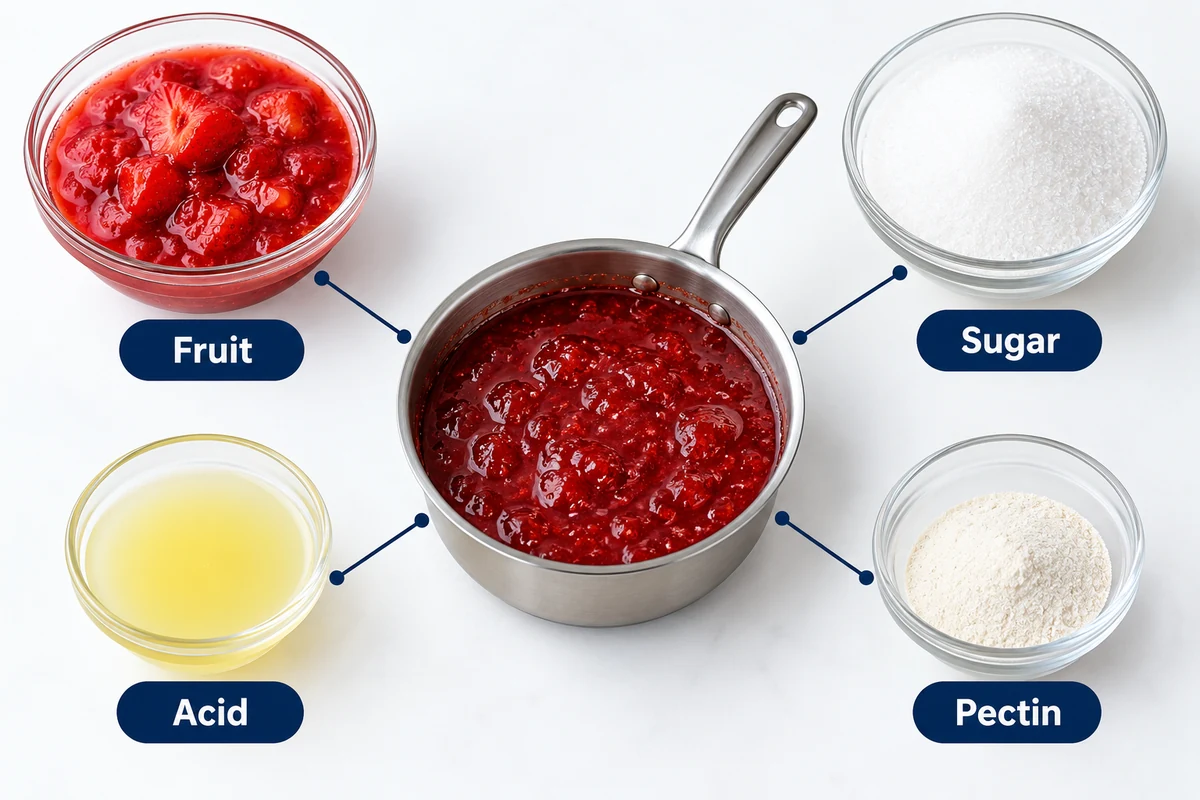
Conceptual visual explaining fruit, pectin, sugar and acid as distinct recipe inputs.
Judge the cooled jam, not only the hot pan
Read the method’s endpoint: some recipes specify a temperature, some a sheet or plate observation, and pectin recipes may specify a full rolling boil for a stated interval. Do not substitute one endpoint casually for another. Once the batch is filled or cooled as directed, assess the jam at its intended serving temperature. Does a spoonful mound gently or run? Is liquid separating from the gel? Are pieces spread through the jar or collecting in one layer? Write down the observation and the time after cooling, because some products continue to set.
If the result is soft, first check the record rather than adding a random extra dose of pectin. Verify the fruit measurement basis, sugar amount, acid ingredient, pectin type, order of addition, batch size and actual cooking step. The NCHFP troubleshooting guidance identifies incorrect proportions, insufficient acid, excessive water and cooking errors among causes of a soft set. Reworking a batch should follow an authoritative procedure for that exact pectin type and storage style. Simply recooking until it “looks thicker” can damage flavour while leaving the real formula problem unresolved.
A small development trial is especially useful for a bakery or foodservice filling. Make two clearly labelled samples with the same tested base method, changing only the fruit cut or another permitted variable. Cool them in the same way and compare spreadability, piece distribution, flavour and any weeping after the same holding period. Then repeat the preferred option before scaling it. Do not call a single attractive spoonful a validated commercial formula: shelf-life, package compatibility and food safety require their own controls and, where relevant, qualified testing.
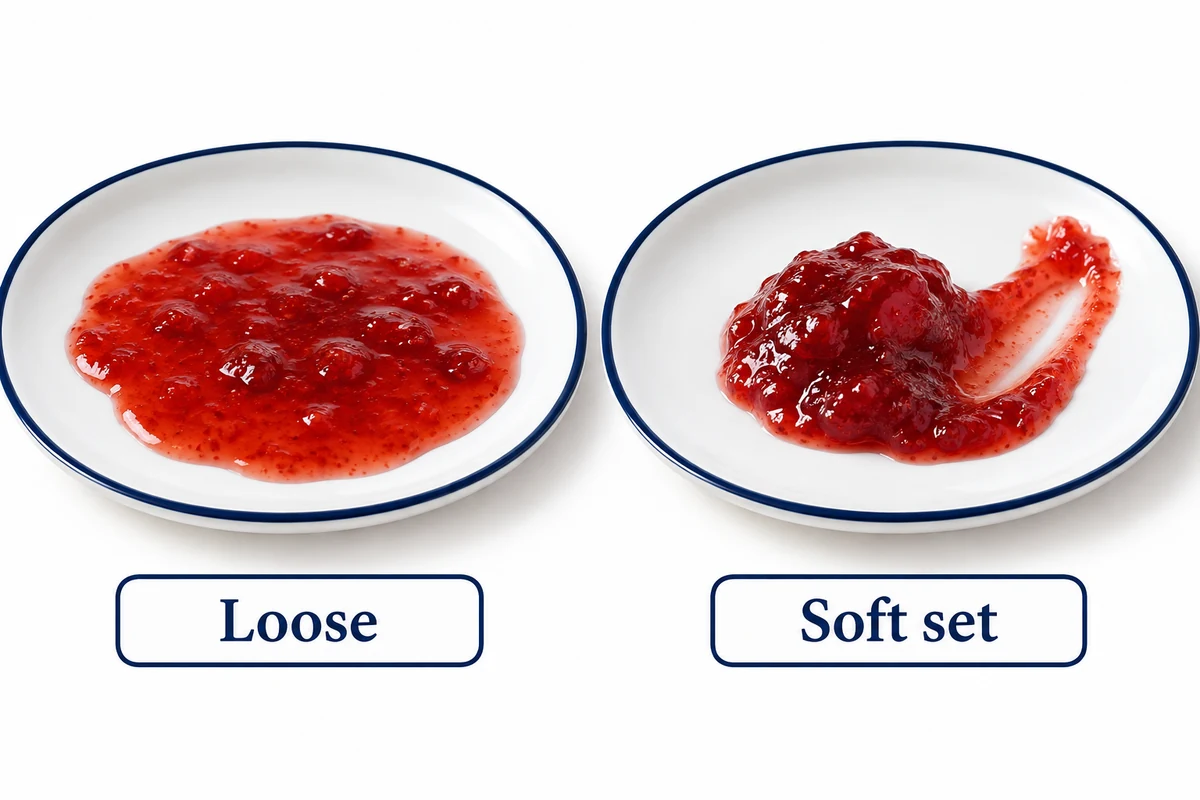
Conceptual visual explaining spoon or plate observation of loose versus set jam.
Use the right storage route
Freezer jam belongs in the refrigerator or freezer according to its tested instructions. The National Center for Home Food Preservation’s uncooked berry-jam recipe says room-temperature storage is unsuitable for that product. A cooked spread placed in a clean jar is not automatically a canned product either. For shelf-stable jars, use a tested jam formula, the specified container preparation and the stated heat-processing method for your altitude and jar size. If you have changed fruit, pectin, sugar or batch scale beyond the recipe’s limits, do not infer safety from the lid sealing.
For fruit handling, thaw in the refrigerator or another route the authoritative guidance permits; do not leave a bag on a warm counter for hours. Keep work surfaces and containers clean, and follow the package’s handling instructions. Once opened, store the jam as its recipe and label direct. Discard a jar with visible mould or other spoilage signs rather than scraping the surface. These points matter more than whether the starting strawberry was fresh or frozen.
When strawberry form becomes a buying decision
A home cook can use whichever plain frozen strawberries suit the recipe. A manufacturer needs the delivered form to stay comparable from one trial to the next. Whole IQF fruit may give visible pieces but require crushing; a consistent cut or purée may simplify dosing and texture control. The useful questions are concrete: What exactly is in the bag? Is sugar present? What is the cut or particle form? How much fruit remains as pieces after the intended thaw and mixing method? Those answers belong in a sample comparison alongside the jam result.
Discuss frozen strawberries for a jam trial
We supply frozen strawberry forms through our China-based partner network. We can review the whole-fruit, cut or purée form you need, clarify the specification and coordinate a representative sample for your own jam trial. Send the intended fruit form, target texture, approximate quantity and destination; we will check a suitable supply option and the sample route. Your recipe and preservation validation remain with your food-development team.
