


On this page
Yes, frozen berries can work in overnight oats, but the first decision is whether those berries are suitable for a breakfast that will not be cooked. Read the pack instructions and the food-safety guidance where you live before choosing the method. If the product says to cook before eating, heat the berries as directed, cool them promptly under refrigeration, and then add them to the oats. Leaving frozen berries in a cold jar overnight is a thawing step, not a substitute for required heating. When the berries are suitable for uncooked use, you can mix them in before chilling for a colored, fruit-flavored base or add them at breakfast for more distinct pieces. Both routes need a refrigerated jar. The best timing is therefore a choice about product suitability first and texture second.
Check the berry label before making a no-cook breakfast

The photograph shows whole frozen strawberries as a fruit form; preparation instructions must be checked separately.
An overnight-oat recipe often looks simple: oats, a liquid, perhaps yogurt, and fruit in a covered jar. The fruit is the ingredient that needs an extra question. “Frozen” describes storage and temperature; it does not tell you whether a specific pack was prepared and labeled for eating without a heating step. A berry intended for a cooked dessert and one suitable for a cold topping may look identical through the bag. Choose by the product instructions and applicable local advice, not by color, brand familiarity, or the fact that the fruit is individually frozen.
The Nutrition.gov overnight-oatmeal recipe [1] includes fresh or frozen berries and lets the cook add fruit during assembly or just before eating. That is a useful culinary model, but a recipe is not a blanket clearance for every frozen-berry pack on sale in every country. For example, the Food Safety Authority of Ireland [2] recommends boiling imported frozen berries for one minute before consumption in its jurisdiction. Those two pages are easier to reconcile when the pack and local safety context come before the recipe method.
Before opening the bag, check whether its instructions and local guidance permit this no-cook breakfast. If they do, plan the texture you want. If the pack requires cooking, make the heating step part of breakfast preparation. If the instructions are missing or ambiguous, do not treat the overnight refrigerator as a workaround; choose a product with a clear route or prepare the fruit through the applicable cooking guidance. This matters particularly when the bowl is for someone at higher risk from foodborne illness, because a casual assumption can be more consequential than an imperfect texture.
What berry juice does to soaked oats

The photograph shows whole frozen blueberries; it does not show their effect on finished oats.
As frozen berries soften, released liquid can carry color and flavor into the surrounding oats. This is not automatically a flaw. A breakfast with a pink or purple base may be exactly what someone wants; a layered jar with pale oats and visible berries calls for a different assembly. The distinction is where the juice goes. If berries are stirred through at night, more of that liquid contacts the grain during the soaking period. If fruit rests on top, more color may remain near the upper layer until the jar is stirred. The result depends on berry type, broken-piece share, quantity, and how much liquid the oat mixture already contains.
Oats absorb liquid while chilled. A jar that starts firm can become spoonable by morning, while a jar that begins loose may become softer still after berry juice enters it. It is tempting to remove a large amount of milk on the assumption that frozen fruit always adds a fixed amount of water. That assumption is weak: a handful of whole blueberries, crushed raspberries, and fruit cooked into a sauce release liquid differently. Begin with a base texture you can recognize, then change one ingredient at a time on later batches. Otherwise you cannot tell whether the difference came from the oats, the fruit, the yogurt, or the waiting period.
Look at the bowl as well as the jar. A thin pool at the edge can disappear with one gentle stir, but vigorous mixing may break fragile fruit that was still intact. A jar with fruit kept above the oats gives the eater a choice: keep separate spoonfuls, fold some berries through, or mix everything. If the same fruit is mixed throughout before chilling, that choice is mostly gone. Choose a fruit-stained oat mixture or a cold oat base with identifiable berries before you assemble the jar.
Mix at night or add at breakfast

Illustrative comparison of assembly timing; both portions require a suitable berry preparation and refrigerated holding.
The two timings produce different breakfasts, even with the same berries. Mixing suitable uncooked-use fruit through the base before refrigeration favors an integrated fruit flavor and color. Adding prepared fruit at breakfast preserves more separation between oat and fruit layers. The Health Canada chocolate-berry recipe [3] chills the oat mixture and uses raspberries as a serving-time topping. Its method shows one way to control the bowl’s appearance.
| Decision | Fruit mixed before chilling | Fruit added at breakfast |
|---|---|---|
| Visual result | More opportunity for color to move into the oats | Fruit can remain a clearer top layer until stirred |
| Fruit pieces | Fragile pieces spend longer in contact with wet oats | Pieces avoid overnight handling inside the jar |
| Liquid adjustment | Berry juice becomes part of the base to assess in the morning | Base can be checked before fruit is placed on top |
| Practical preparation | One covered jar is assembled the night before | Fruit is held separately under suitable cold conditions or prepared safely before service |
There are useful middle routes. Put fruit above the base without stirring it in; the lower berry surface may soften and stain the first oat layer, while the upper pieces remain visible. Prepare a berry layer separately and spoon it between oats and yogurt at service. If you want a mixed berry color but whole pieces on top, divide the fruit between those roles. The same pack can therefore serve a mixed base and a final garnish, provided its instructions permit the preparation used for each portion. Keep the two portions identified during preparation so the intended texture is deliberate.
Frozen fruit placed straight on a finished bowl can cool a serving quickly and may still feel icy when eaten immediately. That can be pleasant for some people and unpleasant for others. For a smoother breakfast, prepare the fruit in advance under the applicable safe route and hold it chilled for service. If your goal is visible fruit without a cold center, serving-time addition does not mean the fruit must come directly from the freezer. It means the berries spend less time inside the oat mixture. Keep those two ideas separate: fruit temperature and assembly timing are independent variables.
Prepare cook-before-use berries separately

Conceptual preparation sequence for berries that require heating. Follow the product instructions and applicable cooling guidance.
If the pack says to cook the berries, do that as a separate, deliberate step. Follow the instructions on that pack and the rules that apply where you are. The Food Safety Authority of Ireland’s specific one-minute boiling advice concerns imported frozen berries in its consumer context; it should not be copied as a universal global standard or substituted for a different product instruction. What must not happen is a jar labeled “no cook” quietly becoming the reason to omit a required fruit-heating step. Heat the fruit through the appropriate method before using it in a cold breakfast.
After heating, consider what is being added to the jar. Cooked fruit can be a sauce, a spoonable mixture with intact pieces, or a drained topping. A thick fruit mixture may stay visible on top of oats; a thin sauce will travel into them readily. Do not assume that straining is necessary: the released juice carries useful fruit flavor, and removing it changes the ingredient amount. If the recipe needs a firmer layer, reduce or otherwise manage the fruit as part of the cooked preparation, then let it cool under safe conditions. Record whether juice was retained, because a trial made with drained fruit cannot be compared directly with one that kept all the liquid.
Prompt cooling matters when warm cooked fruit is destined for a chilled jar. A small shallow container can help heat leave the fruit more readily than a deep pot left on the counter, and the mixture should be placed under refrigeration according to suitable food-handling guidance. The FDA’s food-storage guidance [4] says to refrigerate perishables promptly, maintain the refrigerator at or below 40°F/4°C, and follow commercial frozen-food cooking instructions. It also notes that freezing does not kill most bacteria. These are separate controls: adequate heating for the product, then safe chilling and handling for the prepared topping.
Adding a very hot fruit mixture directly to a closed oat jar can warm the oats and dairy and change the texture before the jar cools again. The better workflow is to complete the fruit preparation, cool it promptly, and assemble or top the breakfast when both components are in the intended chilled state. Do not infer that a few seconds of contact with hot fruit cooks the oats, and do not infer that a brief microwave warm-up of a finished jar fulfills a berry pack’s instructions. A product-specific cooking requirement needs its own complete step.
Keep utensils and containers clean when transferring the prepared fruit. If one spoon handled unheated cook-before-use berries, do not use that spoon for the ready breakfast without washing it. The issue is easy to miss in a small kitchen, where the same board or measuring cup is used for fruit, oats and garnish. A clear order is helpful: read the pack, prepare the fruit, cool and store it, then assemble with clean equipment. This sequence is less confusing than trying to solve a food-safety requirement after the oats and berries have already been mixed together.
Build a jar comparison you can repeat
Most advice about “the best” berry timing skips the question of what changed between jars. If you want to compare outcomes, start with a single frozen-fruit product and a single oat base. Use the same oats, dairy or plant drink, jar size, berry mass, assembly time and refrigerator. Prepare the berries by the same safe route for both jars. Then put one portion in the base before chilling and keep the second portion separate for addition at service. The only planned difference is fruit timing. This is a proposed kitchen comparison, not a test we have carried out.
Write down the starting condition. Was the fruit frozen, safely thawed, or cooked and chilled when it entered each route? “Mixed at night” describes timing but not that condition. If you compare a cooked fruit sauce with whole frozen berries, any difference in oat thickness could be due to processing and broken fruit as much as timing. For a clean comparison, use the same prepared fruit divided into two equal portions. If the product is suitable for uncooked use and you choose to compare frozen and thawed forms, make that a separate second trial.
At breakfast, examine the jars before stirring. Note whether a free-liquid layer has formed; where the strongest color sits; how many pieces still look distinct; and whether the spoon meets firm oats, loose oats, or uneven pockets. Take a photo under similar light if the visual difference matters, but do not treat a photo as a moisture measurement. Stir each jar once in the same way and taste. A formulation decision can then be based on the finished breakfast rather than on attractive berry pieces in the unopened bag.
Adjust texture without losing the fruit
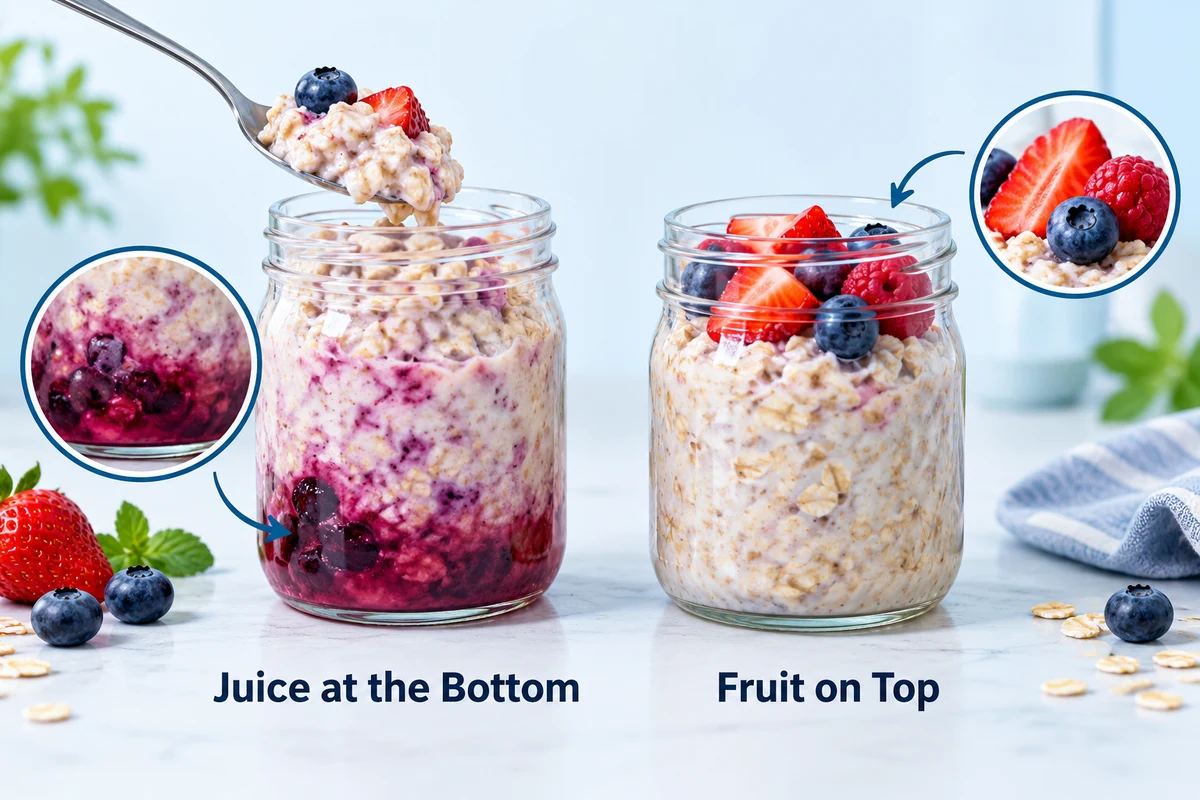
Illustrative texture choices: released juice can enter the base, while a separate topping keeps more fruit identity. No trial result is shown.
Once the fruit route is safe and the assembly timing is chosen, adjust texture through the base. For a thin jar, first check whether liquid is pooling or simply waiting to be stirred through the oats. A gentle fold may bring the bowl together without any ingredient change. If it remains loose, change the base on the next batch in a measured way: a little less added liquid, a different oat amount, or a more viscous dairy component. Do not make all three changes at once. The aim is to learn which adjustment creates a pleasant spoonful while keeping a useful amount of fruit.
Reducing the berry portion can thicken the bowl, but it can also erase the reason for adding berries. Before removing fruit, consider keeping it on top, using a thicker oat base, or preparing a less free-flowing cooked fruit layer when cooking is required. A topping can give strong fruit identity even if less juice enters the oats. For a fully mixed breakfast, the color and flavor may be worth a softer base. The right target is a chosen eating experience, not an arbitrary rule that no red juice may appear.
Chia seeds, yogurt and different oat types all alter mouthfeel. Their effects are recipe variables, not fixes guaranteed to absorb any volume of thaw liquid. If you add chia, account for the extra thickening time and check the final texture after the same refrigerator hold. If you use quick oats in one jar and rolled oats in another, they may look different even with identical fruit. Keep the comparison honest by changing one variable and tasting the entire spoonful, including fruit and base.
Appearance can matter as much as viscosity. Stirring dark berry juice into pale oats makes a vivid bowl but can hide whole pieces. If recognizable fruit is important for a menu photograph or retail jar, reserve some suitable prepared berries for the surface. A layered jar needs enough space above the oats so a topping can be added without crushing it under the lid. In a development trial, measure usable fruit after assembly and serving, not only the mass tipped from the bag. A few large fragments may look like a generous topping while distributing unevenly between servings.
Refrigeration, serving and leftovers
Cover and refrigerate the assembled oats during soaking. North Carolina Cooperative Extension specifically advises against leaving an uncooked oat mixture with liquid at room temperature overnight; its overnight-oatmeal safety article [5] provides a refrigerated recipe with berries. Chilling controls the holding environment. It does not convert a cook-before-use berry into a ready-to-eat one, and it does not make a previously mishandled ingredient sound. Keep the two questions visible throughout preparation: was the fruit prepared as required, and was the finished breakfast held correctly?
Make only the number of portions the household or service can handle under reliable refrigeration. Use a clean container with a lid, and return unused portions to the refrigerator promptly. A grab-and-go jar may spend time in a bag or on a desk before eating; plan for that journey rather than assuming it remains at refrigerator temperature because it began cold. If the meal cannot be kept chilled as required, change the meal plan. Adding frozen berries at the end is not a dependable substitute for refrigeration of oats mixed with milk or yogurt.
Leftovers need a practical rule based on the most perishable ingredient and the actual time and temperature history, plus any directions on the dairy and fruit packages. A jar repeatedly opened, sampled with a used spoon and returned to the refrigerator is different from an untouched sealed serving. For a kitchen producing multiple jars, date the batch and avoid a vague promise that all recipes keep equally well for a fixed number of days. Fruit type, dairy choice, preparation, temperature control and handling all affect the appropriate decision.
If the fruit was cooked, store the prepared topping as a distinct component until you are ready to assemble or serve it when that gives better texture and clearer handling. If an opened frozen bag contains more fruit than needed, keep the remaining product according to the label rather than thawing the whole bag to make one jar. Repeated thawing and handling can damage fruit shape and complicate safe storage. Prepare the quantity needed for the planned breakfasts, and keep track of which portion has already been heated.
Choose fruit forms for the breakfast you want
Start with the finished spoonful. For an even berry flavor through the oats, smaller or softer fruit pieces may integrate easily, with the understanding that more color may travel into the base. For a clear topping, larger intact pieces may be preferable if they survive the chosen preparation route and are pleasant at serving temperature. A mixed pack can provide both forms, but the proportions and breakup may vary; a photograph of the frozen bag cannot establish how much fruit will remain whole after overnight contact with wet oats.
For recipe development, write the ingredient brief around decisions you can verify. Specify the berry species or blend, whole versus broken-piece preference, any added ingredients, intended uncooked or cooked use, and the target appearance after the actual chill and service interval. Ask for the applicable product instructions before approving a no-cook route. If the berry is intended to be cooked, the recipe and production plan need to accommodate that requirement. If the goal is a cold, ready-to-serve breakfast, choose an ingredient whose documented intended use fits it rather than trying to solve the mismatch by changing only the jar assembly.
If you are comparing ingredient forms for a prepared breakfast, keep a record of the exact fruit form and the preparation route alongside the sensory result. A change in pack specification can alter the finished jar even when the recipe card is unchanged. Our product specifications and sampling overview is relevant when an ingredient team needs a defined sample basis for that comparison. We can use that sample basis to compare whole-piece share and the amount of juice reaching the finished jar.
View frozen mixed berries
Compare mixed-berry forms for a coloured oat base or a distinct breakfast topping. Check the selected product’s preparation instructions before choosing its no-cook route.
View product forms →References
- [1] Nutrition.gov, Overnight Oatmeal↑ — frozen-berry recipe and addition timing.
- [2] Food Safety Authority of Ireland, Advice to Boil Imported Frozen Berries↑ — jurisdiction-specific one-minute boiling advice.
- [3] Health Canada, Chocolate-Berry Overnight Oats↑ — serving-time raspberry topping.
- [4] FDA, Are You Storing Food Safely?↑ — refrigeration and commercial food instructions.
- [5] N.C. Cooperative Extension, Overnight Oatmeal Safety↑ — refrigerated oat preparation.
