


On this page
Fresh and frozen blueberries can both make good food ingredients, but they enter a production line in different conditions. Choose fresh when the finished item needs the firm appearance of a gently handled berry placed near service. Consider IQF frozen fruit when berries will be mixed, baked, cooked, blended or portioned through a frozen supply program. Neither choice is automatic. The winning ingredient is the one that meets the finished-product target with a workable process and a confirmed supply specification.
The U.S. Highbush Blueberry Council’s ingredient-format comparison [1] makes a similar use distinction: minimally processed fresh berries fit gentle placement and foodservice uses, while individually quick frozen berries can be free flowing through plant processes. It describes the ingredients and samples in that project. A buyer still needs to test the actual offered fruit in its own recipe and line.
Start with the finished product

Whole frozen blueberries on a handling surface show the incoming fruit form before recipe testing.
Before asking which blueberry is “better,” picture the product at the point the customer sees and eats it. Are whole berries visible on a chilled parfait? Are they scattered through a muffin batter and baked? Are they blended into a smoothie, heated in a filling or dosed into yogurt? Those uses ask different things from the fruit. A firm surface berry can matter greatly in a fresh display and hardly matter after a controlled bake.
Write the target in observable terms. For a visible topping, that might be intact shape, surface appearance, a pleasant bite after a defined hold and a low amount of loose juice in the cup. For a baked inclusion, it might be berry distribution, a recognisable piece after baking and an acceptable amount of colour movement in the crumb. For a smoothie, it may be throughput, finished flavour, texture and portion consistency. This short brief keeps a buying conversation tied to the product rather than to an abstract preference for fresh or frozen.
The intended point of eating matters as much as the mixing step. A berry can look sound when it leaves the line but soften or release juice while a dessert waits for service. Conversely, a berry that seems soft after thawing may perform well in a cooked filling where individual firmness is not the target. Test the product when the customer will actually receive it, using the service temperature and hold time planned for that product.
Do not use this choice to settle an unrelated nutrition question. The XMG article on how fresh and frozen nutrient comparisons work covers that separate topic. Here, the decision concerns physical form, line handling, finished appearance and an accepted sensory result.
Choose by visible use and processing path

Illustration: fresh berries can be placed after filling, while IQF frozen fruit can enter a controlled mixing step. Test the intended route.
Fresh berries arrive as chilled fruit and generally call for gentle handling. They can be useful when the berry remains plainly visible and minimally processed, such as a hand-placed topping, salad or parfait. Confirm the actual firmness, bloom, size, maturity and condition of the offered fresh berries; the word “fresh” alone does not promise that every carton will suit the display. A delicate fruit can also be bruised or crushed if it is forced through a process designed for a different ingredient.
IQF frozen blueberries are separate pieces held frozen until their intended use. That free-flowing form can suit measured additions to a mix or foodservice preparation, subject to the actual berry grade, pack and equipment. A frozen berry still needs handling controls: temperature, timing, dosing method and a plan for what happens when the fruit warms. A bag of loosely separated berries on arrival does not guarantee they will remain separate after poor storage or a long open hold on the line.
The distinction is clearest when the use points are compared honestly. For a chilled, visible garnish where fresh snap is part of the customer’s experience, trial a fresh candidate under the actual service hold. For a muffin inclusion, test the offered frozen fruit at the intended mixing and baking conditions alongside a fresh candidate if both are commercially possible. For a blended drink, establish the desired final texture and process temperature first; ingredient form then becomes a line and formula question rather than an argument about which berry looks better in a bowl.
Do not assume frozen means one fixed specification. The XMG blueberry product page describes frozen blueberry options and asks the buyer to confirm type, berry size, whole percentage, surface condition, packing and order requirements. Actual availability must be checked for the project. A comparison against fresh fruit should name the exact frozen type and grade, not treat every IQF offer as identical.
What changes during handling

A separate original view shows whole frozen fruit in a liner before a handling trial.
Freezing changes the physical state of water within the fruit. Once the berry thaws, its texture can be softer and juice can move more readily than in a gently handled fresh berry. Kitchen examples in King Arthur Baking’s direct recipe comparison [2] show that difference and why cooked or baked use can remain suitable. The outcome in a production line depends on the actual berry, formula and process; the kitchen example is a reason to trial, not a universal correction factor.
Ask where the first meaningful change happens. Is it during transport or thawing, while berries wait in a hopper, in a mixing step, during heating, or only after the packaged product has been held? A final product with purple smears does not automatically identify the cause. The XMG guide on why frozen blueberries bleed colour in batter deals specifically with that question. Here, record the stage that makes fresh or frozen useful in your chosen product.
The two forms also create different timing obligations. Fresh fruit needs a receiving, chilling and use plan appropriate to its condition. Frozen fruit needs a stable frozen chain and an agreed plan for adding it frozen or after controlled thawing. Do not move between these methods midway through an approval trial without recording the change. A berry thawed and drained before use is not the same process input as one added directly from frozen.
For automated dosing, free flow, berry size and whole-fruit percentage may affect portion repeatability. Those characteristics require their own tests. The XMG article on blueberry size counts and uniformity in automated dosing explains how to measure those variables. Use it when the ingredient must pass through a feeder; do not decide from a fresh-versus-frozen label alone.
Appearance after processing can surprise teams. A fruit that looks ideal in a receiving tray may be hard to dose or may disappear in a baked product. A frozen candidate that looks frosty and dull in a cold sample may still provide the desired visible pieces after the intended process. Both statements are possibilities to check, not promised outcomes. Inspect and taste the finished food.
Run the two candidates through the same product
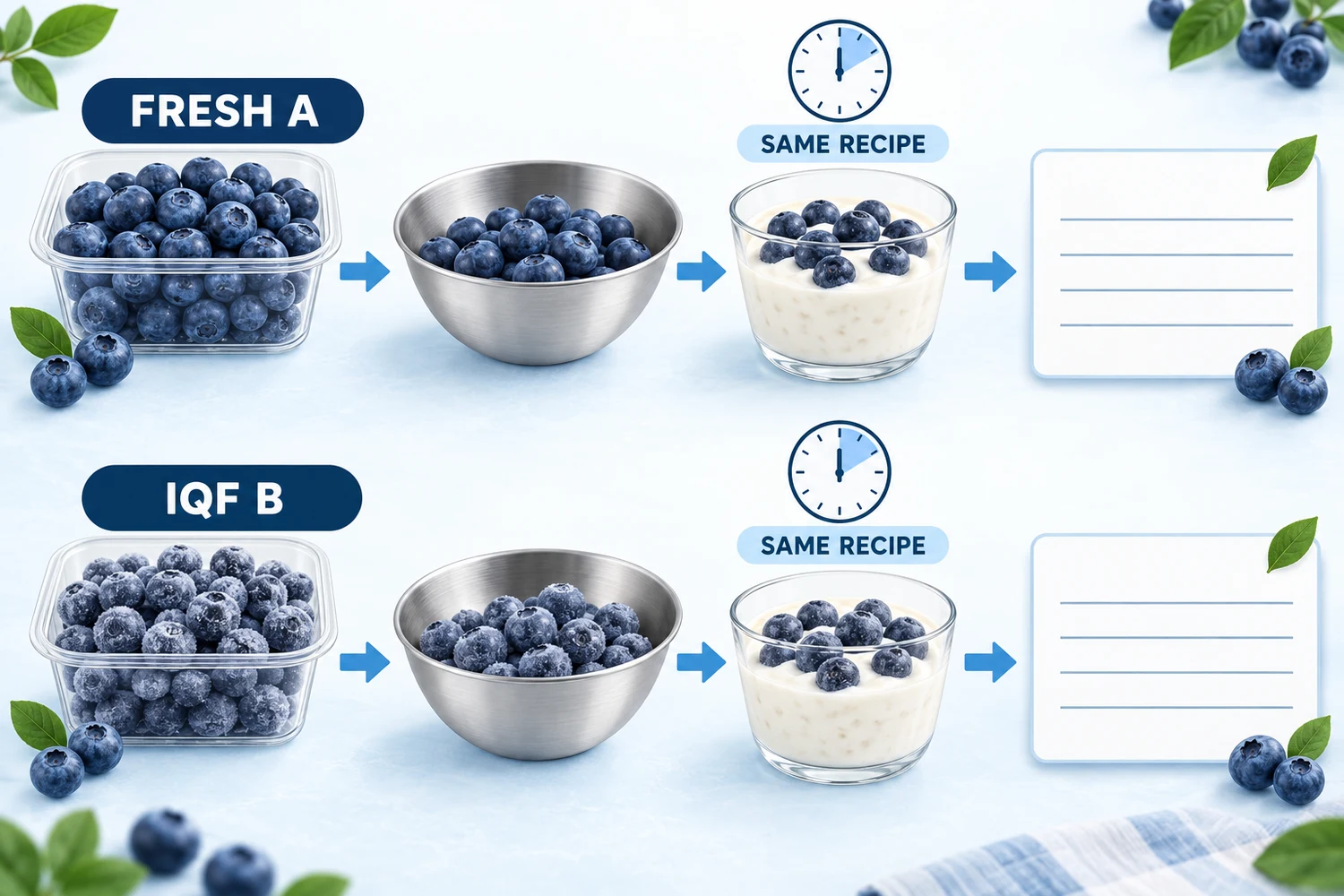
Illustration: compare identified fresh and frozen candidates under the same recipe and serving conditions before changing the formula.
When both forms are viable options, make a matched first trial. Identify the fresh and frozen samples separately, including product type, lot reference, date received, berry size direction and relevant handling condition. Set the same fruit mass in the recipe, then hold the other ingredients, process settings and service stage as consistently as practical. If a fresh candidate is rinsed or trimmed and a frozen candidate is thawed or drained, record those steps and the resulting usable mass.
Compare them first without silently optimising one recipe. For a muffin, use the same batter, inclusion target, mixer sequence, deposit weight, bake and cooling window. For a yogurt fruit cup, use the same base, fruit dose, filling sequence and service hold. For a beverage, record whether the fruit is crushed, blended or strained. The intent is to see what the ingredient form changes in a stable process. A second round can then adjust a particular formula or handling step to improve either candidate.
At defined points, note where berries remain whole, how much juice is released, whether colour migrates, whether pieces are distributed as intended and how the finished product tastes. Do not collapse those into a single “quality” score. A product may be visually excellent yet difficult to process, or operationally easy yet miss the desired fresh-fruit bite. The buyer decides which criteria are essential for the named application.
Keep a reference sample and formula version. If fresh wins a hand-placed topping trial and frozen wins a baked inclusion trial, those are not contradictory results; they answer different product questions. If the fruit candidate changes, repeat the parts of the trial that matter to the decision. When a customer wants both a fresh-looking garnish and year-round industrial portioning, it may need separate formats or a revised product design rather than a single blanket winner.
The U.S. blueberry ingredient comparison [1] can help frame use cases, but the buyer’s own matched recipe is where an acceptance decision belongs. Do not transfer published sensory or nutrient readings from its tested ingredients to an untested commercial lot.
Measure usable fruit and cost in use
A purchase-price comparison can mislead when the two forms incur different preparation, storage, waste and processing costs. Compare on a defined basis: delivered kilograms, inspected usable kilograms, fruit actually placed into accepted finished product, and the labour or line steps needed for each. State whether any water, juice or trimming loss is counted and how rejected product is handled. Then calculate cost per accepted finished unit using current quotations, rather than using an old market-average price.
For fresh fruit, inspect the amount that meets the selected display or processing standard at the point of use. For frozen fruit, inspect whole percentage, clumping, fragments and any loss connected to the chosen thawing or dosing method. Neither form gets an automatic loss allowance. A project should measure the stage that actually affects its finished output. A cold-chain incident or a poor fresh receiving lot should be recorded as a supply or handling problem, not treated as a permanent property of the entire category.
Also record what the process gains or loses. Frozen berries may be easier to inventory over a longer program if the freezer and ordering cadence suit the operation; fresh fruit may fit a rapid local service model. But storage itself has a cost, and a frozen route can require special thaw or mixing controls. Compare the real site constraints, destination and current offer rather than applying a market-average price to the order.
If an ingredient is rejected on appearance but tastes acceptable in a puree, that does not automatically make it usable in the current product. Keep any rework or alternate use inside the buyer’s documented food-safety, labelling and specification rules. The cost calculation should follow the accepted product, not an optimistic assumption that every off-grade berry can be recovered elsewhere.
Carry the result into a purchasing brief

Illustration: keep pack, usable fruit, handling and finished-product observations together in the buying record.
Once the trial identifies a preferred route, convert its observations into a specification request. Name the finished product and whether blueberries will remain visible, be baked, blended or held chilled. State the selected fresh or frozen ingredient form, the tested dose and process, the key acceptance criteria and the sample or lot reference. Separate mandatory requirements from useful preferences.
For an IQF frozen route, specify the blueberry type, size direction, whole-fruit and fragment requirements, packing, lot identification and documents needed for the destination. Include the target application and the points where your line is sensitive, such as feeder flow or colour during a hold. A decision to use fresh berries should be sourced through a fresh-fruit supplier.
Keep the approved recipe version with the purchasing record. If the future supplier changes berry type, grade or handling route, compare the proposed fruit with that reference. A good trial is only useful when the ordered ingredient matches what was tested closely enough for the buyer’s risk and change-control requirements.
Questions buyers still ask
Are frozen blueberries better than fresh for baking?
Either can work, but the result depends on the recipe, mixing sequence, berry condition and the desired baked piece. Test the actual candidates at the same fruit mass and bake conditions, then inspect colour movement and finished texture. For detailed colour-control work, use the XMG batter-bleed guide.
When is fresh blueberry the clearer choice?
Fresh can be a strong candidate for gentle, visible placement where firm fresh texture and appearance are central to the item served. Confirm the offered fruit condition and test it through the intended service hold. “Fresh” alone does not ensure every lot meets that target.
Can IQF blueberries be added without thawing?
They often can enter a recipe from frozen because the pieces are separate, but the method must fit the equipment and formula. Define the addition point and temperature, then check the actual line and finished product. A thawed-and-drained trial is a different process and should be recorded separately.
Does frozen automatically cost less?
No. Current purchase prices, usable yield, labour, storage, rejected product and accepted finished units determine cost in use. Compare quotations and measured process output on the same basis. Do not rely on a general price claim.
Does XMG supply fresh blueberries?
This comparison explains when fresh may fit an application. The current XMG product route discussed here is IQF frozen blueberry. Ask us to confirm the frozen form and specification available for your order; source a fresh requirement through a supplier that offers it.
Explore frozen blueberry options or return to Food Knowledge for more ingredient guidance.
Discuss a frozen blueberry sample with XMG
Tell us the finished food, intended fruit dose, target berry size and whether visible whole pieces matter. Add the process stage, pack, expected volume and destination. We can check which IQF frozen blueberry form and specification are currently available through our supply partners, then discuss a sample for your own line trial. Fresh blueberries should be sourced through a supplier that offers them.
Frozen Blueberries
Review our frozen blueberries range, product forms and specification options.
View Frozen Blueberries →