


On this page
A frozen food pallet is secure only when its cartons remain supported, the load stays attached to the pallet through handling, and the finished unit can be stowed without blocking the refrigerated container’s air path. Stretch wrap contributes containment, but it cannot repair an unsupported carton edge, a weak pallet, or a loading pattern that crosses the reefer load line. Start with the actual cartons, pallet and route. Then agree how the unit will be built, handled, inspected and recorded.
There is no responsible universal number of film turns, wrap tension, pallet height or air gap for every frozen fruit, vegetable and mushroom shipment. Those settings depend on carton strength, stack geometry, film and equipment, handling, container design and carrier instructions. A road distribution test can inform one part of the decision; it does not by itself prove that a sea reefer load will remain stable and circulate air correctly. The practical task for an importer is to connect the packing specification to the complete transport unit and to the actual loading plan.
Treat the pallet as a complete transport unit

This photograph shows a frozen fruit cargo form only; it does not show a pallet, wrapping, overhang or airflow.
A carton may survive compression on its own yet move when the whole pallet accelerates, stops, turns, lifts or receives an impact. Conversely, a tightly wrapped stack may look stable while its bottom layer is damaged or its load is too large for the pallet. The object to approve is therefore the assembled unit: product in its primary pack, filled cartons, stacking pattern, pallet, film, edge protection and any other restraint that will travel with it. If one part changes, the behavior of the unit can change.
Before discussing film, identify where the pallet will actually go. A container load can pass through a freezing site, staging area, truck, terminal and destination warehouse. Each transfer introduces a different opportunity for fork contact, tilt, vibration, shock or temporary exposure. Ask who moves the pallet, with what equipment, and whether it will remain intact until final receipt. A load designed only for a clean warehouse aisle may face a very different movement pattern at a port or during destination distribution.
ISTA’s horizontal impact method treats a unitized load as an assembled shipping object and addresses a particular handling hazard. That is useful language for a packing discussion: the test specimen should resemble the shipment that buyers will receive. It is still a bounded method, not evidence that every transport condition has been simulated. The actual distribution chain determines which hazards and tests deserve attention.
For a buyer, the first decision is whether cartons will travel as one palletized unit or be unloaded and rebuilt en route. If the unit is broken down, the destination handler needs instructions for the carton-level handling and restacking. If the unit stays together, the packing brief must describe the pallet as well as the cartons. Record the product and pack format, cartons per layer, layer pattern, pallet type, intended handling direction, outer dimensions and any material that contributes to restraint. This makes later inspection specific: a shifted top layer, detached film at the base and a damaged bottom corner are different failures with different remedies.
Photographs can establish the proposed configuration, but a photograph cannot measure containment or demonstrate transport performance. Use images to show what was packed and where restraint was placed, then pair them with the agreed specification and relevant observations or test records. The same distinction applies to diagrams in this guide: they explain relationships between parts, not the condition of an actual loaded shipment.
Keep cartons supported within the pallet footprint
Carton overhang is an immediate geometry check. When a carton projects beyond the pallet deck, part of its base loses support and its edge is easier to catch during movement. The unsupported edge can also reduce the useful load path through the lower boxes. FedEx’s freight guidance tells shippers to avoid overhang. The Codex Alimentarius code for fresh produce transport also states that cartons should remain within the pallet outline. Its product scope is fresh produce, but the support geometry prompts the same check for a frozen-food pallet: does the stack rest where the pallet can support it?
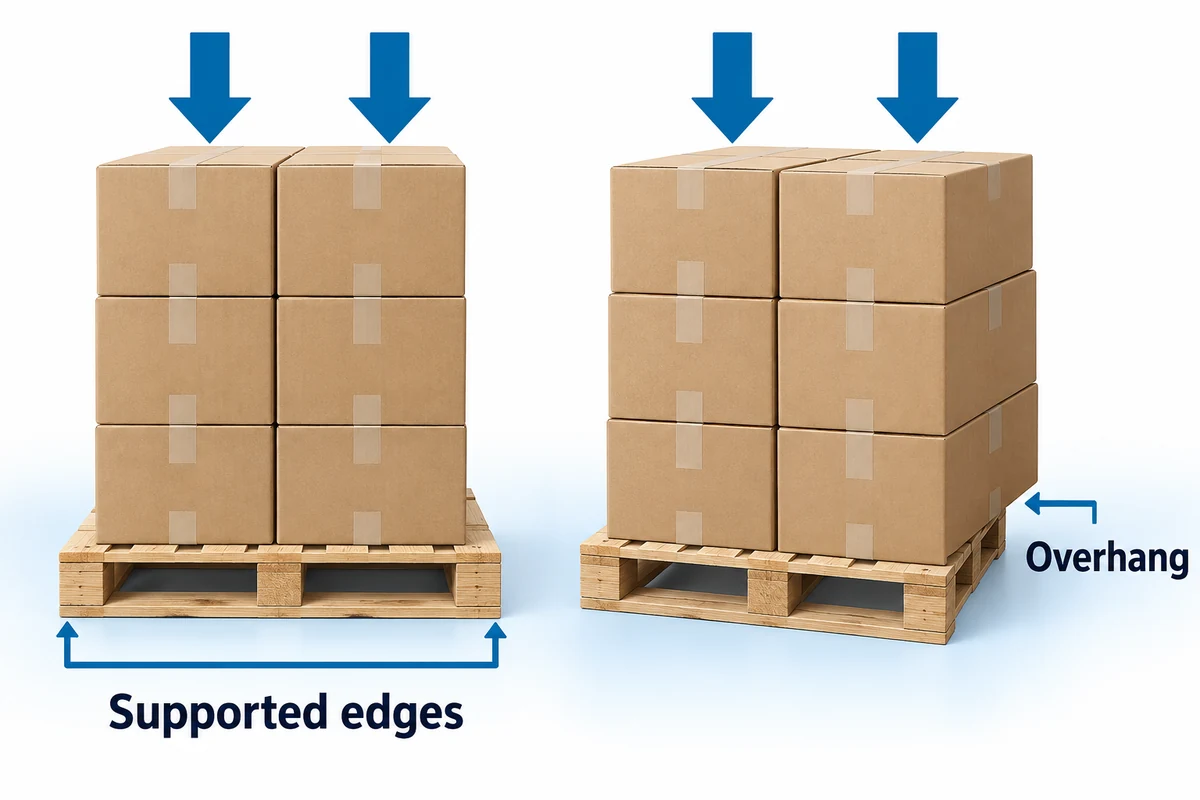
Illustrative support comparison. Assess the complete pallet and carton arrangement; no transport performance is certified.
Check every side at the bottom and top of the load, not only the side facing the camera. A nominal carton dimension may hide bulging after filling or freezing, and a mixed layer may produce one projecting corner even when the overall stack appears square. Measure or inspect the finished pallet rather than approving a drawing alone. The diagram contrasts supported edges with a visible overhang; it deliberately supplies no safe weight or height. Those values belong to the actual carton, pallet and shipment specification.
Keeping boxes within the footprint does not mean pushing them together so tightly that the required carton ventilation or loading arrangement is defeated. A reefer’s airflow design and the carrier’s loading instructions still govern the final stow. Check whether carton vents are meant to align, whether the pallet deck permits the required flow, and whether neighboring units create blocked faces. The Codex fresh-produce code discusses deck-board support while keeping air circulation open, and Hapag-Lloyd’s reefer guidance calls for an unobstructed air path. Check the selected container and cargo rather than copying either source as a universal pallet drawing.
Look particularly at the lowest layer. Heavy, regular cartons may create a clean vertical load path; light or mixed cartons can leave gaps or localized pressure. A corrugated carton also behaves differently after moisture exposure. The correct response to an edge or compression concern is to revisit carton grade, fill, layer pattern and pallet support together. More film around an unsupported corner hides the issue without providing a firm base below it.
A useful acceptance question is: if a fork lifts this exact pallet, which carton edges carry load and which ones project into a collision path? The answer should be visible in a front, side and top view. If the product mix or customer pack changes, repeat that check. A pallet originally approved for one carton size should not automatically be treated as approved for a revised case with a different footprint or weight distribution.
Set wrap containment around the actual load

Conceptual unit-load configuration. Select containment and protection for the actual load; this is not a prescribed film count.
Stretch film is a restraint system only when it joins the cartons into a coherent stack and engages the pallet in the way the agreed design intends. Film placed around the middle of the cartons can hold those cartons together while leaving the entire stack free to slide on the pallet. FedEx’s packaging guidance makes the base connection explicit for its network. For an ocean reefer shipment, apply the same question to the actual unit and verify the required method with the packer, handling team and carrier; do not import FedEx’s film-layer prescriptions as sea-freight rules.
Containment is also more than visual coverage. Film selection, pre-stretch, machine setup, wrap path, load shape, corner condition and cold handling can change the holding effect. A fixed instruction such as “wrap several times” says little unless it is tied to those variables and to a target that can be checked. Ask the packing team to specify the film and equipment used, the starting and ending positions, how the lower load is retained, and how they check that cartons cannot readily move relative to the pallet. The appropriate setting should be demonstrated on a representative load, then retained as a controlled packing instruction.
Too little containment leaves cartons able to splay or shift. Excessive or poorly placed force can deform outer cases, crush corners, pull a light top layer inward or obscure inspection. A torn sheet or loose film tail can also become an operational nuisance during loading. The goal is a stable unit with cartons in their intended geometry. Inspect for uniformity around all faces and at the lower edge; a neat front face alone is weak evidence.
Frozen cargo adds a separate question: where can air travel after the wrapping is applied? Hapag-Lloyd warns that plastic wrapping can act as a vapor barrier and impede air circulation around product. That does not mean every frozen pallet must be left unwrapped. It means the film design must be evaluated together with the intended reefer airflow and cargo pack. Identify any carton ventilation features before covering them. Avoid using film as an accidental full-face seal where the approved loading plan relies on airflow through the cartons or between units.
For a trial, build the load with the actual cartons and film, photograph it from each side, lift and move it under the planned handling conditions, and inspect for slip, corner damage and case deformation. A controlled trial is evidence about that configuration only. If a new film, carton size, pallet or stacking pattern is adopted, the earlier observation is no longer a direct substitute for checking the revised load.
Protect edges without weakening the unit
Corner boards and other edge protectors can distribute a restraint force and shield vulnerable carton edges. They are useful where the film or strap would otherwise concentrate force on a small part of the case. Their position, length and material still need to suit the finished stack. A protector that stands proud, slips during handling or bears against an unsupported carton does not solve the underlying geometry. Keep the stack aligned first; then decide whether protection improves the unit.
Think of three separate contacts: carton against carton, carton against pallet, and restraint against carton. The first depends on stacking pattern and case dimensions. The second depends on deck support and friction. The third depends on film, strap or board placement. A failure at one contact can appear later as a general “pallet problem.” Diagnosing the contact prevents a superficial fix, such as tightening the film when the real issue is a projecting bottom case or a damaged pallet board.
Top sheets and covers may protect from dust or handling exposure, but they can alter the air path or conceal a shifted top layer. In a reefer, decide on any cover as part of the loading design, with the carrier’s instructions in hand. Similarly, additional strapping should be evaluated for edge pressure and compatibility with carton construction. The article cannot set a universal number of straps, boards or film layers because the product, route and unit design vary.
Inspect the pallet itself before adding cargo. Broken deck boards, protruding nails, unstable blocks or an unsuitable footprint introduce risks that wrap cannot correct. The pallet must also be compatible with the shipment’s handling equipment and destination requirements. For a reusable or mixed pallet pool, an inspection step matters because a previously approved design can be undermined by a different physical pallet. Where wood packaging rules or treatment marks apply, coordinate those requirements separately with the buyer and destination authority; a valid mark does not demonstrate unit-load stability.
Use an exception route rather than accepting a visibly compromised unit. If a corner is crushed or film has separated at the pallet base, record the condition before loading, identify whether the affected cartons need replacement, and rebuild or restrain the unit under an approved instruction. Simply adding film over damage can make the pallet look uniform while removing the evidence needed to identify why it moved.
Preserve the reefer air path around secured cargo
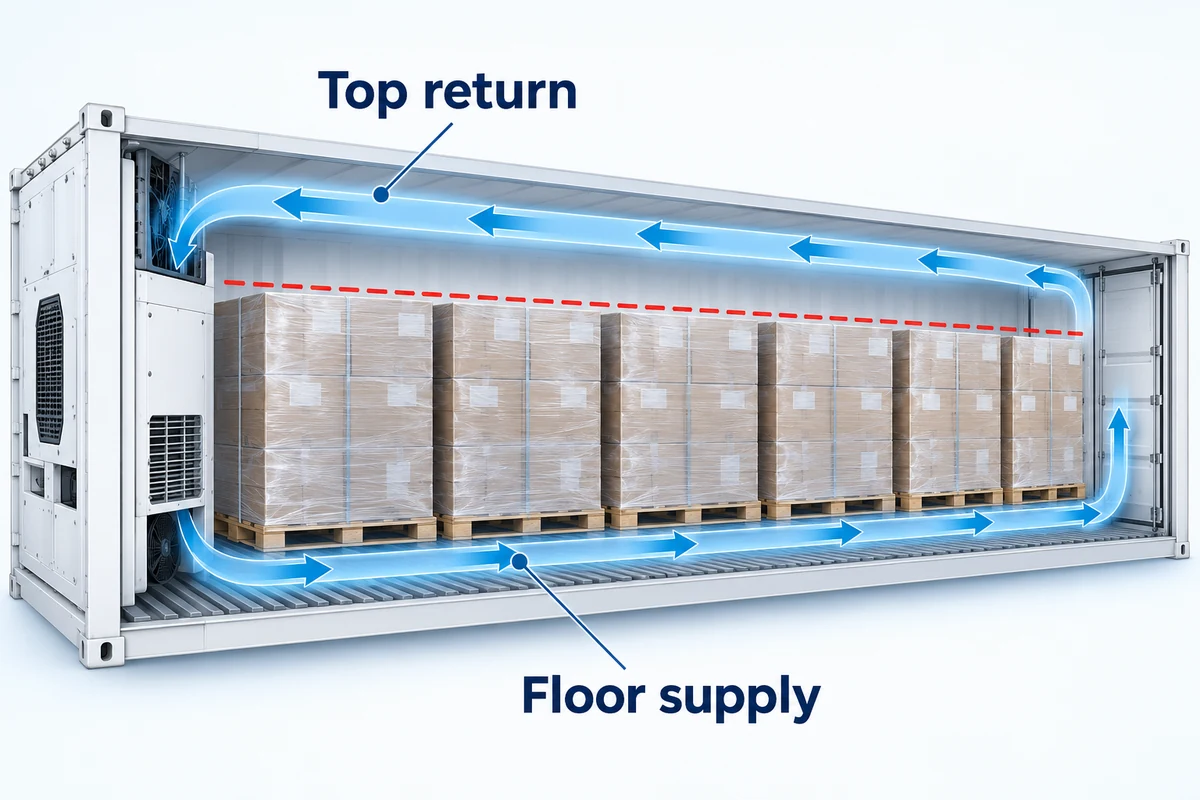
Schematic airflow relationship. Follow the carrier and equipment guidance for the actual loading configuration; no universal clearance is shown.
The reefer and the pallet must work as one loading system. In a common container arrangement, conditioned air travels through a T-bar floor under the cargo and returns above it toward the refrigeration unit. Maersk describes T-bar floors as part of refrigerated cargo circulation, and carrier diagrams show the upper load line that should remain clear. The exact flow arrangement and permitted loading pattern depend on the equipment and carrier. Confirm the instructions for the booked container before finalizing pallet dimensions or placement.
A secure stack can still be a poor reefer load if cartons rise above the marked load line, loose film obstructs the floor, a cover blocks the return path, or pallet and carton details defeat the planned vertical or horizontal circulation. Hapag-Lloyd cautions against blocking air circulation and stacking above the load line. For pallet deck details, the Codex fresh-produce code offers a separate support-and-airflow check. Neither source establishes one universal clearance dimension for all frozen-food equipment.
There are two restraint decisions here. Film and edge protection help keep cartons on their pallet. The completed pallets must also be stowed and, where required by the carrier’s cargo-securing plan, restrained so the units cannot move within the container. Wrapping a pallet more tightly does not replace suitable container stowage or dunnage. Maersk’s payload definition includes dunnage and cargo-securing arrangements, which is a reminder to include those materials when the equipment and loading plan are checked.
The conceptual cutaway here labels floor supply and top return to make the conflict visible. It is not an image of a packed XMG container and cannot certify a shipment. In the actual load, check the unit against the container’s red load line, floor and return-air openings, and the carrier’s requirements for cargo placement. A pallet that fits on paper may need a different orientation or count once the complete load is laid out. The loading team should be able to show where supply and return air will move after the doors close.
There is also a distinction between maintaining frozen cargo and cooling down warm cargo. A refrigerated container is operated according to the booking and carrier instructions; wrapping should not be used as a substitute for proper product temperature, pre-loading handling or equipment setup. Ask the logistics team to confirm the required cargo condition, set point and monitoring responsibilities for this shipment. These are shipment-specific decisions, and the pallet security plan must not obstruct them.
Airflow and stability can pull in different directions. A tighter unit may reduce movement, while a closed film wall or solid sheet may block circulation that the chosen package depends on. Conversely, leaving large unplanned openings in an unstable stack is not a sound airflow strategy. Resolve the tradeoff by choosing a tested or otherwise justified pack and stow arrangement for the actual frozen product, then documenting both the restraint and the air path. If the carrier changes the equipment type, revisit the layout instead of assuming the same pallet pattern remains suitable.
Test handling and distribution as separate stresses
A load trial should answer a precise question. Can the assembled pallet tolerate the handling and distribution environment expected for this route while the cartons remain usable and the unit can still be unloaded safely? Start with the likely hazards and the failure that matters to the buyer: carton shift, collapsed lower cases, film separation, topple, puncture, temperature-related exposure during an exception, or damage discovered on arrival. Select observations and tests to match those questions.
ISTA lists different procedures for different shipment types. Its Procedure 3E concerns unitized loads of similar packaged products in full truckload shipment. That makes it relevant when a road leg of this character is part of the distribution chain, but a 3E result should not be described as a complete ocean reefer validation. ISTA also publishes a horizontal-impact approach for unrestrained unitized loads, which can inform handling stability questions. The methods have stated scopes. Sea transport, moisture, container stowage and reefer airflow may call for additional evaluation or operational controls beyond a chosen distribution test.
Specify the test specimen before requesting a pass/fail statement. It should include the actual carton construction and fill, pallet, number and arrangement of layers, film, corner pieces and any top treatment. Agree the acceptance criteria in advance: how much shift is acceptable, what carton damage counts, whether film may loosen, and whether the pallet remains safely handleable. Those criteria must reflect the buyer’s product and logistics requirements. A laboratory label by itself cannot define what a damaged frozen food carton means for a particular importer.
After testing, inspect the same places that commonly fail in real movements. Compare lower and upper layers, all four corners, pallet-to-load engagement and any film tears. Record both good and bad outcomes. If a redesign follows, change one or a small set of documented variables so the result can be interpreted. A new carton footprint plus a new pallet plus different film may improve the appearance of a load, but it makes attribution difficult unless the configuration is fully captured.
A transport test is not a substitute for loading inspection. Even a well-characterized design can be assembled incorrectly. Likewise, a photograph of a clean pallet before dispatch is not a substitute for a stress assessment where one is needed. Use the two forms of evidence together: design-level evidence for the chosen configuration and shipment-level checks showing that the units loaded match it.
Record a loading configuration that can be repeated
A workable pallet specification should be detailed enough that a second packing shift can build the same unit. Start with product and carton identification, net and gross case quantities, carton dimensions and construction, pallet footprint and condition, layer count and pattern, expected gross unit mass, film and edge protection, and finished outside dimensions. Add the handling and loading instructions that matter for this route. If mixed SKUs or changed case sizes are allowed, state the approved variants rather than letting a single diagram stand for every shipment.
Record the critical checks at three points. Before packing, verify materials and pallet condition. After unitizing, inspect footprint, corner protection, restraint at the base, film damage and visible carton deformation. Before closing the reefer, verify that the actual stow follows the carrier’s loading instructions, leaves the required air path and respects the marked load line. Assign the checks to named roles or teams so exceptions have an owner. A checklist with no responsibility can become a paperwork exercise.
Photos are most useful when they answer an inspection question. Capture each face of representative units, a close view of the lower film and pallet connection, the top of the stack, and the loading arrangement that shows clearance to the relevant reefer features. Keep the shipment identifier, date, product or lot reference and pallet configuration with the files. These images document a condition at a point in time; they should not be captioned as proof of maintained temperature or test compliance unless that evidence exists separately.
At destination, ask the receiver to distinguish transport damage from unloading damage where possible. Photograph any shifted layers or crushed corners before the unit is dismantled. Note which pallet positions are affected, because a repeated problem near a door or wall may suggest a loading or restraint issue that a general carton redesign would miss. Compare the destination observations with the packing record and the agreed stow plan. One damaged case does not by itself identify the cause, but a consistent pattern can direct a focused investigation.
Keep a change log. A different carton supplier, product pack weight, pallet construction, film roll or wrapping machine setting can alter performance. Route and carrier changes can alter handling and air-path constraints. The log should say what changed, why the team accepted it, and what verification was repeated. This is especially useful for seasonal frozen products where an identical article name may mask changes in case count or net weight.
Coordinate frozen cargo, packing and loading requirements

This fruit photograph illustrates a cargo product form; pallet support and packaging must be checked separately.
The buyer, packer, freight forwarder, carrier and receiving warehouse each see a different part of the same pallet. A good pre-shipment conversation connects those views before the load is built. The importer can specify destination, carton presentation, intended distribution route, handling equipment and any receiver pallet rules. The packing team can confirm the proposed carton, pallet and restraint configuration. The carrier or forwarder can confirm the booked reefer’s stow and airflow requirements. The receiver can identify unloading limitations and the evidence needed to handle exceptions.
Send one consolidated brief rather than separate instructions for the carton, film and container. Include the destination, pallet specification, carton and product details, shipment plan, expected handling stages, selected carrier instructions, and any test or inspection evidence the buyer requires. Mark unresolved items clearly. If the finished pallet will exceed a receiver limit or conflict with the reefer’s marked loading area, adjust the design before production packing begins.
The final approval should state what is known and what remains to be checked. A representative trial can support the unit-load design; carrier guidance can support the reefer stow; shipment photographs can document the actual loading condition. None replaces the others. When those pieces agree, a pallet is easier to build consistently, inspect before dispatch and evaluate fairly if a problem appears at destination.
Request a frozen-food quotation
We coordinate the frozen-food packing brief and shipment documentation around the selected cargo and loading plan. Share the destination, pallet and carton specification, expected handling route, carrier instructions and receiver requirements. We can identify the packing information and confirmations needed before loading.
Discuss shipment requirements →References
- [1] International Safe Transit Association, Test Procedures — procedure selection and shipment-type scope.
- [2] International Safe Transit Association, Horizontal Impacts for Unrestrained Unitized Loads overview — unit-load handling assessment and its limits.
- [3] Codex Alimentarius, Code of Practice for Packaging and Transport of Fresh Fruit and Vegetables — pallet support and deck airflow principles; fresh-produce scope.
- [4] Hapag-Lloyd, Reefer Cargo Handling guideline — air circulation, wrapping and load-line guidance.
- [5] FedEx, How to Pack: Packaging Freight Shipments — pallet overhang and base engagement in its freight network.
- [6] Maersk, Refrigerated Cargo — refrigerated container airflow context.
