


On this page
Pre-cooking frozen shiitake is the more reliable starting method when a dumpling filling is already wet or must hold its shape through wrapping and cooking. It lets some mushroom liquid leave in the pan before the pieces meet cabbage, tofu or meat. Direct mixing can work with a suitable small cut and a filling designed to handle the moisture, but it leaves that water-release step inside the dumpling. Neither choice replaces full final cooking. Check the frozen mushroom’s product instructions, cook the complete dumpling filling safely, and use the finished bite—not the smell of a raw mixture—to decide which route suits the recipe.
A good comparison begins with the same frozen shiitake lot, equal mushroom portions and the same base filling. Change only the mushroom preparation. Cook one portion before mixing and add the other directly as instructed by its product label. Then compare liquid in the mixing bowl, ease of sealing, wrapper condition, cooked yield, aroma and the cut center. This is a method for a kitchen trial, not a claim that XMG has run one. The answer may differ between diced mushroom and thick slice, a cabbage-heavy vegetarian mix and a tightly bound meat filling, or a dumpling boiled in water and one pan-fried then steamed.

Frozen shiitake pieces in a bag with visible frost.
Start with the product and filling
“Frozen shiitake” is not one uniform ingredient. Whole caps, slices and dice place different-sized pieces inside a small wrapper. Large slices can puncture or interrupt a tight filling; small dice distribute more evenly but may release liquid across a larger exposed surface. Ask whether the product was frozen raw, blanched or cooked before freezing. A frozen food’s appearance does not establish that it is ready to eat. The US Food and Drug Administration [1] cautions that ready-to-cook frozen foods still require the cooking directed on their packages. Begin with the actual label and handling specification.
Inspect the frozen lot before building a trial. Separate pieces can be portioned consistently. A solid clump may thaw unevenly or carry excess loose ice into one side of the comparison. If you must temper pieces to chop them, do so under appropriate refrigerated handling and treat their released liquid as part of the ingredient. Weigh the mushroom portion on the same basis for both methods. Comparing a drained pre-cooked portion with a heavier, ice-covered direct portion without recording the difference would tell you little about the methods themselves.
The rest of the filling deserves equal attention. Cabbage, spinach or other leafy ingredients may release their own water. Tofu can carry surface moisture. Meat protein can bind some liquid, depending on the recipe and mixing method. A spoonful of oil changes lubrication but cannot make uncontrolled free water disappear. If the base filling is already loose, adding frozen pieces directly may turn a manageable recipe into a leaking one. If the base is deliberately firm, the mushroom liquid may contribute juiciness. The point is to identify where water is coming from before deciding whether to remove it.
Public recipes show both approaches. The Kitchn’s shiitake-tofu potstickers [2] cook a mushroom-cabbage mixture and squeeze it before mixing, while a chicken-mushroom dumpling recipe card [3] mixes chopped mushrooms into a filling that is cooked afterward. Those are recipes, not product-specific food-safety validations. They show why a universal “always sauté” or “never sauté” rule would be too blunt.

Sliced shiitake pieces spread closely in a tray.
What pre-cooking changes
When frozen shiitake hits a pan, ice melts and water leaves the mushroom tissue. With enough exposed pan area and suitable heat, some of that water can evaporate before the mushrooms meet the filling. You can see the sequence: icy pieces soften, liquid collects, the pan becomes less wet, and the pieces may begin to take on a cooked surface. If the pan is crowded, the liquid has less room to escape and the pieces mostly steam. “Pre-cooked” therefore describes a step; it does not prove that the moisture problem was solved. The cook should observe the pan, not rely on a fixed minute count.
Pre-cooking also changes flavor and texture. Browning can add roasted notes, while prolonged high heat can drive off some fresh aroma. The mushrooms may become smaller and firmer. For a cabbage dumpling with a delicate wrapper, a drier mushroom may be valuable even if its flavor is different from a briefly heated piece. If the filling needs a juicy mushroom bite, cooking away too much liquid may make the result seem dry. The goal is to reduce uncontrolled free liquid to a level the recipe can handle, not to desiccate the mushroom.
Cool a cooked mushroom component before mixing it into a raw meat or egg filling, and manage the holding time according to the recipe’s food-safety plan. Hot mushrooms can warm a cold filling while the cook is wrapping dozens of dumplings. In a small home batch, let the component stop steaming and refrigerate promptly as needed; in foodservice, use the applicable cooling and cold-holding controls. Do not leave a large warm bowl on the bench while making wrappers. Pre-cooking the mushroom does not make the rest of a raw filling safe.
One practical option is to keep a little clean, concentrated mushroom liquid and add it back by measured spoonfuls after the filling’s binding is assessed. This allows flavor adjustment without bringing back the entire volume of free water. Do not assume every liquid is worth retaining: check its smell and the product’s cleanliness. If a batch has grit, unusual odor or other quality defects, a strongly seasoned dumpling will not correct it.
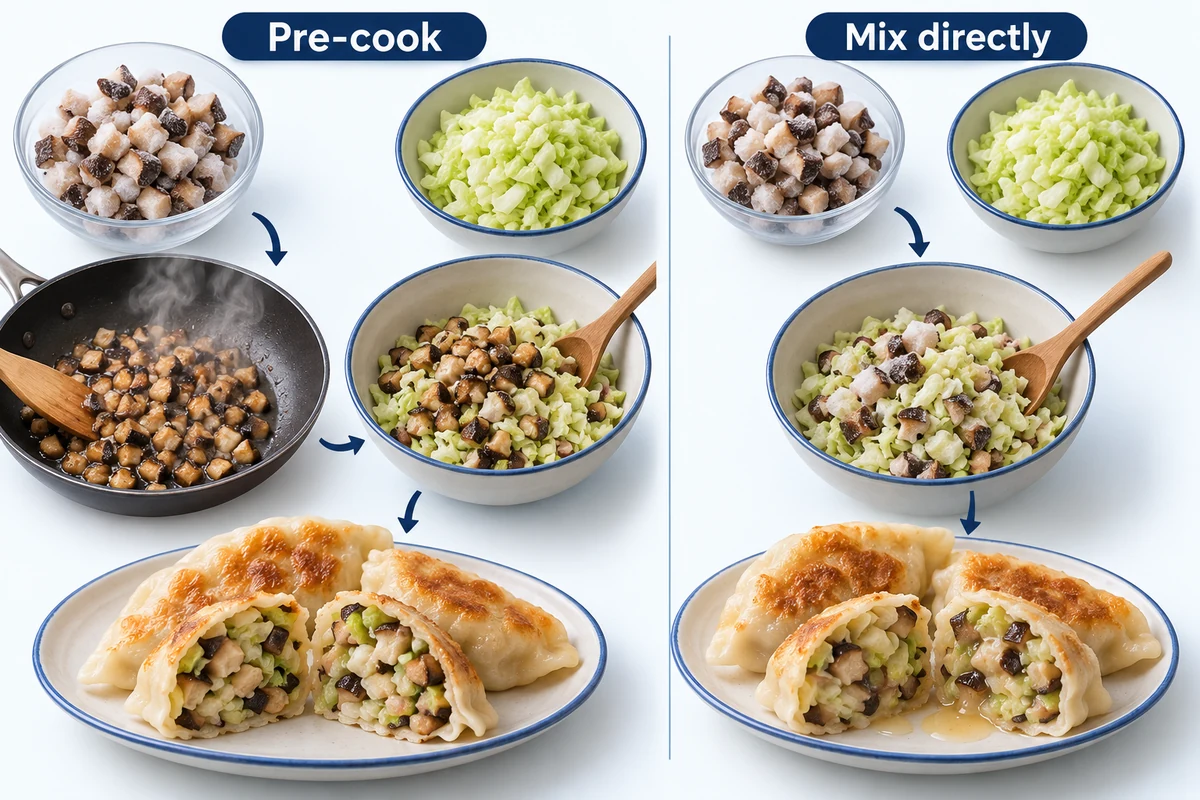
The diagram scrolls horizontally on smaller screens.
Illustrated equal shiitake filling portions following pre-cook and direct-mix paths.
When direct mixing can work
Direct mixing is plausible when the frozen ingredient’s instructions permit cooking as part of the assembled dumpling, the pieces are small enough to heat evenly, and the base filling has a plan for released moisture. The mushrooms may enter the mix frozen or suitably tempered according to the product and recipe. “Direct” describes skipping a separate mushroom pan step; it never means serving the frozen mushrooms uncooked. The wrapper and filling still need complete final cooking. For a thick, large dumpling or a dense filling, do not guess doneness from a browned wrapper.
The potential advantage is a more integrated, moist filling with less handling and fewer pans. The potential drawback is liquid appearing after the dumpling is already sealed. During steaming or boiling, that liquid can collect in a pocket, loosen a vegetable filling, or stress a thin wrapper. Some dumplings are intentionally juicy, so a small amount of liquid is not automatically a defect. The issue is whether the finished texture matches the dish: a clean bite, a coherent center and a wrapper that stays intact during service.
A binder should not be treated as a repair for every wet mix. If liquid is visibly pooling before wrapping, adding starch or crumbs by guesswork changes the recipe and can produce a pasty center. First distinguish moisture coming from cabbage or tofu from moisture supplied by the mushroom. A small trial portion can show whether the base needs better draining, whether the mushroom needs a separate pan step, or whether a smaller cut would solve the packaging problem. Make only one substantive change at a time.
Raw meat adds a separate safety obligation. If a dumpling filling includes ground poultry, the FDA safe-food-handling temperature chart [4] gives 165°F (74°C) for ground poultry; for raw ground beef, pork, veal or lamb it gives 160°F (71°C). These are meat safety values, not invented temperatures for shiitake. Use a thermometer where the dumpling format allows an accurate center check and follow the product and local foodservice requirements. Wrapper translucency or surface color alone cannot establish that a meat center is safe.
A fair two-batch dumpling trial
Begin with a single frozen mushroom lot and one base filling. Divide the mushrooms evenly, using the same cut distribution in both portions. Pre-cook one mushroom portion until the planned degree of liquid reduction, then cool it appropriately. Keep the other portion in its intended direct-mix condition. Prepare equal quantities of the base, season both alike and record any mushroom liquid added or discarded. If one filling includes cabbage that was squeezed and the other does not, you are comparing two recipes rather than one mushroom decision.
Wrap the same number of dumplings with the same wrapper size and filling weight. Record whether the mixture sticks together on the spoon, whether liquid appears in the bowl, and how easily the edges seal. Put the two batches on separate marked trays so they do not get confused. Cook each by the same final method and to the correct degree for its ingredients. If one batch is pan-fried then steamed and the other boiled, the wrapper and water exposure will obscure the mushroom effect.
Cut several cooked dumplings from each batch after a comparable rest. Look for a firm but not dry center, visible pockets of free liquid, wrapper tearing and mushroom distribution. Taste the filling, then a whole dumpling with wrapper, because the wrapper can mute or change perceived mushroom flavor. If the intended service includes chilling or freezing assembled dumplings before final cooking, repeat the trial in that service condition. A result from freshly wrapped dumplings may not predict the same wrapper integrity after frozen storage.
Write the observations in a compact score sheet: ingredient form, portion weight, pre-cook endpoint, free liquid at mixing, wrapper seal, cooking method, center doneness, released liquid after cutting, mushroom bite and overall preference. Use descriptive words before assigning any numeric score. “Wet” might mean liquid pooling on the tray, a juicy interior, or a soft wrapper; those are different problems and lead to different fixes. A small record is more useful than a memory that one batch “seemed better.”
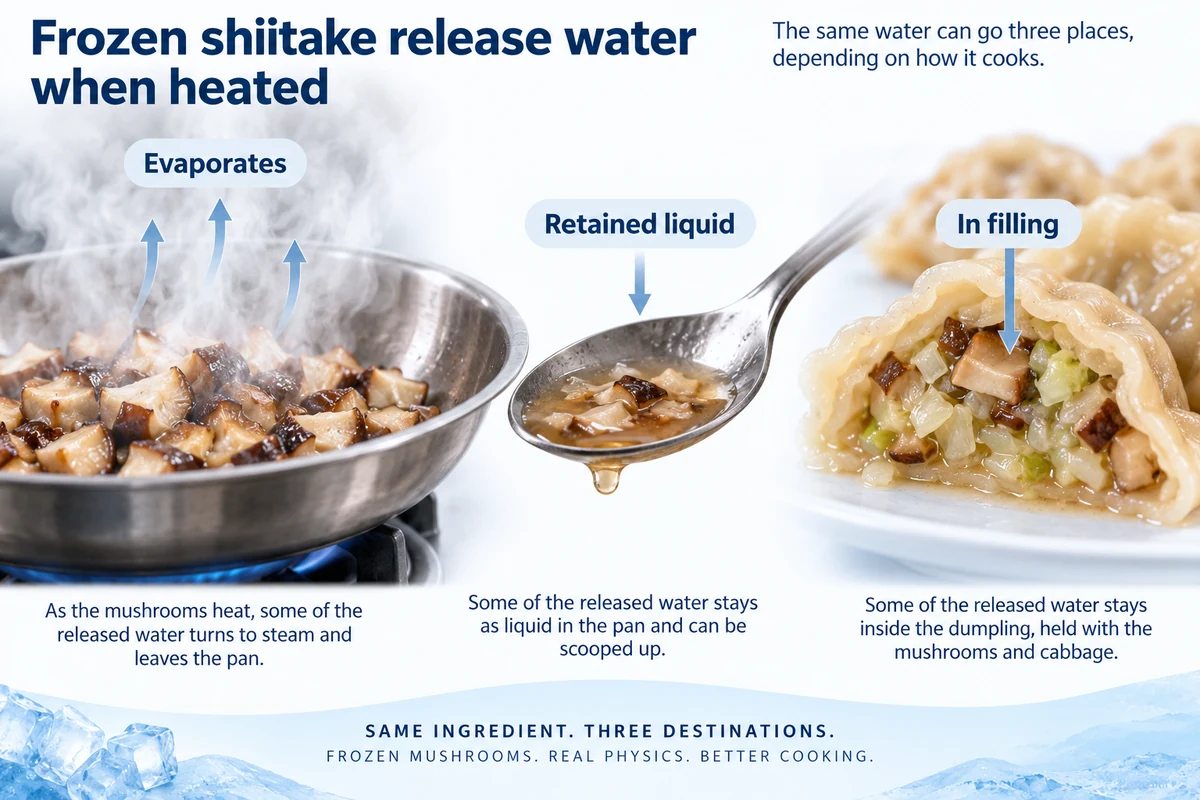
The diagram scrolls horizontally on smaller screens.
Illustration of shiitake liquid evaporating, remaining in pan and entering a dumpling.
Cooking the final filling completely
Food-safety decisions depend on the complete filling, not only on the mushroom. Freezing does not reliably kill all microbes in a ready-to-cook food, as the FDA notes. A pre-cooked mushroom mixed with raw chicken still belongs to a raw-chicken dumpling until the final center reaches the applicable safe endpoint. A direct-mixed mushroom in a vegetable dumpling still needs the product’s stated cooking. Do not assume that a cold or partly frozen center becomes safe because the exterior wrapper is hot.
Cooking methods vary in heat delivery. Boiling surrounds the dumpling with hot water, while pan-frying followed by steaming heats through a combination of contact and steam. A dense center, thick wrapper or large mushroom piece can slow heating. For a new recipe, cook a test dumpling, open it and check the center; for meat fillings use a suitable thermometer and the relevant official endpoint. Avoid inventing one universal number of minutes for all dumpling sizes and compositions. The method should be checked against the actual product and recipe.
Separate clean tools from utensils that touched raw meat. Keep uncooked dumplings cold while waiting for the pan, and handle cooked dumplings on a clean plate. If batches are to be cooled or held for later service, use the local controls for that food and operation. A kitchen decision about pre-cooking mushrooms can improve texture, but it does not replace a safe workflow from receiving frozen ingredients through service.
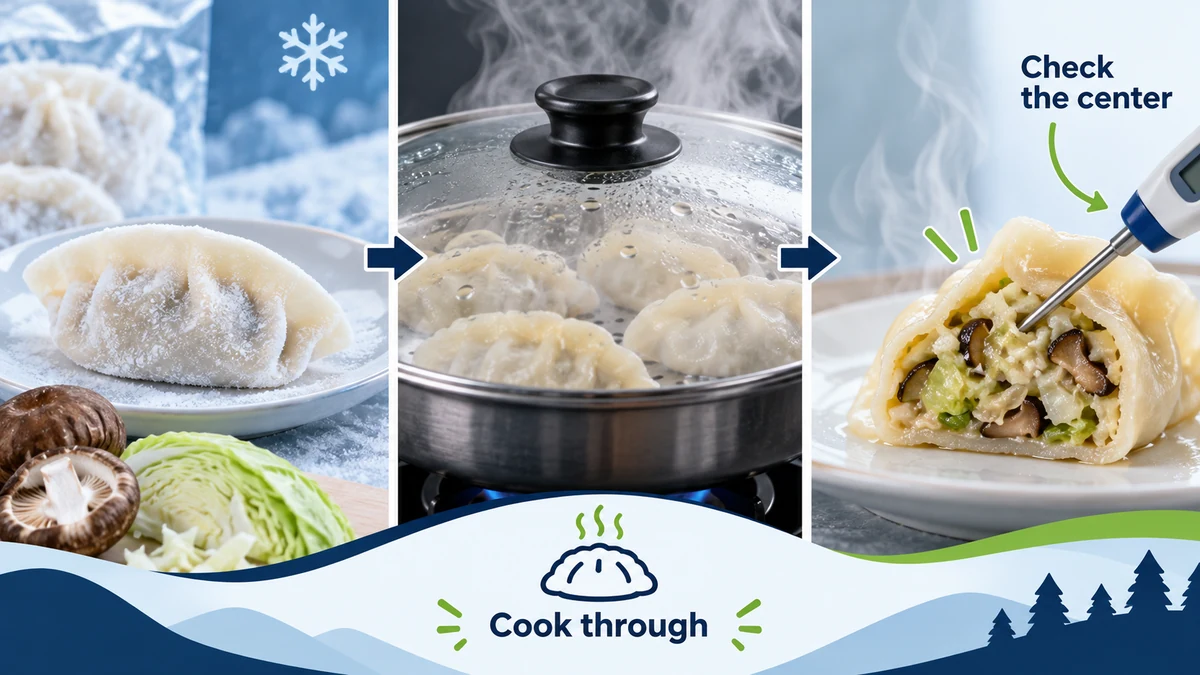
The diagram scrolls horizontally on smaller screens.
Illustrated frozen dumpling cooked under a lid and checked at the center.
Diagnose leakage, weak flavor and loose binding
If liquid leaks during wrapping, inspect the bowl before changing the mushroom step. Liquid already pooling there points to the combined filling. A cabbage-heavy mix may need draining even when the shiitake is pre-cooked. If the bowl stays dry but liquid appears only after final cooking, mushrooms or other ingredients are releasing water inside the wrapper. Try a controlled pre-cook comparison or a smaller amount of a larger cut. Avoid adding more filling to compensate; overfilling makes the seam more vulnerable.
If flavor is weak after pre-cooking, review the pan endpoint. A crowded pan can leave the mushrooms steamed but diluted; an aggressively dry pan can remove appealing notes. Taste the cooked mushrooms before they enter the mix, then taste the completed filling. If the mushrooms taste good alone but disappear in the dumpling, the relative amount and seasoning of other ingredients may be the issue. Do not claim that one cooking step universally “locks in” aroma. Aroma and taste are perceived in the final combination.
If the filling falls apart, identify whether the pieces are simply too large for the wrapper, whether the base has adequate binding, or whether water has weakened the matrix. Finely chopping mushroom can improve distribution but may also increase exposed area and apparent softness. If a meat filling is involved, mixing technique can matter as much as the mushroom. Record these variables; do not attribute every loose center to frozen shiitake. Try a small adjustment and repeat the same cooking method.
If the wrapper tears after cooking, look at its seam, overfilling, handling and cooking agitation as well as internal liquid. A dumpling that survives steaming but breaks in a rolling boil may have a wrapper problem rather than a mushroom problem. The kitchen’s real target is not “zero liquid.” It is a filling that holds its intended shape, cooks through and delivers the expected juicy or firm bite without an accidental puddle.
Choosing a frozen shiitake form
Once the kitchen method is clear, choose a product form that reduces unnecessary work. For a finely textured filling, dice may be easier to distribute than whole caps. If the recipe wants visible mushroom pieces, sliced or coarser cuts may be desirable, but the wrapper size must accommodate them. A sample should be evaluated after the exact cooking process: initial frozen appearance alone will not reveal final piece integrity or liquid release. Keep the form and cut recorded so a successful trial can be repeated.
XMG’s public whole shiitake and sliced shiitake pages show why the form needs a deliberate choice. For a dumpling program, ask for the intended cut, processing description and a representative sample, then test it in the actual filling. Do not infer a universal blanching status, yield or safety instruction from a generic product photograph. A supplier can confirm the order-specific information; the kitchen must validate the recipe and final cooking step.
The practical decision is therefore conditional but clear. Pre-cook when free water threatens the filling or when a browned mushroom note is desired. Consider direct mixing only when the product permits it and the filling plus final cooking method can handle the resulting water and heat the center fully. Run an equal-batch trial before scaling. That gives a result tied to your dumpling rather than to a recipe for a different mushroom cut, wrapper or filling.
For a production kitchen, keep the acceptance description practical: mushroom form and cut, the pack’s preparation instruction, the filling formula, wrapper size, batch size and final cooking method. Those details make a small trial transferable to a working line. If a new lot changes its moisture behavior, recheck the filling before altering the whole recipe. A trial based only on one attractive plated dumpling can miss bowl drainage, wrapping speed and the final dumplings in the batch. Record what the cooks actually see at each stage, including any extra liquid that must be poured off. It is easier to solve a specific observed problem than to follow an absolute rule about frozen mushrooms.
Explore frozen mushrooms
Review the listed frozen mushroom forms and match the named species and cut to your dish. Follow the exact product’s cooking and handling instructions.
View frozen mushroom forms →