


On this page
Sweet corn and field corn belong to the same maize species, but they are selected and harvested for different purposes. Sweet corn is grown for tender, sweet kernels eaten as a vegetable. Field corn is commonly harvested as mature grain with dry, starch-rich kernels, then used in feed, industrial products and many processed human foods.
The difference is therefore both crop type and harvest endpoint. Sweet corn is not simply field corn with sugar sprinkled on it, and field corn is not inherently inedible. Cornmeal, grits and other food ingredients demonstrate that mature corn can reach the table through an appropriate food-processing route.
If your recipe expects moist whole kernels, a bag of frozen sweet corn is a different ingredient from dry dent-corn grain or cornmeal. Decide what the dish needs—whole tender kernels, a meal, coarse grits or another prepared form—before trying to substitute one corn product for another.
Type and harvest stage work together
Sweet-corn varieties are selected for the qualities people want in a vegetable ear or kernel. Field-corn crops are commonly selected for grain characteristics and their intended processing uses. Harvest timing then brings each crop to a suitable state. The shared word “corn” establishes a plant relationship but does not establish one culinary identity.
Sweet corn is harvested while the kernels are tender and moist. Mature grain corn is collected at a later development endpoint, when its grain is suitable for the relevant drying, storage and processing route. University of New Hampshire Extension’s sweet-corn guide [1] explains sweet-corn types and their eating characteristics. Purdue Extension’s FoodLink guide [2] describes tender ears with kernels that release a milky liquid.
Leaving a sweet-corn ear longer on the plant changes maturity and eating quality. It does not automatically change its cultivar into the field-corn variety grown next door. Conversely, picking a field-corn crop earlier does not guarantee the sweetness or tenderness of a selected sweet-corn variety. Genetics and development are related variables, not interchangeable explanations.
“Field corn” is a practical agricultural category, often used in the United States for grain corn such as dent corn. It is not a promise that every field-grown ear has identical kernel composition. Sweet corn also grows in fields. The term describes the crop category and intended route, rather than whether the plant was grown outdoors.
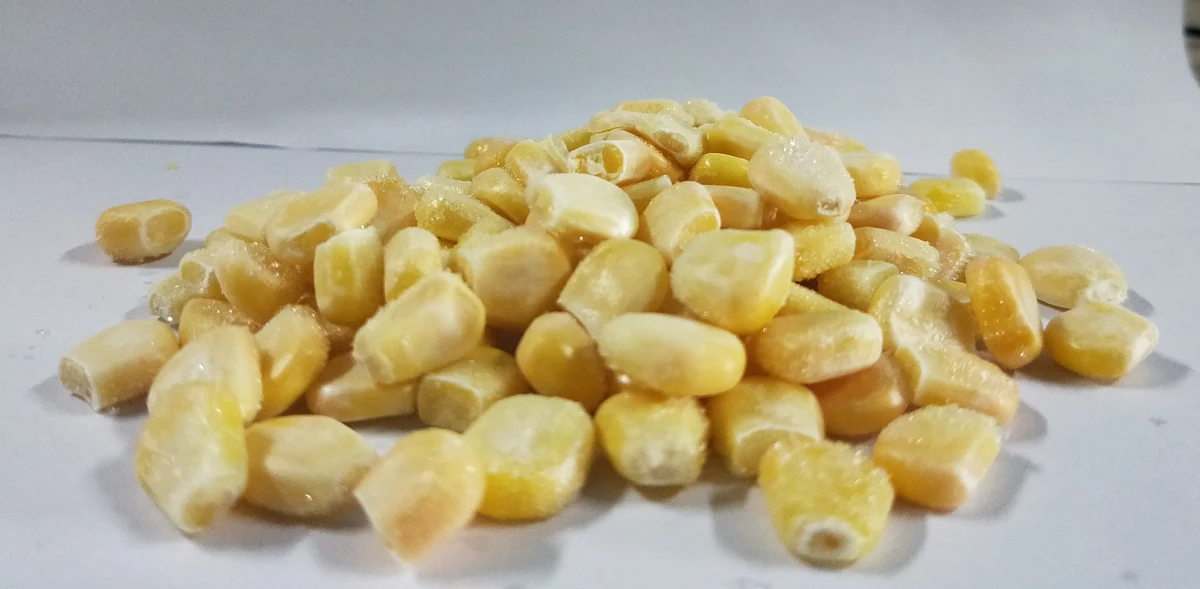
Loose kernels illustrate the vegetable ingredient form; sweetness and variety require product information.
Recognize the kernel rather than the colour
At vegetable harvest, sweet-corn kernels are plump and tender. Mature dent-corn kernels have the firmer, dry-grain appearance associated with their later stage. The characteristic dent gives dent corn its name. Purdue’s overview of corn types [3] explains how dent, sweet and other corn categories differ.
Yellow colour does not distinguish them reliably. Sweet corn can have yellow, white or mixed-colour kernels, and mature grain corn also occurs in different colours. A yellow kernel could belong to a tender sweet-corn ingredient, a dry mature grain or a cooked food prepared from that grain. Colour should be read together with moisture, texture and the complete product description.
The cob is another separate physical feature. “Corn on the cob” describes kernels supplied on an ear; it does not by itself name the crop type. An ear intended for fresh vegetable eating is normally selected as sweet corn, while a dry mature grain ear has a different use. Seeing an ear rather than loose kernels is not enough to establish how it should be prepared.
A photograph can show visible form but cannot verify sweetness, cultivar or an analytical sugar value. If identification matters, use the supplied name and supporting product information. For an unfamiliar ingredient, “dry dent corn for milling” gives much clearer guidance than “yellow corn.” The same principle applies to a frozen product labelled sweet corn.
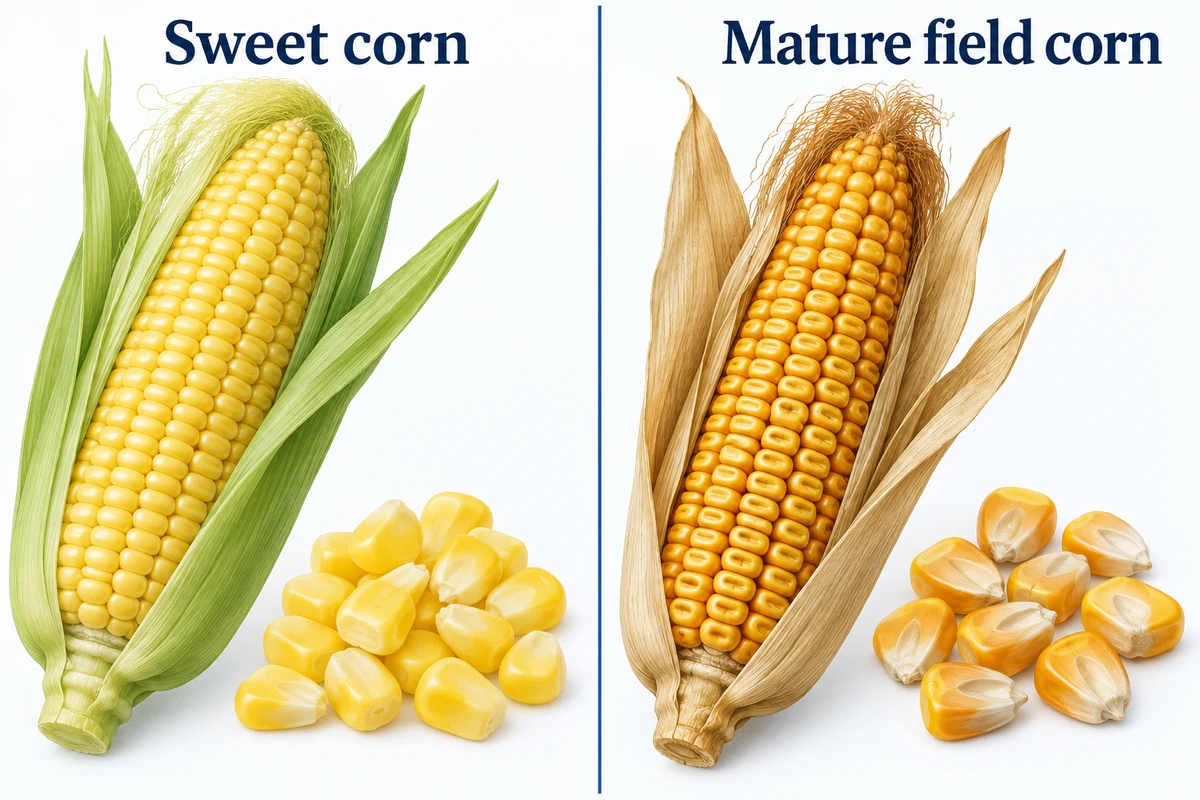
Type and harvest endpoint work together; mature field corn also has human-food uses.
Sweetness, starch and tenderness
The sweet-corn category includes different genetic types, including standard sugary, sugary-enhanced and supersweet varieties. These types do not all behave identically after harvest. University of New Hampshire Extension describes the relationship between sweet-corn genetics, sweetness and starch development; its guidance also cautions against treating all varieties as though they lose sweetness at the same rate.
For cooking, sweetness and tenderness are separate observations. A kernel can have a pleasant sweet flavour but a firmer skin than another sample. A softer kernel is not necessarily sweeter. Keep those qualities separate when comparing products, especially when the finished dish requires a visible kernel with a particular bite.
Mature field-corn grain is used for its grain properties, often including starch that supports milling and further processing. That does not mean sweet corn contains no starch or that field corn contains no sugar. The categories describe useful tendencies and end uses, not absolute chemical opposites. Precise composition requires information about the particular crop and food form.
Cooking changes the food that reaches your mouth. Whole sweet kernels, cooked grits and a cornmeal batter present different structures even though they all come from maize. The texture of the final food depends on particle size, water, heat and other ingredients as well as the starting crop. A grain’s field appearance cannot predict the mouthfeel of every processed food made from it.

Illustrative kernel states, with no fixed moisture or harvest-day claim.
Field corn also becomes human food
Field corn is often associated with livestock feed and ethanol, but those are not its only uses. Mississippi State University Extension’s overview of corn types [4] lists human-food products among its applications. Mature corn can become cornmeal, grits and other ingredients through the processing route suited to the particular food.
Milling changes the physical form of grain into smaller particles. A meal and a coarse grit have different particle structures and may need different preparation. These are not simply loose sweet kernels in another package. A cornmeal recipe expects the characteristics of meal, while a whole-kernel recipe expects pieces that remain identifiable in the finished food.
Other corn foods involve more than milling. The product’s stated treatment matters, whether it is cooked, precooked or processed for a particular application. Select a food ingredient with directions for that use. Do not assume that an arbitrary supply of agricultural grain is the same as a retail food ingredient because both originated from field corn.
The phrase “field corn cannot be eaten” is therefore misleading. A more accurate statement is that mature dry grain is not the same pleasant, tender whole-kernel vegetable as sweet corn. Human-food routes prepare that grain for different foods. This distinction explains its use without dismissing a major family of corn ingredients or promising that every grain product can be cooked in the same way.
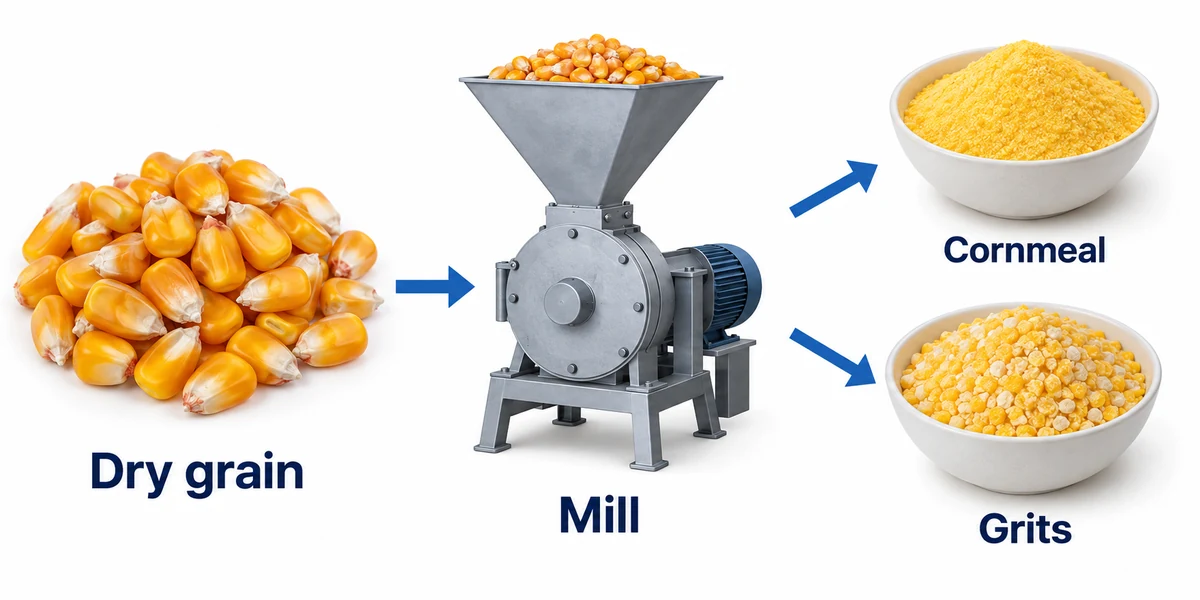
Conceptual milling relationship, not evidence of an XMG facility or one universal milling process.
Why the forms do not substitute directly
Whole sweet-corn kernels contribute moist pieces, colour and a distinctive bite. Dry cornmeal contributes particles that interact with a recipe’s water and structure. Replacing meal with whole frozen kernels removes part of what the meal was meant to do. Adding kernels to a cornmeal recipe can be an intentional variation, but it does not replace the meal’s role.
The reverse substitution changes a vegetable dish into something else. Cornmeal stirred into a salad or vegetable side is not a whole-kernel alternative. Grits can be cooked as their own ingredient and combined with other foods, but they need a preparation route that makes sense for coarse grain particles rather than an instruction written for frozen sweet kernels.
| Form | Expected role | What a substitution must address |
|---|---|---|
| Sweet-corn kernels | Moist whole vegetable pieces | Visible pieces, flavour and bite |
| Sweet corn on the cob | Ear or cob-section presentation | Serving form and removal of kernels if needed |
| Cornmeal | Milled grain particles in a recipe | Water balance and recipe structure |
| Grits | Cooked coarse-grain ingredient | Particle size, hydration and final texture |
No equal-weight conversion resolves all those differences. Start with a recipe written for the form you have. When redesigning a dish, identify what the original ingredient contributed before choosing an alternative. That makes the change deliberate and avoids relying on the shared plant name as a substitution rule.
What frozen sweet corn preserves
A frozen sweet-corn product starts with the selected vegetable crop and its harvested kernels or cob sections. Freezing preserves the supplied form in a frozen state. It does not change the cultivar into field corn or transform whole kernels into dry grain. The frozen product still needs preparation and handling appropriate to the pack.
Its eating quality depends on the raw material and processing as well as the later recipe. Do not infer a universal sweetness from the word IQF, or assume all frozen kernels have the same tenderness. A comparison should use the same relevant preparation and serving conditions so that differences in cooking do not obscure differences between products.
Loose kernels and cob sections also create different kitchen work. A kernel ingredient is ready to enter the next preparation without cutting it from an ear; a cob section provides its own serving presentation. That form decision is separate from the underlying sweet-corn versus field-corn distinction. It is useful to answer both questions instead of letting one stand in for the other.
Our frozen sweet-corn page describes product forms. A clear product description and sample reference can then connect the chosen form with its intended dish. For a narrower serving-format comparison, see kernels versus corn on the cob.

Whole kernels contribute visible pieces, unlike a milled grain ingredient.
Choose the corn form for the dish
Popcorn is another corn type, and its dried kernels are selected for popping behaviour. It should not be assumed that any dried field-corn kernel will pop in the same way. The broader corn family includes several useful types whose names reflect different characteristics. Keeping popcorn separate helps prevent “sweet versus field” from becoming an incomplete two-category rule for all maize.
For a menu description, name the prepared food rather than rely on an agricultural term. “Sweet-corn kernels,” “cooked grits” and “cornmeal batter” tell the reader what will appear on the plate. That precision makes a recipe easier to follow and explains why two foods with a common crop origin can have different textures, preparation needs and serving roles.
Begin with the outcome: tender whole kernels, an ear to serve, a grain porridge, or a batter built from meal. That is a more useful selection guide than colour or the broad word “corn.” Read the ingredient name and directions to establish whether the product is a vegetable, dry grain or processed grain food.
For whole-kernel applications, consider the desired sweetness and bite separately. For milled ingredients, consider the stated particle form and preparation. Keep added kernels distinct from the grain ingredient they accompany. A cornbread can contain both meal and sweet-corn pieces because they perform different jobs.
When you compare alternatives, change one clearly described ingredient at a time. Note any required liquid, preparation or portion change. A successful version of a particular dish gives you a useful recipe; it does not prove that all corn forms are interchangeable.
Related ingredient explanations are available in Food Knowledge and the frozen vegetable range.
For the frozen product forms discussed here, see our IQF Frozen Sweet Corn page.
View product forms →