On this page
A golden sample is useful when it shows the appearance, flavour or texture you intend to buy and the written specification identifies exactly what that sample controls. It cannot replace the agreed limits, test methods, lot identity or acceptance rules. For frozen produce, there is another condition: the retained sample must still be a suitable reference when you use it. A dated bag in a freezer does not remain an unchanged standard indefinitely.
We would therefore approve the reference and the specification as a linked set. Give each a clear identity, state which attributes are judged against the physical material, record how those attributes are assessed, and agree when the reference needs review or replacement. If the sample and the written requirement appear to disagree, pause that decision and investigate the specific attribute. Choosing whichever evidence produces the preferred answer makes the original approval meaningless.
Give the reference a narrow, useful job
Start by naming the decision the sample will support. A whole strawberry reference might communicate the intended presentation and a recognisable colour direction. A peach slice reference might help the development team discuss tenderness after a specified preparation. A mixed-vegetable sample could demonstrate how the components look together. These are different tasks, and one physical pack need not control every characteristic of the eventual order.

Whole frozen strawberries provide a visible form reference; the appearance alone does not establish analytical values or lot acceptance.
The word “golden” can obscure that distinction. An attractive sample may be a development target, an indicative stock sample or material from an identified production lot. Record which it is. If the sample represents a target that the proposed supply route has not yet demonstrated, call it a target. If it represents accepted output, identify that output. Approval of the visible form does not automatically approve the packing, intended use or all subsequent production.
Describe the attributes in ordinary, observable language before creating a scoring system. “Whole berries with the agreed range of shape” gives a reviewer something different to examine from “firm texture after preparation.” A general description such as “good quality” leaves too much unstated. Conversely, an elaborate score for an attribute nobody uses creates paperwork without improving acceptance. Choose the few characteristics that affect the finished product or the customer’s experience.
Keep the reference’s purpose visible on the approval record. For example, write that a sample supports a colour and presentation discussion while size distribution, broken material and analytical requirements remain controlled by named specification fields. That statement prevents a later reviewer from assuming that every feature of the small pack became a purchase commitment.
Decide which evidence controls each attribute
A physical sample, a photograph and a written requirement answer different questions. Before shipment, make their relationship explicit for each important attribute. The following matrix is a working approach for discussion, not a universal hierarchy that overrides your purchase agreement.
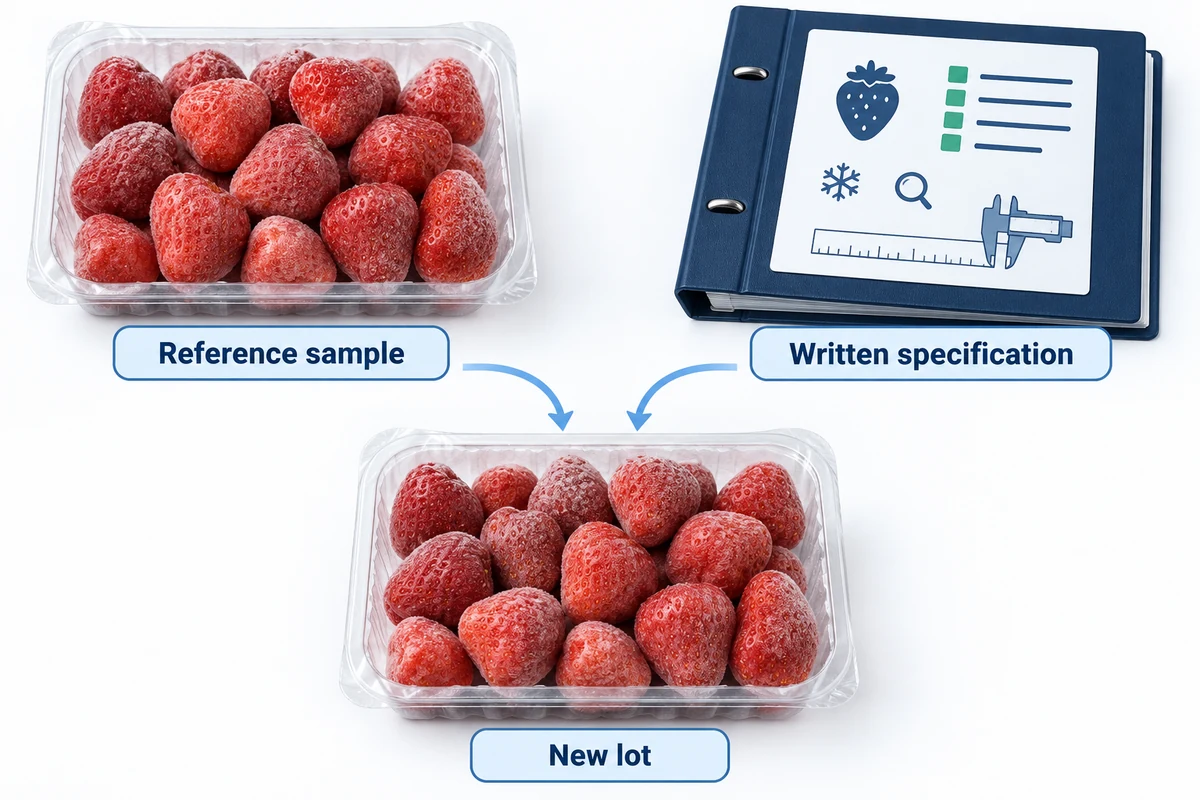
Conceptual evidence roles: the physical reference supports the attributes assigned to it, while the specification defines the agreed checks and acceptance basis.
| Attribute or question | Useful reference | What still needs a written basis |
|---|---|---|
| Visible form and overall appearance | Identified physical sample and controlled views of it | Product identity, state of preparation, relevant descriptors and permitted variation |
| Piece size or defect level | Defined measurement or sorting result | Unit, method, sample basis, limits and decision rule |
| Flavour, aroma or texture | Suitable reference assessed under matched conditions | Preparation, attributes, assessor responsibility and acceptance approach |
| Analytical requirement | Result from the required test on identified material | Method, reporting basis, required evidence and acceptance criterion |
| Pack, label and lot identity | Approved pack record and actual delivered identification | Relevant versions, configuration and links between sample, order and lot |
A photograph is particularly easy to overuse. It can preserve a view of the pieces, their arrangement and visible surface condition at a particular moment. It cannot preserve the sample’s aroma or the resistance felt when a slice is handled. Nor can an ordinary screen image establish an analytical value or reproduce colour exactly across different cameras, displays and room lighting. Use it to support the record, with its viewing conditions described, rather than turning it into evidence for attributes it does not capture.
Numerical requirements deserve their own clear measurement basis. If broken fruit is assessed by weight, the shape of the photographed pieces does not establish the percentage in a lot. If slice thickness matters, specify where and in what state it is measured. A small reference pack may illustrate the presentation while still being unsuitable for estimating the distribution in commercial material.
For batch results, keep the distinction between a continuing requirement and a report on identified material. Our guide to comparing a COA with the product specification covers that document review. A physical reference adds another form of evidence; it does not make the report or the specification unnecessary.
Identify the approved material before storing it
A reference system fails quickly when several similar bags circulate without a reliable connection to the approval. Put the product and form, sample identifier, source-lot reference where available, preparation or production information, receipt date and approval record together. Keep the sample code distinct from the specification revision. They can be linked without being the same identifier.
Record the condition in which the material was approved. Was it evaluated frozen, after a specified thaw, or in a cooked application? Was the liquid retained or removed? Was the pack unopened until evaluation? Those details matter when someone later tries to repeat the comparison. An approval comment that says “texture accepted” without the preparation basis gives the next reviewer an outcome but no reliable way to reproduce the assessment.
Store any buyer and supplier reference portions under an agreed arrangement, and identify who is responsible for them. If two locations hold material from the same original sample, their subsequent histories can still differ. Each location needs its own receipt, storage and usage record. The shared origin does not prove that the portions remain equivalent after one has been opened several times or transported again.
Use an inventory that answers practical questions: which portions remain sealed, where they are stored, which portion was used for each comparison and when the next suitability review is due. A short controlled record is sufficient if it remains current. A freezer full of unidentified bags is not made more useful by retaining them for longer.
A frozen reference still changes with time
Freezing slows important quality changes; it does not turn food into a permanent reference object. The University of Georgia’s National Center for Home Food Preservation explains that quality can continue to decline during frozen storage and that warmer frozen conditions shorten quality retention. Oxygen exposure, dryness and continuing reactions can contribute. That general principle supports reviewing an ageing reference, but its household guidance does not establish a commercial retention interval for your sample.
Separate two clocks. One concerns how long a sample must be retained for the relevant programme or agreement. The other concerns how long it remains suitable for a particular comparison. A portion could still need to be retained as part of the record after it has stopped being a dependable reference for fresh colour or texture. Mark its purpose accurately rather than discarding the distinction.
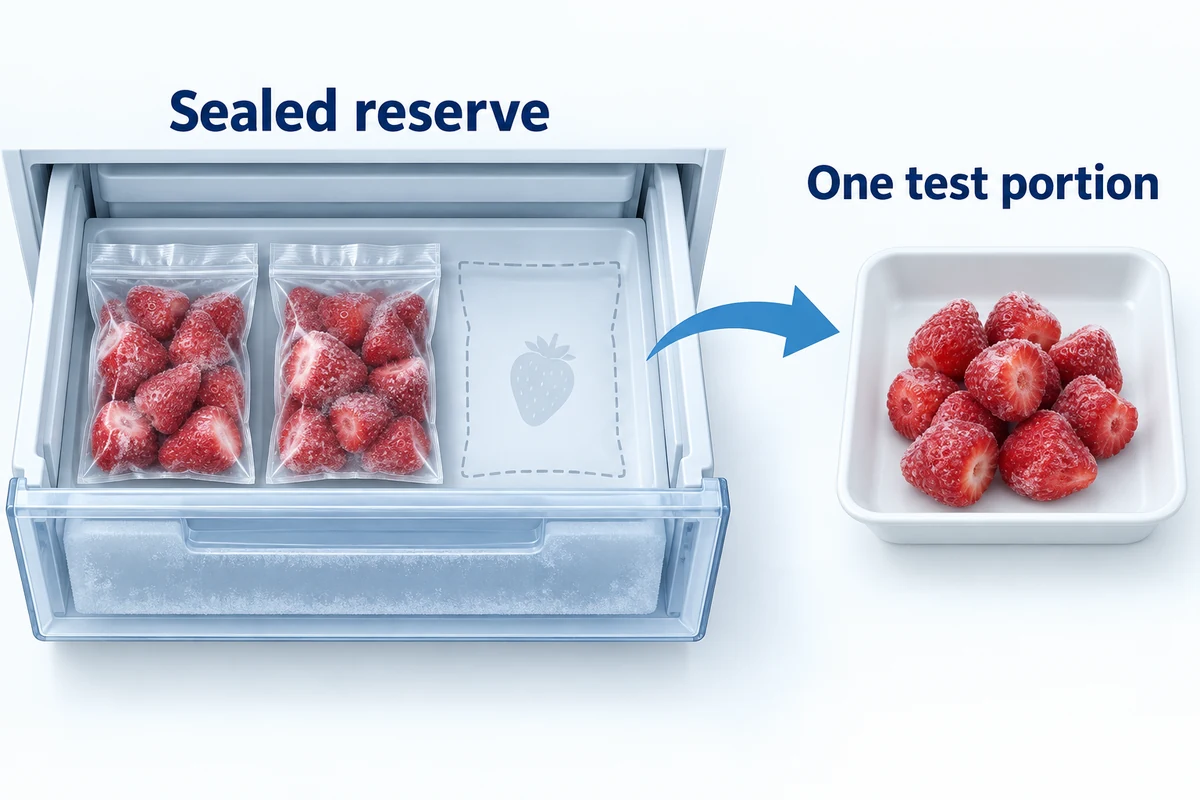
Illustrative handling arrangement: a test portion has its own history while the reserve stays sealed. The number of portions is an example, not a sampling requirement.
Where the programme allows, divide representative material into suitable separately identified portions at the outset. Taking one portion for evaluation can leave the others unopened. The illustration shows that handling principle; it does not prescribe three bags, a sample weight or a specific storage life. Choose the quantity from the anticipated assessments, required methods and reserve needs.
Do not silently return a used or thawed evaluation portion to the reference inventory as though nothing happened. Record the changed history and handle it under the applicable procedure. Even where further use is permitted for a limited purpose, the portion is no longer an untouched comparator. Repeated access also needs consideration when the remaining material has warmed, gained moisture or lost its original package protection.
Set review triggers that suit the product and intended attribute. These might include a scheduled review, a storage deviation, damage to the package, uncertain handling, visible change or exhaustion of sealed portions. The trigger initiates an assessment; it is not proof that the commercial specification has changed. Avoid setting an arbitrary six-month or twelve-month rule merely because it is easy to put in a spreadsheet.
Match the preparation before comparing samples
Compare the reference and the candidate under the same defined conditions for the attribute being assessed. In a peach-slice comparison, draining one dish while leaving liquid in the other can change what the reviewer sees and handles. In a cooked vegetable trial, different preparation or holding conditions can confound the comparison. Fix those differences before attributing the outcome to the supplied ingredient.
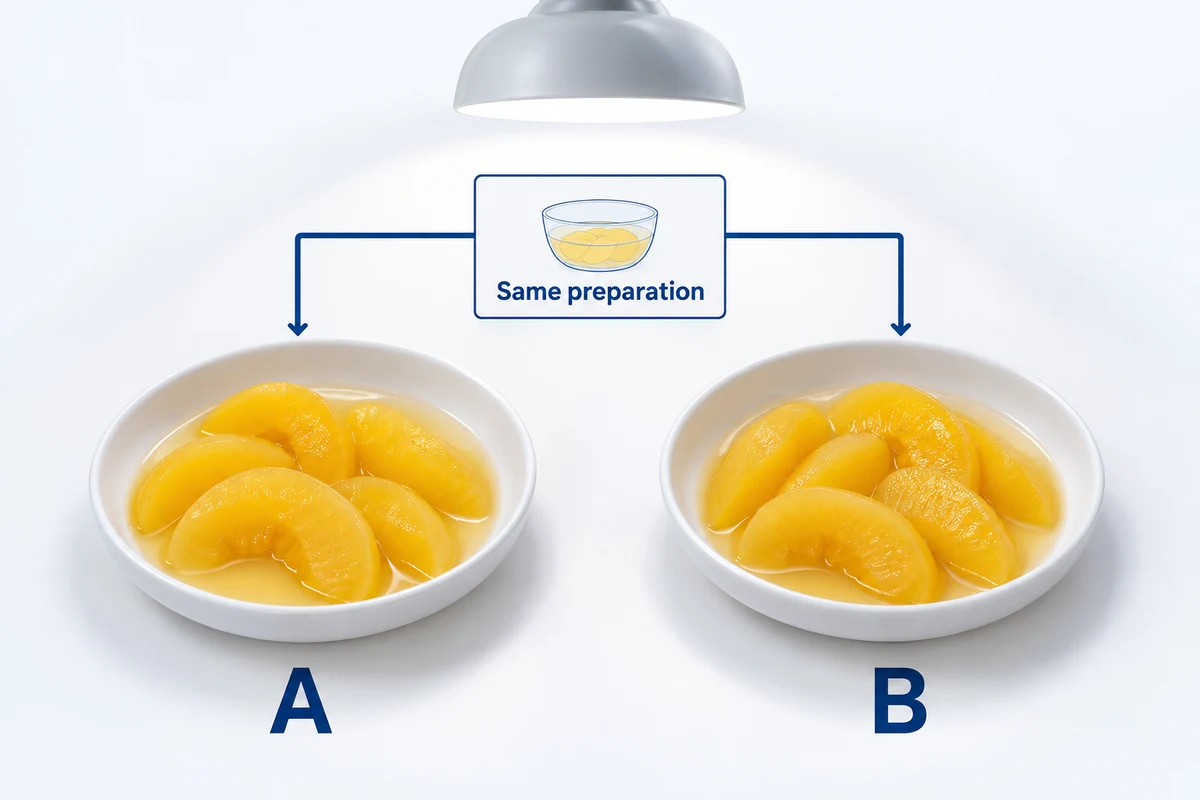
Conceptual comparison under matching conditions. The dishes illustrate a method relationship and do not show measured results or an approved preparation protocol.
Write a usable preparation instruction: the material to take, the equipment or container where relevant, the handling sequence, the assessment state and the observation to record. Use the preparation specified for the intended application, including whether the assessment retains thaw liquid or removes it. Where the product requires cooking, the evaluation must respect those instructions and the food-safety conditions of the programme.
The Canadian Food Inspection Agency’s shelf-life guidance describes sensory assessment against a reference by trained assessors using established criteria and conditions appropriate to consumption. It also treats sensory, physical, chemical and microbiological testing as distinct tools. The practical implication here is limited but useful: a pleasant-looking or acceptable-tasting reference is not a replacement for the other evidence required to establish product suitability.
Use consistent viewing conditions for appearance comparisons, and record them sufficiently for another reviewer to repeat the work. ISO 8589 provides general sensory test-room guidance, with a stated scope that is not specific to a food or test type. Its public description does not supply a peach-specific acceptance method. If formal sensory methods apply to your programme, use the relevant current method rather than claiming compliance from a desk lamp and two dishes.
Coding samples can help separate the observation from expectations about which is the approved reference. Decide who sees the identities, who records the assessment and who makes the acceptance decision. Keep the observations themselves: “slice breaks during the specified handling step” is more informative than a free-floating “fail.” When assessors disagree, those observations help locate the difference in interpretation.
Replace the reference without quietly changing the target
Replacing an old reference with the latest available lot is convenient, but it can allow the target to move without an explicit decision. A replacement needs its own review against the existing written requirements and the attributes the reference is intended to communicate. Record why the change is needed and which material is proposed.
If the old reference remains suitable for the comparison, assess old and proposed material together under the same procedure. If it has visibly deteriorated or its history is uncertain, do not treat it as unquestionable evidence of the original target. Use the original approval observations, appropriate photographs, written fields and any other valid retained evidence to define what the replacement must satisfy. Record the limitation of the old material.
A replacement record should connect the retired sample identifier, new identifier, specification revision, reason for replacement and approval date. State whether the product target changed. If the target remains the same, the new reference supports the existing requirement. If the acceptable colour, texture or presentation has changed, that is a requirement change and needs the corresponding approval rather than a housekeeping note.
Keep the change understandable to the people using the reference. Remove superseded material from routine comparison access or mark it clearly for its remaining record purpose. Share the new identity with the supplier, inspection party and buyer staff who need it. The next order should not be evaluated against whichever version happened to be easiest to find.
Resolve a sample and specification disagreement
When the physical reference seems to conflict with the written requirement, name the exact disagreement first. “The lot is different” is too broad. It may mean the measured cut is outside an agreed range, the colour appears different under another light, or the older reference has become softer. Each possibility needs a different check.
- Identify the affected material and attribute. Record the candidate lot, sample identifier, specification revision and observation. Keep unaffected decisions separate where the control procedure allows.
- Check the evidence basis. Confirm that the correct documents and reference were used, review the reference’s condition and history, and compare the preparation and measurement methods.
- Apply the agreed authority and review route. Determine which approved requirement controls that attribute and who may interpret or amend it. Refer an unresolved contractual question through the appropriate commercial process.
- Record the disposition and follow-up. Document the evidence, authorised decision, affected quantities and any correction to the method, reference or requirement before repeating the comparison.
A second observation can clarify an inconsistent preparation. It should not be used to search for an agreeable result while ignoring a confirmed problem. If there is a food-safety concern, involve the responsible qualified team under the applicable control procedure. A replacement reference or a commercial concession cannot resolve that concern by itself.
We would ask for a compact discrepancy record rather than several disconnected photographs. Attach the relevant specification field, both sample identities, the preparation record and the actual observations. Through the inspection scope agreed for the order, clarify whether the facility, an agreed inspector or another qualified party performs the review. Procurement can coordinate the response while the authorised acceptance responsibility remains explicit.
A working example for peach slices
Consider a fictional buyer developing a dessert with visible yellow peach slices. The buyer approves a reference for presentation and tenderness after its specified preparation. The written requirement separately controls cut description, defect assessment, packing and the evidence needed for lot acceptance. No numerical limit is implied by this example.

Yellow peach slices show the visible cut in the working example. A photographed selection does not establish a lot-wide defect percentage.
At the next comparison, the candidate slices appear firmer than the retained sample. The first question is not whether the supplier must make them softer. Review the original approval observations and the preparation records. The older sample has been opened for several previous assessments, while the candidate is taken from an intact pack. That difference does not prove why the textures differ, but it prevents treating the two histories as equivalent.
The reviewer checks an available sealed reference portion, follows the same preparation for both materials and records the relevant handling observation. If the candidate meets the defined requirement, the ageing working portion may need retirement. If the difference remains outside the agreed acceptance basis, the candidate needs the prescribed disposition. Either conclusion should follow the evidence, not a preference to keep production moving.
Now suppose the photographed reference contains a few small pieces and the delivery has noticeably more. The photograph can help explain what the buyer observed, but it cannot establish the delivery’s defect percentage. Apply the written definition and sampling method. This avoids arguing over a visually selected handful when the purchasing requirement concerns a measured proportion of the assessed material.
Finally, suppose the buyer decides that firmer slices actually work better in the dessert. That can be a useful development finding, but it is a new target decision. Record the application approval and update the relevant reference or specification through the agreed process. Do not rewrite the earlier requirement retrospectively and call the change a sample replacement.
Specifications & Sampling
See how we coordinate product specifications, samples and approval requirements.
Review Specifications & Sampling →References
- [1] Canadian Food Inspection Agency: Shelf life studies — reference-based sensory assessment and the different roles of testing.
- [2] National Center for Home Food Preservation: Frozen-storage quality changes — general mechanisms of continuing quality change; household guidance is not a commercial retention schedule.
- [3] DIN EN ISO 8589: Sensory test-room guidance — the standard’s published scope, rather than a product-specific evaluation procedure.
