On this page
Compare frozen spinach on two separate results: the usable spinach your preparation produces and the way the frozen product enters your recipe. A compact portion may be convenient to count but still needs weighing and a yield check. Loose cut leaf may be easy to dose by mass but behave differently during mixing, draining or holding. The format name alone does not settle either question.
We start by separating leaf form from frozen unit form. Whole or cut leaves can be packed into portions; chopped spinach can also arrive as portions, loose material or a larger block, depending on the product offered. We compare candidate samples under the same preparation and weighing conditions, then check whether those results hold in the kitchen’s recipe.
For a filling that requires drained spinach, compare the retained weight at the specified draining stage. For a soup that incorporates the spinach and its liquid, assess the complete recipe process instead. Keep frozen input, drained spinach and finished-dish weight distinct throughout the trial.
Separate leaf form from the frozen unit
“Leaf,” “chopped,” “portion” and “block” do not all describe the same property. Leaf and chop terms describe the vegetable material. Portions and blocks describe how that material is grouped when frozen. A quotation that says only “spinach portions” leaves the leaf structure, unit size and preparation behaviour unresolved.

Illustrative comparison: identify the frozen form and dose, then measure retained spinach under the same agreed preparation and draining method. No yield result is implied.
| Candidate presentation | What the description still needs | Useful trial question |
|---|---|---|
| Loose whole or cut leaf | Leaf or cut definition, stem content and condition of the frozen pieces | Can the required mass be removed and distributed consistently? |
| Leaf portions | Leaf form inside the unit, portion mass and its variation | Does the portion separate during preparation while retaining the intended leaf appearance? |
| Chopped portions | Chop definition, unit size, unit weight and frozen separability | Does counting or weighing suit the batch and the finished texture? |
| Larger spinach blocks | Internal leaf or chop form, block mass, pack construction and preparation route | Does the unit fit the normal batch without an impractical partial-block remainder? |
The distinction appears in commercial product ranges. Ardo offers both leaf spinach in portions [1] and chopped spinach in portions [2]. Those are examples of two different materials sharing a portioned presentation, rather than a universal specification for the word “portion.” Obtain the actual product description and sample for the offer you are comparing.
The Codex spinach text [3] distinguishes whole, leaf, cut-leaf, chopped and pureed styles. Its stated scope excludes product indicated for further industrial processing, so it should not be applied automatically to every ingredient contract. Use the applicable definition and write the agreed cut into your own specification. Do not assume that two suppliers use an informal trade name to mean identical leaf dimensions.
Define the weight your recipe actually needs
Start with the recipe instruction. “Add 5 kg spinach” is incomplete if one operator weighs the frozen product and another weighs it after preparation and draining. Both can follow the words and introduce different amounts of retained spinach and liquid into the batch. Specify the weighing stage before evaluating either product.
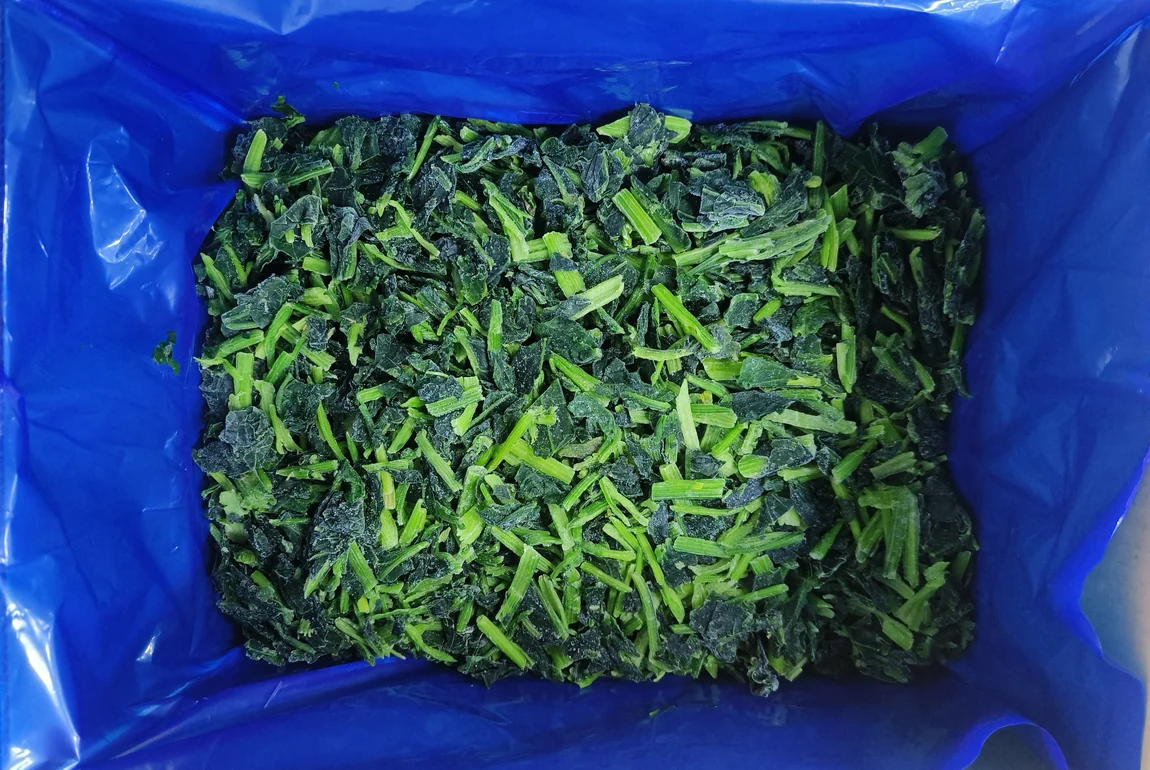
Visible leaves and stems establish the product form. Their appearance does not measure drained yield or the leaf-to-stem mass ratio.
The frozen input is the amount of product taken for the trial, excluding the packaging and using the agreed treatment of any material remaining in the pack. The drained result is the retained spinach after the specified preparation and draining method. The finished-dish weight may include stock, dairy, other vegetables or additional ingredients; it is not a direct measurement of spinach recovery.
Keep the pack’s declared net weight separate from your dosing record. A 2.5 kg bag is a supply unit. It does not tell you how many portions it contains, whether each portion weighs the same, or how much spinach will remain after your preparation. Darta’s chopped-portion product information [4], for example, lists several pack configurations under separate article codes. Record the precise item and pack being tested.
Drained weight is also different from dry matter. The spinach retained in a sieve still contains water. Pressing it more firmly can change the retained mass without establishing its analytical dry-matter content. If solids concentration matters to your formulation, request the appropriate test and result basis; do not derive it from a drain percentage or from how dry the leaves look.
For a direct-from-frozen recipe, identify the point at which the spinach becomes part of the dish. An additional laboratory-style draining step may help compare samples, but it need not represent the kitchen’s usable output. Keep a comparison test and a recipe trial as separately named results when their preparation stages differ.
Compare drained yield on one written basis
A drained-yield comparison needs a reproducible method. Agree the sample identity and starting mass, the preparation endpoint, the draining equipment, the drain duration and the handling before weighing. State whether the procedure permits spreading, shaking or pressure. Use a method suitable for the product and intended assessment, following the relevant preparation and food-safety requirements.
These details can change what remains on the sieve. A different mesh can alter the retention of small particles; a squeezed sample and a gravity-drained sample have not received the same treatment. Water added during preparation, material left in the container and product transferred between vessels also need consistent handling. Otherwise, an apparent supplier difference may be partly a difference in the test.
Calculate the result from recorded masses: drained yield equals retained spinach mass divided by the frozen starting product mass, multiplied by 100. Call it the yield under that named method. It does not, by itself, measure product quality, leaf content, dry matter or nutritional value.
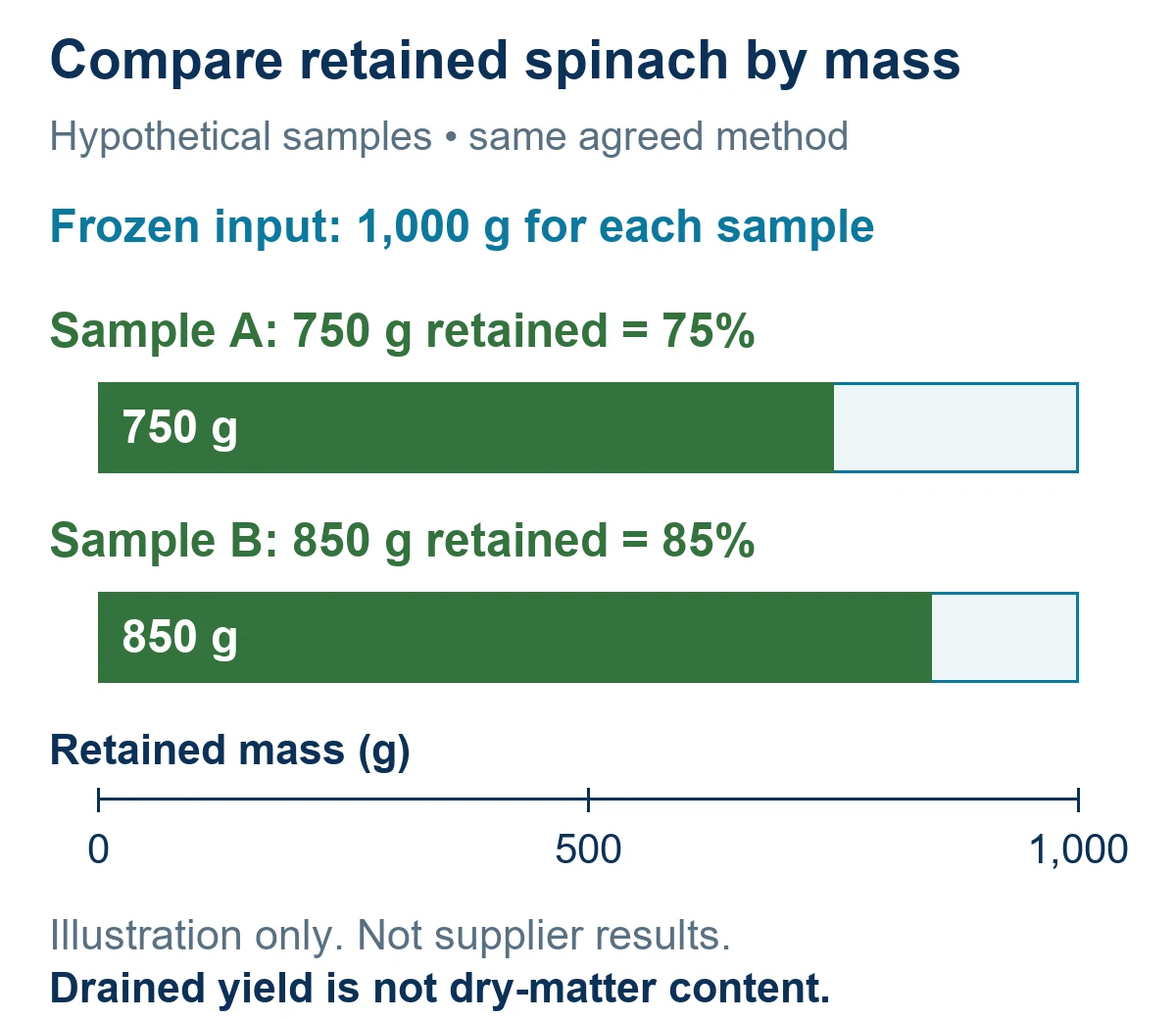
Hypothetical values only: 750 g and 850 g retained from 1,000 g represent 75% and 85% recovery. These are not dry-matter results or a ranking of spinach forms.
| Hypothetical comparison | Sample A | Sample B |
|---|---|---|
| Frozen starting product | 1,000 g | 1,000 g |
| Retained spinach after the same agreed method | 750 g | 850 g |
| Calculated drained yield | 750 ÷ 1,000 × 100 = 75% | 850 ÷ 1,000 × 100 = 85% |
| Calculated frozen input for 10 kg of retained spinach at that yield | 10 ÷ 0.75 ≈ 13.33 kg | 10 ÷ 0.85 ≈ 11.76 kg |
These figures are invented to explain the calculation. They are not XMG results, supplier benchmarks or recommended spinach limits. The examples do not assign Sample A or B to a particular frozen form. A higher retained weight is useful only if that retained material also meets the recipe’s required texture, composition and handling conditions.
Repeat the agreed comparison on enough representative sample units for the decision you need to make. Keep individual masses and results as well as any average. Record lot identity and deviations from the method. If the observed difference is small compared with the variation between repeats, obtain better evidence before treating it as a dependable purchasing advantage.
Check portion weights and the dosing routine
Portioning offers a handling option, not an automatic guarantee of dose accuracy. A nominal portion weight needs a defined tolerance and a way to assess it. Tell us how the kitchen doses spinach: by counting portions, weighing a batch or feeding a dosing machine. A count-based routine needs dependable unit weights; a hopper trial needs to establish whether frozen pieces flow and release.
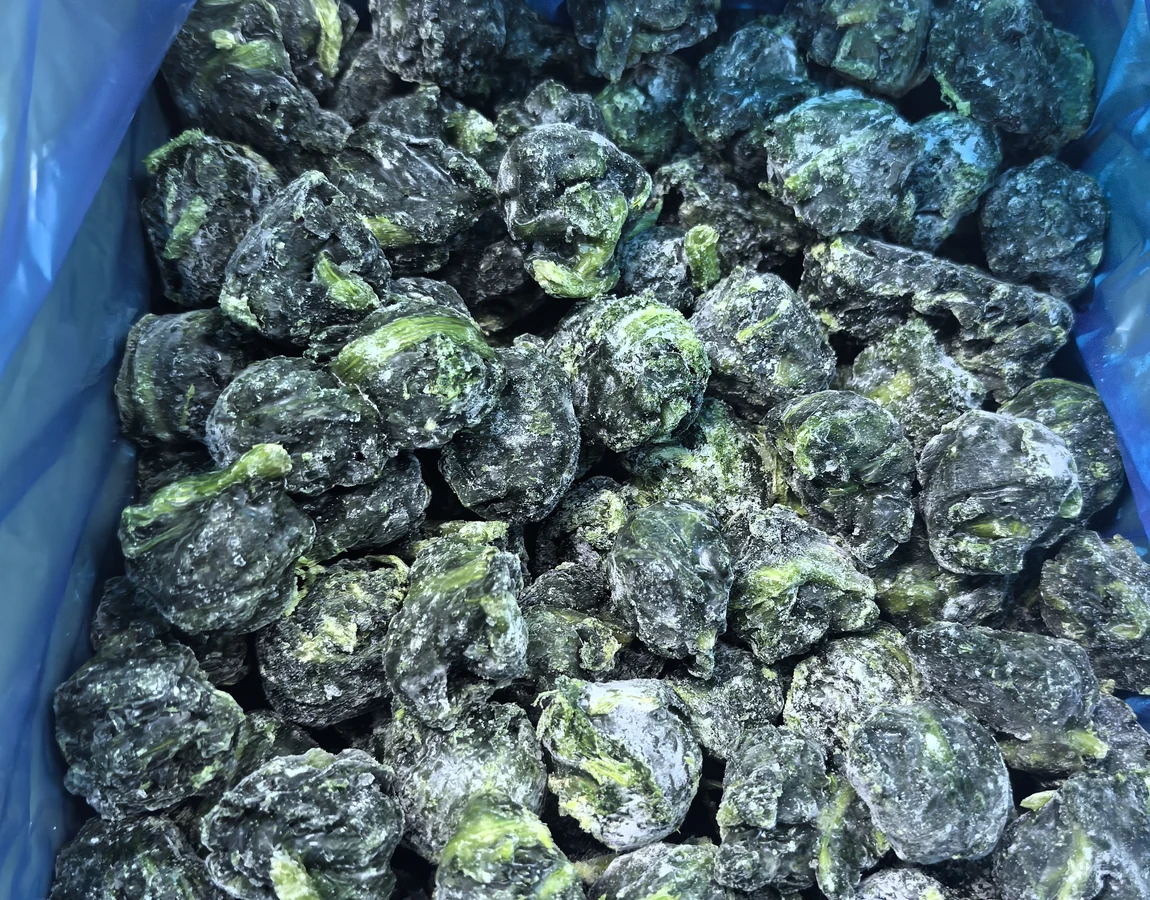
Countable frozen portions still need an agreed weight tolerance and a preparation trial. Their visible size does not establish usable recipe weight.
Measure individual units from representative packs if count-based dosing matters. Retain their range and distribution, together with the average. In a hypothetical set with a 50 g average, some units could be lighter and others heavier. The average alone would not establish the mass of four randomly selected portions, and no nominal value should replace the agreed tolerance.
Check separability at the intended handling stage. If portions are fused together, the operator may be unable to remove a normal recipe quantity without extra handling. If they break into fragments, counting units becomes less meaningful. Record the condition as received and the action required; do not infer the cause of clumping or breakage from appearance alone.
For weighing-based dosing, observe whether the product can be added in suitably small increments. A large block may match a full production batch but be inconvenient when the batch requirement changes. Loose material can allow incremental dosing, but its flow, bridging or retention in the actual equipment still needs testing. Avoid assuming that a bag labelled IQF will work identically in every hopper or kitchen process.
Include the ordinary pack-opening and transfer work in the trial. Time spent separating units, recovering pieces from the liner or managing a partial pack can matter alongside preparation yield. Use the operation’s authorised handling and storage procedures for opened packs. A format that fits the normal batch and preparation rhythm may be preferable even when another format has a slightly higher measured drain result.
Test dispersion, texture and water in the finished dish
After the controlled sample comparison, test the shortlisted form in the equipment and recipe that will use it. Record the starting condition, batch size, addition sequence, preparation endpoint and assessment time. The operator should follow validated cooking and handling requirements for that product. A supplier’s method for another spinach item is not a substitute for the directions and process applicable to yours.
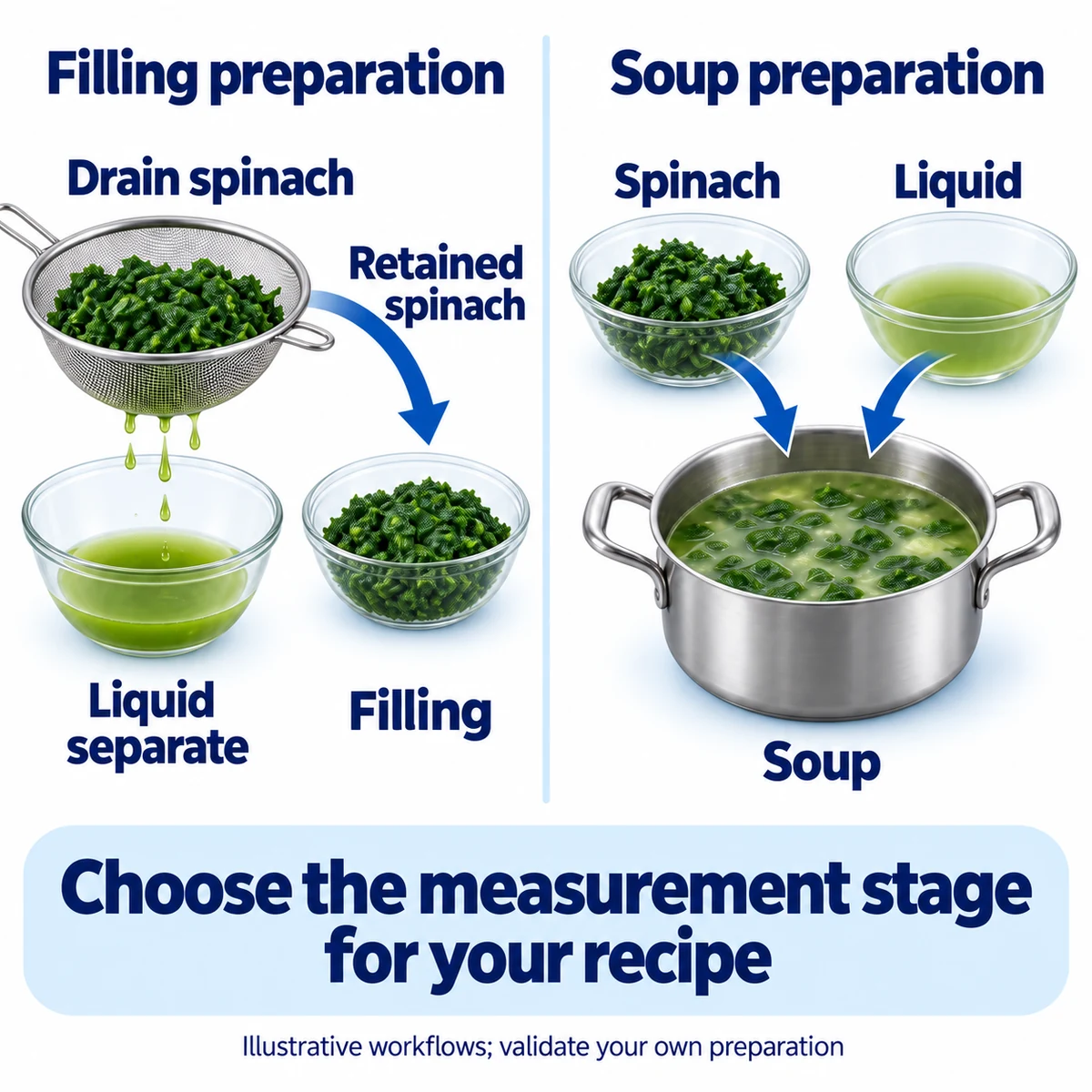
Two illustrative workflows: the recipe determines whether the relevant comparison concerns drained spinach or spinach incorporated with its liquid. Validate the actual preparation.
In a filling trial, look at the spinach at the point where the recipe calls for it. If the method specifies draining or pressing, apply the defined treatment and record the retained weight before other ingredients are added. Then assess distribution, texture and any liquid that appears during the subsequent preparation or holding stage. A drain result obtained earlier may not explain the complete filling behaviour.
For a soup or sauce, your recipe may incorporate liquid released from the spinach. In that case, record how the spinach affects the batch’s consistency and ingredient balance. Do not count intentionally retained recipe liquid as waste simply because a separate comparison test collected it below a sieve. The illustration shows two possible assessment points; the actual recipe determines which one matters.
Check dispersion directly. Note whether compact units separate at the required stage, whether visible leaves remain in the intended form, and whether the spinach distributes across the batch. A sample that looks suitable after preparation can still give uneven portions if it collects in one area during holding or serving. Assess portions drawn through the normal dispensing method, not only the appearance of the whole pan.
Describe texture in terms the operation can verify: visible leaf pieces, objectionable fibrous stems, an overly fine consistency or a filling that does not handle as required. Keep colour and flavour observations under the same preparation and assessment conditions. The USDA frozen leafy-greens grade framework [5] treats character, appearance and stem-related factors as quality considerations. A yield percentage does not replace those checks.
Record both immediate and later observations when the normal operation includes holding. Name the time and conditions rather than writing “good after cooking.” If the kitchen changes the recipe to accommodate a candidate spinach, record that version separately. Otherwise, the purchasing comparison may attribute a recipe adjustment to the ingredient itself.
Turn the trial into a repeatable purchase specification
Preserve the conditions behind sample approval so a repeat order can be checked against the same reference. Keep the supplier item reference, spinach form, cut description, unit format, pack and lot identity with the trial record. Include the method used to prepare and weigh the sample, the relevant individual results and the approved recipe version. Photographs should show the state being assessed and identify when they were taken.
Set measurable requirements around the selected application. These may include the agreed leaf or cut description, portion mass and tolerance, frozen separability, relevant defects and a method-defined drained yield. State which requirements apply to the frozen material and which apply after preparation. A compact portion photograph cannot, by itself, define the leaf structure that should appear after the unit disperses.
Use the approved trial to decide which measurements deserve routine attention. A filling programme may focus on the retained weight under its preparation method and the handling of the finished filling. An operation dosing directly from frozen may give greater attention to unit consistency, pack discharge and dispersion. Keep both product quality and operational performance visible, without demanding an unrelated test merely because another spinach specification contains it.
Where an analytical requirement is needed, name it separately. Dry matter, residue testing, microbiological criteria and drained yield are different questions with different methods and decision bases. Do not use an acceptable appearance or preparation yield as evidence that another requirement has been satisfied. Confirm the applicable testing scope and supporting records with the responsible QA parties.
Also define how a change will be handled. A different cut, portion size, pack or processing route can alter the preparation comparison. Ask for relevant changes to be communicated so the buyer can decide whether another trial is necessary. Keep the previous approval and the new result distinguishable; silently replacing the sample reference makes later complaints harder to investigate.
For our frozen spinach supply, the enquiry should identify the form, cut or portion requirement, packing and intended use. We coordinate the sample and written product reference with the proposed supply route. The operator’s kitchen feedback is most useful when it includes the actual preparation method and observations, so that everyone is reviewing the same requirement.
Compare supply offers against the same usable output
Compare quotations only after establishing that the products are suitable candidates for the same job. A fine chopped ingredient and a visible-leaf ingredient may both have attractive prices while serving different recipes. Align the specification, pack, quantity and commercial terms, then use the measured trial results to understand the amount of product the operation requires.
For a recipe requiring drained spinach, divide the required retained mass by the applicable yield expressed as a fraction. In the hypothetical example above, 10 kg of retained spinach corresponds to approximately 13.33 kg of Sample A or 11.76 kg of Sample B. Those calculations assume the stated yields apply to the operation being planned. Confirm that assumption with an appropriate trial before using it for ordering.
The calculation estimates ingredient input; it does not rank the complete offers. Include preparation effort, usable texture, dosing consistency, pack handling and material that the actual process cannot use. Avoid counting the same loss twice: if a drained-yield result already accounts for the liquid removed at a defined stage, do not add that identical removed mass again as a separate waste allowance.
For a recipe that retains the spinach liquid, compare the complete formulation and operating result. A supplier with a lower drain percentage is not automatically a poorer choice for that use. Equally, a higher drain percentage does not establish that the product meets the required leaf quality or works in the dosing system. Use the trial to confirm the required leaf quality, recipe consistency and handling before comparing the amount of ingredient needed.
Keep one comparison record for each approved product-and-pack combination. Show the frozen input basis, relevant prepared output, portioning observations, recipe result and unresolved items. Our foodservice supply coordination connects the selected form and pack with kitchen-test feedback. A clear record makes it easier to review a repeat order or a proposed alternative without starting the comparison from a product name alone.
Frozen Spinach
Review our frozen spinach range, product forms and specification options.
View Frozen Spinach →References
- [3] Codex: Standard for Quick Frozen Spinach↑ — product styles, quality characteristics and the document’s stated scope.
- [5] USDA: Frozen Leafy Greens Grades and Standards↑ — quality factors and links to inspection resources.
- [1] Ardo: Leaf Spinach in Portions↑ — a commercial example distinguishing leaf structure from portioned presentation.
- [2] Ardo: Chopped Spinach in Portions↑ — a different internal form with separate packing and preparation information.
- [4] Darta: Chopped Spinach Portions↑ — product identity, pack configurations and product-specific preparation information.
