On this page
Choose IQF or block-frozen vegetables by the condition your processing line needs at its first operating step, then compare the work required to deliver that condition consistently. Loose pieces can support incremental feeding and changing batch quantities. A defined block can fit a plant that has a suitable preparation route or consumes complete units. Neither presentation proves that the line will achieve its required output, accuracy or product quality.
The useful comparison begins at pack opening and ends with acceptable output from the process. Include separation or conditioning, transfer, metering, temporary storage and restart behavior. A fast downstream machine cannot compensate indefinitely for an inlet that supplies vegetables in irregular bursts. Equally, adding a block-preparation stage may be practical when its capacity, product result and schedule fit the operation.
Specify the condition required at the first process step
Begin with the receiving machine’s actual input requirement. It may need separate frozen dice, a controlled stream of pieces, a softened ingredient or a complete charge for a batch vessel. Identify the permitted physical state, piece dimensions, temperature condition and delivery pattern with the plant’s technical team. “Suitable for automated processing” leaves all of those interfaces unresolved.

Original mixed-vegetable reference. Visible individual components help identify the material; their appearance does not establish blend percentages, pack discharge or feeder performance.
Keep the vegetable itself consistent in the comparison. Record the species, cut, preparation state and other relevant specification fields before considering how it is frozen together. An IQF diced carrot and a block of carrot puree are different ingredients as well as different presentations. If both are acceptable alternatives, evaluate the complete recipes and processes; their results cannot isolate the effect of loose versus block form.
Define what the word “block” means in the quotation. It may be an intentionally supplied unit with agreed dimensions and mass, or a mass of formerly separate pieces that has become connected. JBT Marel’s Octamix description, for example, addresses frozen vegetable masses formed during storage. The incoming condition must be described before a buyer selects the handling route or interprets the need for a breaker.
For loose supply, write the separability requirement and the assessment method. A photograph can show individual pieces at the surface without establishing how a complete pack empties. Ask whether the normal dose can be delivered at the plant’s instructed handling condition, and record any connected material that changes the operation. Cause investigation and acceptance of that condition are separate decisions.
Finally, specify where the comparison finishes. A packing line may need a stable supply to weighing hoppers. A meal line may need vegetables distributed through a mixer before depositing. A sauce process may deliberately reduce particle structure. That endpoint determines whether preserving an individual vegetable piece is a requirement, an advantage or simply irrelevant to the intended product.
Include depacking and transfer in the comparison
Trial the quoted pack, including its liner, closure and case arrangement. Opening a small sample bag by hand does not demonstrate how a production carton will release material into a bin tipper. Observe the sequence from identifying the lot to removing packaging and transferring the food. Keep the handling method consistent with the site’s approved procedures and the equipment instructions.
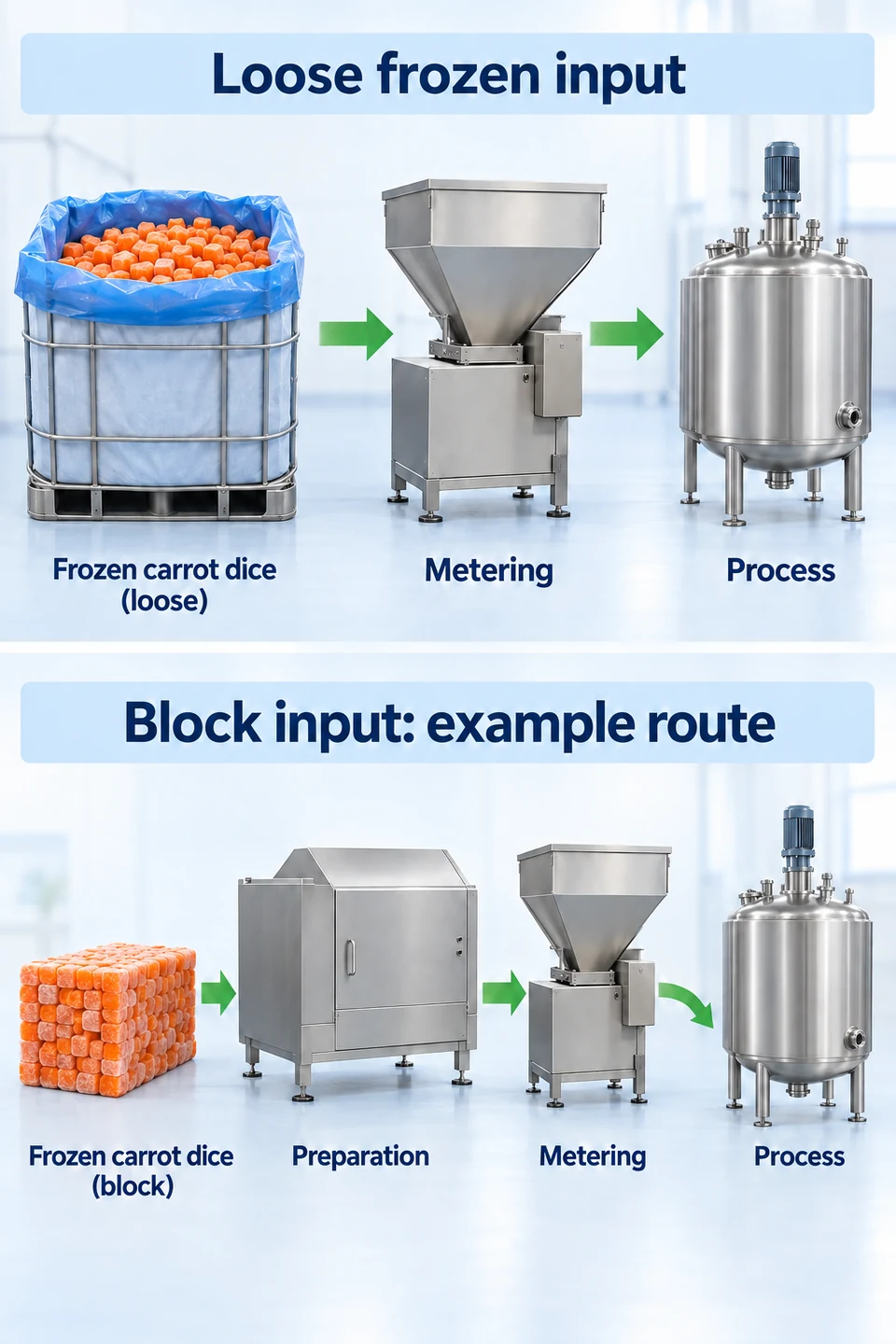
Illustrative routes for the same diced ingredient. The lower example requires preparation before metering; other plants may use complete blocks differently. Equipment shapes are schematic, with no size, throughput or compatibility claim.
Record the time needed for each pack cycle, including the ordinary work between packs. Loading the next container, removing an empty liner and recovering acceptable material can interrupt the supply even when the actual tip takes only seconds. Count those intervals in the inlet assessment. An average based only on the moments when food is moving gives an incomplete picture of available capacity.
Check how the pack and product separate. Material held in a fold, a frozen mass that releases suddenly, or loose pieces remaining in corners can each change the next operation. Record the amount and condition of retained product using an agreed method. Identify packaging integrity separately; apparent complete emptying is not evidence that every packaging component has been removed correctly.
Follow the material through every transfer. Include the drop into the receiving hopper, movement along the conveyor and discharge into the next machine. Compare the incoming and outgoing piece condition where intact cuts matter. If a candidate requires an additional lift or transfer, assess its contribution to handling time and breakage with real material rather than assigning a generic damage allowance.
A whole-route drawing is useful even for an existing plant. Mark where the operator acts, where product waits and which stage supplies the next one. Key Technology’s Veg-Mix description brings dumping, declustering, metering, mixing, conveying and controls into one IQF vegetable system. That published arrangement illustrates why the decision involves several interfaces, not only the label on the ingredient bag.
Separate declustering, size reduction and tempering
Declustering aims to separate connected pieces while retaining the required vegetable cut. Size reduction deliberately changes the material into smaller units. Tempering changes its thermal condition to suit a subsequent operation. Those tasks may appear in the same route, but they produce different results and need different acceptance criteria. Specify which result the plant needs before asking equipment to solve a “block problem.”
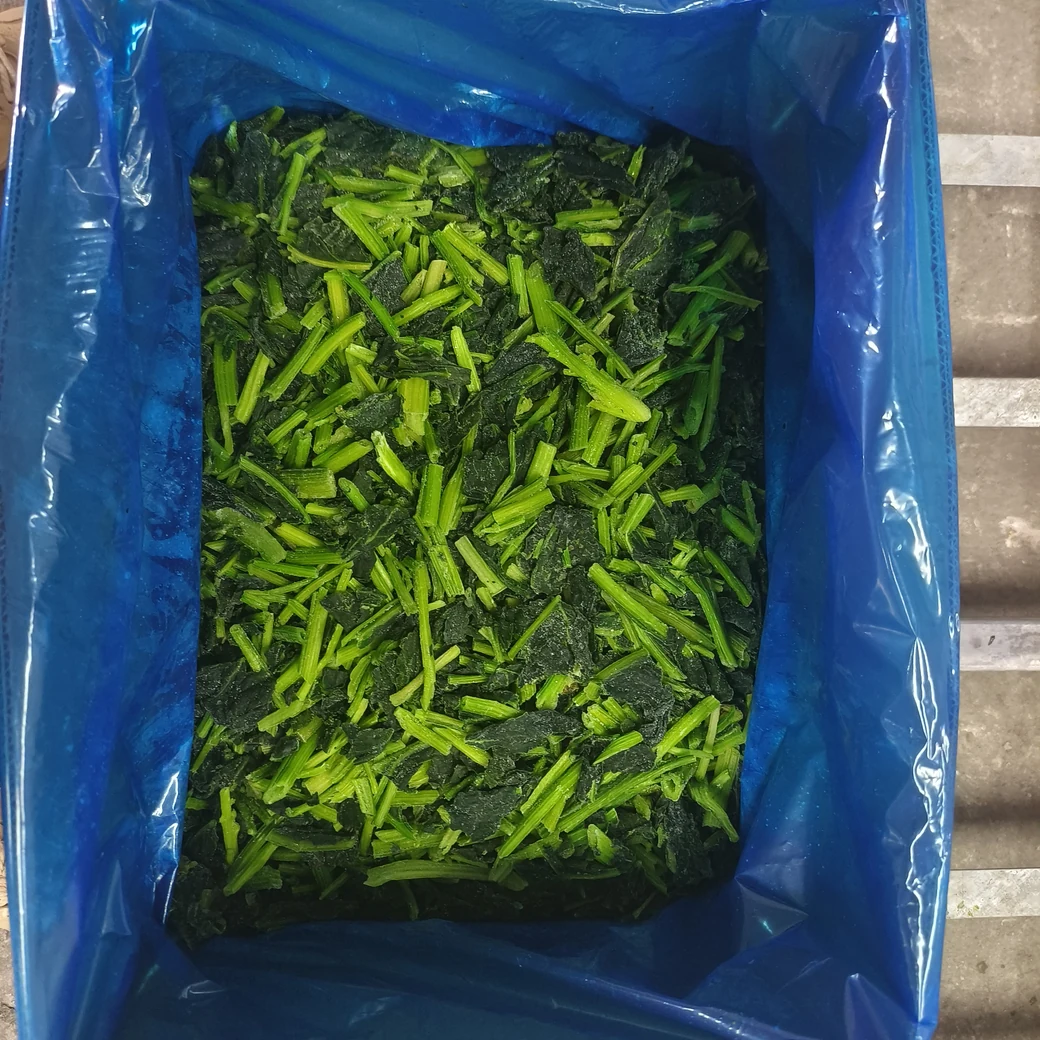
Original leafy-vegetable pack reference. The liner and product form part of the handling interface; this photograph does not demonstrate release performance, freezing method or a specified block mass.
Equipment offered for post-IQF handling shows that loose freezing and later separation are not mutually exclusive. ProEx describes a cluster-breaking system with optional stages for larger masses, followed by product-specific roll arrangements and possible grading. This is a supplier’s equipment description, not proof that any connected vegetable can be restored without damage. The actual product and required cut still need a trial.
For a separation trial, collect material before and after the relevant stage. Record remaining connected pieces, acceptable individual cuts and newly created fragments on the same inspection basis. Keep the operating settings and inlet condition with the result. A setting that releases one vegetable cleanly may change another vegetable’s shape or create more fines, even when both appear under the same broad equipment category.
When the route uses thermal conditioning, establish the required endpoint with the process owner. Stalam describes radio-frequency equipment for both IQF and block products, including packaged and bulk presentations. Its examples show a possible equipment route; they do not establish a universal conditioning time, prove that every package is compatible, or mean that all frozen vegetables should be fully thawed before processing.
Evaluate the prepared output at the next machine. Material that leaves a block-preparation stage as large uneven chunks may still be unsuitable for a small metering opening. A conditioned ingredient may behave differently from a fully frozen one during transfer. Define the acceptable output condition and its permitted waiting period through the plant’s validated process, then preserve those conditions during the production comparison.
Measure feed delivery through normal interruptions
Measure how much acceptable vegetable reaches the consuming process over time. Keep the mass basis and observation interval clear. The rate during uninterrupted discharge, the average across a complete pack cycle and the average across a full production run answer different questions. Use the full run to understand output, while shorter intervals help locate the irregular delivery that the total conceals.
Place the observations at the relevant interfaces. A breaker can produce material quickly into a hopper while the hopper outlet releases it slowly. Alternatively, the outlet may empty rapidly and then wait for the next prepared block. Record input, output and waiting at both stages before blaming either machine. A capacity figure for one stage does not describe the connected line.
| Interface | Record during the trial | Question the result answers |
|---|---|---|
| Pack to receiving hopper | Complete pack-cycle time, retained product and sudden releases | Can normal depacking sustain the required supply? |
| Preparation to feeder | Output condition, usable mass and time between releases | Does the preparation stage supply material the feeder can use? |
| Feeder to consuming process | Delivered mass over time, empty intervals and excess accumulation | Does the process receive the right amount when required? |
| Stop and restart | Material location, restart sequence and consecutive output checks | Does the route recover without unacceptable first output? |
Observe demand changes as well as supply changes. When a downstream unit pauses, the upstream route must respond according to its control design. Review what happens to material already moving, what capacity remains available and how the restart is coordinated. Ask the equipment team to confirm the interlocks and operating sequence; the ingredient trial should reveal the product behavior within that approved sequence.
A vendor-published La Huerta case describes separate vegetable infeed hoppers, declustering and metering, with controls adjusting overall line flow while retaining preset mix ratios. It also describes feed conveyors that respond to downstream demand. Those are two linked tasks: supplying enough total material and preserving the required composition. A stable overall weight does not by itself show that each vegetable component is arriving correctly.
For a blended ingredient, inspect the composition of output across the run where segregation could affect the product. For separately fed vegetables, retain each component’s delivery record. Heat and Control’s frozen-vegetable weigher case describes separate mix sections and staged hoppers before combined discharge. Its particular performance figures are not specifications for another line; the relevant lesson is to examine the complete feed and discharge arrangement.
Calculate usable buffer time before choosing capacity
A buffer is material held between operations so a short interruption upstream does not immediately stop the consuming process. Its useful capacity is the amount the outlet can actually deliver under the operating condition. Product below a practical discharge limit, stuck in a corner or required as a minimum operating reserve should not be counted as available material for bridging the interruption.
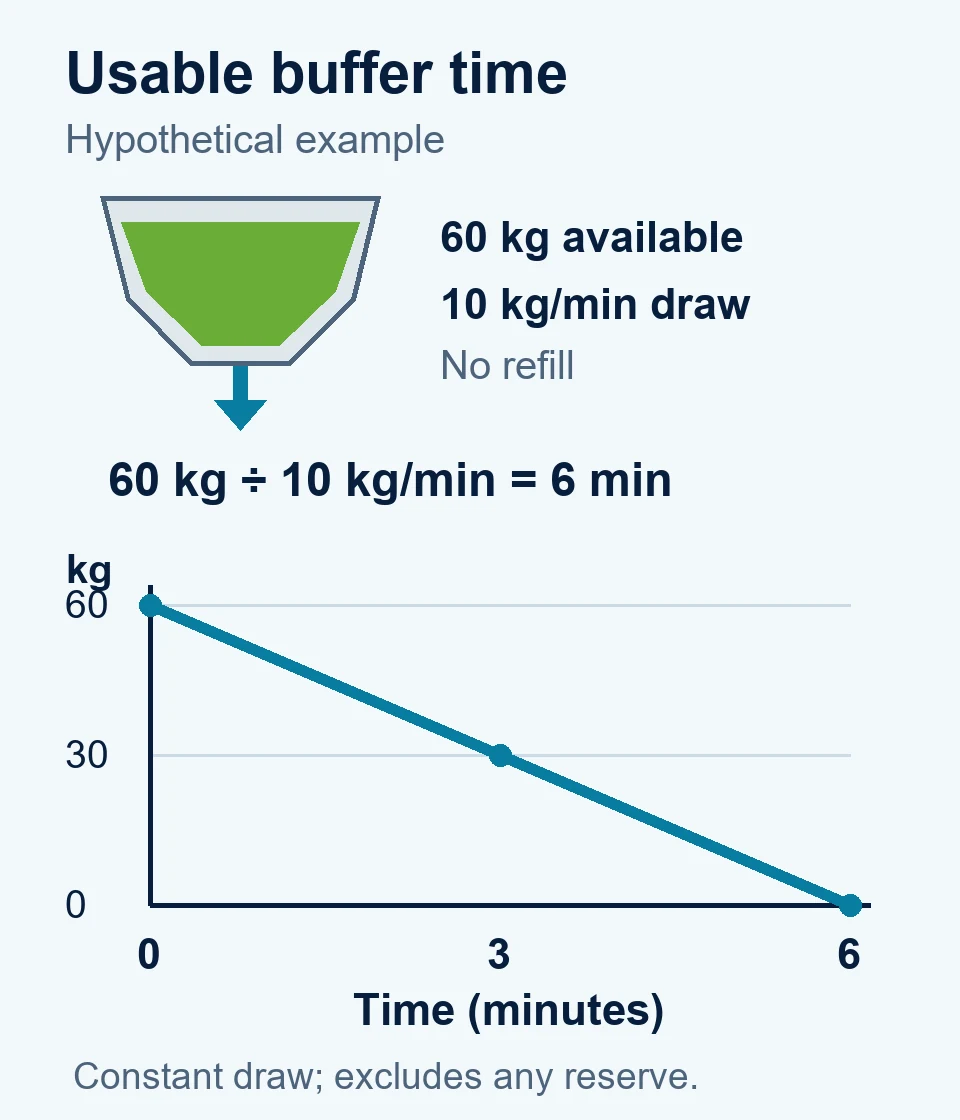
Hypothetical calculation with constant consumption and no refill: 60 kg of usable material at 10 kg/min lasts six minutes. The amount excludes any inaccessible material or required reserve and is not a hopper-sizing recommendation.
For a simple estimate with no incoming refill and constant consumption, buffer time equals usable material mass divided by the consumption rate. Keep the units consistent. A hypothetical 60 kg of available vegetables feeding a process at 10 kg per minute provides six minutes of coverage. After three minutes, 30 kg remains; after six minutes, the available material has been consumed.
These values illustrate arithmetic, not a recommended hopper size or a measured production result. A three-minute interruption in that example consumes 30 kg. A six-minute interruption consumes the entire 60 kg, leaving no allowance for restarting the supply. If the stated 60 kg is total hopper contents rather than available inventory, the usable coverage can be shorter.
Repeat the calculation with the plant’s observed conditions. Demand may vary, upstream preparation may refill intermittently, and the buffer may be partly empty when a stop begins. Use a time record of input, withdrawal and available inventory to assess those situations. Dividing nameplate hopper capacity by average consumption can conceal an interruption that begins at the lowest normal fill level.
Additional inventory also creates additional waiting. Review how product temperature, condition, traceability and the permitted process interval are controlled while vegetables remain in the buffer. Check the actual discharge pattern during emptying and changeover. A large container does not automatically provide predictable first-in, first-out movement, and mass capacity alone cannot establish an acceptable holding arrangement.
Test batch size, changeovers and restart quality
Compare the input unit with the real batch schedule. An intentionally supplied block may suit a process that uses a complete unit each time. A recipe requiring a different amount creates a remainder that must be handled through an approved route. Loose product can offer smaller additions, but the pack-opening frequency, weighing work and behavior of partly used packs still belong in the comparison.
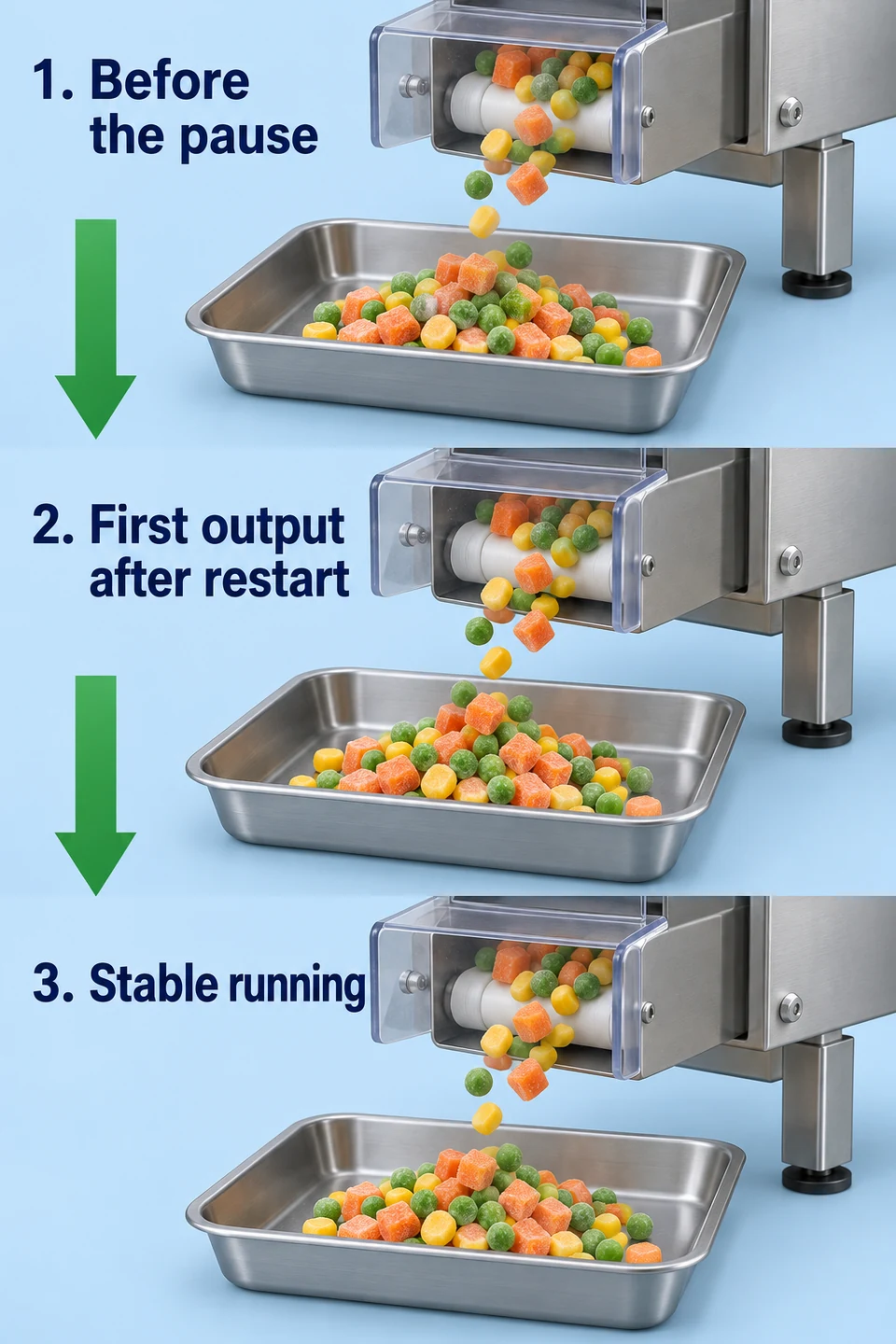
Illustrative sampling sequence. Compare actual output before a pause, at restart and during stable running; the pictured trays are schematic and do not show measured equal masses or a performance result.
Record the smallest and largest planned batches, including ordinary adjustments during production. Check whether the preparation stage can deliver the required amount without leaving excessive material between machines. The right supply form for a long, steady run may be different from the right form for several short recipes. Make that schedule visible before comparing the nominal purchase price per kilogram.
Include a planned changeover in the trial. Identify how the last product leaves each hopper, transfer and preparation unit, and how the next lot or recipe enters. Record recoverable ingredient, material requiring separate disposition and the time before acceptable output resumes. Keep lot identity and any mixing of residual material within the site’s traceability procedure. Empty appearance alone may not explain where all material went.
Sample the output before a pause, during the first restart discharge and after stable running resumes. Use consecutive observations instead of selecting the most attractive tray. Compare dose or component distribution, piece condition and the finished product criteria that matter. Any difference should be traced to the actual stage and setting before deciding that the incoming frozen presentation caused it.
Keep routine stoppages distinguishable from an abnormal event. The first material after an ordinary downstream pause may follow a different handling decision from material held through an extended breakdown. The process owner should define the permitted restart and disposition conditions. A supplier comparison should work within those controls and preserve the recorded product condition, rather than create an informal workaround to improve the trial result.
Compare accepted output across the complete route
Compare commercially suitable candidates after both routes can produce acceptable output. Align the vegetable, cut, preparation state, pack and commercial delivery basis. Then record the additional resources each route uses: depacking labor, preparation equipment, transfer work, energy where measured, cleaning time and the material that the operation cannot use. Avoid allowing a lower ingredient price to hide an unresolved feeding step.
Use the same output definition in the comparison. For this decision, accepted output might mean kilograms meeting the next process’s input condition, or finished production units meeting the agreed recipe and appearance criteria. State the endpoint explicitly. Comparing purchased kilograms on one route with finished meal weight on another creates a denominator problem before any cost calculation begins.
Keep observed results separate from assumptions. If energy has not been measured, identify the estimate and its basis. If a machinery change is required, obtain the proposed design and commercial assessment from the responsible equipment supplier. A short ingredient trial can identify a promising route without establishing annual operating cost, equipment reliability or the return on a capital investment.
Preserve the approved operating and supply references together. Retain the product and pack identity, preparation settings, usable buffer basis, feed observations and acceptance checks. Confirm which changes require another trial, including a different liner, block dimension, cut distribution or prior processing state. The purchasing result should describe an ingredient the plant can repeatedly receive and use, with the relevant operating conditions visible.
Frozen Vegetables
Browse our vegetable range and compare product forms, specifications and packing options.
Explore Frozen Vegetables →References
- [1] JBT Marel: Octamix, frozen vegetable mass handling.
- [2] Stalam: COLDWAVE+ for vegetables and fruit, product and packaging options for conditioning.
- [3] ProEx: Block Breaker / Cluster Buster System, staged post-IQF separation.
- [4] Key Technology: Veg-Mix System, integrated vegetable handling.
- [5] Key Technology: La Huerta implementation, vendor-published flow-control example.
- [6] Heat and Control: Frozen vegetable mixing with an Ishida weigher, staged feeding and mixing example.
