On this page
Frozen edamame pod sampling should report empty pods, beans per pod and damage as separate results. Keep the selected pods identifiable, record their outside condition before opening, then count and examine the beans using agreed definitions. Every percentage needs its own numerator and denominator; an average bean count cannot replace a distribution or a damage assessment.
The inspection brief should also distinguish product approval from cause investigation. A sampled pod can show what was present when opened. That observation does not automatically explain why a bean is missing or establish the condition of every carton in the shipment.
Define the pod sample before opening it
Start with the lot, pack and product identity. State whether the material is in-pod edamame and record the declared treatment and specification version. Keep selected packs separate long enough to preserve any pack-level pattern. An average from pooled material can hide a concentration of partly filled or damaged pods in one particular pack.

Authentic original-video still from the product library. Product context only; no inspected lot, bean count or cooking status is established.
We supply frozen edamame in pod and kernel formats. For an in-pod programme, confirm the actual pod-fill, bean-count and damage requirements rather than borrowing the acceptance fields from a shelled-bean specification. Our in-pod and shelled comparison covers the product-form choice. Once in-pod material is selected, the inspection needs its own definitions and sampling basis.
Choose the sampling plan for the decision being made. A qualification sample, a receiving inspection and a complaint investigation may examine different material for different reasons. Record how cartons, packs and pods were selected. A handful chosen for its poor appearance can illustrate a concern, but it cannot establish that concern’s frequency throughout the lot.
State what counts as one inspected pod. A complete closed pod, an already split pod and a loose half-shell should not enter the count without a rule. Record loose beans and fragments separately before preparation. Otherwise, the inspector may unknowingly count a broken pod twice or assign a loose bean to a shell that did not contain it.
Record the sample state and follow the agreed examination procedure. Keep incoming frozen-state observations separate from the condition needed for opening or other checks. If preparation changes the material, retain the original views and document the step. Do not compare a heavily frosted sample with a prepared one as though the two appearance records were equivalent.
Use a working sheet that preserves identity through opening. A simple sequence number for each pod can connect the outside appearance with bean number, fill and internal findings. For larger inspections, agree a practical recording method that preserves the information the decision needs. This preserves the link between a damaged shell and the condition of the beans it contained.
In Virginia Cooperative Extension’s edamame product guide [1], whole pods and shelled beans are distinct commercial forms. Its fresh-product discussion also considers pod appearance and bean number. Treat that as product context, not a universal frozen-lot requirement. The order specification must identify which form and acceptance criteria apply to the material being sampled.
Distinguish empty pods from partly filled pods
Define “empty” before recording the result. For an examination based on bean presence, a pod with no beans is different from a pod containing one bean and other unfilled positions. A partly filled pod is not automatically an empty pod. If the buyer also uses a minimum fill or bean-size criterion, report that field separately.
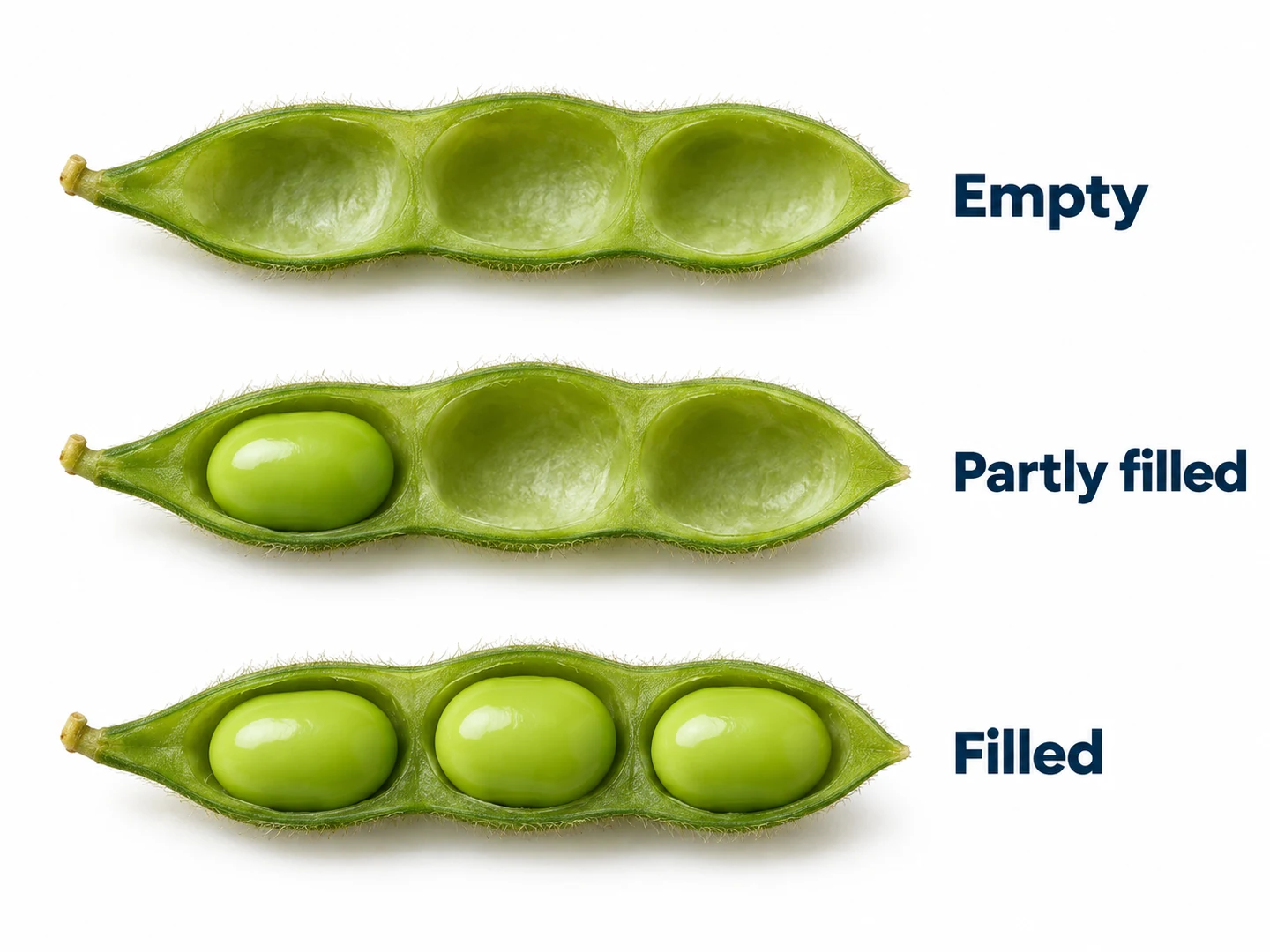
Conceptual three-position pods, not actual inspected samples or a universal pod structure or grade.
Do not infer the bean count solely from the outside bulges. Use the agreed opening method to establish what is present. Keep the pod and its beans together while recording the result. If a bean falls out during handling, note it at once so an inspection-created loss does not become an unexplained empty position.
An already open pod creates a different evidence problem from an intact pod opened by the inspector. The absence of a bean in the former does not establish whether it was never present, fell out during handling or was lost earlier. Record the incoming split condition and the observed contents. Keep the proposed explanation as a separate question.
Agree how very small or poorly developed beans are classified. An inspector may count a visible bean while also flagging that it misses the agreed fullness criterion. Another method may define a qualifying bean differently. Either approach needs an explicit definition; changing it midway through the sample can alter both the empty-pod result and the bean-count distribution.
The Virginia Tech handling and processing guide [2] describes sorting raw pods for fill, colour, damage and bean condition. It reproduces a cited raw-pod grading scheme in which one-seeded and fuller pods can follow different product routes. That scheme is not a globally mandatory frozen-edamame grade. It shows why bean presence, fill and the intended product need separate consideration.
Biology can help frame an investigation without diagnosing the inspected lot. An original University of Maryland research-team report [3] describes experimental pollination treatments and differences in pod and bean quality. The report concerns a field experiment. It does not establish why an individual frozen pod is empty, nor does it predict the fill distribution of a particular supplier’s delivery.
Photograph selected examples with their identifiers and the complete opened pod in view. Include the beans alongside their original pod where that supports the record. Avoid displaying a few loose beans next to several shells and presenting the arrangement as an observed relationship. Clear images should preserve the inspection finding, not reconstruct a more convenient sample after the fact.
Report bean-count distribution, not just an average
A distribution shows how many examined pods contained each recorded number of beans. An average compresses that information into one value. Two samples can have the same average while presenting different proportions of empty, one-bean and fuller pods. Keep the distribution when the buyer’s requirement concerns the experience of individual served pods.
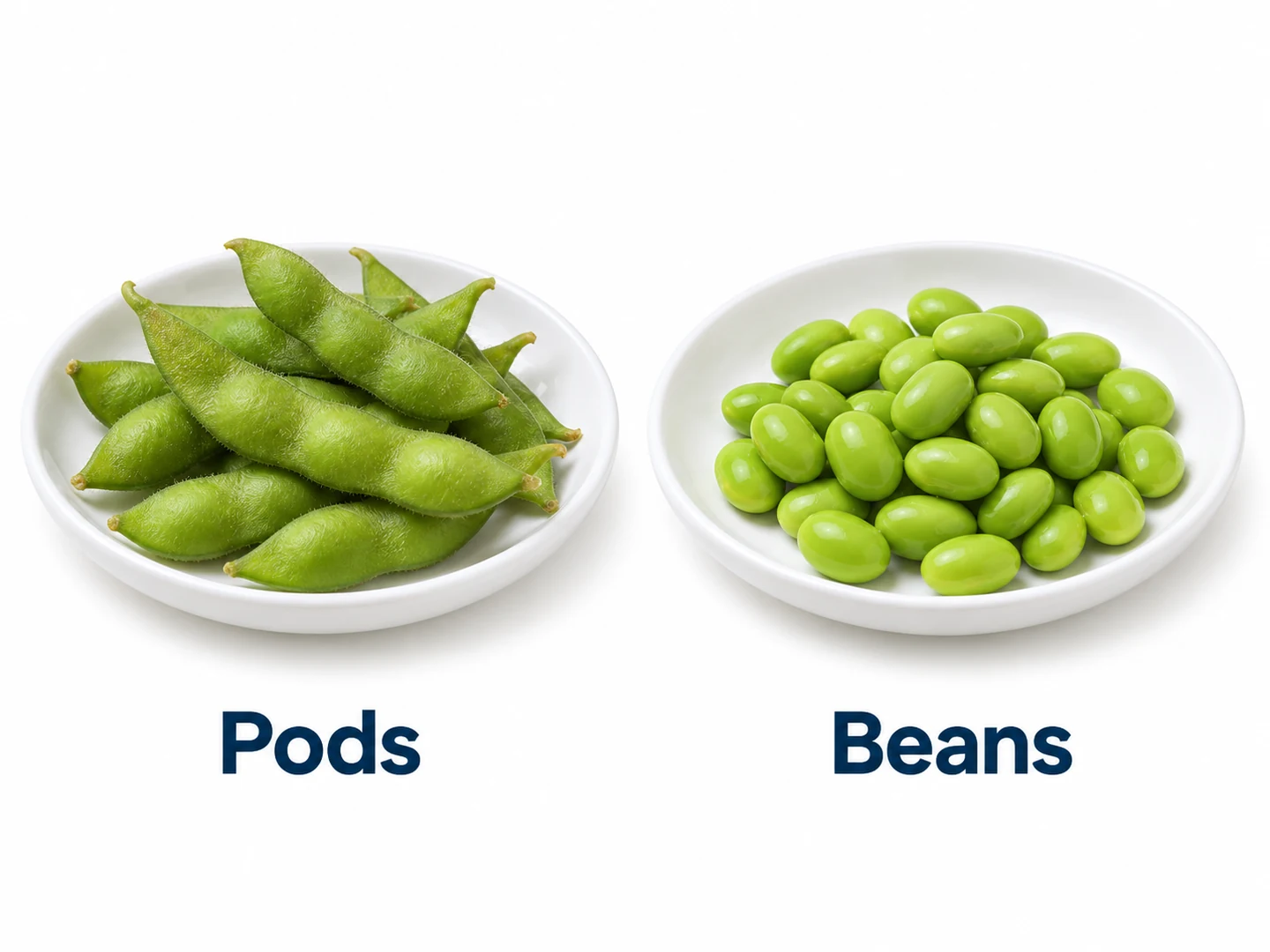
Illustrative physical units. The two portions are not matched samples and show no measured count or yield.
The following numbers are hypothetical and do not represent an XMG lot or an acceptance standard. Suppose an inspector opens 100 identified pods and records four empty pods, 16 pods with one bean, 50 with two beans and 30 with three beans. The distribution describes the sample before any separate damage or bean-size classification is applied.
| Beans observed per pod | Pods in the example | Beans represented |
|---|---|---|
| 0 | 4 | 0 |
| 1 | 16 | 16 |
| 2 | 50 | 100 |
| 3 | 30 | 90 |
| Total | 100 | 206 |
In this example, empty pods are 4% of the examined pods. Pods containing at least two beans are 80% of the examined pods. The average is 206 divided by 100, or 2.06 beans per examined pod. These are three different descriptions of the same sample. Each should be compared only with a requirement written on the corresponding basis.
If the inspector excludes the four empty pods from the average, the calculation becomes 206 divided by 96, approximately 2.15 beans per non-empty pod. That value may answer a defined question, but it cannot replace the all-pod average without disclosure. State whether empty pods remain in the denominator whenever reporting an average bean count.
Keep the categories open to what the material actually contains. The example stops at three beans for simplicity; it does not establish that every edamame pod has three potential positions or that a different count is automatically defective. Record additional observed categories where needed and apply the buyer’s agreed definitions.
Use the distribution to check a stated requirement directly. If the contract names a proportion of pods within a bean-count category, calculate that proportion from the corresponding pod counts. Do not infer it from the average. A high average can coexist with some empty pods, and it does not reveal whether the beans meet the separate fullness or condition criteria.
Retain the original counts as well as rounded percentages. Small samples can produce relatively large percentage changes when one pod moves between categories. The report should allow another reviewer to reconstruct the calculation and see the size of the examined sample. More decimal places do not increase the amount of evidence collected.
Keep pod damage and kernel condition identifiable
Inspect the exterior before opening, then record the internal condition against the same pod identifier. A split seam, a torn tip, a surface blemish and a damaged bean are different findings. State the location and the applicable classification. A single combined “damage” field may conceal the requirement that actually needs attention.
Authentic original-video still from the product library. These beans are not presented as recovered from the pictured pod sample.
Separate incoming damage from changes made during inspection. Opening can split the shell or mark a bean if the method is poorly controlled. Record the original condition first and agree how inspection-created damage is handled. If the opening method prevents a reliable internal assessment, address that method problem before drawing a supplier-quality conclusion.
Distinguish the number of damaged pods from the number of damaged beans. Continuing the hypothetical example, suppose nine of the 100 pods meet a defined pod-damage criterion, while six of the 206 recovered beans meet a separate kernel-damage criterion. Those results are 9% by pod count and approximately 2.9% by bean count. They describe different populations.
Keep the relationship between those observations where it matters. Several damaged beans might come from one pod, while a pod with a torn shell might contain beans that meet the kernel requirement. The two percentages cannot be added to produce a total defect rate. A combined acceptance rule must define how overlapping findings and different units are handled.
Agree whether a defect result is by count or by mass. Large and small beans contribute equally to a bean-count percentage but contribute different amounts to a mass percentage. Similarly, weighing an entire affected pod is different from weighing only a damaged bean removed from it. Name the measured material and preserve the original denominator.
The Pacific Northwest Extension edamame guide [4] distinguishes the beans that are eaten from the discarded pod shells. Its marketing discussion also separates bean-number preferences from bean flavour. For inspection, that supports keeping exterior presentation, bean quantity and kernel quality as individual fields rather than letting one stand in for all three.
Visible marks can raise investigation questions without establishing a cause. Describe their location and extent, and retain relevant material when further examination is required. If the condition raises a potential safety concern, follow the responsible technical team’s hold and review process. Tasting or assuming that an intact exterior guarantees acceptable contents is not a substitute for that assessment.
Turn pod counts into usable product comparisons
Pod count per stated mass, beans per pod and recovered bean mass are different measurements. A bag containing more pods does not necessarily provide more usable beans. To compare a yield requirement, define the input material, preparation, shelling, draining and acceptance steps, then measure the output produced by that procedure.
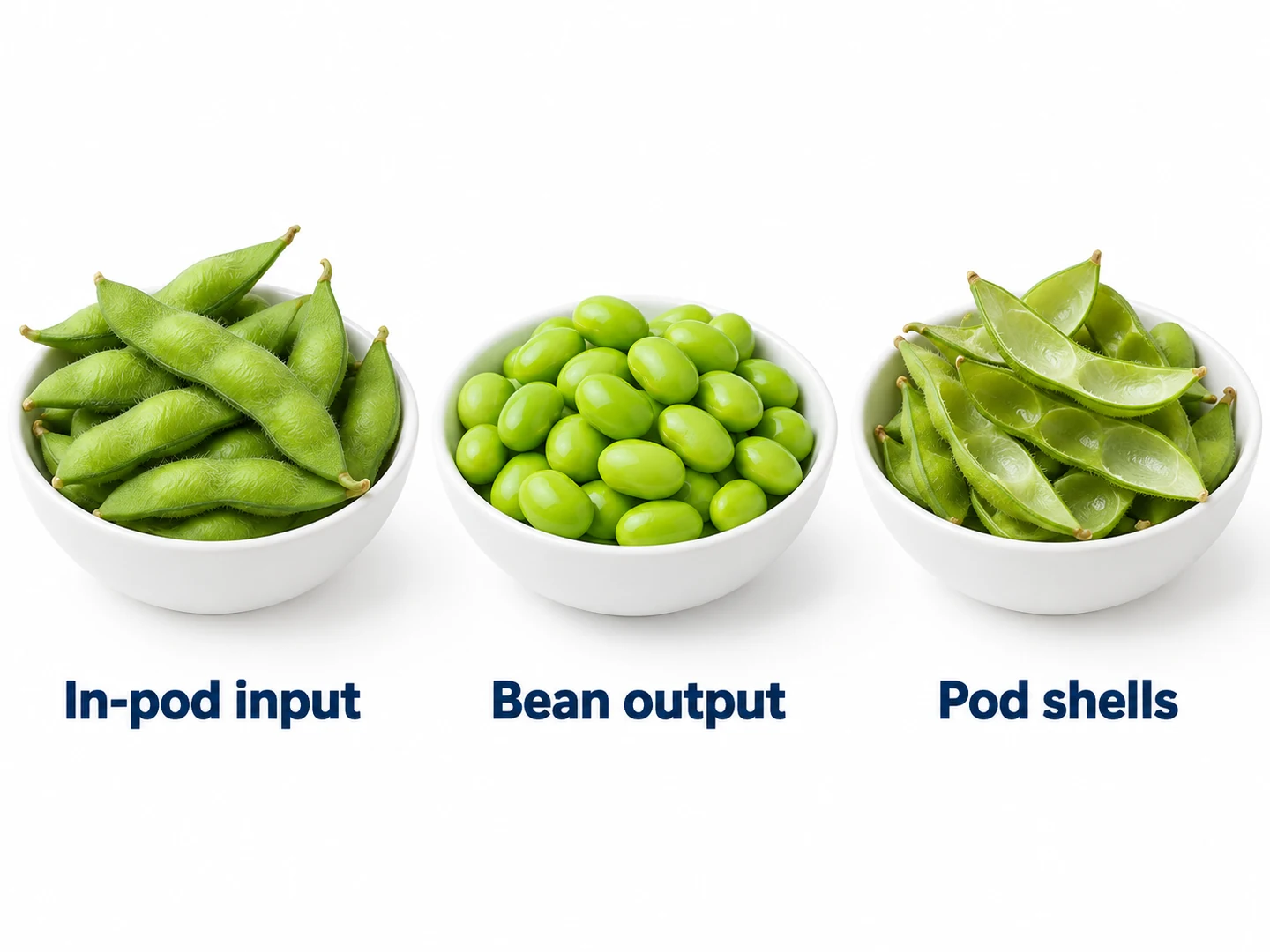
Conceptual material fractions, not an observed mass balance, expected yield or equal quantities.
In an original edamame quality study by Moseley and colleagues [5], researchers assessed pod weight and colour across cultivars and planting and harvest dates. Hundred-pod weight was measured before blanching, while colour assessment followed preparation. The study’s quality index is not a frozen-lot grade or a shelling-yield result. It illustrates why a named measurement also needs its sample stage.
Define whether the input mass includes loose ice, loose beans or other material and handle each fraction according to the agreed method. Keep the treatment consistent when comparing lots. A yield measured from prepared, drained pods should not be compared directly with a percentage calculated against the unopened frozen pack unless the relationship between those bases is documented.
Consider a separate hypothetical trial with 1,000 g of defined in-pod input. Suppose the recorded outputs are 480 g of recovered beans, 500 g of pod shells and 20 g of collected liquid. The outputs account for the input mass in this example. The bean recovery is 48% of the input mass; it is not a bean-count percentage.
If 30 g of the recovered beans fail the agreed usable-quality criterion, 450 g remain acceptable under that trial definition. Usable bean yield is then 45% of input, while the total recovered-bean result remains 48%. Keep both values and the reason for the rejected portion. Removing the rejected beans from the report would hide part of the product comparison.
These figures are examples, not expected commercial yields. Actual outcomes depend on the supplied material and the defined procedure. If the measured fractions do not account for the input, record the difference and investigate the handling or measurement question. Do not assign all unexplained mass to an assumed product defect.
For an in-pod serving programme, also evaluate the approved preparation and portioning use separately. The kitchen may care about the proportion of visibly full pods, the prepared bean texture and the consistency of a served portion. A laboratory-style shelling exercise answers a yield question; it does not by itself approve the presentation or eating quality of the finished service.
Agree the sample report and release criteria
A useful report brings together sample identity, selection method, preparation, original counts and the applicable criteria. State the result for each field with its unit and denominator. Keep the distribution, exterior findings and kernel observations accessible so the reviewer can understand the decision without reconstructing the inspection from a folder of unlabelled photographs.
Separate measurement from disposition. An inspector can report what was observed, while the authorised buyer or quality reviewer applies the agreed acceptance rule. A result outside a stated requirement may lead to rejection, further investigation or a specifically authorised concession. Record the responsible person, affected lot and scope of any decision.
If a repeat sample is needed, explain what it will resolve. It may examine another part of the lot, check a disputed definition or investigate a pack-level concentration. Preserve the first result. Combining incompatible samples or selectively retaining only favourable findings makes the record less useful and can conceal the issue the second inspection was supposed to address.
Keep appearance and fill sampling separate from other required evidence. The pod inspection does not establish GMO status, microbiological conformity or every destination-market requirement. Those questions need their own specified records and methods. A complete order review connects the relevant evidence to the same supplied product without pretending that one type of sample answers every question.
Send the fields that need confirmation through our product specification and sampling workflow. We coordinate the in-pod product requirement, sample questions and relevant partner-factory response. Include the observed distribution or damage record where a comparison is already underway, so the follow-up can address the actual point of disagreement.
For repeat orders, retain the approved definitions and reference material with a version and effective scope. If the buyer changes how partly filled pods or small beans are classified, update the inspection brief before the next comparison. Keep the previous method alongside the revision so repeat-order results can be compared on the same basis.
Frozen Edamame
Review our frozen edamame range, product forms and specification options.
View Frozen Edamame →References
- [2] Li et al. Edamame in Virginia III: Handling and Processing from Harvest to Package. Virginia Cooperative Extension, SPES-456P, 2023.↑
- [1] Li et al. Edamame in Virginia I: Products and Marketing. Virginia Cooperative Extension, SPES-454NP.↑
- [4] Miles, O’Dea, Daniels and King. Edamame. Pacific Northwest Extension, PNW525, February 2018.↑
- [5] Moseley et al. Effect of Planting Date and Cultivar Maturity in Edamame Quality and Harvest Window. Frontiers in Plant Science, published January 2021, DOI 10.3389/fpls.2020.585856.↑
- [3] Cutlip, K. Pollinators Make a Big Impact on Edamame Marketability. University of Maryland Department of Entomology, December 2023. Research-team report.↑
