


On this page
Add frozen peas according to the texture you want in the finished risotto and the instructions on the pea pack. If you want individual peas that still feel distinct against creamy rice, start by adding them near the end of rice cooking, then keep the risotto hot long enough to complete the product’s required heating. If you want peas to soften and mingle with the rice, an earlier addition may suit the dish. The exact point depends on whether the peas enter frozen or thawed, how much you add, how vigorously the pan simmers, and whether the finished risotto will wait before service. A pea purée is a separate ingredient: it colours and flavours the rice but cannot preserve the bite of whole peas.
Published risotto recipes use strikingly different routes. La Cucina Italiana [1] adds frozen peas with the rice, whereas a mushroom and pea risotto [2] adds them when the rice is nearly done. A Milk Street recipe reported by AP [3] folds thawed peas in off heat. Those are recipe choices, not controlled evidence that one entry point fits every frozen pea and every risotto.
Choose the pea preparation route first
Read the bag before choosing a pan sequence. Frozen vegetables differ in processing and intended use, and instructions for cooking, heating or thawing take priority over any general risotto suggestion. If a pack says to cook from frozen, do not quietly substitute an off-heat thawed finish. If it calls for heating through, plan enough active heat after the peas enter. A quick visual change to brighter green is an aesthetic observation, not a check that the product has met its directions.
Next decide whether you are working with intact loose peas, a partly thawed clump, completely thawed peas, or a separate pea purée. Loose peas disperse across a pan more evenly than a solid cluster. A cluster can cool a local patch of rice and warm unevenly unless it is broken apart according to the pack’s directions. Thawed peas carry their own surface moisture, which can loosen a risotto that was already at its preferred consistency. A purée changes the rice itself and should be judged for creaminess and pea flavour, rather than for whole-pea bite.
Set the rice goal before discussing the peas. The centre of each rice grain should reach your intended bite, and the surrounding liquid should remain fluid enough for the risotto to move when the pan is shaken. If the rice is still firm and dry, pea timing cannot rescue the rice. If the rice is already soft and thick, extending the simmer merely to heat a large frozen addition may make the finished plate heavy. Build the pea route around the rice endpoint rather than treating the two ingredients as if they finished independently.
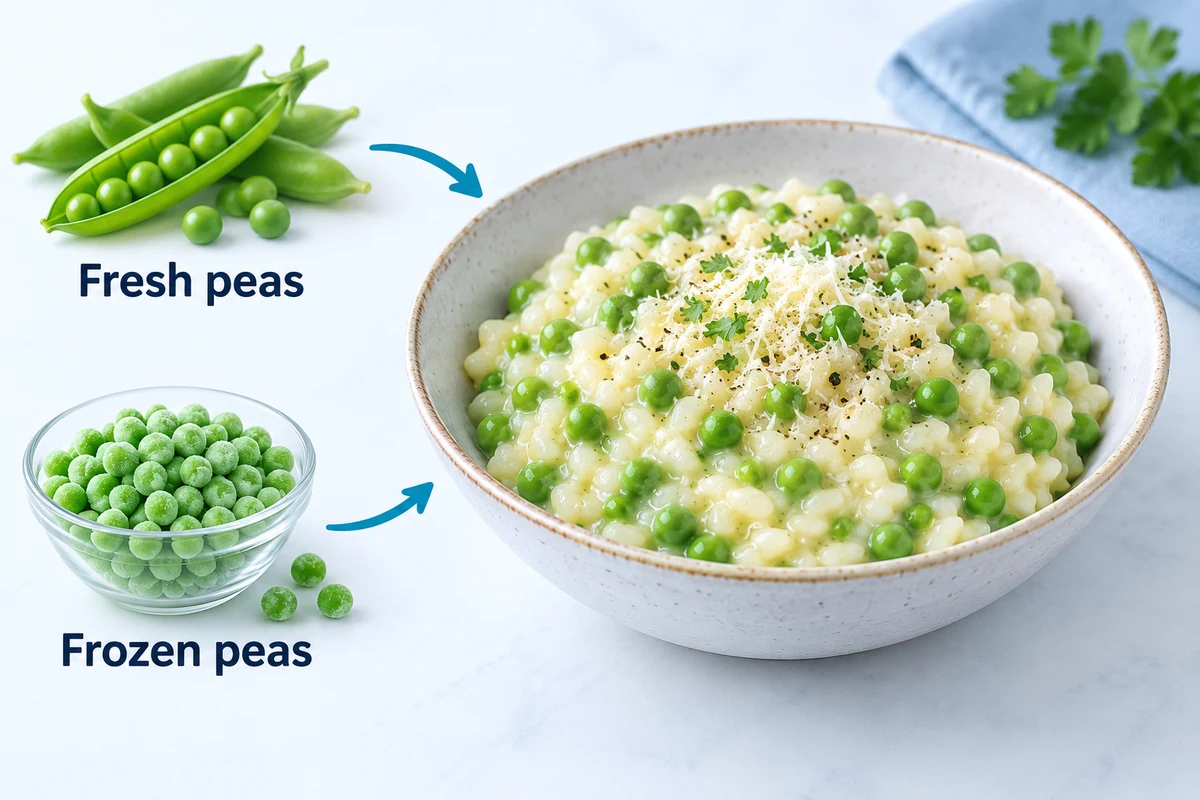
Illustrative ingredient and risotto context. Fresh and frozen starting forms are shown; this scene is not a batch trial or a cooking-time guarantee.
Early, middle or late addition changes the finished dish
An early addition puts whole peas through most of the rice cooking. It is useful when the dish aims for soft peas that become part of the rice, and it gives frozen peas time to warm without a separate step. It also exposes them to continued stirring and heat. For a dish where each pea should hold a clear shape and small bite, that exposure is the reason to compare an alternative. Early addition is not a mistake: one published Italian recipe expressly uses it with frozen peas. Its result belongs to that recipe’s ingredients and process.
A middle addition is a practical compromise when the rice still needs more broth but you do not want the peas present from the start. It is especially worth trialling when a sizeable quantity of peas enters frozen and would otherwise interrupt the final rice finish. The precise stage should be described by the rice condition, not by a number of minutes: add them while the rice still has enough cooking to recover its simmer and meet the pack’s directions, then watch what happens to both components.
A late addition gives whole peas the least time in the pan. It often supports a more distinct contrast between creamy rice and individual peas, provided that the required heating is still achieved. The apparent simplicity hides several variables. A small amount of loose peas disperses differently from a large mound. A wide pan holds and recovers heat differently from a narrow, crowded one. Peas straight from the freezer behave differently from peas already thawed under the pack’s permitted method. A risotto eaten immediately differs from one that waits in a hot pot while diners gather.
Off-heat addition should be treated as a specific recipe route, not as a universal shortcut for frozen vegetables. In the Milk Street version, the peas are thawed and the recipe folds them in with the finishing ingredients. A cook using another pack should check its instructions before copying that move. If the product requires cooking, the last stir alone may not meet that requirement. Even when it is appropriate, the off-heat route will alter the final pan temperature and may require careful handling of the rice’s remaining liquid.
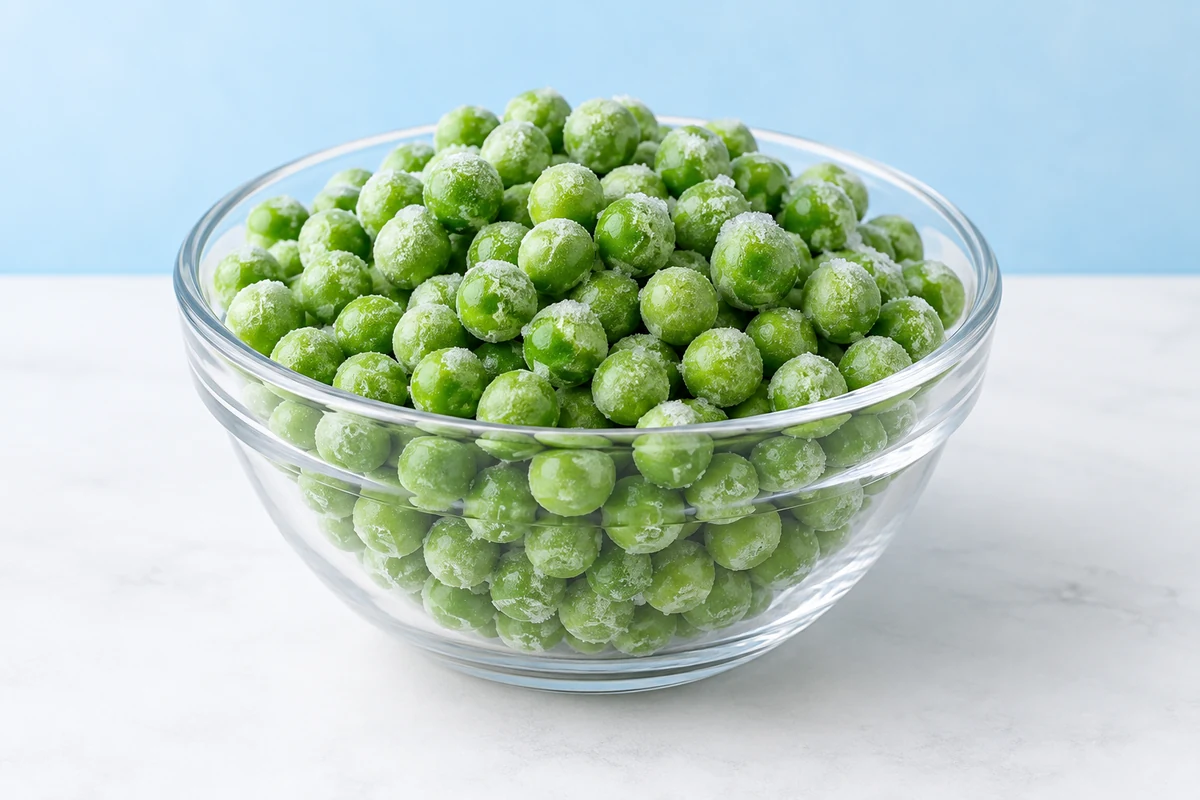
Conceptual pea-form illustration; not a photograph or a sample from this article.
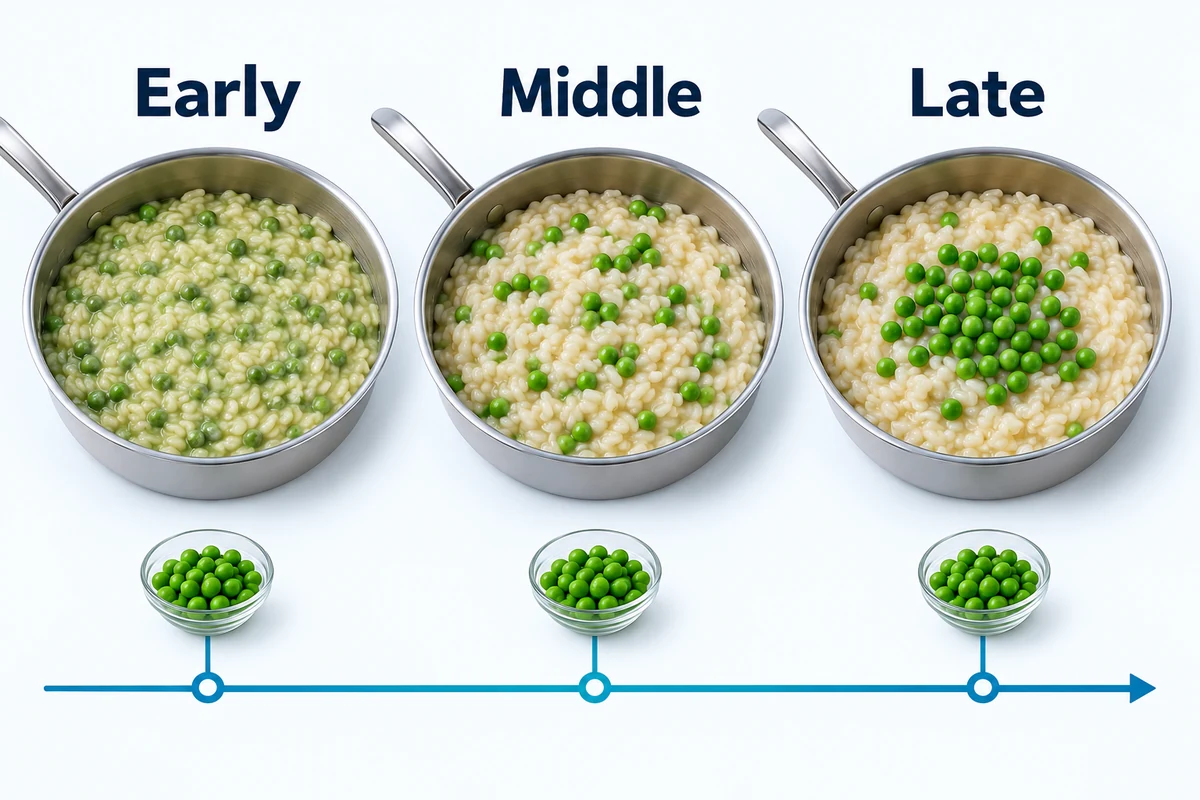
Illustrative timing comparison. Choose the addition point by the actual pea product, pan recovery and target bite rather than a universal minute.
The clearest comparison holds the rice recipe constant and changes only the point of pea addition. A table is more useful than a single clock time:
On a narrow screen, swipe this table sideways to read the remaining columns.
| Route | Reason to consider it | What to watch |
|---|---|---|
| Early | Peas are intended to soften with the rice | Loss of a separate pea bite during continued stirring |
| Middle | Frozen peas need active heating while rice still has room to cook | Heat recovery and whether rice needs more stock |
| Late | Distinct whole peas are a priority | Whether peas meet pack directions before rice overcooks |
| Off heat | A tested recipe specifically uses appropriately thawed peas | Pack instructions and the final serving temperature |
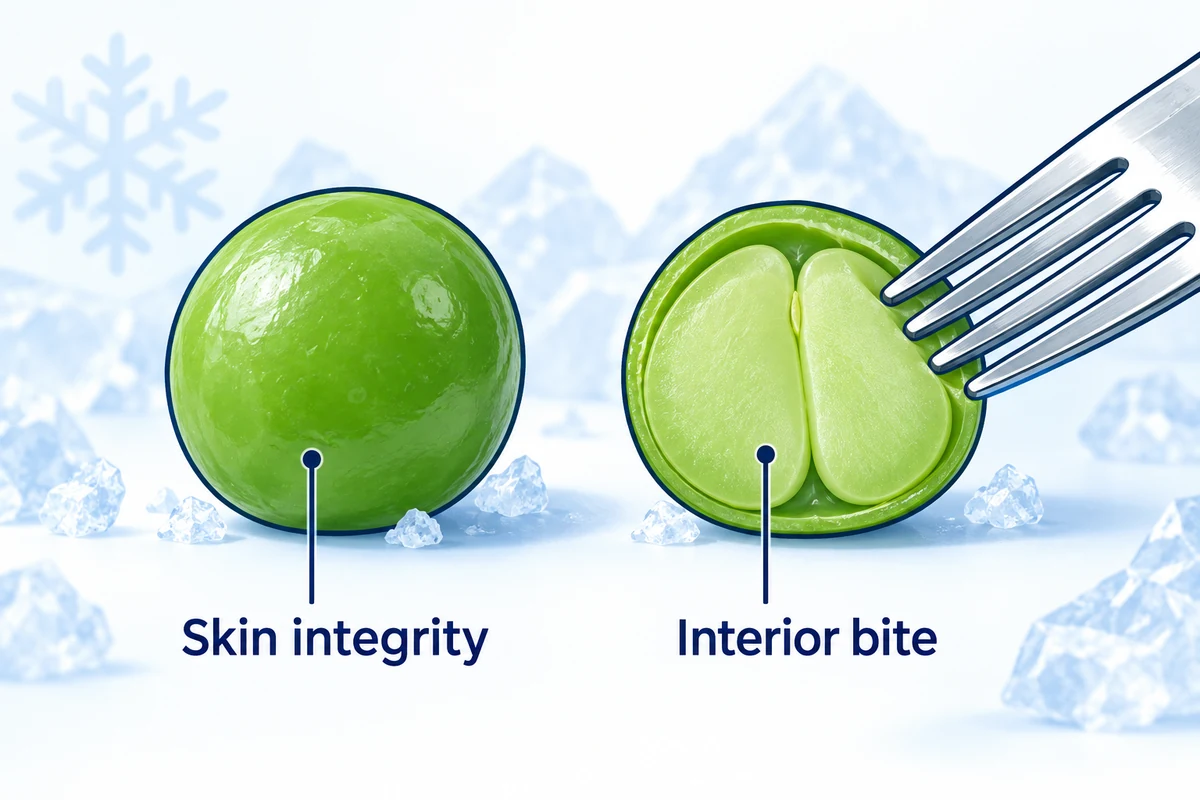
Conceptual pea attributes for assessing a finished risotto; no sensory result is shown.
Account for the heat taken up by frozen peas
Frozen peas absorb heat from the risotto as they warm. That is an ordinary heat-transfer constraint, not a fixed penalty that can be reduced to one number. The effect depends on the pea quantity, the initial pea state, the amount of hot rice and stock, the pan, and the heat under it. In a small batch, a modest frozen addition may recover quickly. In a crowded service pan, a heavy addition can bring the simmer down and tempt the cook to compensate with more vigorous heating than the rice needs.
Look at the pan immediately after adding the peas. If the simmer stops, keep the rice moving gently and allow it to return while checking the rice’s liquid. Do not assume that an unchanged green colour means the cold load has disappeared. If the mixture thickens while the peas warm, a little hot stock can restore the flow of the risotto; add it for the rice texture, not because every frozen pea recipe requires extra liquid. If the risotto becomes loose after thawed peas enter, give the pan a moment to come together before adding more stock.
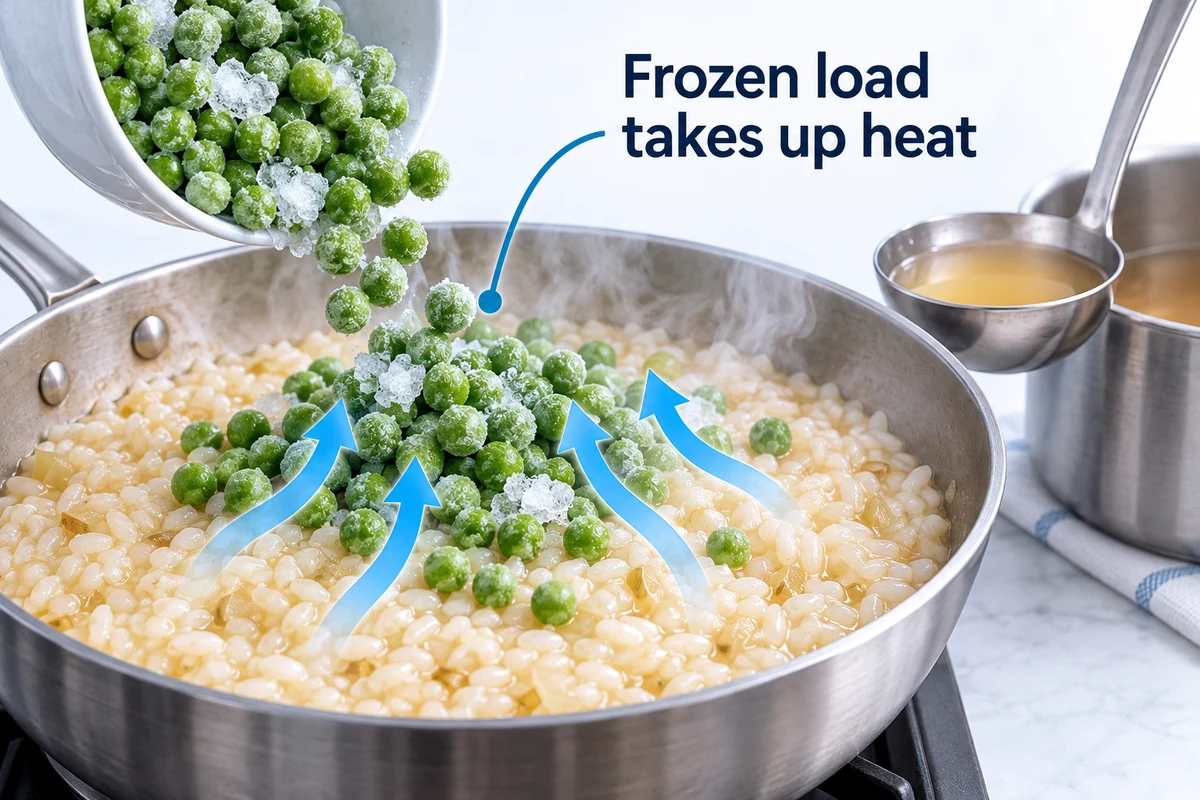
Conceptual heat-load mechanism: frozen additions take up heat. The illustration contains no measured temperature, recovery time or cooking result.
Fit pea heating around the rice endpoint
Risotto asks for two endpoints that can conflict. Rice needs its desired internal bite and a mobile, creamy exterior. Frozen peas need the preparation specified by their producer and the bite you want on the plate. If the peas need more active heat than the rice can tolerate at the last moment, bring them in earlier or use a separately prepared pea component if the pack permits. If the peas are already adequately prepared for the chosen route, later addition may preserve their definition. The decision is a sequence problem, not a colour problem.
Begin checking the rice before it is fully finished, while you still have room to adjust. Taste several grains from different parts of the pan. If they are close but clearly need more cooking, that may be the window for a frozen addition. If the grains are at their target, you have little margin to simmer the peas without changing the rice. In that case, a recipe using thawed peas may be suitable only when the package allows the chosen preparation. Follow the product directions and check the dish as a whole.
Do not use a fixed number of minutes borrowed from another recipe as your main control. Rice variety, stock temperature, pan size and pea load vary. Instead, record a few observable checkpoints: rice just short of its target; peas distributed rather than clumped; pan hot and moving after addition; product heating instructions met; and a pea bite that matches the dish. Those checkpoints give a cook more useful information than a timer alone.
Compare immediate service with a waiting plate
A risotto that is right at the stove can change while it is carried, held or served. Rice continues to take up liquid, and peas remain in a hot, moist environment. The contrast between the two may narrow: the rice can become tighter while the peas soften. This does not prove a particular waiting period is acceptable or unacceptable. It means that the moment of evaluation should match the moment the diner receives the bowl.
For immediate service, assess a spoonful after the product’s heating requirement is met and the risotto is finished. Note whether the pea skin gives a pleasant resistance and whether its centre is tender rather than hard. Then assess a second spoonful after the realistic wait for your table or service line. If the second spoonful loses the intended bite, change one factor in the next trial: add peas later within the pack’s directions, shorten the hot hold, or hold prepared components separately when suitable. Avoid changing the rice variety, pea quantity and holding method together.
Run a practical risotto timing comparison
A useful test can be small. Divide one batch of the same rice and stock into equal portions before the peas enter. Use peas from the same bag and weigh or measure equal amounts. Keep the pan size, heat, stirring style and final stock adjustment as similar as practical. Prepare the peas according to the package. Trial an early, middle and late route only if all three allow the required heating. If one route cannot meet the instructions without destroying the rice endpoint, record it as unsuitable for that product rather than forcing a sample.
Write down the actual state of the rice when peas enter. “Rice still firm and flowing” is more transferable than “four minutes left,” because the cook can recognize it in a different pan. Record whether peas were loose, clumped or thawed; whether the simmer stopped; whether extra hot stock was needed; and whether the pan became too thick or too loose. These observations explain the result better than a photograph of three bowls.
At service, blind-taste if possible. Ask which sample has the intended pea bite, whether the pea skin seems intact or soft, and whether the rice is creamy without being overdone. Repeat after the normal waiting period. The winner can depend on the intended dish: a purée-led pea risotto may value blended flavour, while a plain risotto with whole peas may value individual texture. No untested recipe should claim that its chosen entry point will preserve colour or bite across all products.
On a narrow screen, swipe this table sideways to read the remaining columns.
| Keep constant | Change deliberately | Record at service |
|---|---|---|
| Rice, stock, pea bag, pea quantity, pan and target rice bite | Point of whole-pea addition | Rice flow, whole-pea integrity, pea bite and heat-through compliance |
| Same portion and serving vessel | Immediate tasting versus realistic waiting | Change in rice thickness and pea bite |
Keep leftovers separate from a fresh-service trial
Leftover risotto is a different product state. Chilled rice firms as it stands, and reheating needs added liquid and heat to make the dish pleasant again. Peas already present undergo another heat cycle, so a fresh-service result cannot predict their reheated bite. If leftovers are part of your intended use, evaluate them separately under safe chilling, storage and reheating practices. Follow any applicable directions for the prepared food, and handle cooked rice with particular care rather than leaving it at room temperature while conducting a texture experiment.
Never use the pea’s surface colour or the rice’s steam as the sole safety check. Product package directions and applicable food-safety guidance control preparation. The texture comparison starts after those conditions are met. Where a pack does not state how a proposed thawed or off-heat use should be handled, use an allowed cooking route rather than assuming previously blanched frozen peas are ready to eat.
Match the pea form to the risotto
The final decision begins with the pea form. Whole loose peas create small distinct bites; puréed peas create a more integrated base; a mix can do both. Inspect the actual ingredient, not just its product name. Size distribution, broken peas, clumping and thaw liquid all affect how evenly the ingredient enters the rice. For a kitchen trial, write these observations next to the timing result so the same bowl can be reproduced with another pack.
If the goal is a clearly separated pea and rice texture, begin the comparison with whole peas and a late but fully compliant addition. If the goal is a soft, integrated pea risotto, compare an earlier entry or a separately prepared purée. If the dish must wait on a buffet or be reheated, use that final condition as the judging point. The best entry point is the one that meets the pack’s preparation instructions and produces the intended rice and pea texture when the customer eats it.
For teams choosing an IQF pea form for a risotto application, a sample comparison with a defined cooking method can make timing feedback actionable. Record whether you need whole peas, a purée component or a particular cooked bite, and use the same risotto procedure across candidate samples. That gives the ingredient decision a fair basis without turning a single recipe into a promise about every lot.
View frozen green peas
Review whole frozen green pea forms. Match the product instructions and size to the risotto addition point, pan recovery and bite you want at service.
View product forms →