


On this page
Ordinary fresh mushrooms generally contain modest amounts of protein per 100 grams of food, while a dried-mushroom number can look much larger because water has been removed. Plain frozen mushrooms still contain their water. Freezing is not drying, so a dry-weight protein percentage should not be applied directly to a frozen portion.
Read the food description and denominator before comparing the number. Species, edible part, fresh or dried state, cooking, draining, serving size and analytical method can all change the comparison. A research value on dry solids, a dried ingredient as sold and a cooked wet portion describe different materials. None provides a universal protein specification for every XMG mushroom product.
A useful comparison has two results: protein per 100 grams of a clearly described food, and protein in the realistic portion you plan to eat or use. That keeps concentrated ingredient data from becoming an exaggerated claim about a bowl of ordinary mushrooms.
Most disagreement begins with the weight basis
A statement such as 20 percent protein is incomplete until it names the material being weighed. Twenty grams in 100 grams of dry solids and twenty grams in 100 grams of wet food are very different claims. The same sentence can travel through several websites after its denominator has disappeared.

For an indication of ordinary wet-food scale, a primary study of cultivated mushrooms in Finland [1] reported protein based on amino acid analysis in a range of 1.8–2.09 grams per 100 grams of fresh weight for its tested mushrooms. That is a study result with specified species and method, not a range guaranteed for all mushrooms or a frozen product label.
Dried ingredients can legitimately have larger concentrations per 100 grams because that weight contains less water. It does not follow that a typical dried portion supplies the headline amount. Nor does a dry-solids value necessarily match a commercially dried food that retains moisture. Preserve the whole food description whenever you record a nutrient number.
Protein presence also differs from the broader claim that a food is high in protein. That wording can have defined requirements in a labeling market. A savory taste, a substantial cooked texture or a large dry-weight percentage does not establish the claim for a normal portion. Evaluate the food and its actual composition rather than its resemblance to another ingredient.
Start with a fully described food record
A useful record starts with the species or named mixture, edible material and preparation state. White button mushrooms, shiitake and oyster mushrooms are not one interchangeable sample. A database record for raw whole edible material may not describe a bag of trimmed slices, a cooked drained portion or a blend.
The USDA FoodData Central documentation [2] explains its data types and supporting metadata. Save the record identifier, food description, nutrient unit and source information with the value. Search snippets are useful for finding the entry, but they may omit the processing description or serving weight you need to interpret it.
Record whether a value is analytical, calculated or declared for a branded product. Those descriptions need not make one record unusable, but they explain what the evidence covers. A declared value on a particular label may be the appropriate starting point for that marketed food, while a general database record may be suitable only for an estimate.
Dates deserve attention without confusing age with validity. A historical food-composition record can remain useful when its identity and basis are clear. It cannot certify a current batch. For a public comparison, give the data source and state rather than making a historical table appear to be a newly measured frozen ingredient.
Species, edible part and preparation still matter
Species differences remain after the weight basis is aligned. So do differences in growing conditions, maturity, included tissues and handling. A study of caps, a study of whole fruiting bodies and a study of mycelial material may each be informative, but they are different food descriptions. Do not substitute them merely because their English names contain mushroom.

Trimming can change what reaches the dish. If a tough or unwanted part is removed, the consumed portion has a new mass and possibly a different tissue balance. A nutrient estimate for the entire original ingredient should not automatically be assigned to the retained cap material. If the difference matters to a claim, matching composition evidence is more useful than assuming trim has no effect.
For a blend, the proportions of the species belong in the calculation. A mushroom mix is not nutritionally described by the component with the highest protein value. Use weights and values for each appropriate component, or a valid measurement of the defined blend. A changing mix needs updated evidence rather than a permanent single-species number.
The frozen mushroom range provides product-form context. For nutrition comparison, add the selected ingredient’s composition and preparation details. Product photos can show slices, pieces and visible tissue; they cannot establish a protein concentration or the analytical method used to calculate it.
Drying changes concentration before it changes the headline
Imagine a sample containing water, protein and other solids. Removing water reduces the sample’s total mass. If protein quantity is held fixed in a simple model, protein per 100 grams rises because the denominator shrinks. The model demonstrates concentration; it does not claim that every real drying process retains every protein component unchanged.

Plain freezing changes water’s physical state rather than deliberately removing it in the way drying does. If the entire portion and its liquid remain in the food, a fresh-to-frozen comparison does not acquire a dry-food denominator merely because ice is present. Freeze-dried powder is a different product: its drying stage, rather than the word frozen, creates the concentrated material.
This distinction explains why a scientific paper using freeze-dried samples can still report a fresh-weight result, a dry-solids result or both. Sample preparation and reporting basis are separate fields. Read the methods and table headings. The fact that a laboratory dried a sample for analysis does not mean that the final number refers to 100 grams of dried food as eaten.
Commercially dried mushrooms also contain some residual water. To compare them precisely with an analytical dry-solids result, you need that moisture information. Treating the as-sold dried product as completely water-free can introduce another error, even after you have correctly distinguished it from fresh food.
Work through a wet-to-dry calculation
The following is an explicitly hypothetical mass-balance example. Start with 100 grams of mushrooms containing 90 grams of water, 2 grams of protein and 8 grams of other dry matter. There are 10 grams of total dry solids. Assume, only for this calculation, that drying removes water and all these solids remain.
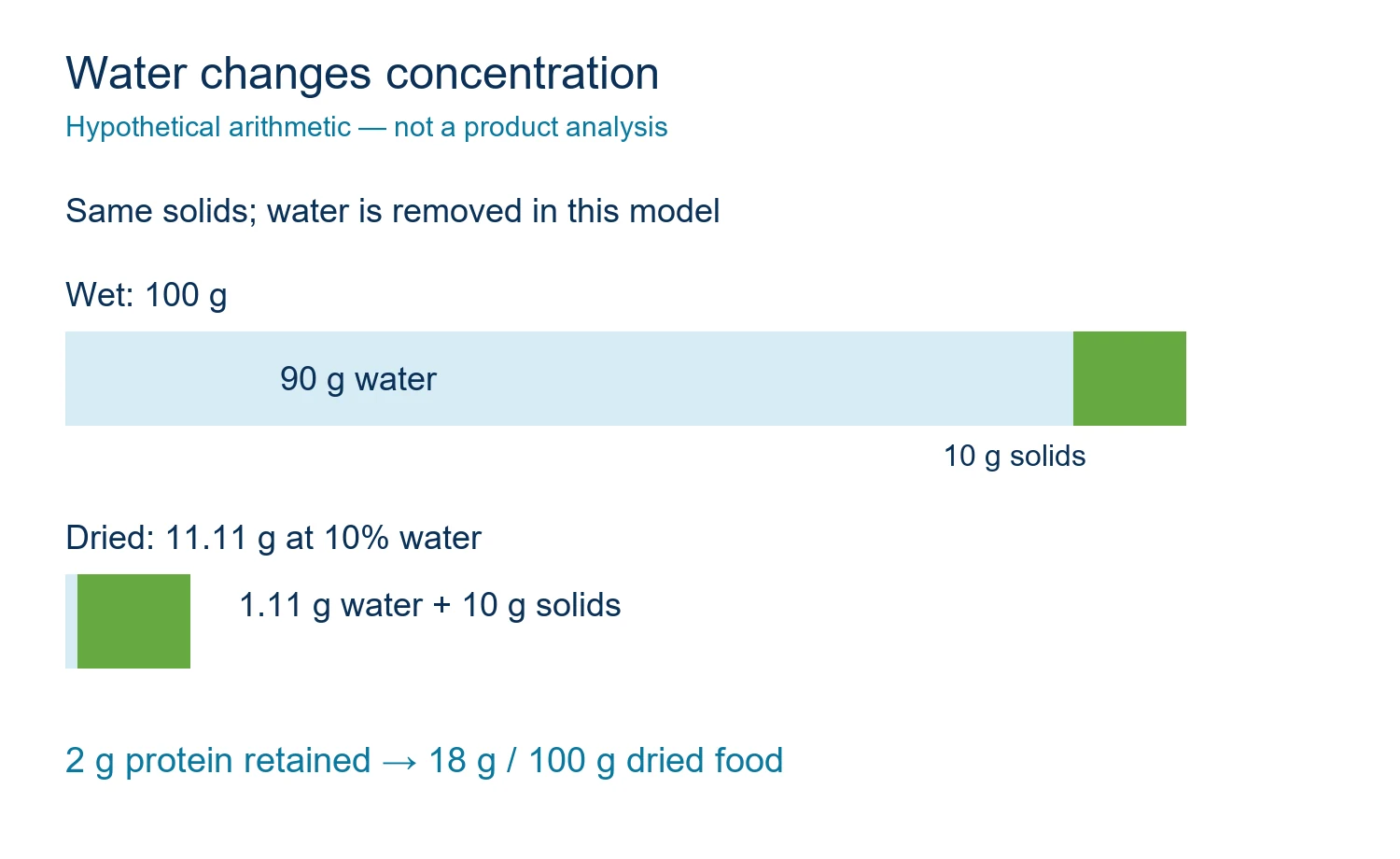
If the dried food contains 10 percent water, the retained 10 grams of solids occupy 90 percent of its final mass. Final mass is therefore 10 divided by 0.90, or about 11.11 grams. Protein quantity remains 2 grams in the model. Protein concentration is 2 divided by 11.11, multiplied by 100, or 18 grams per 100 grams of that hypothetical dried food.
On an entirely dry-solids basis, the same 2 grams of protein divided by 10 grams of dry solids gives 20 grams per 100 grams of dry solids. The two concentrated numbers differ because the 18-gram expression includes residual moisture, while the 20-gram expression does not. Both are consistent within this hypothetical example.
Working backward, a value of 20 grams per 100 grams of dry solids becomes 2 grams per 100 grams of wet food if the same wet material contains 10 percent dry solids. This is not a universal ten-to-one conversion for mushrooms. It requires the actual sample’s solids fraction, matching material and a justified assumption about what the processing changes.
A real fresh-mushroom database entry and a real dried-mushroom entry usually come from separate records, not two stages of one tracked batch. They can show how foods differ as described. They cannot, by themselves, calculate how much protein was lost from that particular fresh material during drying. Retention needs paired amounts and process evidence.
Freezing, draining and cooking create new comparison questions
Freezing itself does not justify borrowing a dried value, but the later way you prepare frozen mushrooms can change the food mass. Thawed liquid may be retained in a soup or discarded before a filling is mixed. Heating can evaporate water, while sauces or other ingredients add mass. The finished food state deserves its own description.
For a frozen ingredient calculation, establish whether the composition record describes the food as sold, thawed with all liquid, or drained. Then weigh the amount on the same basis. Taking a drained mass and multiplying it by an as-sold concentration silently changes the denominator, even when the multiplication is arithmetically correct.
Cooking yield also matters. If a portion becomes lighter as water evaporates, protein per 100 grams of cooked food can rise without protein being created. Conversely, a sauce can dilute the concentration by adding mass. A comparison of raw and cooked concentrations should therefore include the relevant yield or portion amounts when the question is nutrient retention.
Do not assume that all released liquid is nutrient-free. The scope of the food actually eaten needs to be specified. A recipe estimate can transparently state its simplifying assumptions, but a high-confidence nutrient claim needs appropriate evidence for the finished edible product. Visible water release alone does not measure protein losses.
The related frozen versus dried shiitake guide considers culinary form and preparation. Those application decisions are useful alongside nutrition arithmetic, but flavor strength and rehydrated yield do not determine protein concentration on their own.
Protein analysis is not always the same calculation
Some reported protein values are calculated from measured nitrogen using a conversion factor. The procedure estimates protein; it does not mean that every nitrogen-containing molecule is a protein molecule. Mushrooms contain non-protein nitrogen, so the chosen method and factor can materially affect a comparison.
The FAO/INFOODS food-composition checking guidance [3] includes nutrient expressions and nitrogen-to-protein conversion factors, listing a mushroom factor of 4.38. A primary oyster-mushroom study [4] also explains its use of that factor because of fungal non-protein nitrogen. Other work may use different factors or amino acid analysis.
Consider an illustrative sample with 1 gram of measured nitrogen on its stated basis. Multiplication by 6.25 gives 6.25 grams of estimated crude protein; multiplication by 4.38 gives 4.38 grams. The nitrogen measurement has not changed. The conversion method has. This example shows why two headline values can differ before species, moisture or portion is considered.
These factors are not interchangeable adjustments to apply casually to a label. Read how the original author or data source defined protein. If you recalculate a research value for a comparison, keep the original result and explicitly identify the alternative method. Do not silently alter a supplier’s declared value or present a recalculation as a new laboratory measurement.
Protein quantity also does not fully describe amino acid composition or digestibility. A dry-weight concentration should not be translated into a claim of equal nutrition to meat or another food. That comparison asks additional questions about realistic portion, the rest of the food and protein quality, which a single grams column cannot answer.
Compare the portion that reaches the plate
Per-100-gram data are useful for aligning records. Portions are useful for understanding how much a dish contains. Show both when readers might otherwise compare a large wet serving with a small dry ingredient dose. The dry food’s concentration may be higher while its chosen portion remains much smaller.
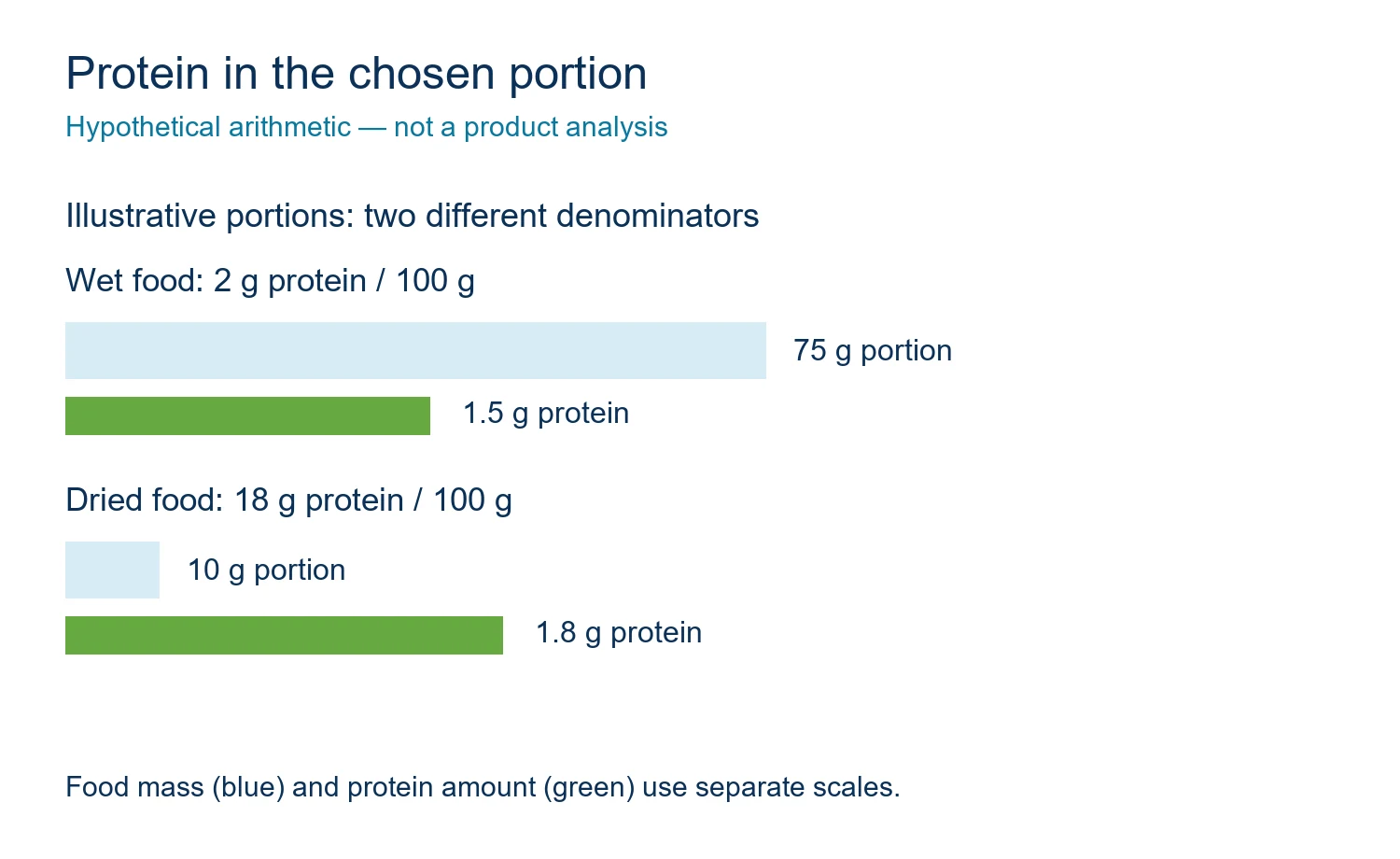
Using the hypothetical numbers from the earlier model, 75 grams of wet mushrooms at 2 grams protein per 100 grams supplies 1.5 grams of protein. Ten grams of dried mushrooms at 18 grams per 100 grams supplies 1.8 grams. These are illustrative portions, not recommended servings or measured values for an XMG product.
The portion calculation is concentration multiplied by portion mass, divided by 100. Rehydrating the hypothetical 10-gram dried portion with water would change its final food mass, but water alone would not add protein. If all material were retained under the model, the portion’s 1.8 grams of protein would be distributed through the larger rehydrated amount.
A spoonful or cup is not a fixed gram mass across forms. Loose slices, dense pieces, whole caps and dry powder fill volume differently. Use the serving weight stated with the source or weigh the actual intended portion when appropriate. A cup value without its mass can obscure an otherwise correct comparison.
A practical meal decision also includes the other ingredients. A mushroom sauce with milk, beans or another protein-containing component cannot be described from the mushroom number alone. Conversely, a larger mushroom portion should not be assumed to replace the complete nutritional contribution of another ingredient merely because it gives a savory texture.
A mixed dish needs ingredient masses and finished yield
Begin a recipe calculation with each ingredient’s edible mass on a defined basis. Multiply that mass by its matched protein value, then add the ingredient amounts. Include every protein-containing component rather than assigning the dish a mushroom-only value. Keep an audit trail of record identities so you can update the estimate when the formulation changes.
Next, establish the finished edible yield. The estimated protein per 100 grams of dish is the estimated total retained protein divided by finished dish grams, multiplied by 100. Protein per serving then uses the actual serving mass or a defined division of the batch. A recipe’s starting ingredient mass is not automatically its cooked yield.
This calculation still has evidence limits. Losses during trimming, draining or cooking may need appropriate adjustment, and a database estimate is not a finished-product assay. State that it is an estimate when that is what it is. If the value supports a declared claim, use the applicable evidence and labeling approach for the actual product and market.
For a commercial formulation, maintain the same species proportions, ingredient form and preparation method through the calculation. If one mushroom type is replaced or the draining step changes, revisit the record. A small recipe revision can alter both the protein numerator and the food-mass denominator.
Read an online number without copying its error
When a result looks unusually high, first look for the missing basis. Search for fresh weight, dry weight, dry matter, dehydrated, freeze-dried, as sold, cooked or drained. Read the table heading as well as the body sentence. A percentage may describe the dry solids even when the article opening speaks generally about mushrooms.
Then trace the number to its record or study. A repeated value across several websites is not several independent measurements. One supplier’s dried-shiitake nutrient sheet [5], for example, reports 9.58 grams protein per 100 grams for its described dried ingredient. That does not establish a paired conversion from another source’s fresh shiitake value or describe frozen shiitake.
Check whether two articles use different nitrogen factors before declaring either wrong. Also check whether a chart compared analytical dry solids with a normal serving. These are explanation problems to resolve, not reasons to average incompatible numbers. An average of mismatched forms can be less useful than either clearly described original.
Retain missing data as missing. A blank cell, an unreported component or a value below a method’s reporting limit may require different treatment. Do not rewrite every absent protein entry as zero. If the product information is incomplete, make a clearly qualified estimate using the best matching record or leave the specific value unresolved.
Build a useful nutrition record for a frozen ingredient
A compact record should preserve the ingredient identity, product code or database identifier, species or blend, cut, edible part and ingredient statement. Add the source date and whether the value describes the frozen food as sold, a prepared state or a dry-solids calculation. These details prevent the same ambiguity from returning when the number is shared.
Keep the measured or declared protein value with its unit and denominator. Where available, record the analytical method, nitrogen factor, moisture and sample scope. Then add the intended portion or recipe use as a separate calculation. A clear division between evidence and arithmetic makes the record easier to review.
For a nutrition editor, write the conclusion at the level the evidence supports: modest protein in a described wet mushroom food, a more concentrated dried ingredient, or a particular declared portion. For a food developer, connect the composition estimate with the actual recipe mass and yield. Neither task benefits from a universal mushroom number detached from its food state.
For a wet mushroom portion, use a matching wet-food value and its measured or declared serving weight. For a dried ingredient, retain its residual-moisture basis and calculate the smaller amount used. Keep those records separate so a concentrated dry-solids result cannot be mistaken for the protein in a frozen dish.
Explore the product forms behind this application.
IQF Frozen Mushrooms →