


On this page
The vitamin D content of frozen mushrooms cannot be predicted from the word frozen. The important questions are which mushroom species and form you have, whether it received ultraviolet exposure, and what food state the reported number describes. UV treatment can raise vitamin D2 in mushrooms; freezing is a separate operation and does not establish that treatment occurred.
Use the actual product’s nutrition information or an appropriately matched analysis. A UV-treated mushroom result, a dried-mushroom result and an ordinary frozen ingredient are not interchangeable. Before comparing numbers, align the nutrient unit, the fresh or dry weight basis, and the portion. No specific vitamin D content or UV treatment is established for an XMG product by the research discussed here.
A large number in a search result may be accurate for its study while answering the wrong question about your bag. Understanding the treatment and the denominator is more useful than selecting the highest mushroom value you can find.
Frozen mushrooms do not have one vitamin D value
Mushrooms are fungi, and their vitamin D content can vary. A primary analysis of retail mushroom samples [1] included ordinary species entries and UV-treated portabella as separate sample descriptions. The paper also reports earlier vitamin D2 results for that sampled material. A UV-treatment qualifier belongs to the food description; it cannot be dropped when the number is reused.

The frozen category can contain different species, whole caps, slices, pieces or blends. Products may also differ in earlier handling and processing. A statement about one cultivated white-mushroom sample therefore does not automatically describe frozen shiitake or oyster mushrooms. The visible product form is useful identification evidence, but color, cap shape and frost cannot reveal a vitamin D assay result.
There are two separate questions to answer. Does the ingredient contain vitamin D, and how much of that nutrient is present in the portion you actually use? A generic food overview may help with the first question. The second requires a matched amount and a trustworthy value for the specific food state. Keep those tasks separate when writing a menu, comparing labels or planning a recipe.
UV treatment changes a precursor into vitamin D2
Mushroom tissue contains ergosterol, a sterol that can serve as a precursor to vitamin D2. UV exposure can initiate its conversion through a previtamin stage. This is a chemical response to appropriate light exposure, rather than a nutrient being created by the freezer. Agriculture and Agri-Food Canada’s research explanation [2] describes this relationship in cultivated button mushrooms.
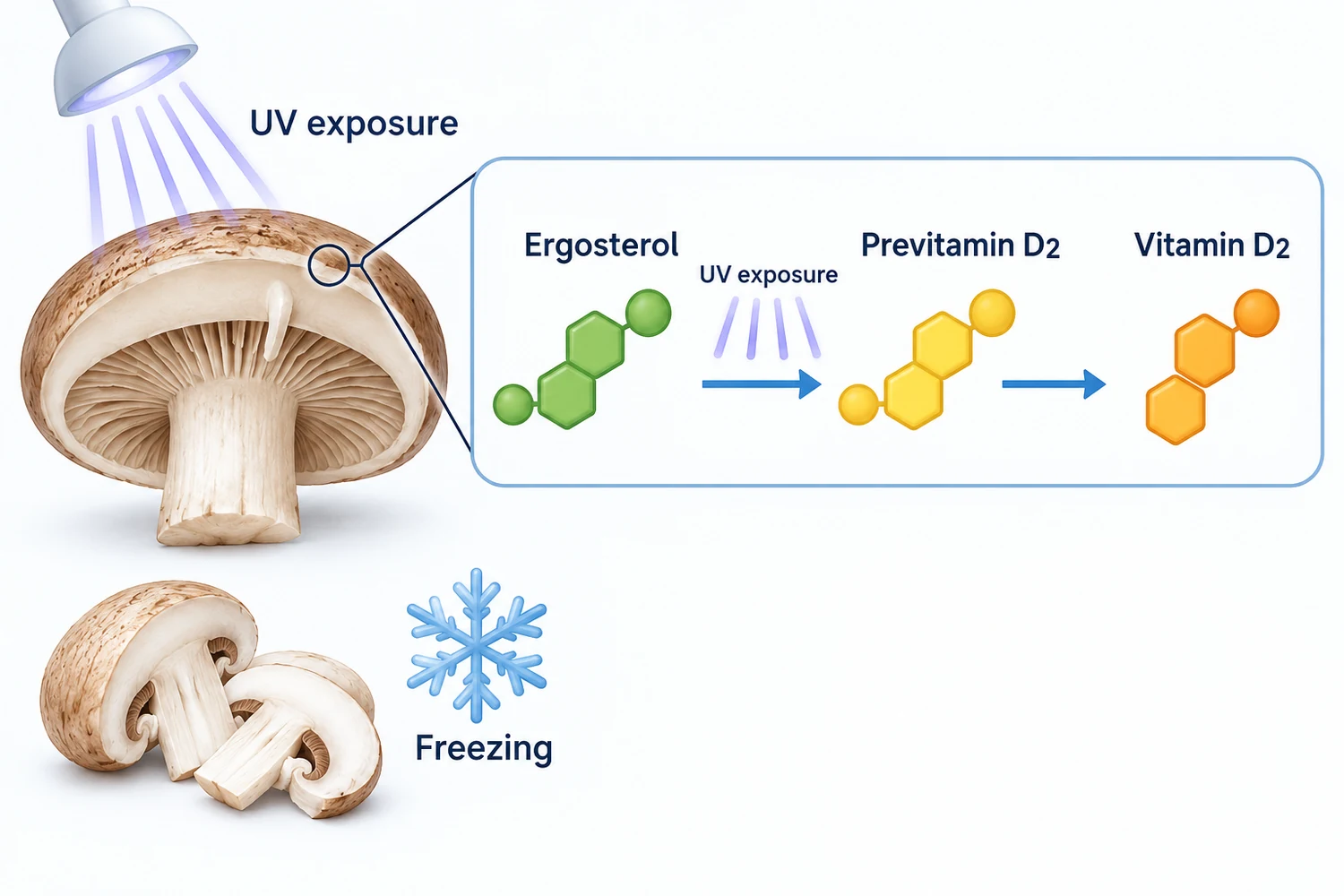
The mechanism explains why two otherwise similar-looking mushroom products can have different values. One may have been processed with a documented UV treatment, while another has no such documented exposure. The useful evidence is the processing description and resulting composition information. A marketing photograph of mushrooms in sunshine is not an analysis and does not show the exposure delivered to every piece.
Vitamin D2 is also called ergocalciferol. It should be identified correctly when reading a mushroom study. A report may give D2 specifically, whereas a nutrition label may declare vitamin D under the applicable labeling rules. Neither the name vitamin D nor the presence of a precursor tells you a portion value without the associated measurement.
The schematic describes a pathway, not a treatment recipe. Commercial exposure conditions and analytical verification need product-specific control. It does not imply that leaving any frozen mushroom bag near a window or using a household lamp gives a known vitamin D dose. Improvised exposure is not a substitute for a declared or tested food composition.
Species, cut and exposed surface matter
The identity of the mushroom remains relevant even when UV exposure is confirmed. Species, tissue, exposed surface and treatment arrangement can change the experimental outcome. Slices expose different surfaces from intact caps; cap and stem material are not necessarily equivalent samples. A pile of pieces also presents different exposed surfaces from a single arranged layer.
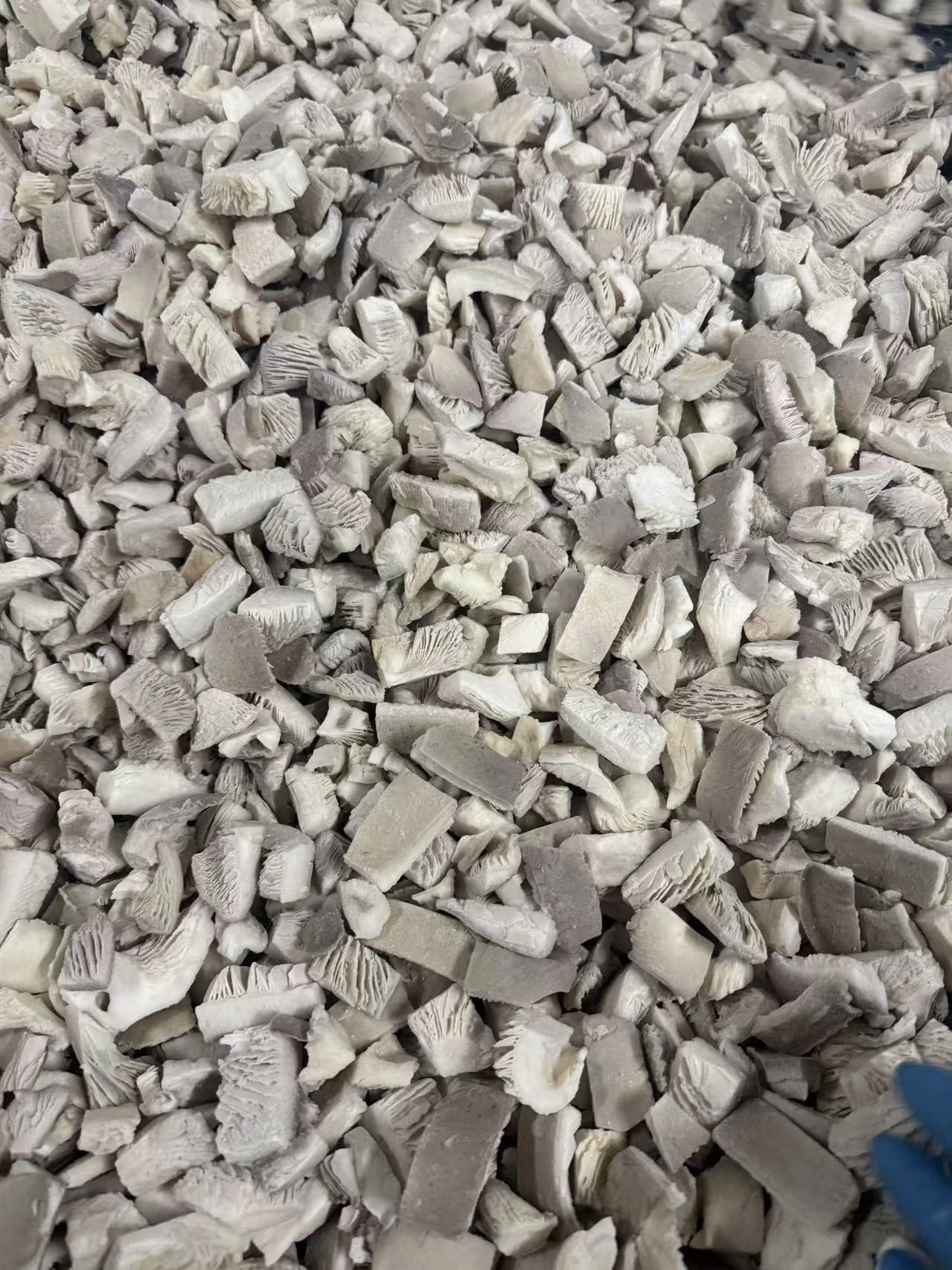
A primary study on UV treatment of white button mushrooms [3] compared irradiation from different surfaces, sliced material, treatment temperatures and distances from the light source. It also examined storage and cooking. The study supports the conclusion that treatment conditions matter. It does not establish one composition value for all sliced mushrooms or provide an XMG product specification.
A multi-species UV-B study in Thai edible mushrooms [4] considered fruiting bodies, mycelia and freeze-dried powders. Those material descriptions are part of the result. A powder value and an intact edible mushroom value answer different food-form questions, even when both appear beneath the same species name.
For a blend, check what the composition record covers. A measurement of one species cannot certify a mixture with changing proportions. Even a correctly tested blend needs a description of the included ingredients and the state of the tested sample. If that information is missing, report the uncertainty instead of selecting a convenient single-species number.
Freezing preserves a food state; it does not document UV exposure
Freezing and UV treatment answer different processing questions. A frozen product may have been UV-treated beforehand, but that sequence requires evidence. A supplier’s statement that mushrooms are individually quick frozen describes their freezing process and piece separation; it does not establish a vitamin D enrichment treatment.
Likewise, a study reporting retention after frozen storage begins with a specified sample. The result describes that sample’s starting vitamin D content and subsequent handling. It cannot establish the starting content of an unrelated bag. A retention fraction without the initial quantity leaves the amount in the food unknown.
Consider two hypothetical products with different starting amounts. If both retained the same fraction during storage, they would still finish with different amounts. The arithmetic is ordinary multiplication: final amount equals initial amount multiplied by the retained fraction. The example teaches why retention and composition are separate fields; it supplies no retention percentage for commercial mushrooms.
The frozen mushroom range helps distinguish ingredient species and forms. For nutrition work, add the actual label or composition record to that product description. Product availability, useful culinary form and verified nutrient content are related pieces of information, but none can stand in for the others.
Align the units before the portion
Vitamin D results can use micrograms, written as µg or mcg, or International Units, written as IU. They may then be expressed per gram, per 100 grams or per serving. Read both parts together. A number alone is incomplete, and a unit conversion cannot repair a mismatch between dry powder and wet food.
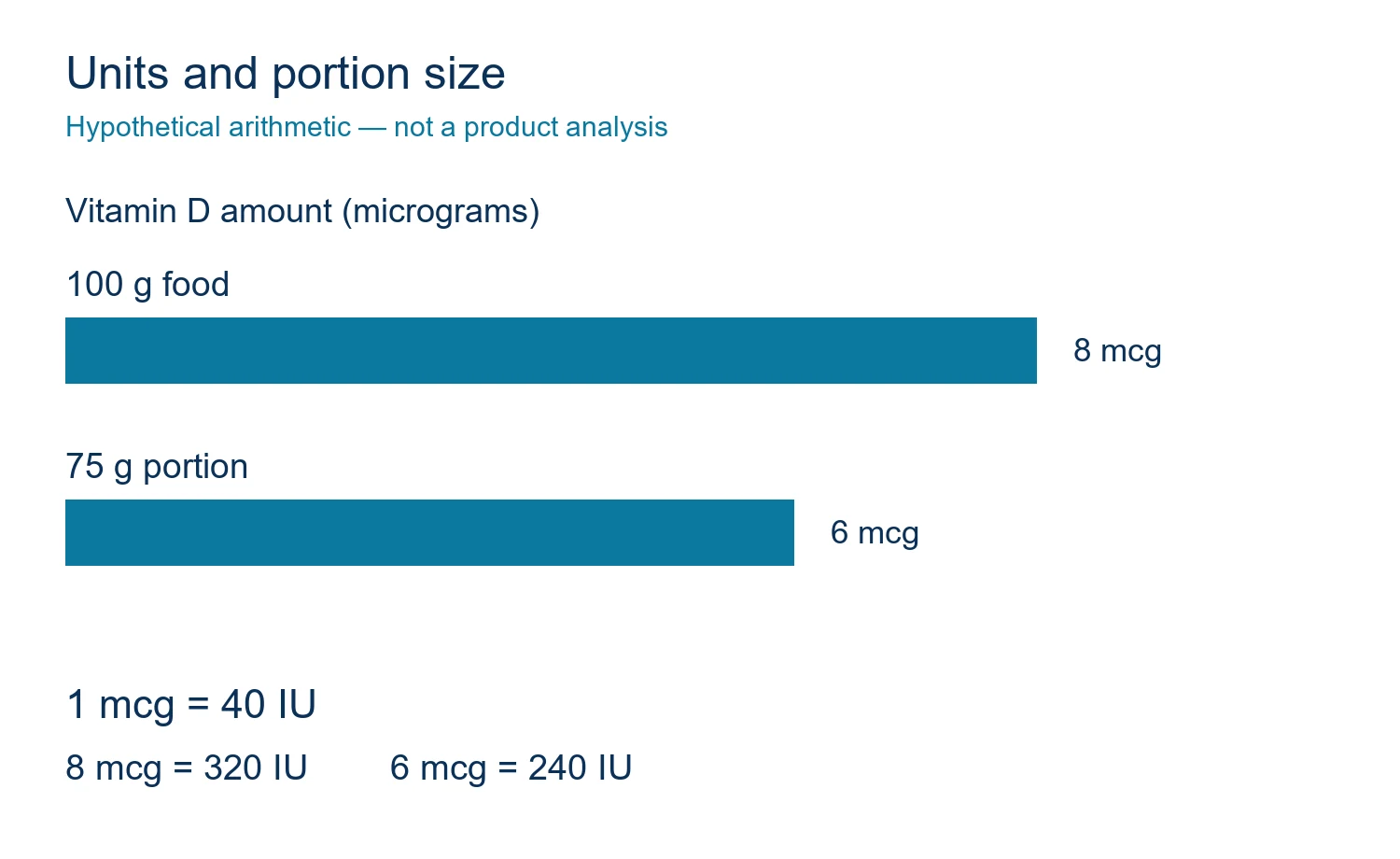
For vitamin D, one microgram corresponds to 40 IU. Here is an explicitly hypothetical food record: 8 micrograms per 100 grams of the stated product. That is 320 IU per 100 grams. If the portion is 75 grams of that same food state, it contains 6 micrograms, or 240 IU. The conversion changes the unit; the portion calculation changes the amount of food.
The working formula is nutrient amount in the portion equals the value per 100 grams multiplied by portion grams divided by 100. Keep the food state unchanged during this step. If the record describes a frozen ingredient weighed as sold, weighing the cooked drained portion and using that weight directly may introduce a new basis.
Pay particular attention to micrograms per gram. A result of 1 microgram per gram is 100 micrograms per 100 grams, not 1 microgram per 100 grams. A lost denominator can create a hundredfold error without any change in the underlying study. Copy the complete unit into your working notes before rounding or writing the final sentence.
Use sensible precision. A hypothetical calculation can be exact for teaching, but a real analytical or label value may have variability and rounding. Adding extra decimal places does not make the food more precisely known. Preserve the declared basis and present only the precision the evidence supports.
Fresh weight and dry solids are different denominators
A dry-solids basis removes water from the denominator mathematically. It does not mean that a 100-gram portion of ordinary frozen mushrooms contains 100 grams of dry material. This distinction is essential when reading concentrated study results or comparing a powder with a wet ingredient.
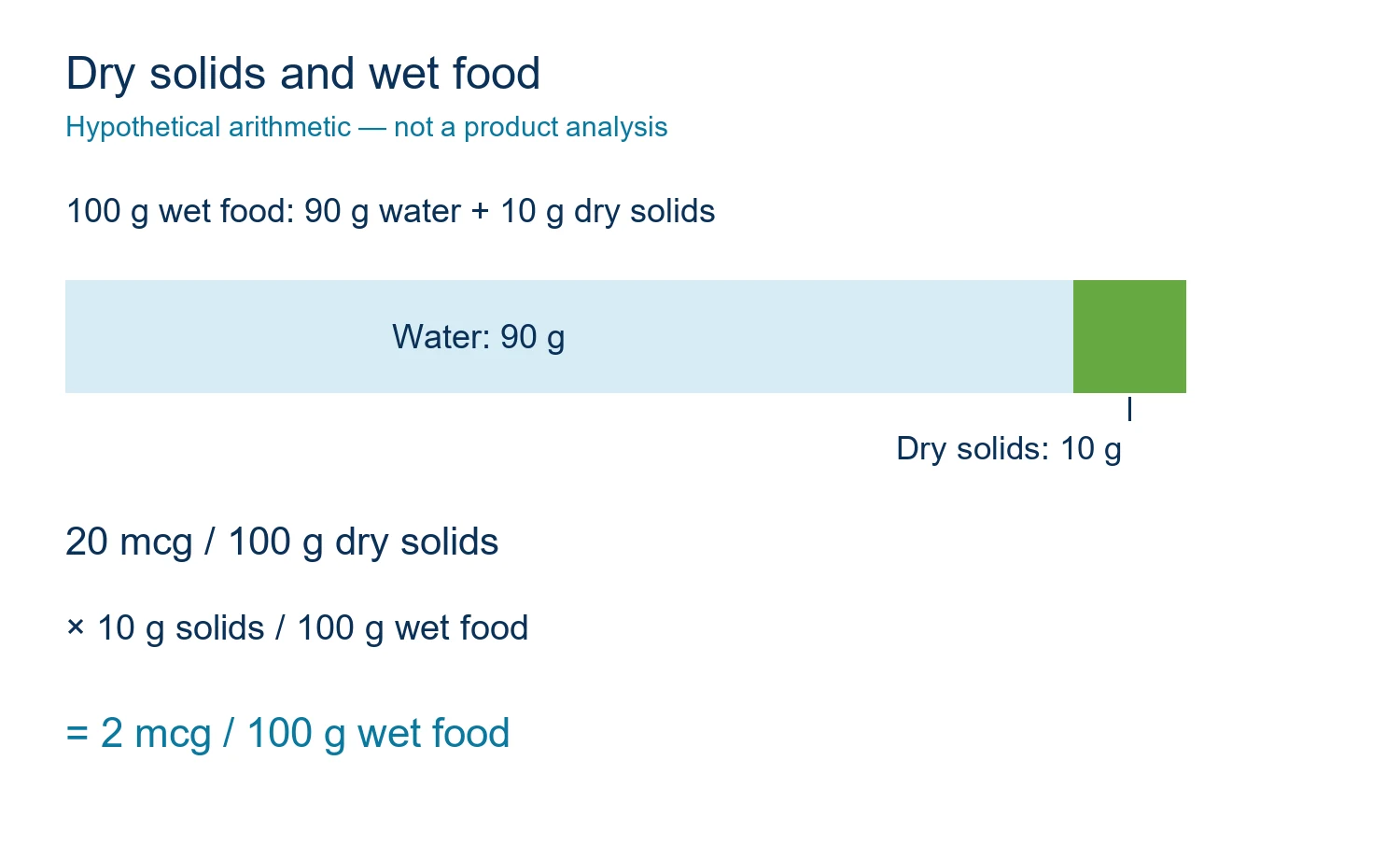
Suppose a hypothetical result is 20 micrograms per 100 grams of dry solids, and the food contains 10 grams of dry solids in each 100 grams of wet food. The wet-food result would be 2 micrograms per 100 grams, provided both values refer to the same sample and the conversion introduces no additional nutrient change. That is 80 IU per 100 grams of wet food.
This example assumes a measured solids fraction and matching material. You cannot perform it responsibly by borrowing the moisture percentage from another species or assuming every mushroom is exactly the same percentage water. A commercially dried ingredient also retains some moisture; its as-sold weight is not necessarily identical to an analytical dry-solids denominator.
A primary postharvest UV-B study [5] reports vitamin D2 on a dry-solids basis and examines storage behavior. That wording must travel with any numerical quotation from the study. Converting it to a frozen-portion claim would require the relevant moisture and product conditions, rather than a guess based on a familiar food name.
Keep two columns in a comparison sheet: the source’s original expression and any carefully calculated expression. The original makes the conversion auditable. The calculated column should state its assumptions. If the solids fraction is unavailable, leave the wet-food conversion unresolved; a missing input is preferable to a precise-looking error.
Cooking and storage evidence need a matched product
Storage and cooking can change both nutrient amount and food mass. These are separate effects. A cooked sample may contain less water, so its concentration per 100 grams can change even if its total vitamin D amount moves in another direction. A larger concentration is not automatically proof that cooking created more vitamin D.
Read a retention study for its starting material, exposure treatment, storage temperature, duration and analytical basis. Then read the cooking method and whether liquids or other fractions were included. A result for the tested preparation should be described with those conditions close to the claim. Freezing, refrigerating and cooking are not interchangeable study stages.
For a recipe, the relevant question is the nutrient amount in the part actually eaten. A whole cooked dish, drained mushrooms and mushrooms plus retained sauce have different denominators. If the cooking changes yield, weigh or otherwise document the finished edible amount before calculating concentration. Do not infer vitamin D recovery from a photograph of a smaller cooked portion.
A manufacturer developing a declared nutrient value needs evidence appropriate to the finished product and intended claim. A general research paper can guide which variables to investigate. It cannot replace the necessary composition and labeling work for a product made with a different species, blend or process.
Read a label, a database entry and a laboratory report differently
A label is useful because it identifies a marketed food and its declared serving. Check the ingredients and whether the stated value is as sold or as prepared. Follow preparation instructions where required. If UV exposure is part of the product description, retain that qualifier when comparing it with another product.
A database record supplies a food description and nutrient data for that record. The USDA FoodData Central documentation [6] distinguishes data types and supporting information. A general record may be useful for estimation, but a similarly named food is not a batch certificate for your ingredient. Save the record identity rather than copying a search snippet alone.
A laboratory report needs its own reading discipline. Identify the sample, collection and testing dates, preparation state, analytical method, nutrient measured, unit and reporting limit. Confirm whether it reports vitamin D2, another defined component or a calculated total. A result below a reporting limit is not necessarily an exact zero, and a blank database cell should not be silently converted into zero.
If the report describes a selected enriched sample, do not extend it to an entire product line. If it describes a composite, understand what was combined. The scope of the sample is part of the evidence, especially where treatment uniformity or blended species could influence the final composition.
Use vitamin D information without turning it into a health promise
A nutrient-composition result does not turn any mushroom portion into a treatment. The presence of a nutrient in a food, the amount eaten and a person’s health needs are different questions.
A vitamin D number cannot show that a mushroom dish will prevent disease, correct a deficiency or replace an individually recommended supplement. Those conclusions require clinical context beyond food composition. Avoid using a high experimental value to imply a guaranteed health outcome from an ordinary frozen ingredient.
For everyday food comparison, the useful action is concrete: identify the product, read the declared amount, align the serving and include the rest of the meal. A food can be valuable for flavor, convenience and variety even when its vitamin D value is unknown or modest. There is no need to invent a nutrient advantage to explain its culinary role.
For an editor, wording should reflect the evidence level. Mushrooms can contain vitamin D2 is a general statement. This product declares a particular amount per serving is a product-specific statement. This UV-treated research sample had a particular result is a study statement. Keep those sentences distinct rather than allowing one to stand in for another.
A practical evidence check for a frozen mushroom product
Start by recording the exact species or blend and the edible form. Add the product name or code and ingredient statement. Establish whether UV treatment is confirmed, absent from the available description or simply unknown. Unknown is a valid evidence status; it should not be rewritten as untreated or enriched.
Next, select the composition evidence that actually matches the intended food. Record the nutrient unit and denominator, then calculate the planned portion without changing food state mid-calculation. If the dish will be cooked or drained, describe how the ingredient value is being used and what yield information is available.
Finally, check what the information can support. A general meal estimate, a comparison article and a regulated product claim may need different levels of evidence. A sourced estimate should be identified as an estimate. A product claim should be evaluated under the rules that apply to its market and the evidence supporting that actual product.
Consider a practical example with three documents. The bag identifies plain frozen oyster pieces, an online chart describes UV-exposed white mushrooms, and a research paper reports vitamin D2 per gram of dried solids. All three may be internally accurate. None of the latter two automatically supplies the bag’s portion value. The first missing link is food identity and treatment, before any multiplication is attempted.
If a matching report later identifies the oyster ingredient as sampled frozen, gives a vitamin D2 value per 100 grams as sold and states the analytical scope, the comparison can move forward. Calculate the amount used from the as-sold mass. If the dish uses drained mushrooms, retain that preparation difference in the estimate rather than pretending the original report measured the drained food.
For an editorial table, an unresolved entry can state that the actual product value was not available. That communicates more than a blank or an invented zero. Separate an illustrative calculation into its own row, label it as hypothetical and keep it away from any product name. Readers can then learn the arithmetic without mistaking it for a nutrition specification.
The same discipline applies to a supplier conversation. A request for species, treatment confirmation, food state, unit and sample scope is concrete. A request for mushrooms rich in vitamin D is too vague to establish whether the offered ingredient meets the intended use. Resolve those fields before discussing a label claim or comparing quoted nutrient numbers.
A matching label or analysis lets you calculate vitamin D in the frozen amount used. Keep the species, treatment and food state beside that value when sharing it. Where those fields are missing, leave the specific portion value unresolved until suitable evidence is available.
Explore the product forms behind this application.
IQF Frozen Mushrooms →References
- Phillips et al.: Vitamin D4 in mushrooms and matched retail-sample descriptions↑
- Agriculture and Agri-Food Canada: UV-C light increases vitamin D in mushrooms↑
- Primary study: UV treatment and vitamin D stability in white button mushrooms↑
- Primary study: UV-B treatment across Thai edible mushroom materials↑
- Primary study: postharvest UV-B treatment and dry-solids vitamin D2 results↑
- USDA FoodData Central: Data documentation↑
