


On this page
Frozen produce and fresh produce should not inherit the same reefer ventilation instruction. For ordinary frozen cargo, the carrier guidance reviewed here calls for the fresh-air vent to be closed. Fresh produce may require a commodity-specific air-exchange instruction because it continues to respire. Neither statement means that internal refrigerated air circulation can be ignored.
The decisive distinction is between exchanging air with the outside and circulating conditioned air within the container. Confirm the cargo’s actual state, the agreed fresh-air setting and its units, the equipment context, and who will check the setting at the handoff. Keep temperature, humidity and any controlled-atmosphere requirements in their own fields rather than using “ventilation” as a catch-all instruction.
We coordinate the product, packing and shipment requirements for frozen fruit, vegetable and mushroom orders. Before loading, we would ask the buyer and responsible logistics parties to close any conflicting fresh-air instruction. A copied setting from a previous fresh-fruit booking should not reach a frozen-product shipment just because the commodity name is similar.
Frozen and fresh describe different cargo conditions
Write the product’s transport state explicitly. “Mango” could describe fresh fruit or frozen cheeks, slices or dice. “Berries” could refer to freshly harvested fruit, frozen whole fruit or a processed ingredient. The commodity name alone does not establish the carrying condition. Keep the offered form, packing and required frozen condition together in the order and booking brief.

The visible form is frozen mango cheeks. The specified product and carriage brief determine the shipment requirements.
Freshly harvested produce remains biologically active. CMA CGM’s reefer brochure [1] describes oxygen use and the release of carbon dioxide, water and other gases during produce respiration. That explains the purpose of a fresh-produce atmosphere instruction. It does not supply one suitable ventilation rate for every fruit, maturity, pack or voyage.
A frozen-food order has a different carriage brief. Hapag-Lloyd’s frozen-cargo checklist [2] calls for fresh-air ventilation to be closed and treats loading and product readiness as additional checks. Read those instructions within the carrier’s cargo context. Confirm the actual shipment instruction with the contracted carrier rather than deriving a new setting from the product photograph.
Do not plan mixed fresh and frozen cargo merely by choosing a compromise ventilation position. The required product conditions and operational compatibility need a separate assessment. An unsupported middle setting does not solve an incompatible temperature or handling requirement. Keep such a proposal open until the responsible parties establish an accepted carriage arrangement.
Separate fresh-air exchange from internal circulation
The fresh-air vent concerns exchange between container atmosphere and outside air. Internal circulation concerns movement of conditioned air through the reefer’s designed air path. A closed external vent can coexist with active internal circulation. The cargo still needs a loading arrangement that allows the refrigeration system to work as intended.

The diagram scrolls horizontally on smaller screens.
Schematic air-path comparison, not a loading design: fresh-air exchange and internal circulation are different functions. Confirm the actual equipment and commodity instruction.
Use these terms consistently in emails and instructions. “No ventilation” can be misunderstood by a person who uses the word for fan operation, air passage through cartons or external air exchange. Write the intended field as “fresh-air exchange” and record the confirmed setting. Use a different field for circulation or loading requirements. Specific language reduces a preventable handoff ambiguity.
The conceptual comparison shows the two air paths separately. It does not reproduce a particular controller or prescribe a carton layout. The external flap and internal loop represent different functions; the responsible carrier and loading operator supply the equipment-specific instructions. Use the diagram to frame the question, then keep the actual approved answer with the booking.
A temperature logger cannot by itself settle which path was configured. An air trace may help investigate operation, but a value recorded at one point is not a vent-position record. Conversely, a photograph showing a closed vent does not establish product temperature or complete circulation through the load. Request the evidence for the question being asked.
Read the setting with its unit and equipment context
When an air-exchange value is required, retain its unit and meaning. A volume-per-hour value, an opening percentage and a mechanical flap position are not interchangeable descriptions unless the responsible equipment party provides the relevant interpretation. A setting copied without its unit is incomplete even if its number looks familiar.

The diagram scrolls horizontally on smaller screens.
Conceptual equipment view distinguishes external air exchange from internal circulation; it does not reproduce a specific reefer controller or loading plan.
Hapag-Lloyd’s transport checklist [2] identifies fresh-air requirements in cubic metres per hour and distinguishes frozen closed-vent carriage from chilled carriage as required. Its brochure is a useful terminology reference; the confirmed instruction for the contracted equipment and commodity remains the working instruction.
Ask how the relevant value is entered, displayed or checked on the allocated equipment. A manual flap and an automatically managed system may produce different kinds of records. Keep the original setting field name rather than translating all of them into an unqualified percentage. If the booking system and operating instruction express the setting differently, have the responsible operator reconcile them.
Controlled atmosphere is another separate question. Carrier’s XtendFRESH description [3] identifies equipment-specific gas management and automatic fresh-air functions. That is an example of a specialized system, not a reason to request controlled-atmosphere settings for a normal frozen-produce order. Confirm whether such an option is relevant and contracted before including it in the brief.
Also keep humidity, drainage, fan or operating mode instructions distinct where they are required. Do not infer one from another. The article’s closed fresh-air discussion is not an instruction for a buyer to change machinery controls or drain arrangements. The authorized operator should resolve and implement the complete equipment instruction.
Confirm one instruction across the booking and handoff
Place the accepted cargo state and fresh-air field in a versioned shipment brief. Connect it to the product order and booking, then to the allocated container when known. Record who provided the instruction and who will verify implementation. A familiar commodity template should be a starting point for review, not an unexamined operational instruction.
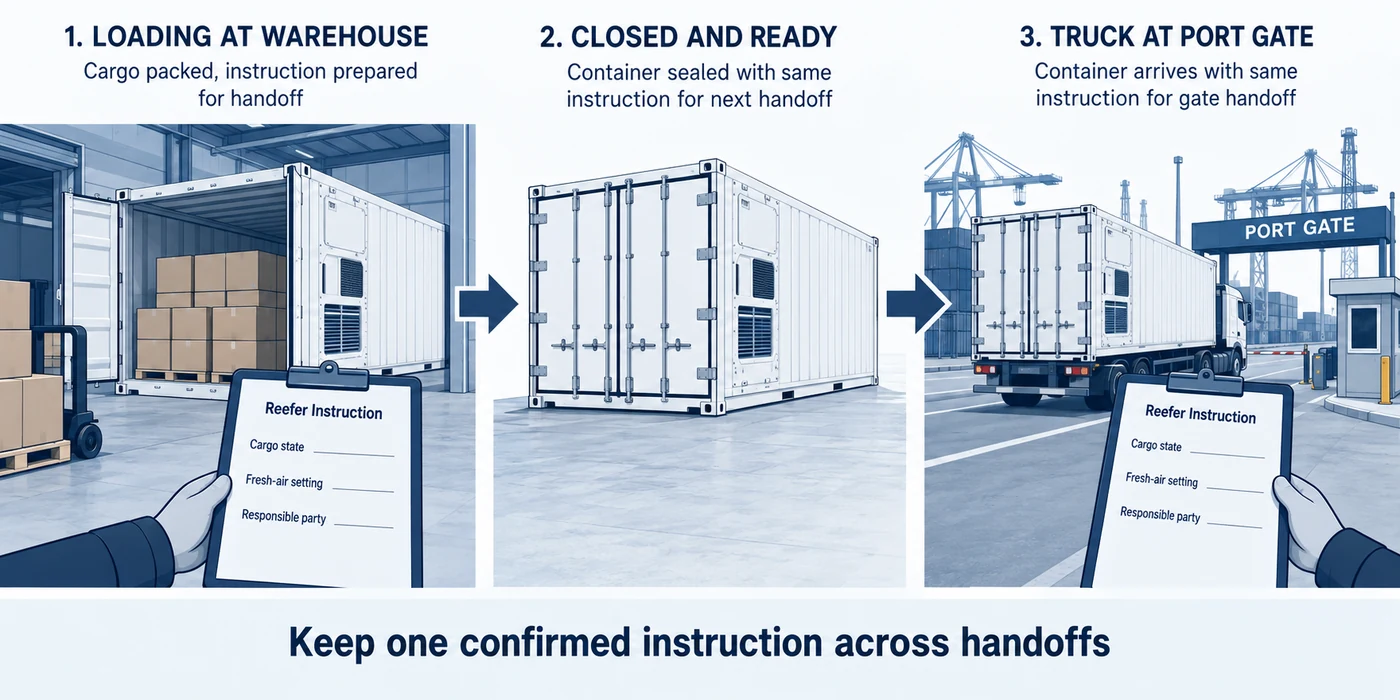
The diagram scrolls horizontally on smaller screens.
Conceptual handoff sequence. The blank cargo-state, fresh-air and responsibility fields illustrate information to keep aligned, not a real shipment record.
Compare the same fields at booking confirmation, equipment release, loading completion and transport handoff where those records are available. The purpose is to detect a contradiction early enough for the responsible party to act. It is not necessary to create several conflicting copies of the complete procedure; one confirmed instruction can be referenced by each handoff record.
For example, a product order may clearly say frozen mango dice, while a reused booking note includes a fresh-fruit exchange value. Neither purchasing nor the loading team should choose between them by habit. Return the inconsistency to the party responsible for the carriage instruction, document its resolution and update every active version before dispatch.
If the equipment changes, establish whether the instruction remains applicable and how it will be checked on the replacement. Link any new confirmation to the replacement container number. Keeping the original box’s setting photograph alongside the new allocation without explanation creates an attractive record that answers the wrong equipment question.
Set a practical owner for document revisions. The buyer may define product requirements while the forwarder transmits the carrier’s approved operating instruction. The loading party implements its agreed checks. State who closes a discrepancy between those records so it does not remain in an email thread while the container moves.
Keep loading, circulation and product readiness aligned
A correct fresh-air field is one part of a frozen shipment plan. The product must be presented in its required condition, the pack must be suitable, and the load must respect the equipment’s usable envelope and circulation requirements. Closing the external vent cannot compensate for cargo that was not ready for its agreed carriage.

Whole strawberries are a frozen ingredient example. Product condition and loading requirements need their own records.
Hapag-Lloyd’s cargo-loading checklist [2] treats product readiness, loading clearances, circulation and completion settings as separate checks. Preserve that separation in the buyer brief: record the evidence needed for each instead of asking for a broad statement that the reefer was “set correctly.”
Whole strawberries and mango pieces illustrate why product form also belongs in the discussion. Their visible identity does not prove a transport set point, eating route or pack performance. The confirmed specification supplies those requirements. A product photo can help prevent a commodity-name mismatch; it cannot replace the required frozen condition or equipment instruction.
Ask the loading party to review carton or pallet arrangement against the carrier’s requirements, including the indicated load line and relevant air passages. If a quantity or pack change alters the arrangement, review the loading plan again. A container that can carry the mass may still need a different stowage solution to protect circulation.
Keep product-temperature evidence and machinery settings separately identified. The set point is an instruction; product measurements concern material at stated locations and times. Our guide to reefer air and product temperature explains how those records should be interpreted when a shipment condition is questioned.
Use a comparison without inventing a fresh-produce rate
A useful comparison begins with the cargo condition and the function of the field. It should not present a frozen and fresh commodity table filled with generic numbers. Such a table looks complete while hiding the variables that determine the actual fresh-produce instruction: commodity, maturity, packing, equipment option and carriage arrangement.
| Decision field | Frozen-produce brief | Fresh-produce brief |
|---|---|---|
| Cargo identity | Named frozen product, form and pack | Named fresh commodity and relevant condition |
| Fresh-air exchange | Carrier-confirmed closed setting for the ordinary frozen route | Commodity and equipment-specific confirmation |
| Internal circulation | Maintain the required refrigeration air path | Maintain the applicable circulation and packing arrangement |
| Special atmosphere option | Do not assume it is needed from the commodity name | Identify the contracted system and operating instruction if relevant |
| Handoff evidence | Match instruction, container and implementation record | Match instruction, container and implementation record |
Consider a hypothetical purchasing comparison for mango. One enquiry concerns fresh fruit; another concerns frozen dice in lined cartons. Keep the commercial fruit name in both rows, but start a separate carriage brief for each. The fresh-fruit instruction should come from the relevant technical and carrier review. The frozen route should carry its own confirmed closed-vent instruction and frozen-product requirements.
The purpose of this comparison is to show which questions change, not to declare one form easier or universally safer to transport. A frozen shipment still depends on product readiness, packing, power continuity, loading and receiving arrangements. A fresh shipment has additional physiological and atmosphere questions. Each needs the complete plan for its actual route.
If the receiver asks for a fresh-air value based on previous produce shipments, clarify whether the request concerns outside exchange, internal circulation or carton ventilation. Those are different answers. Resolve the terminology before requesting a numerical setting. Otherwise a diligent operator can implement a precisely written answer to a question the buyer did not intend.
A useful receiving enquiry can therefore be rewritten as three separate questions. First, what external fresh-air instruction applies to this named frozen product and equipment? Second, what loading arrangement keeps the required internal circulation path available? Third, what record will identify the implemented setting at the agreed handoff? Each question can reach the party able to answer it, and each answer can be checked against the same container reference.
Keep a rejected template in the revision history with a clear superseded status. That helps a later reviewer explain why the booking changed without leaving two competing instructions in use. If the fresh-fruit template included a humidity or atmosphere field, review that field separately as well. Correcting the fresh-air value should not leave another unrelated requirement attached to the frozen shipment.
Handle an unclear or changed setting through the responsible operator
When the setting is unreadable, missing or inconsistent, preserve the available record and identify the container and stage concerned. Ask the responsible carrier, forwarder or equipment operator for confirmation. Do not instruct a driver or warehouse employee to alter a control using a generic internet example. The setting must be reconciled with the actual cargo and equipment.
Separate a document discrepancy from an observed equipment discrepancy. A booking note may contain an old value while the equipment was configured correctly; alternatively, a correct booking may not have been implemented. The investigation needs evidence of both the instruction and the actual state. A repaired email alone does not demonstrate what happened during transport.
For an authorized change, record the old and new instruction, reason, authority, time basis and equipment identity. Establish which parties must receive the updated information and whether the change creates a product-assessment question. A setting adjustment and acceptance of the food are different decisions. Preserve that distinction when discussing a claim or receiving release.
Do not diagnose a whole shipment from a vent photograph or one temperature excursion. Combine equipment records, operational events, product observations and the relevant technical assessment. An unexplained interval should stay visible in the review. The aim is to identify what the evidence supports and the action required, rather than inventing a confident explanation for missing data.
Ask for the evidence the setting question needs
Define the requested evidence before loading. For a manual vent, the responsible operator may confirm position through an identified inspection or photograph. An automatic system may offer a different setting or event record. Ask what is available and how it identifies the container, time and field. Do not require a record that the contracted equipment cannot provide without first arranging another appropriate method.
A useful photograph includes enough context to identify the relevant equipment and setting, with the accompanying record supplying container and time information. A close crop of a flap alone can be difficult to interpret later. Preserve the original file and explanation rather than editing it into a neat graphic that removes the information needed for a review.
Keep initial checks, any recorded changes and the final handoff confirmation in one shipment file. Identify whether the evidence covers only loading or also later stages. A correct pre-dispatch setting is useful evidence at that time; it is not a claim that nobody changed it during the journey. Request later records only where they answer a defined question.
Equipment readiness has its own evidence. Our reefer pre-trip inspection guide explains how to match a readiness record to the allocated box. A completed PTI should be read alongside the operating instruction and loading handoff, rather than treated as proof that every shipment setting was subsequently correct.
At receiving, compare the available evidence with the confirmed brief before deciding whether further assessment is needed. If the question is product condition, use the applicable receiving and food-quality procedures. If it is whether the instruction was implemented, request the equipment or handoff record. Keeping those questions distinct helps the responsible reviewer select a useful next step.
How we coordinate the frozen-shipment brief
We coordinate the supplied product and packing requirements with the responsible facility and logistics parties. That helps keep the named frozen ingredient, carton or pallet arrangement and buyer’s carriage requirements in one order discussion. Our packing information helps define the proposed format before the loading plan is agreed.
For cold-chain and loading requirements, we collect the buyer’s instructions and follow the agreed handoff information. The carrier or authorized equipment operator confirms and implements its operational settings. We help close contradictory product or shipment information before it is carried forward into the next stage.
Send the frozen-product and carriage brief
For a frozen fruit, vegetable or mushroom order, send the product and form, pack, quantity, destination and any carrier instruction already received. Identify an unclear fresh-air field with its original wording and unit. We will review the supply brief and coordinate the product, packing and handoff questions with the responsible parties.
References
Carrier guidance is used within its cargo and equipment scope. Confirm the operating requirements with the contracted carrier for the shipment being arranged.
