


On this page
A Halal requirement for frozen produce should be checked against the target market, the complete product inputs and the actual processing and packing route. A photograph of plain strawberries or vegetables cannot establish those conditions. Nor does a certificate for one facility automatically answer whether the ordered product, a later repacking operation and the intended label are covered.
Start by identifying which authority or customer accepts the certification, then connect that acceptance to the named product and route. Request the complete input list, including any relevant processing aids, and identify where the food is processed, blended, packed or repacked. Close the documentary questions before approving a Halal claim on the final pack. We coordinate this as a product-specific supply question: what evidence is needed for this order, which source can provide it, and which destination decision remains with your importer or certifier.
Start with the destination and intended claim
“Halal required” can mean several things in a buying brief. A retailer may require a certificate accepted by its assurance programme. An importer may need a destination-specific foreign-certificate process. A food manufacturer may need an ingredient acceptable within its own certified operation. A retail brand may also want permission to display a particular certification mark. Name the intended requirement rather than treating those decisions as interchangeable.
For Singapore, MUIS describes its recognition of foreign Halal certification bodies [1] for products manufactured overseas. The current recognition status matters. A certifier recognised for a previous purchase or another destination is not sufficient evidence of present acceptance for a new route. Save the relevant recognition check with the order review, including the body name, applicable scope and date of verification.
Indonesia provides a different procedural example. The official English version of BPJPH Decree 221 of 2025 [2] describes registration of foreign certificates issued through recognised cooperation before the products circulate in Indonesia. It assigns the application to an importer or official representative. Establish the current procedure with that responsible party; recognition of the overseas body and registration of the certificate are separate questions.
These examples do not create a worldwide rule for all frozen produce. Write the country, intended channel, requirement and decision owner on the brief. If no on-pack mark is planned, record that too. A requirement for supporting documents should not silently turn into permission to print a logo, and logo permission should not be assumed from a supplier’s general certification statement.
Describe the complete product and input list
Identify the exact product, form and composition before requesting evidence. Whole frozen strawberries, diced strawberries, a sweetened fruit preparation and a fruit blend are different approval subjects. Likewise, a plain vegetable and a seasoned vegetable mix need different input reviews. Record the ingredients and any additions rather than relying on the main fruit or vegetable named on the sales sheet.
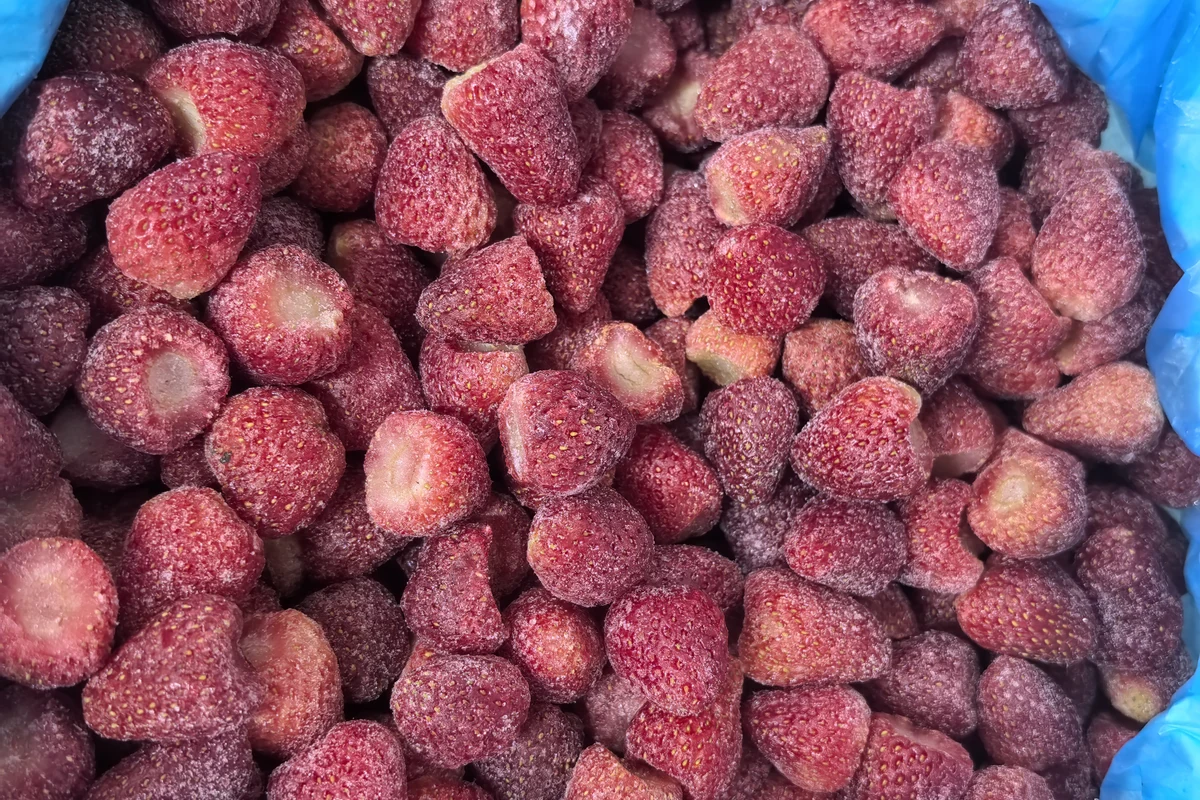
Whole strawberries show a visible product form; composition and certification scope require identified documents.
A visible single-product form is a useful starting point for communication. It does not reveal the complete formulation or processing history. Ask for a current specification tied to the proposed item and source. Compare its product name and form with the purchase description and certificate schedule. Resolve any different names through an identifiable product reference rather than assuming that similar wording means the same item.
For blended or prepared products, request the component details needed by the applicable certifier. A generic description such as “flavour” may not identify its origin or carrier. ISA’s ingredient-review explanation [3] discusses origins, subingredients and processing aids, followed by the process route. The practical consequence is to ask a supplier of an added component for the relevant documentation, not to declare every vaguely named component unacceptable.
Keep food-label ingredients and the technical input review connected but distinct. The information needed to assess an aid or component can go beyond the finished pack’s ingredient wording. Give the assessor the full relevant information through the appropriate technical channel. A brief that contains only the artwork ingredient line may leave unanswered questions even when that line is correct for labeling.
Trace processing aids through the actual route
Ask the applicable source which aids, if any, are used and where. Do not build a list of assumed chemicals from a generic freezing diagram. A plain IQF product may have a straightforward route, while another product or operation uses a different input or treatment. The useful record describes the actual proposed process rather than every process that could exist in the industry.

Strawberry pieces establish a visible cut. They do not disclose the inputs used during processing.
For each relevant aid, connect its identity to its function, source and point of use. The assessor may need a supplier specification, composition or origin information and supporting certification. If a compound input has a carrier or subingredient, identify the information source for that detail. An operator’s statement that the aid is “food grade” answers a different question from its acceptance under the applicable Halal scheme.
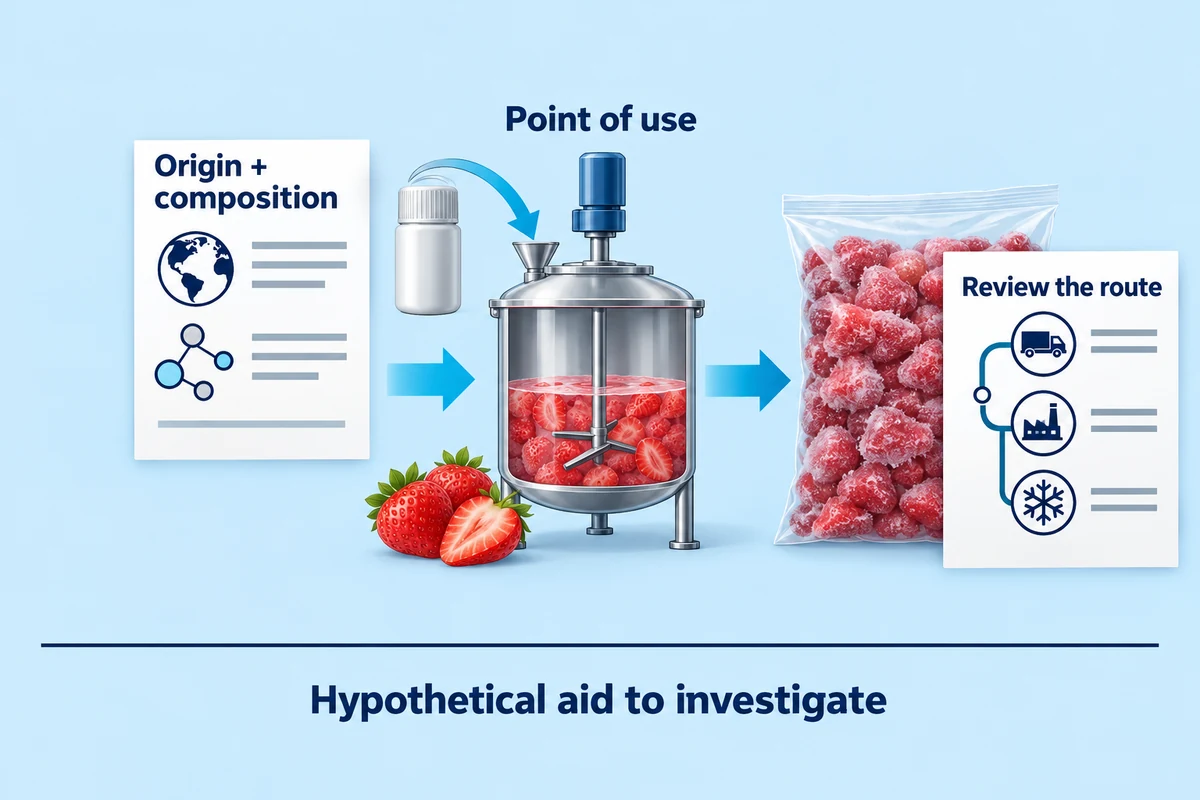
The diagram scrolls horizontally on smaller screens.
Hypothetical aid to investigate; the diagram does not assert that this input is used or approved for strawberries.
Some evidence can be confidential. Record who will provide it directly to the certifier and how the reviewed input will remain linked to the product. Confidentiality need not become an unexplained blank in the purchasing record: the order can identify the input, document reference and responsible technical contact while detailed composition is handled through an agreed channel.
If the source confirms that no relevant aid is used, tie that confirmation to the identified product and process revision. Do not expand it to every product at the location or every future order. If the route changes, reopen the affected input question. A current, specific confirmation is more useful than a long questionnaire filled with guesses about an unspecified facility.
Include blending, repacking and final storage
Follow the food beyond the freezing stage. Identify where bulk bags are filled, whether the product is later blended, and whether a different location repacks it into retail units. Describe transfers, storage and handling relevant to the final supplied product. The route should reach the pack that the customer actually purchases, rather than end at an earlier bulk product.
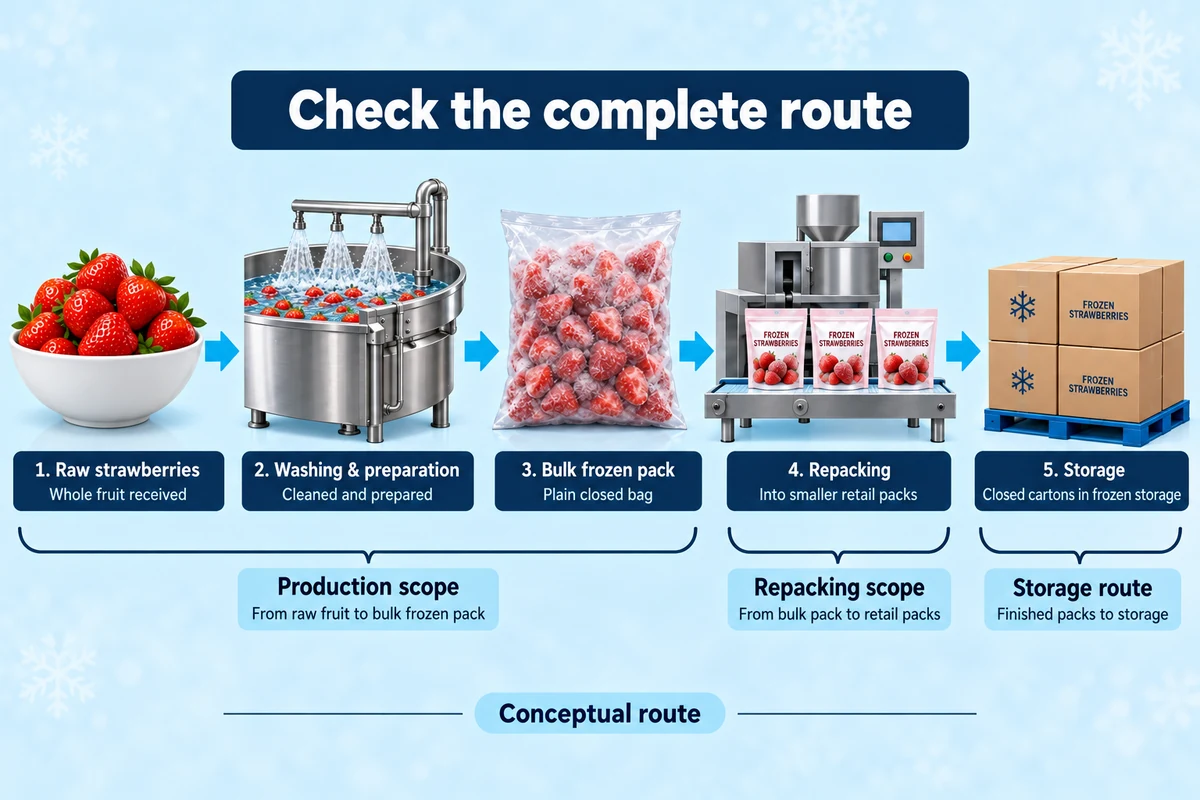
The diagram scrolls horizontally on smaller screens.
Conceptual route: production, later repacking and storage activities must be connected to the applicable order approval.
A flow chart is useful when it shows the real locations and activities. It is less useful when “packing” appears as one box covering both bulk filling at the original site and later retail repacking elsewhere. Split those activities when their scope or responsibility differs. Ask the certifier how each activity is treated under the applicable approval, rather than extending an original facility’s certificate by analogy.
Include shared equipment and product contact where they affect the assessment. The question is how the operation controls the relevant route, not whether every other product in the wider company uses the same ingredients. Request the applicable handling and separation information through the source or assessor. Avoid declaring an entire company acceptable or unacceptable based on one photograph or a partial product list.
For a product held by another storage or handling provider, identify the arrangement that the destination or certifier requires. Keep storage and shipment records connected to the supplied lots. A Halal document does not replace cold-chain or food-safety controls; those remain separate acceptance questions. Conversely, an intact cold chain alone does not establish the documentary approval of processing and packing scope.
Match the certificate to the order scope
Read the certificate and any schedule together. Match the holder, relevant location, product reference, activity and validity information to the actual order. If the document names a legal entity different from the trading supplier, establish the relationship rather than substituting the supplier’s name. XMG is a trading and supply company working with long-term partner factories; documents must refer to the applicable product and route.
ISA’s description of its certification process [4] includes product lists, ingredient specifications, process flow charts and facility information before the audit decision. That illustrates why a certificate request should begin with the identified product. A file named “Halal certificate” is not enough to establish coverage without reading its actual contents and associated schedule.
| Order question | Evidence to connect | Unresolved case |
|---|---|---|
| Will the destination accept it? | Current authority/customer requirement and certifier recognition | A recognised body is cited for a different destination or period |
| Is this the supplied product? | Named product or schedule linked to the current item specification | The schedule shows a different form or unidentified product reference |
| Does the route match? | Applicable site/activity scope and any later blending or repacking | Bulk production is covered but retail repacking is unanswered |
| May the mark be used? | Programme permission and final approved artwork | A general certificate is supplied without permission for that pack |
| Is the evidence current? | Validity, status and change confirmation | The file is old, incomplete or contradicted by a newer route |
Where a schedule is absent or unclear, ask for a written product-scope clarification from the appropriate issuer or responsible source. Specify the product and pack in the question. “Is your factory Halal?” is too broad to resolve whether diced fruit repacked under a particular brand is covered. Keep the reply with the document version that it explains.
Our certificate-verification guide covers document identity and authenticity questions. For Halal, add the destination-recognition and processing/packing scope decisions described here. A food-safety certificate and a Kosher approval answer their own questions; neither should be treated as a substitute for the required Halal acceptance.
Separate testing from approval of the route
A laboratory result answers a defined question about the submitted material and method. It does not itself establish the whole ingredient history, all handling activities or permission to use a certification mark. If analysis is requested, identify what the assessor wants it to resolve and how the sample is tied to the product and lot.
The current MUIS resource guidance [5] states that analysis may be required under the applicable conditions for products, raw materials, additives or processing aids. Its resource index also includes current circulars. Use the applicable scheme and current conditions when deciding the evidence package; do not turn a possible analytical request into a universal requirement for every frozen berry shipment.
An official Singapore explanation of compliance monitoring [6] places documentary assessment, audit and analysis within a broader approach. For a purchasing decision, keep a requested result alongside the ingredient and route records it helps assess. Describe the remaining question explicitly if the available method or sample does not resolve it.
For example, a proposed test might address a suspected input or contact concern. It would not determine whether a later repacker is included in a certificate. Direct the repacking question to scope verification and the analytical question to the agreed laboratory method. Treating every unresolved issue as a test request can waste time while the actual approval gap remains untouched.
Work through a plain strawberry repacking example
Consider an illustrative order for whole frozen strawberries supplied in bulk and later packed into smaller retail pouches at another location. The product remains strawberries, but the supplied route now includes both bulk production and retail repacking. This is a planning example, not a report of an XMG customer shipment or a claim that either pictured site is certified.
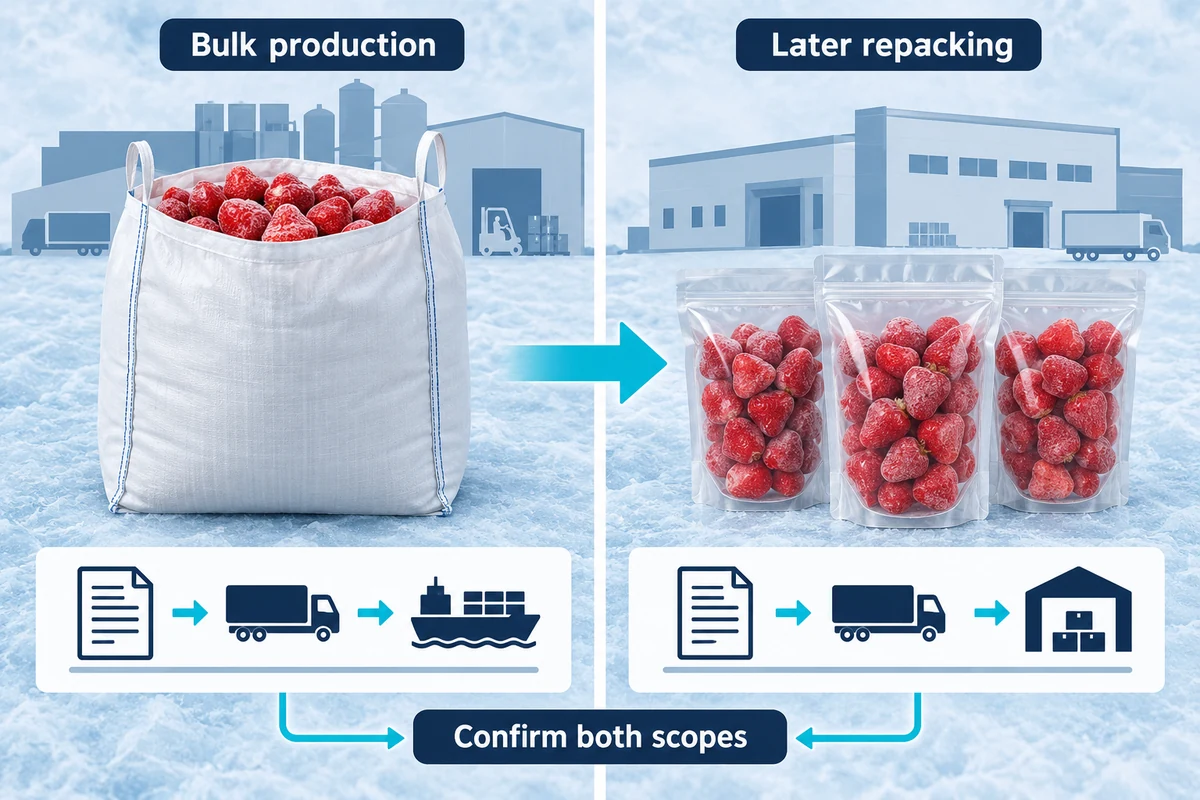
The diagram scrolls horizontally on smaller screens.
Conceptual repacking example: confirm both activities and the final supplied pack within the applicable approval arrangement.
First, identify the bulk item and its specification. Confirm the complete relevant input information with that source and read the applicable certificate schedule. Second, identify the later repacker and the final pack. Ask whether its activity and the resulting retail product are covered under the accepted arrangement. Third, confirm who approves the retail claim and artwork before the pouches are printed.
Suppose the bulk documents identify the exact whole-strawberry item, but the repacking scope is missing. The appropriate decision is to hold approval of the final retail claim while that question is resolved. Do not automatically conclude that the fruit has become non-Halal; the immediate problem is insufficient evidence for the proposed approved route and claim. Distinguish a missing record from an assessor’s finding.
If the source offers a different pack route that stays within a confirmed scope, compare that option with the customer’s requirements. A feasible supply alternative can solve the route problem, but only after the responsible destination or certification decision is closed. Keep the alternative product/pack and its evidence clearly identified so it does not get mixed with the original proposal.
Give the example’s approval record an outcome for each question: confirmed, awaiting clarification or not applicable with a reason. A buyer’s statement that no logo will be printed may close the mark-permission question for that proposed pack, but it does not close a customer requirement for ingredient documentation. Similarly, a confirmed production scope leaves a separate repacking question open until the actual arrangement is reviewed.
Use the unanswered questions to set the order of follow-up. Obtain the proposed repacker’s identity and activity description before requesting an assessor’s scope decision; asking about an unnamed location will rarely produce an actionable answer. If the route is still undecided, compare the available packing routes first. Then ask for the evidence connected to the selected option, so technical review does not spend time assessing a route that the commercial plan has already abandoned.
Once the route is confirmed, carry the same product and packing references into the purchase record. This prevents a technically reviewed bulk item from being replaced by a similar-sounding alternative without reassessment. The purchasing description should be specific enough that the source, receiving team and assessor can recognise which proposal was accepted.
Keep changes inside the approval process
Agree which changes reopen the review. A new ingredient supplier, different aid, revised formulation, another packing location or changed destination can affect the earlier acceptance. Record the changed element, the affected product and the party deciding whether updated evidence is needed. A general promise of “no changes” is less workable than a defined notification and assessment route.
For repeat orders, compare the proposed source and route with the previously reviewed version. Check current document status and any destination-recognition change. If a certificate is renewed, read the new schedule rather than assuming the earlier products remain listed. If an issuer confirms continuity, retain that confirmation with the relevant versions and order reference.
Keep artwork approval connected to scope. A product team may change a brand name, pack size or formulation while a purchasing team continues using an older certificate file. Give the final approver a concise match record: supplied item, source, packing route, document references and intended mark. That makes an unanswered question visible before cartons or pouches are printed.
For an exception, state its consequence narrowly. An expired file requires current status evidence; an unmatched product schedule requires a scope clarification; an unrecognised body requires a destination-acceptance decision. These are different tasks with different owners. Avoid a generic demand for “more certificates,” which can produce a larger folder without resolving the order’s actual requirement.
How we coordinate a product-specific Halal brief
We supply frozen fruits, vegetables and mushrooms and match orders by product, specification, packing and destination. For a Halal requirement, we connect your named product and intended pack to the proposed supply route, then coordinate the relevant production and document questions. This helps your importer or technical assessor evaluate an identifiable proposal.
Our product and quality-document support is tied to the products in your inquiry. We also coordinate packing requirements so a later retail-pack plan is discussed alongside the original product. Certification acceptance, programme permissions and any destination procedure must be confirmed for that route; we do not describe one certificate as coverage for every product or facility.
Send the product, market and packing route
Send the frozen product and form, destination, required certification or customer scheme, bulk or retail pack, and whether blending or repacking will occur elsewhere. Include the intended on-pack claim or mark if relevant. We will review the supply brief and coordinate the applicable specification, packing and document questions for your next approval step.
References
The authority and certifier references retain their own market and scheme scope. The repacking example is an original planning scenario. Verify current recognition, conditions and document status for the proposed order rather than applying a historical certificate or another country’s procedure universally.
