


On this page
Pre-cool the frozen cargo to its agreed carriage condition before loading. Whether you should also pre-cool the empty reefer depends on the loading connection and the applicable carrier procedure. A sealed refrigerated loading tunnel can support cold transfer into a prepared container. Opening a pre-cooled box to warm, humid outdoor air creates a different situation: moisture can condense on cold surfaces and add frost load to the refrigeration system.
There is therefore no useful universal instruction to “pre-cool every reefer for two hours.” Confirm the actual dock arrangement, product readiness, container preparation and door-open power sequence before the loading appointment. A cold controller display does not establish the temperature of the cartons, and an empty container is not a substitute for freezing or cooling the product correctly.
We resolve the loading environment first, then connect the agreed procedure to the product, packing, responsible parties and evidence required at handoff. That order helps prevent a well-intended preparation instruction from creating a moisture problem at the doorway.
Decide from the loading connection, not the word pre-cooling
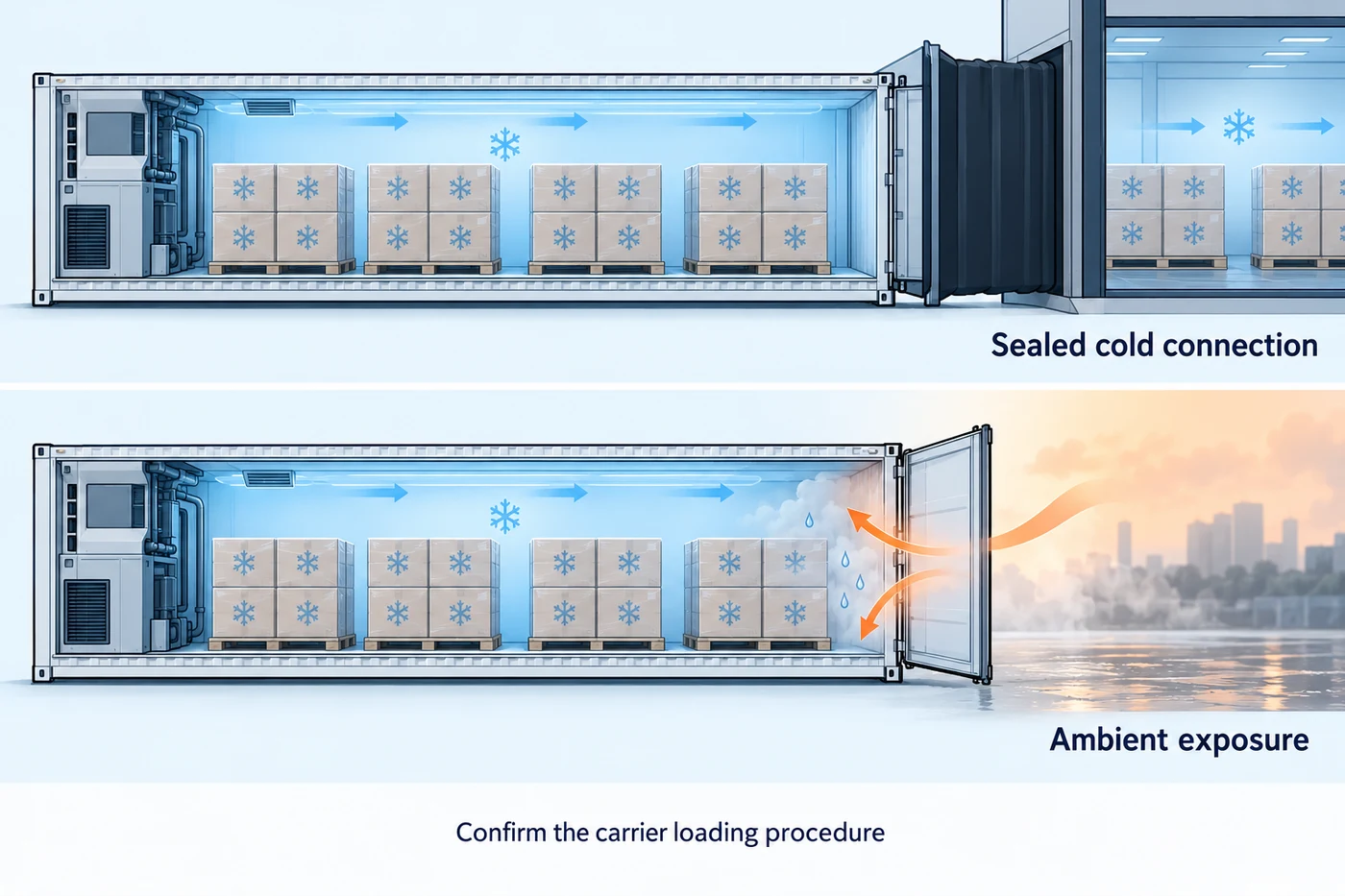
Ask the facility to describe the path the cartons will take. Will they move from a refrigerated room through an enclosed, sealed connection into the container, or will they cross a platform exposed to the yard? A roof over the platform, a warehouse with cold storage elsewhere, and a container parked near a refrigerated door do not necessarily constitute a cold tunnel. The opening through which the goods pass is the relevant feature.
The diagram scrolls horizontally on smaller screens.
Conceptual comparison with the same frozen cargo: a sealed refrigerated connection and an ambient-exposed doorway create different preparation questions. Arrows illustrate exposure, not an equipment airflow model.
Maersk’s Indonesia export guidance [1] distinguishes these environments: it warns against empty-container pre-cooling for ambient exposure while identifying transfer in a cold store as an exception. This is a carrier’s published operational guidance, not a worldwide rule for every shipment. Obtain the instructions that apply to the allocated equipment and booking.
There is also broader guidance to consider. The Codex code for quick-frozen foods [2] recommends pre-cooling transport compartments, while warning against impairing temperature-control efficiency or refrigeration capacity. Its general recommendation and a carrier’s condition-specific instructions answer at different levels. If the proposed operation leaves an apparent conflict, ask the carrier and facility to agree a documented loading method before proceeding. Do not select whichever sentence happens to suit the appointment.
Describe the connection in the loading brief with a photograph or layout and a short explanation of the exposed portion of the transfer. If a dock seal is present, confirm how it interfaces with the actual container. An enclosure drawn on an old facility plan may not describe the equipment presented on the day.
The resulting decision should name both the preparation requirement and its condition. “Prepare the allocated reefer under the agreed sealed-cold-dock procedure” is more informative than “pre-cool required.” Where loading is exposed to ambient air, name that exposure and the carrier-approved preparation method instead. The loading team can then recognise when a changed location requires another decision.
Keep cargo readiness separate from container readiness
Maintain two checks. Cargo readiness concerns the identified frozen product and its required condition before release to loading. Container readiness concerns the allocated box, cleanliness, equipment status and agreed settings. Neither check supplies the missing evidence for the other. A successful machinery inspection cannot tell you whether a pallet left cold storage too early.

Frozen strawberry pieces illustrate product form. Visible frost does not measure the cargo temperature or prove readiness for loading.
A product-temperature record needs an identified lot or sample, time, location, method and suitable instrument. Define those fields with the facility’s responsible quality personnel. Do not prescribe a probing method from a generic loading article: sealed packs, loose pieces and different product forms may require different procedures and contamination controls.
Keep the measurement target clear when the loading team reports a value. Container air, the outside of a carton and an identified product sensing point describe different objects. If the buyer requested a product measurement, a controller screenshot should remain an equipment observation rather than being relabelled as the missing food result.
Likewise, frost visible on a fruit piece does not establish its internal temperature or earlier handling. The photograph here identifies strawberry pieces as one cargo form. It does not show a release test. Appearance can be recorded alongside the appropriate measurements, but should not replace the agreed assessment.
Arrange the physical release around the loading sequence. If cartons are ready but the container is delayed, retain them under the applicable storage procedure until the loading parties confirm the next step. If equipment is ready but product release remains open, resolve the product issue. Treating one readiness milestone as permission to bypass the other can hide the exact condition that needs attention.
Our related explanation of reefer air versus product temperature covers how to identify these measurement targets. Use that distinction when agreeing the loading evidence, rather than trying to reconstruct missing product readings from an empty-box trace later.
Why a cold tunnel changes the decision
An effective cold connection limits direct exchange with outdoor air while the cargo doorway is open. It allows the loading team to consider container preparation together with the condition of the transfer environment. The connection still needs to match the equipment and operating plan; the phrase “cold dock” alone does not demonstrate that it works as intended.
For the planning discussion, confirm where the controlled environment ends, how the container is connected, who verifies the interface and what happens during vehicle arrival or departure. A seal that is useful during steady loading may be absent while the doors are first opened or the container is being positioned. Those stages belong in the explanation.
Ask whether other doors connect the loading area to the yard during the appointment. A refrigerated room can have a materially different exposure when a nearby access door remains open. Keep the discussion practical: the objective is to understand the operation, not to label the facility as adequate from one photograph.
Also describe the transfer and waiting positions. Frozen cartons held within the approved store, cartons staged in the dock area and cartons already inside the container occupy different environments. Name the party who controls each movement and the trigger for releasing the next group. This gives the loading coordinator a way to respond if the appointment changes.
Where pre-cooling is required by the agreed method, the facility and equipment operator should define its completion evidence. Record the actual requirement rather than inventing a duration from the container size. Sun exposure, starting condition, equipment and the loading interface can differ. A stated elapsed time without a completion criterion leaves the team unable to judge readiness.
What changes when the doors open to ambient air
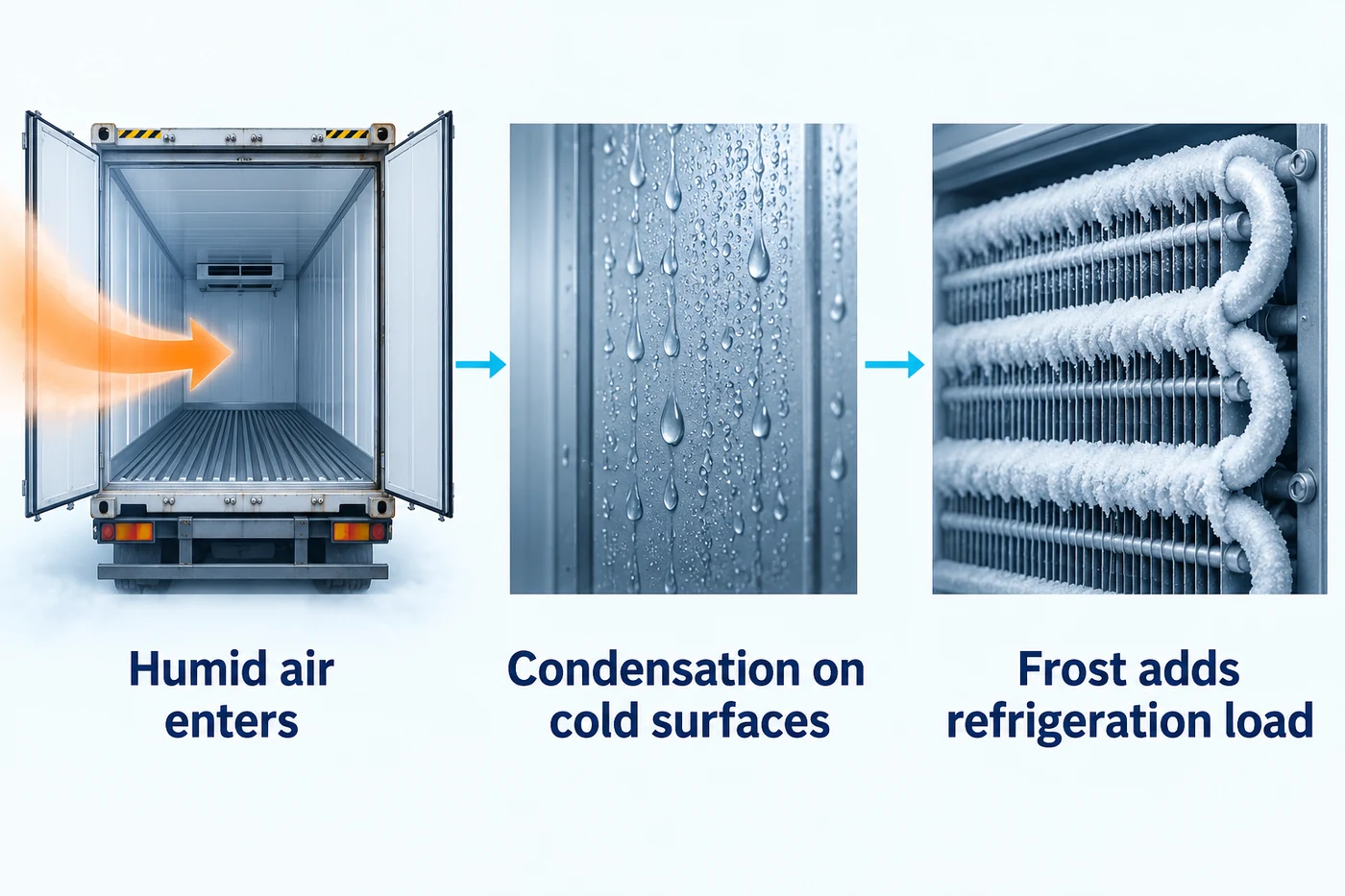
The issue is the exchange at the opening, not simply whether the day feels hot. Warm, humid air contacting cold surfaces can produce condensation; moisture reaching sufficiently cold equipment surfaces can form frost. CJA Marine Services’ pre-cooling note [3] explains the resulting moisture and defrost burden and identifies cold-tunnel loading as a different case. Its illustrative warming figures are not a calculation method for your cartons.
The diagram scrolls horizontally on smaller screens.
Conceptual moisture pathway: humid ambient air meets cold surfaces, where condensation and frost can add refrigeration load. No rate, shipment outcome or inevitable product damage is shown.
Do not interpret this mechanism as a claim that every ambient loading event causes damaged food. It explains why exposing a pre-cooled empty box is not automatically an improvement. The actual outcome also requires the product, packaging, starting condition, exposure and subsequent operation to be assessed within their proper scope.

Mango cheeks provide product context. Their appearance cannot establish exposure duration, transport temperature or an acceptable loading method.
For an exposed platform, use a loading plan that minimises avoidable waiting and names the carrier’s preparation and door-open instructions. This is not an instruction to warm frozen product while preparing the box. Product readiness and protected storage continue to apply. Container preparation must support that objective under the conditions actually available.
If the facility proposes changing from a cold connection to an outdoor platform, pause the operational assumption and obtain the applicable decision from the responsible parties. Retaining the old instruction because it was already printed does not preserve the old environment. Record the change and the revised method with the shipment reference.
Visible water, ice or an unusual equipment condition deserves a specific report. Describe where it was observed, when and by whom, and seek the operator’s assessment where needed. Avoid identifying a cause or prescribing equipment cleaning from a loading photograph. The record should help the right person investigate the condition.
Agree the door and power sequence before loading
Container preparation and refrigeration operation are related decisions, but are not interchangeable. Hapag-Lloyd’s handling guidance [4] instructs switching the unit off during loading and restarting after the doors are properly closed and settings confirmed. Follow the actual carrier and equipment instructions for the shipment, including any defined cold-tunnel procedure.
Before the appointment, write the operational handoffs as a real sequence: the equipment party confirms readiness; the loading parties establish the required connection and door-open condition; loading follows the approved method; doors are closed; settings and operation are confirmed; the loaded container moves into the next agreed power arrangement. Assign the person or role controlling each transition.
“Power available” is too broad. Distinguish a suitable connection being available, the container being connected and the unit operating as required. A connector in a photograph may document one of these states without proving the others. The required confirmation should come from the responsible operational party.
Keep an exception route for a delayed vehicle, an incompatible dock connection, a power fault or changed equipment. Name who can decide whether loading waits, the location changes or another container is used. The coordinator should know whom to contact before cartons are committed to a changed operation.
Do not publish an arbitrary maximum door-open time as a safe limit. The operation must follow its product and equipment requirements. A measured loading duration can be useful evidence, but a duration alone does not establish food condition. Use times to describe the actual event and compare it with the approved procedure, rather than treating the clock as a substitute for the rest of the checks.
Compare two loading plans on the same basis
The following planning comparison describes questions to resolve, not a ready-made operating procedure. Keep the frozen product and agreed carriage requirements constant when evaluating the loading environment.
| Planning field | Sealed refrigerated connection | Ambient-exposed loading |
|---|---|---|
| Transfer environment | Confirm the enclosed connection and its actual interface | Describe exposed platform, yard and waiting positions |
| Empty-box preparation | Apply the agreed carrier/facility cold-loading method | Resolve ambient exposure under the carrier’s applicable method |
| Product release | Identified product checks before loading | The same separate product-release requirement |
| Doors and unit | Record the approved sequence for the connected operation | Record the approved doors-open and restart sequence |
| Change requiring review | Failed seal, changed dock or equipment substitution | Changed exposure, waiting or power arrangement |
| Final handoff | Closure, settings, operation and next power responsibility | The same distinct handoff confirmations |
Consider a fictional booking initially assigned to a sealed refrigerated dock. The carrier’s preparation instructions are agreed for that connection. On loading day, another vehicle occupies the dock and the facility proposes using an outdoor platform. The product specification has not changed, but the condition supporting the preparation decision has. The coordinator should obtain a revised loading decision and keep cartons under their applicable storage procedure while it is resolved.
In another hypothetical case, ambient loading was planned, but the buyer asks the facility to pre-cool the box because a general checklist says so. Return the question to the actual connection and carrier instruction. If a cold tunnel can be arranged, evaluate that complete operation. If it cannot, resolve the requirement with the responsible parties instead of implementing a contradictory instruction silently.
For either case, the useful reply identifies the method, environment and owner. “Done” leaves too much unspecified. A short description tied to the container and appointment gives QA a record it can interpret without assuming which loading conditions were present.
Before choosing a product sampling point, clarify the question being answered. A pre-loading check concerns the identified cargo at that stage; a reading taken after a long wait concerns a later condition. Record the measurement target, location and time rather than grouping every value under “loading temperature.” The responsible QA procedure should define an appropriate method and acceptance basis for the product. Our specification and sampling coordination helps connect the requested evidence to the agreed order requirements.
Make the record usable by someone who did not attend loading. If a check covers selected cartons, identify that selection and its scope. If the team only has an air reading, describe it as air. If the planned product check cannot be completed, record the gap and refer the release decision to the responsible party. A plausible-looking number copied from a controller would obscure the missing evidence and make a later review harder.
There is also a practical difference between a check completed and a result communicated. The loading team needs the applicable release decision before proceeding, while the receiving team needs the supporting record connected to the correct consignment. Agree where the record is stored and how a changed decision reaches the people controlling the cartons and the container. This prevents an earlier confirmation from continuing to govern an operation after its conditions have changed.
Keep evidence through the final power handoff
A loading record should connect the consignment to the equipment and operation. Select fields according to the agreed evidence need: container identity, lot references, product-release record, loading connection, applicable preparation instruction, relevant times, settings, closure and operating confirmation. Preserve the original record and its measurement targets.

The diagram scrolls horizontally on smaller screens.
Conceptual handoff states distinguish closed doors, power connection, operating confirmation and the named next handoff. The illustration is not shipment evidence or a universal equipment procedure.
Record a changed container or loading location explicitly. Do not leave an earlier preparation confirmation attached to replacement equipment without clarifying its applicability. If a photograph is used, keep enough context to identify what it documents: doorway connection, equipment identity, closed doors or power connection. One view need not prove every stage.
Include the next transport handoff in the discussion. Loading can be completed correctly while a later power arrangement remains unclear. Name the responsible party and the agreed reporting route for an interruption or delay. The purpose is to make the next action identifiable, not to claim uninterrupted refrigeration from a finished loading checklist.
For receiving review, retain uncertainty where evidence is incomplete. A missing loading measurement remains missing even when subsequent container air records look normal. A later product reading answers a later question. Keep these limits visible so the responsible QA team can determine what additional assessment is needed.
How we coordinate the shipment brief
We supply frozen fruits, vegetables and mushrooms and connect product, packing and shipment requirements to the responsible facility and logistics parties. Our cold-chain and container-loading coordination includes clarifying order-specific loading and handoff requirements.
For a loading-sensitive order, we can bring the product and pack information together with your requested temperature evidence and the proposed loading arrangement. This helps the facility and logistics contacts resolve the relevant preparation questions before the appointment. The carrier or appointed operator controls its equipment and transport operations; we coordinate the requirements and open points within the agreed supply scope.
Send the product and loading brief
Send the frozen product and pack, destination and schedule, proposed loading connection, and the temperature or handoff evidence you require. We will review the supply brief and coordinate the relevant confirmation points with the appropriate facility and logistics parties.
