


On this page
A frozen-food bag can use a material designed for recycling without being accepted by the collection programme available to the customer. Before approving a “recyclable” claim, verify the finished pack, the destination, the sales area and the actual collection and recycling route. A resin name, recycling symbol or mono-material description does not settle all four.
We would separate two approval questions: does the proposed construction meet the relevant technical assessment, and can the intended customer use a supported disposal route? Keep frozen-food protection in the same decision. A new film that improves a recycling assessment but fails the agreed sealing or handling requirements is not an approved substitute.
For importers and private-label teams, the useful output is a market-specific claim file attached to the exact pack version. It should explain what the claim covers, the evidence behind it and the instruction the customer can follow. This guide reviews the United States, United Kingdom and EU position as of 7 October 2026; collection programmes and implementation details must be checked again when a pack or market changes.
Start with the finished pack and the destination
Begin with a pack identifier rather than “PE bag” or “recyclable pouch.” Record the film construction, thickness, dimensions, printing, adhesive, label and closure. Add the product, filling configuration, intended channel and destination. Ask for the converter’s description of the finished article being supplied, not a brochure for a material family.

This strawberry product example does not identify the liner polymer or demonstrate a recyclable claim; the finished pack needs separate evidence.
A frozen strawberry retail bag and a bulk liner for the same fruit are different packaging articles. They may have different dimensions, printing, closures and disposal users. The retail pack reaches a household; the liner may remain with a processor or distributor. Evidence about a commercial collection arrangement does not automatically support a household-facing statement.
Keep the components separate in the file. The inner bag, outer carton, adhesive label and any secondary wrapping may use different routes. A recyclable carton does not make its liner recyclable. A claim printed across the front of a retail pack can be understood as referring to the whole pack unless its scope is clear.
Define where the claim will appear: on the pack, in a retailer listing, on a website, in a catalogue or in a business specification. The audience and wording affect what information is needed. A detailed converter statement made to a technical buyer may lose its limitations when reduced to a prominent consumer label.
Record the sales geography with enough detail to check access. “Export to Europe” is too broad for a local disposal instruction. A programme may operate in selected stores, cities or commercial sites. Identify the countries and channels that will use the same artwork, and decide whether the claim file needs separate versions.
Separate material design from the collection route
Material design examines whether the finished construction is compatible with a defined recycling stream and assessment method. Collection asks whether the intended user can get the packaging into that stream. Sorting and reprocessing add further questions about the route after collection. Keep each step supported instead of treating the first technical statement as proof of the last outcome.

Illustrative verification framework: assess the finished pack and verify collection, sorting and reprocessing separately. The drawn layers are schematic; no depicted programme is confirmed to accept this pouch.
Swipe to view the diagram on smaller screens.
Use the assessment’s actual scope. Is it an evaluation of the proposed bag, a particular film, a closure technology or a laboratory sample? Which version of the method was used? Which construction features were included? If the finished pack differs from the assessed sample, record the difference and obtain a conclusion that addresses it.
RecyClass’s design-for-recycling guidance [1] evaluates component compatibility with a given recycling stream and is updated as testing develops. That is useful technical evidence. It does not, on its own, establish that every customer has access to a collection point accepting the finished bag.
For collection evidence, retain the named operator, accepted item description, location coverage, preparation instruction and date checked. A store displaying a film-collection bin may still exclude particular packaging. Confirm the programme’s actual rules, not merely the presence of the bin.
Then check the downstream statement being made. “Accepted at this collection point” and “recycled into a specified output” need different evidence. Avoid promising that every individual bag will be recycled. A brand can describe a supported route without inventing a recovery result for packaging whose later handling it cannot observe.
When the evidence ends at collection, say so in the internal decision. A technical team can continue investigating sorting and reprocessing. Leaving the unresolved step visible is better than filling the gap with a recycling-arrow graphic that appears to promise a complete loop.
Why mono-material does not settle the claim
“Mono-material” can be a useful design description, but first ask what the supplier means. Does it describe the dominant polymer, every functional layer, or a particular assessment category? Request the complete construction and the method behind the recyclability conclusion. The word alone does not identify the assessment scope.
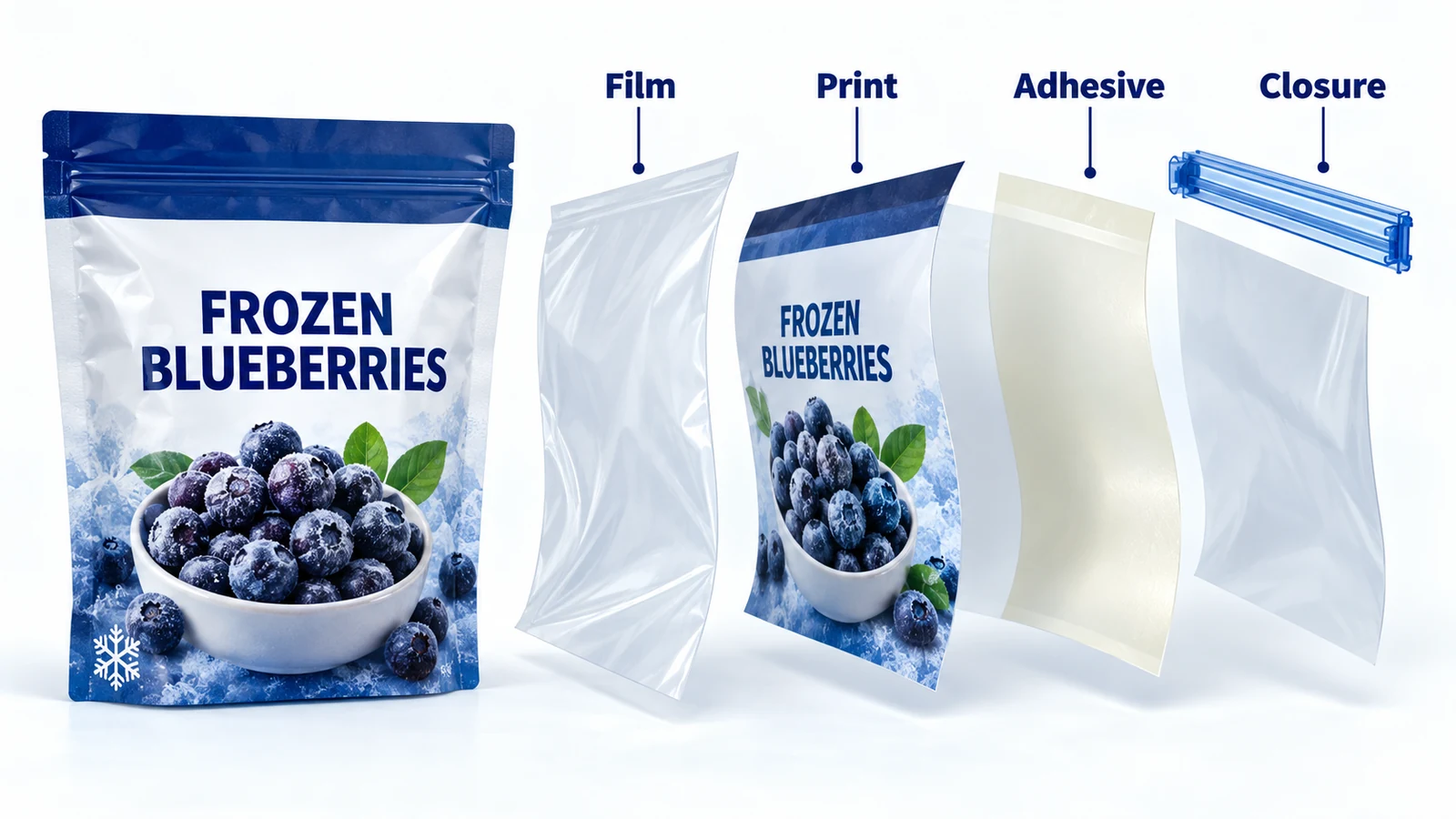
Illustrative construction: film, printing, adhesive and closure can all matter in a finished-pack assessment. The exploded components are conceptual, not a measured layer specification or proof of recyclability.
Swipe to view the diagram on smaller screens.
Review printing, adhesives, coatings, labels and closures as part of the finished article. Do not assume a compatible base film automatically makes every added feature acceptable. Equally, do not reject a design solely because it has several layers: ask whether the actual combination is covered by the relevant assessment.
For an adhesive or closure declaration, check the conditions. A technology approval may concern a specified composition, concentration or application. The converter needs to connect that evidence to the ordered pack. Preserve the declaration and the construction record together so a later material substitution cannot quietly inherit the old conclusion.
Do not identify film structure by touch, stretch or appearance. Those observations can help describe a sample, but they do not reliably replace a converter specification or programme acceptance instruction. A clean-looking transparent bag can still require a different route from another bag that looks similar.
Keep recycled content and recyclability distinct. Recycled content describes a material input claim; recyclability concerns the packaging’s end-of-use pathway and relevant requirements. If both claims are proposed, each needs its own evidence and scope. Neither should be used as shorthand for a complete environmental benefit.
Compostability is another separate route. A compostable bag should not be directed into a plastic-film stream simply because the word sounds environmentally favourable. Review the applicable collection instruction and evidence for the intended disposal method. Customers need a usable instruction, not several competing environmental terms on the same panel.
Check the United States, United Kingdom and EU separately
United States: scope the claim to access and the actual programme
The FTC’s current Green Guides provision on recyclable claims [2] links the claim to recovery through an established recycling programme. An unqualified claim generally requires facilities available to a substantial majority of the consumers or communities where the item is sold; the Guides define that as at least 60%. More limited access needs clear, prominent qualification. A vague “where facilities exist” statement can be inadequate. This is federal marketing guidance, not proof that a particular bag complies with every applicable state requirement.
Programme acceptance must be checked separately. NexTrex’s current collection instructions [3] specifically list frozen-food bags among the items excluded from its programme. That is a rule for this named programme, not a finding that every frozen-food bag is unrecyclable everywhere in the United States.
California also requires a separate review. CalRecycle’s current SB 343 guidance [4] identifies products and packaging manufactured after 4 October 2026 for its labelling restrictions; earlier manufactured items are outside those restrictions regardless of sale date. However, the agency reports that a preliminary injunction issued on 14 July 2026 blocks enforcement of SB 343. Do not treat the manufacturing deadline as an unqualified statement of current enforceability. Keep the manufacturing date and California evidence with the pack file, and reconfirm the litigation and applicable requirements before approving a statement or symbol.
United Kingdom: identify the supported route and instruction
WRAP’s 2021 supermarket-collection guidance [5] describes frozen-food bags among the formats collected through participating stores. It offers a route to investigate, not proof that every store or household bin accepts the proposed bag. Check the selected operator’s current accepted-item list, location and preparation instructions.
The CMA’s Green Claims Code checklist [6] emphasizes clear, accurate, supported claims and the information needed to avoid misleading the customer. Review the words and graphics together. Make the relevant component and disposal route clear rather than relying on an environmental image to communicate an unstated limitation.
European Union: distinguish current duties from later criteria
The PPWR entered general application on 12 August 2026 [7]. The Commission’s 2026 guidance (official Spanish publication) [8] explains that Article 6(1)’s recyclability requirement applies from that date, with the earlier PPWD requirements and related harmonised standards used until the detailed design-for-recycling requirements apply. Article 6(2)(a) applies from 1 January 2030 or 24 months after the relevant delegated acts enter into force, whichever is later. The recycled-at-scale requirement applies from 1 January 2035 or five years after the relevant implementing acts enter into force, whichever is later. These later stages are not all present-day requirements. Conversely, saying that recyclability has no relevance until 2030 would misstate the current position.
For an EU launch, keep the relevant national collection instruction and current conformity review with the pack file. Do not print a future harmonised label or claim a future performance grade based only on a supplier’s expectation. The detailed measures and the article applicable to the proposed statement must be checked for the actual launch date.
Preserve frozen-food performance while changing the film
Review the new construction against the product and handling conditions already approved for the programme. Recycling suitability does not answer whether the bag can be sealed reliably, retain the required barrier performance or survive the intended frozen distribution. Those are separate approval questions with their own evidence.

A clear bag illustrates product and pack context. Its polymer, sealing performance and local recycling acceptance are not established by appearance.
Broccoli florets and frozen fruit provide useful product examples, but neither photograph proves a packing trial. Specify the product actually used in the assessment, the fill quantity, pack dimensions and relevant handling. Do not transfer a favourable result from a different product merely because both products are frozen.
Compare the proposed bag with the approved construction under matched conditions. Record the sealing arrangement, finished-pack configuration, storage and handling stages, and inspection endpoints. Ask the technical team which differences require a new trial. A changed film thickness, closure or print system can make a previous report an incomplete basis.
Keep the findings separate: a recyclability assessment, a food-contact review and a frozen-pack performance trial support different conclusions. A pass in one column must not populate the others. Our guide to moisture barrier and seal integrity addresses the physical-performance comparison; use that evidence alongside the disposal claim review.
Plan the transition. Identify which orders use the old pack and which use the revised version, and keep the artwork linked to the correct construction. A new disposal statement printed on old film stock creates a different problem from a successful new-material trial. Approval needs the material and artwork versions to agree.
If the proposed construction fails the agreed performance criteria, retain the finding and review alternatives. Do not reduce product protection simply to keep a marketing claim. The commercial discussion can consider another design, a narrower supported statement or a later transition after further assessment.
Build a claim file for each pack version
Use one short decision sheet linked to the supporting records. It should name the pack, market, proposed wording, evidence owner, approval date and review trigger. The purpose is to make a future change easy to recognize, not to accumulate unrelated certificates that nobody can connect to the bag.
| Record | Question it answers | Failure signal |
|---|---|---|
| Finished construction and version | Which exact pack was assessed? | Main resin named but print, closure or adhesive omitted |
| Technical assessment and method | Compatible with which recycling stream? | Film family brochure presented as finished-pack assessment |
| Collection coverage and instruction | Who can use which route? | One collection point presented as nationwide availability |
| Frozen-pack approval | Does it protect the ordered product? | Different fill or product used without a justified transfer |
| Claim and artwork approval | What will the customer understand? | Pack-wide claim supported only for the carton |
| Change and review record | When must the evidence be reopened? | Old approval carried across a material substitution |
Assign responsibility for each record. The converter supplies the construction and relevant technical information. The product and packing teams assess suitability. The importer or brand’s responsible reviewer decides what is appropriate for the destination and proposed wording. Coordination does not transfer the final claim decision to an unrelated supplier brochure.
Record limitations where the claim decision is made. If the evidence covers a particular collection network, identify that scope. If a component needs separating, show the instruction. If a claim is not yet supported, leave it unapproved instead of attaching a general sustainability statement that appears to fill the missing evidence.
Keep the evidence current through defined triggers: a material or additive substitution, changed printing, revised closure, a new sales area, a programme exclusion or revised rule. A routine review date is useful, but it does not replace action when a material change occurs before that date.
A practical two-market approval example
Consider a hypothetical brand reviewing the same proposed retail bag for two sales programmes. Its converter supplies a complete specification and a technical assessment. The brand also has a satisfactory product-specific packing trial. These are fictional circumstances for explaining the decision, not records for an XMG pack.

Illustrative destination check: similar-looking packs still need the actual programme and local instructions confirmed. Both routes remain unresolved; neither pictured location establishes acceptance.
Swipe to view the diagram on smaller screens.
Programme A has a verified collection route accepting that finished construction, with coverage and preparation instructions matching the customers who will see the claim. Programme B’s intended collection operator excludes the item. The converter’s technical information is unchanged, but the proposed disposal instruction cannot be copied from A to B.
For A, the reviewer still checks whether the wording accurately represents the available route and whether any qualification is needed. Acceptance somewhere is not automatically enough for an unqualified statement across the whole sales area. For B, the team needs another supported route or a different statement; it cannot resolve the exclusion by printing a resin code.
The UK WRAP guidance and the named NexTrex exclusion illustrate why this check matters in practice. They concern different systems and should not be reduced to “the UK accepts all bags and the US rejects all bags.” The correct comparison is between the specific package, programme, location and instruction.
If the brand sells online into a wider geography, reopen the coverage question. The product page might reach people outside the original collection area even if the first retail listing did not. Match the claim’s reach to the evidence, and keep market-specific pack or listing versions under control.
Keep instructions usable after the purchase
A useful instruction identifies the component and the route in words the customer can act on. Test it on the finished pack at normal reading size. A small qualifier far from a large recycling claim can fail to communicate the condition, even though both sentences technically appear in the artwork.
Keep the online listing consistent with the physical pack. If the carton and liner have different instructions, preserve that distinction in both places. A retailer may shorten supplier content, so review the actual listing rather than assuming your original wording survived unchanged.
Use a website or QR code for supporting detail where appropriate, while retaining the necessary immediate qualification in the claim. The destination page needs an owner and a maintenance process. A printed link to an obsolete collection locator is not a durable solution for a long-lived packaging version.
Ask a reviewer unfamiliar with the project to explain what they would do with the empty bag. If they interpret a store-return instruction as permission to use the household recycling bin, revise the presentation. This is a practical communication check, not a substitute for the technical or market review.
Before placing the print order, reconcile the construction, evidence file, claim approval and final artwork. After receiving the printed packs, check that the actual statement and component instructions match the approved version. Keep the retained sample and approval references with the order so later questions can be answered from the pack that was sold.
How we coordinate the frozen-food packing brief
We supply frozen fruits, vegetables and mushrooms and coordinate bulk, foodservice, retail and private-label packing options around the proposed order. Identifying the product, pack format and destination first helps keep the construction and evidence request specific.
We can coordinate physical samples for your product and packing review, and connect packing and document requirements with the relevant supply route. Your responsible technical and market reviewers retain the final performance and environmental-claim decisions. We do not turn a generic material description into a guaranteed recycling outcome.
Send the product and pack size, destination and sales channel, proposed material and exact claim you want to assess. We will review the brief and coordinate suitable supply, sample, packing and document options for the next approval step.
References
Current claim and collection sources: FTC recyclable claims guidance [2]; CMA Green Claims Code checklist [6]; WRAP supermarket-collection guidance (2021) [5]; NexTrex programme instructions [3]; European Commission PPWR implementation [7]; Commission Notice C/2026/3084, official Spanish publication [8]; RecyClass design-for-recycling guidance [1].
- RecyClass design-for-recycling guidance↑
- FTC recyclable claims guidance↑
- NexTrex programme instructions↑
- CalRecycle’s current SB 343 guidance↑
- WRAP supermarket-collection guidance (2021)↑
- CMA Green Claims Code checklist↑
- European Commission PPWR implementation↑
- Commission Notice C/2026/3084, official Spanish publication↑
