


On this page
Scallions and green onions commonly mean the same slender onion vegetable in American English. “Spring onion” is less consistent across markets: it may describe that slender form, or a young onion with a noticeably swelling bulb. The names overlap, so the physical product is a more reliable guide than a claim that each English word has one universal meaning.
Look at the base and leaves. Does the onion have a narrow white base with long green leaves, or a rounded young bulb beneath the green tops? Is the recipe asking for the whole plant, the white base, the green leaves or chopped pieces? Those details tell you much more about the intended ingredient than the name alone.
For a recipe, a photograph or short description usually resolves the ambiguity. For a frozen cut product, ask for its stated identity and visible form. Rings and dice can show which parts are included, but chopping removes some of the features that distinguish an intact slender onion from a young bulbing onion.
Three names with overlapping meanings
University of Illinois Extension explicitly treats scallions and green onions as two names for the same food in its ingredient explanation [1]. It describes tender green-and-white stalks without a developed bulb. That is a useful answer for a reader holding two similar slender bunches in an American grocery shop.
Purdue Extension’s onion guide [2] uses a more specific distinction for spring onions: a larger young bulb, sometimes from a bulbing onion that still has its green leaves. That gives cooks a practical visible difference, but it should not be turned into a universal rule that every country or seller follows.
British usage can be broader. The Royal Horticultural Society uses “spring onions” for a young salad crop, and its salad-onion guide [3] describes the crop family. A British recipe requesting spring onions may therefore intend the slender bunch familiar to an American reader as green onions. Check the recipe’s illustration and preparation rather than assuming it requests a large bulb.
The overlap does not make the names useless. It means that their precision depends on context. A local seller and cook may understand the same word perfectly, while a translated recipe or international order needs a few additional physical details. The most helpful correction is a clearer description, not an argument that one region’s familiar wording is wrong.
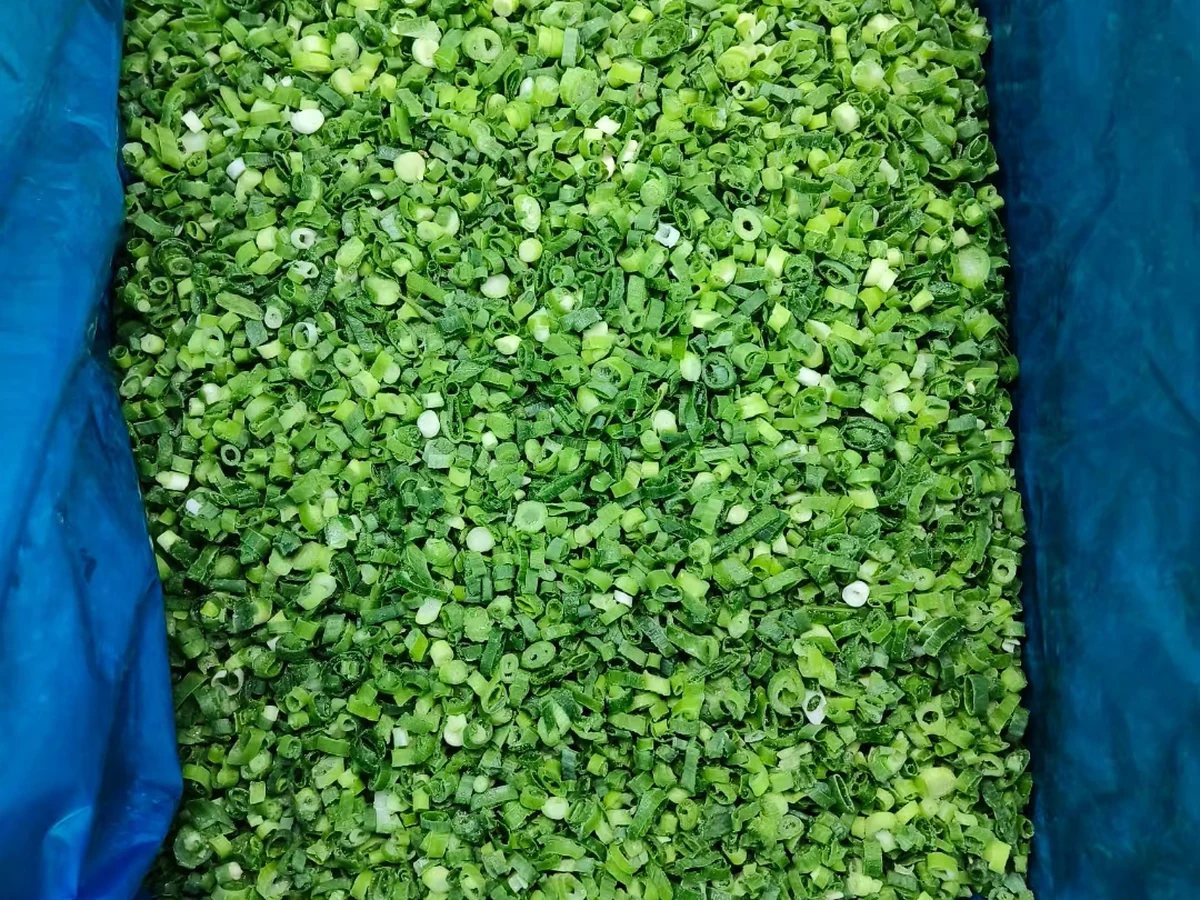
A chopped product shows included parts but does not reconstruct the bulb shape of the intact plant.
Look at the base, leaves and bulb
On a slender green onion, the white lower part remains narrow and transitions into the green leaves. On a young bulbing onion, a visibly rounded base has begun to develop. That difference can matter when a recipe expects fine rounds, whole lengths or a bulb substantial enough to slice and cook separately.
Inspect the whole plant if it is available. The diameter of the base, the degree of swelling and the leaf form help establish what the recipe writer had in mind. A bunch with a slight enlargement is not necessarily a completely different ingredient category; natural variation exists. Describe the visible amount of swelling instead of treating an arbitrary boundary as a global standard.
White and green parts both belong to the food, though they may be used differently. A recipe might cook the white base in a dish and reserve the green leaves for the finishing stage. Another may use the complete chopped plant. “One spring onion” is not enough information if the recipe only intends a particular part or if the onions differ substantially in size.
| Word in the recipe or offer | Common interpretation | Useful physical confirmation |
|---|---|---|
| Scallion | Slender green-and-white onion, especially in US usage | Narrow base, green leaves and supplied parts |
| Green onion | Often the same slender form as scallion | Base swelling, whole or chopped form |
| Spring onion | Slender salad onion or young bulbing onion, depending on market | Actual bulb development rather than the name alone |
Use the table alongside the actual bag or bunch. A seller’s name is most useful when it comes with a description of the base, bulb and included leaves. If the recipe uses a local term, keep that physical description in your ingredient notes so another cook can select the same form.
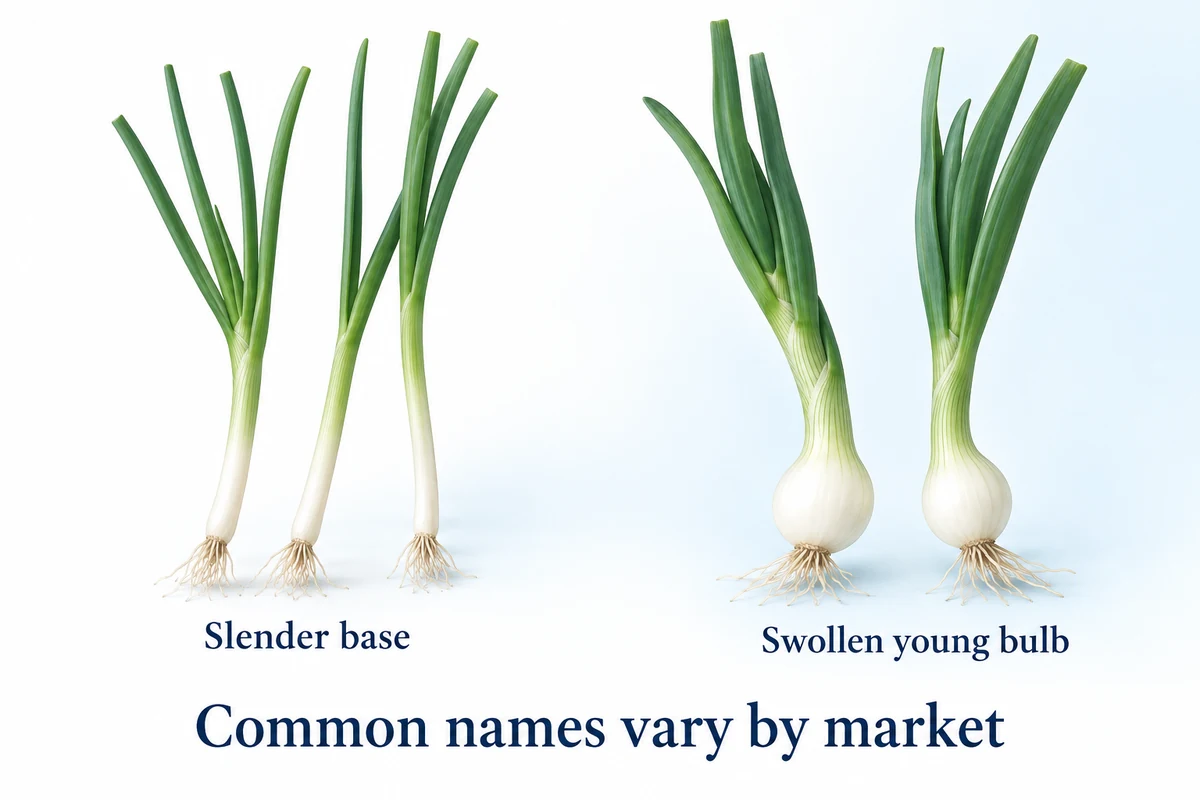
Common names overlap across markets; the illustration is not a global naming standard.
A name does not identify one species
Common vegetable names do not always map neatly to a single botanical species. The RHS salad-onion guide identifies both Allium cepa and Allium fistulosum among salad-onion varieties. A young bulbing onion and a bunching onion can therefore arrive under overlapping cooking names despite differences in their growth habits.
This matters because “they are all just onions picked at different ages” is also too broad. Harvest timing can explain a young bulbing onion, but it does not explain every bunching type as an early version of the same mature bulb. A name such as green onion usually tells the cook a usable food category; it may not establish the exact botanical identity.
University of Maryland Extension’s onion-growing guidance [4] describes using thinned young plants as green onions while allowing others to develop bulbs. That is one valid route to a green-onion food. It should be read alongside the broader salad-onion variety distinction, rather than used to declare that all green onions have identical maturity behaviour.
For everyday cooking, exact species may not be necessary if the visible form and flavour suit the dish. If species or variety is important to an ingredient requirement, request that information explicitly. A common name and a close-up of cut rings cannot confirm every botanical distinction. Avoid adding scientific precision that the supplied information does not actually support.
How the visible form changes cooking
A slender white base can be cut into small rounds that cook and distribute differently from slices of a swollen bulb. Green leaves provide another shape and texture. These parts can be combined, but the preparation should follow the role the recipe assigns them rather than treat every chopped piece as interchangeable.
For a garnish, fine green pieces create a particular appearance. A recipe asking for a cooked onion base may instead need the white or bulb portion to soften. If you substitute a bulbier young onion for a slender bunch, review the piece size and the amount of each part, not simply the number of onions used.
Flavour also varies within the named categories. Illinois Extension describes the white part as holding more onion flavour than the green part. That is useful culinary guidance, not a fixed strength ratio for every variety. Taste the prepared food when appropriate and adjust the recipe cautiously rather than assume one name guarantees the same flavour intensity.
A count-based substitution can be misleading when bunches differ in size. If a repeatable recipe needs a stated amount of chopped onion, specify the part and prepared quantity. “Chopped white and green portions” or “green leaf rings only” is more reproducible than a vague instruction to add three spring onions. The recipe remains understandable across markets even when local names differ.
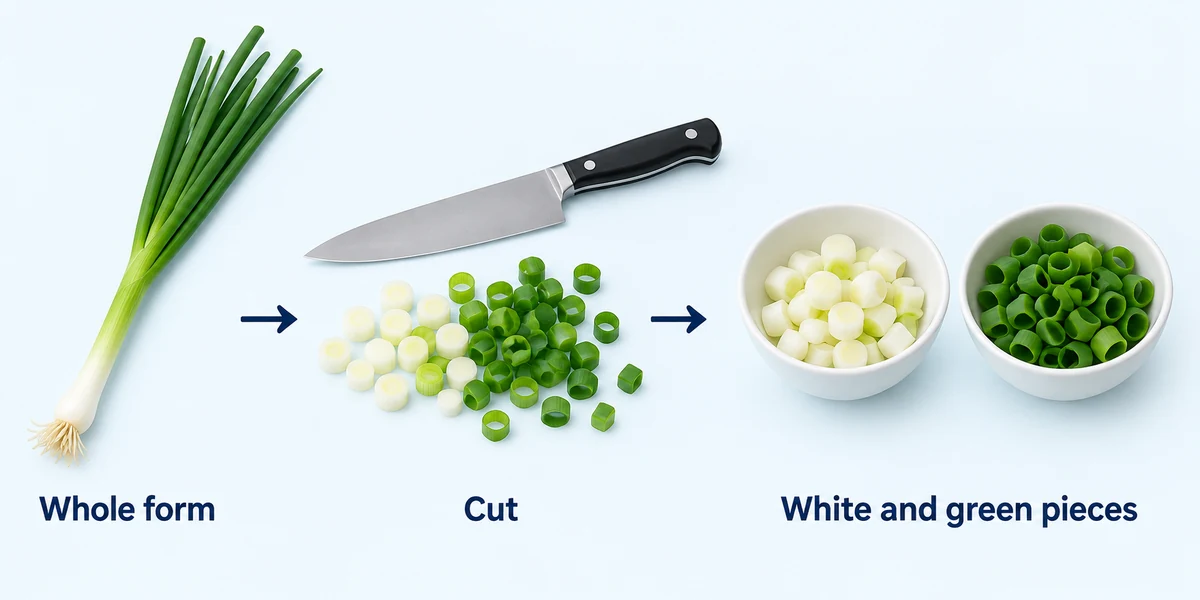
The cut reveals the included parts but removes some whole-plant features.
What a chopped frozen product reveals
Frozen cut green onions may show green hollow rings, pale base pieces and transition pieces. Those visible elements help establish the supplied physical form. They do not necessarily reconstruct the exact shape of the intact plant, particularly once its bulb or base has been chopped into small pieces.
A mixed white-and-green cut is different from green leaves alone. A dice is different from a ring or a long strip. Those are useful product distinctions independently of whether the common name is scallion, green onion or spring onion. Confirming them makes a translated recipe or ingredient offer easier to understand.
The photographs here show chopped green-and-white onion material. They illustrate a cut ingredient, not a botanical identification from an intact plant. The visible pieces should be described accurately; the photograph does not establish a measured proportion, exact cut tolerance or a flavour result. Those require suitable product information or an actual evaluation.
Frozen form also deserves its own preparation instructions. A cut frozen ingredient should not automatically be treated as an identical garnish to a freshly cut bunch. Follow its intended use and pack directions, then assess its suitability for the dish. The shared onion name establishes the food family but does not erase a change in supplied state.
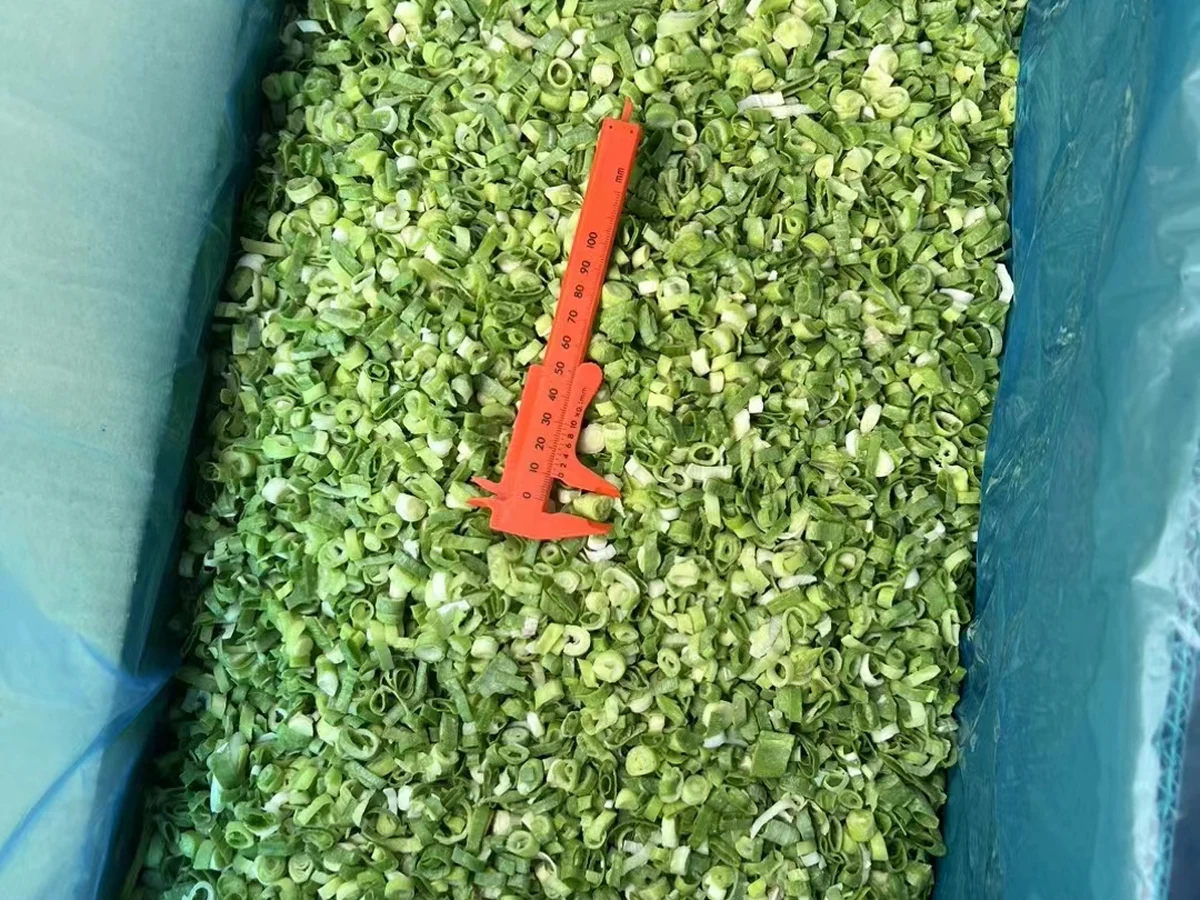
The cut form is visible; this photograph does not establish a measured white-to-green ratio.
Resolve a recipe or order by description
Translation adds another reason to keep the physical description. A word chosen from a dictionary may cover a wider or narrower group than the name familiar to the cook. Preserve the intended ingredient by describing the whole shape and prepared part. A simple image reference can help, provided it shows the actual form rather than an unrelated allium.
Keep that description with the recipe once the ambiguity is resolved. If the next cook sees only “spring onion,” the same uncertainty may return. Adding “slender white base and green leaves, chopped together” or “young rounded bulb with tops” usually supplies enough information without turning a kitchen instruction into a botanical catalogue.
Start with a whole-product reference where the question concerns bulb development. A photograph showing the roots, base and leaves is more useful for that question than a tight crop of only green tops. For a chopped product, use a description of the included parts and cut alongside a sample reference.
Then state the intended role in the dish. “Thin green rounds for a finishing garnish” tells a different story from “white base pieces cooked into the sauce” or “small young bulbs grilled with their tops.” Those descriptions remain clear even when the recipe title uses a name unfamiliar to the reader.
For a substitution, compare the prepared amount and relevant form. If the alternative has a larger bulb, decide whether to use that bulb, trim it or change the cut. If only green tops are available, consider whether the original recipe relied on the white base. A pleasant onion flavour does not guarantee that the alternative produces the same appearance or preparation.
Our frozen green-onion page describes the cut forms. A clear product description and sample reference can keep the physical identity visible. The separate guide to white and green portions in a frozen cut addresses proportion measurement after the ingredient identity has been established.
Nearby alliums that deserve separate names
Chives are related to onions but are not simply small pieces of green onion. Illinois Extension’s chive guide [5] describes their fine hollow leaves. Their scale and culinary use differ from the thicker green-and-white vegetable sold in a bunch. Garlic chives introduce another distinction, with flat leaves rather than the typical hollow common-chive leaf.
Leeks also deserve a separate identity. Their broad flat leaves and substantial pale shaft differ visibly from the slender hollow-leaved green onion. The Wisconsin Department of Agriculture’s vegetable guide [6] describes the leek’s thick white stem and flat leaves. A dish written for leeks may need a different preparation and amount.
Related foods can sometimes be exchanged in a flexible dish, but family resemblance does not make the names synonyms. If you choose a substitute, describe the change and assess the finished result. Avoid relabelling chives or leek pieces as scallions simply because they are green and onion-flavoured.
For further ingredient explanations, browse Food Knowledge and the frozen vegetable range.
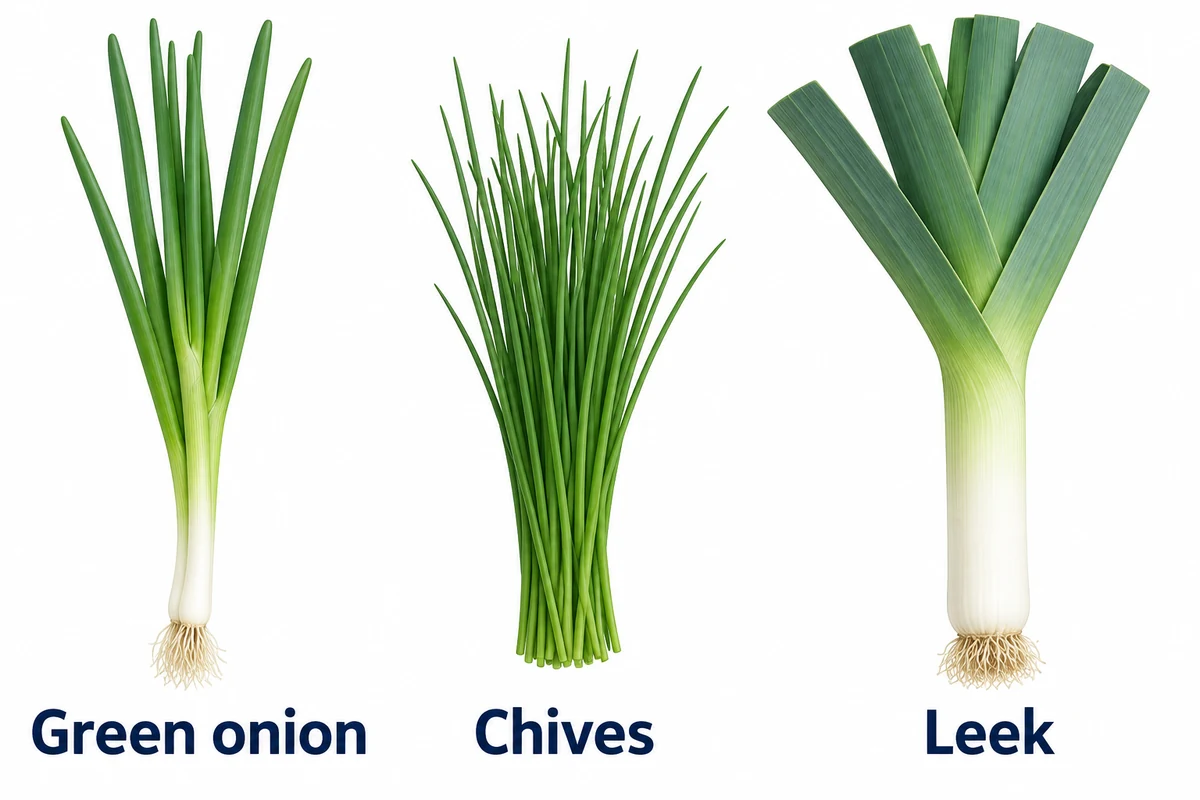
Schematic ingredient identities, not equal quantities or flavour strengths.
For the frozen product forms discussed here, see our IQF Frozen Green Onions page.
View product forms →