


On this page
Before approving a frozen-food supplier in China, verify one proposed order as a connected chain: the company that signs and receives payment, the facility that will actually produce the goods, the exact product and process, and the documents that apply to that facility and product. A valid business registration does not establish manufacturing capability. A genuine factory certificate does not establish that the quoted SKU is made at the certified site. A good sample does not identify the production lot that will be shipped. Each link needs a named record and an owner who can explain a mismatch.
If the supplier is a trading and supply company working with partner factories, that structure can be entirely workable. The key is to make the structure explicit before your approval: who is your counterparty, where will production happen, who holds the certificate, and what changes require your consent? We work with long-term partner factories and coordinate suitable supply routes. For any inquiry, our role is to match a suitable route and coordinate order-specific confirmation. Your qualification file should still be precise enough that procurement, QA and the receiving team can identify the approved route without relying on an email recollection.
Start with one order-specific identity chain
Swipe to read the figure on a narrow screen.
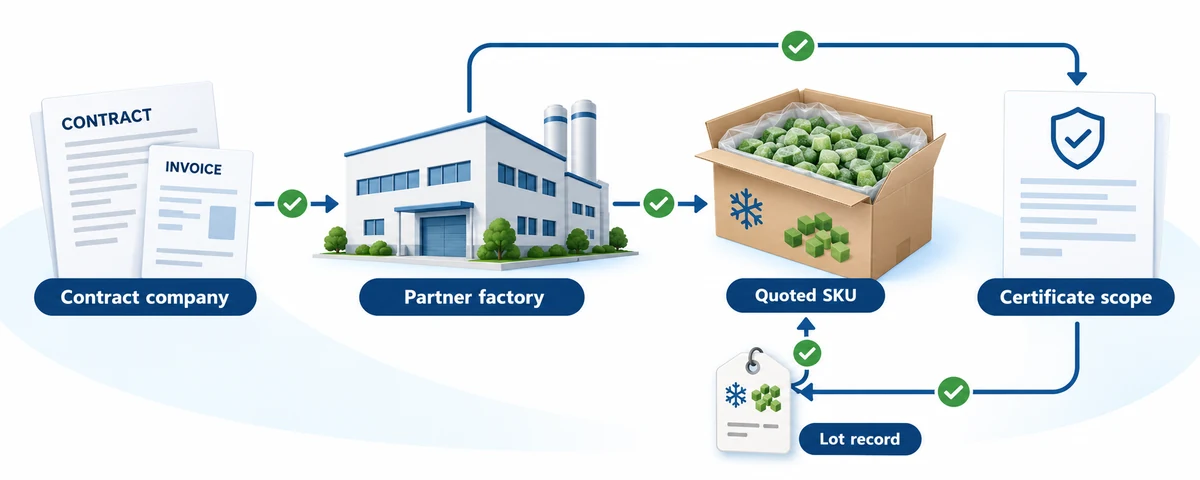
Conceptual diagram of the records to reconcile before approving a supplier
Make a one-page crosswalk for the proposed item, not a general supplier dossier. Write the legal name and registration number of the company issuing the pro forma invoice, the beneficiary on the payment instructions, the producing facility’s legal name and physical address, the product description, the planned process and pack, and the certificate or market approval that you require. Add the document owner and the date checked. This is a working control sheet; it need not be an elaborate audit form.
The distinctions matter because the same company may sell several frozen categories through different partner facilities. One partner may process IQF broccoli florets, another may pack fruit, and a third may hold an approval relevant to a particular destination. Do not turn one facility’s certificate into a network-wide claim. Conversely, do not reject a legitimate supply company because its name differs from the plant’s: require the supplier to document the relationship and allocate responsibilities.
| Question | Record to compare | Acceptable answer | Point requiring resolution |
|---|---|---|---|
| Who sells to us? | Business registration, quotation, contract and invoice | The legal counterparty is consistent and authorized in your purchasing process | The quotation, contract and beneficiary name change without explanation |
| Where is this item made? | Proposed facility name, address and production route | One producing site is identified for the approved SKU or a defined alternative is approved | Only a general company brochure or a different site’s photo is offered |
| What will be made? | Product specification, sample reference and pack artwork | Form, cut, process, packing and destination requirements match the site proposal | The sample, quote and specification describe materially different goods |
| Which evidence applies? | Certificate, audit scope, test plan and market documents | Holder, address, activity, product scope and validity cover the proposed route | A document is current but belongs to another facility, activity or product |
| Which lot ships? | Production, release, packing and shipping identifiers | Lot codes connect the approved SKU to relevant records and cartons | The shipment cannot be traced back to the proposed facility and release decision |
Use the crosswalk before price becomes the sole comparison point. It exposes questions while there is still time to change the facility, reapprove a sample or ask for a different document. The illustration here is a method, not a depiction of a particular XMG order or partner factory.
Verify the company you will contract and pay
Ask for the supplier’s full Chinese legal name, unified social credit code, registered address and business registration copy. Compare these with the quotation and contract. China’s official National Enterprise Credit Information Publicity System can be used to search the company name or code and check current registration information. A registry match is a starting identity check; it does not prove the quality of a frozen product, available capacity, solvency or export performance.
Confirm who issues the invoice, who receives payment and who handles claims. Where a group company or a different export entity is used, request a written explanation and have procurement approve that arrangement before any payment instruction changes. Bank details should be checked through an established, independently confirmed contact channel. This is a transaction-control question, separate from whether the proposed factory is technically suitable.
Ask the sales contact to state its role in plain terms. A trading company may coordinate several facilities and provide one commercial contact; a factory may sell directly; an export agent may act for a manufacturer. Your contract should identify the entity that owes you the goods and the remedy if specification, timing or documentation fails. If a seller describes itself as the manufacturer while the production licence, site address and certificate belong to another company, pause for clarification. The issue is the unexplained discrepancy, not the use of a partner factory itself.
Do not rely on a translated English company name alone. Different translations of a Chinese legal name can appear on marketing pages and certificates. Record the Chinese legal name and registration identifier, then ask the supplier to reconcile any translation or affiliated-company variation in writing. Check the identity again if a later pro forma invoice names a different entity.
Name the factory that will make this SKU
Before qualifying a plant, obtain its full legal name, operating address and its exact role: washing, cutting, blanching, freezing, packing, repacking, storage or another step. For an IQF item, the site that freezes the product may differ from a site that merely stores or repacks it. Your approval scope must say which activities and locations matter for the order. A photograph of equipment cannot establish that the proposed SKU will run there.
Request a site profile that relates to the item: process flow, relevant line or packing capability, product categories and any subcontracted stage. The detail should be proportionate to the risk and your customer requirements. A commodity bulk pack may need a different review from a retail private-label item with destination-specific artwork and claims. Ask which facility created the approved sample and whether commercial production is planned on that same route. If the answer changes, decide whether sample, specification, certificate and audit approval must be repeated.
A visit or live video review can establish that a site exists and help test the claimed process, but it is a snapshot. Ask to see the actual areas and records relevant to your product, with permission and confidentiality managed sensibly. Where the product risk or customer programme warrants it, use a qualified on-site or third-party audit. Review the audit’s named site, activities, date, findings and corrective-action status. A tour of a tidy room is not an audit of process controls or lot traceability.
For a supply network, ask whether the proposed plant is the primary route or one of several possible routes. A backup is valuable only if its differences are reviewed in advance. Origin, product grade, process, packing, certificate scope, document set, lead time and price can all move when the facility changes. Write a change-notification rule into the approval or purchase terms so an alternative is proposed before it is used. Our supply-network page describes how we compare routes and keep material differences visible.
Match the quoted product to the production route
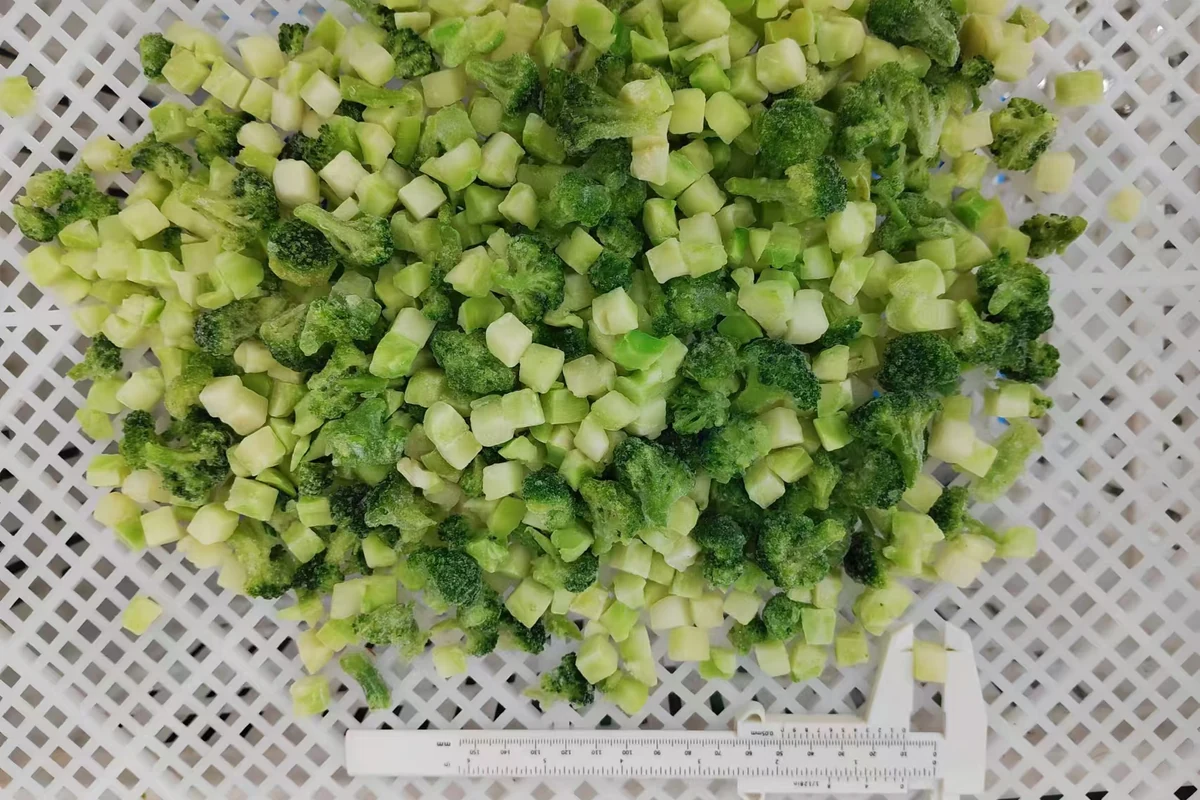
Original product-form example; not proof of a particular producing site
The word “broccoli” is not a sufficient SKU. State species or variety where relevant, form and cut, size basis, blanching or other treatment, grade, defect tolerances, net weight, inner and outer packing, label language, destination, storage requirement and intended use. Choose fields that affect your application or market. Ask who owns the specification version and what sample or drawing it refers to. The supplier should identify the proposed factory against that version, not a generic catalogue category.
A concrete example is IQF broccoli florets compared with broccoli stem dice. Both may be frozen broccoli, yet they differ in cut, expected use, sorting and the production or packing steps involved. The real product photograph in this section shows broccoli pieces and stem dice as visible forms; it does not prove their producing site or certification. If your quotation says “florets” but the sample contains a high proportion of stem dice, settle the description and tolerance before supplier approval. If the facility certificate lists a broad vegetable category, check whether the actual activity and product fall within the certificate’s written scope and your customer acceptance rules.
For frozen fruit, distinguish whole, halves, slices, dice, puree or blocks. A sample of whole strawberries cannot automatically approve a puree line or a different facility. Our later strawberry photograph makes the product-form question tangible; it is not an XMG batch record. Tie the sample ID, date, product specification and proposed site together. Record whether the sample is representative of planned production and what must be reapproved after a route change.
Document a short list of critical requirements. Put food-safety or market-entry requirements first, followed by product identity, fit for use and packing. If a statement is only a preference, say so. This lets the supplier offer a suitable alternative without quietly substituting one that invalidates a mandatory condition. It also makes a first trial order more informative: you can tell whether an issue belongs to the product, process, pack or route.
Read certificates by holder, site, scope and date
Swipe to read the figure on a narrow screen.
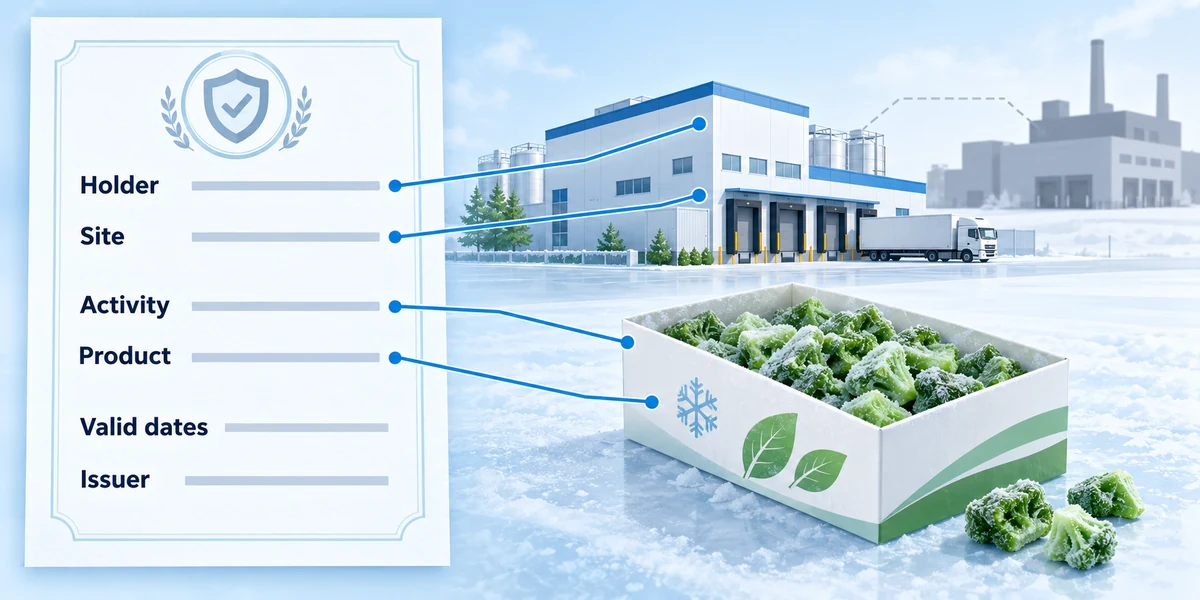
Conceptual scope illustration, not an actual certificate
Request a full, legible certificate rather than a logo on a slide. Record the certification programme and version, certificate number, issuing certification body, legal holder, physical site, listed activity, product category, issue and expiry dates, and any annex containing exclusions or additional locations. Compare those fields with your crosswalk. Where the scheme provides a directory or verification channel, use it; otherwise contact the issuer through its independently found contact details.
The Global Food Safety Initiative [1] explains that it does not itself issue supplier certificates: certification bodies issue certificates against recognised programmes. Thus “GFSI certified” alone is not a sufficiently specific claim. Check the actual programme and relevant scope. A genuine certificate for a warehouse, a different factory address or a different activity may still be irrelevant to your frozen SKU. A certificate for one partner facility cannot be assumed to cover another.
Certificate validity has a time dimension. Check its status when approving the route and recheck if production or shipment will occur after expiry or a surveillance or recertification change. If a certificate is suspended, expired or under a changed scope, obtain current issuer confirmation and decide whether alternative evidence or a new route is acceptable to your customer. Do not substitute a PDF from a sales folder for a live status check when the scheme offers one.
Market permissions are a separate question. Requirements vary by product and destination. Have your importing or regulatory team identify any facility registration, official certificate, testing or declaration required for that precise shipment. For example, the U.S. FDA’s FSVP guidance [2] describes importer verification responsibilities for covered foods; a plant certificate does not replace the importer’s programme. Do not infer that an approval for one destination transfers to another market. Ask for a market-specific document list early enough to influence facility choice.
Our separate certificate verification guide goes deeper on authenticity and issuer checks. In this qualification file, the decisive question is whether a verified document belongs to the actual site, product and activity proposed for your order.
Connect samples, lot records and shipment documents
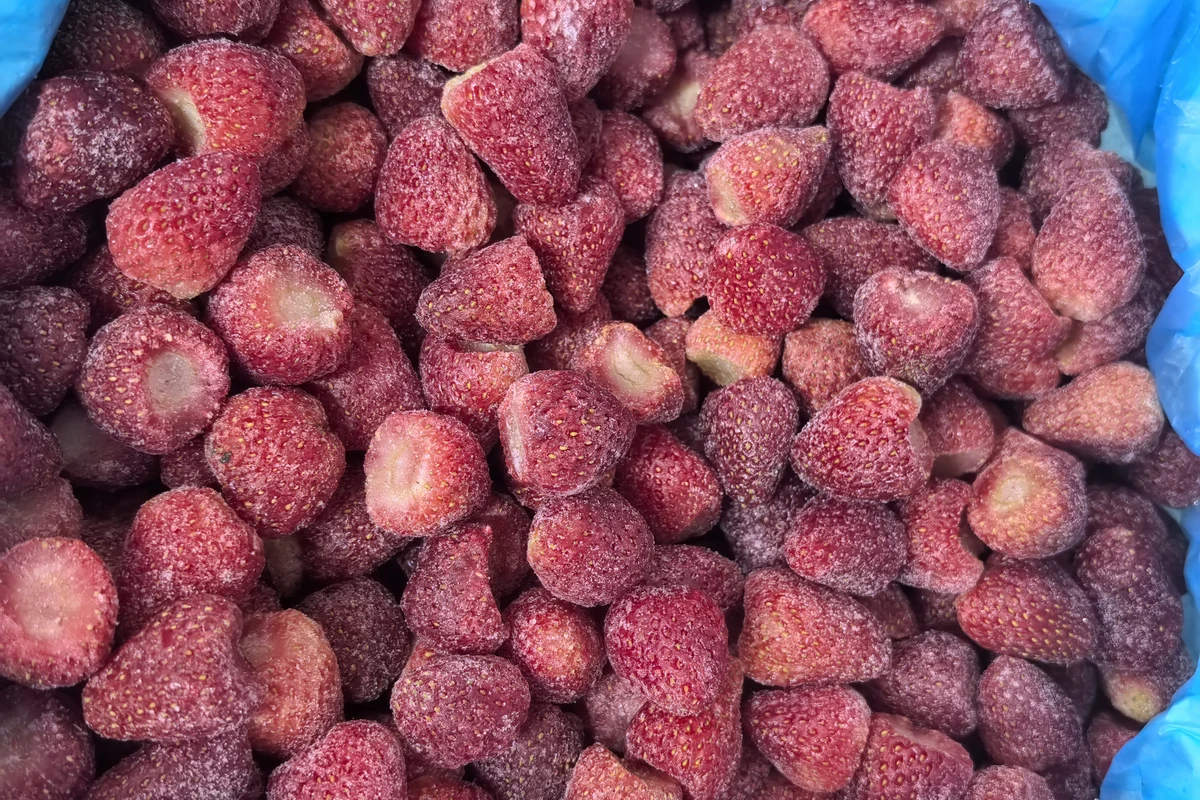
Real product-form reference; not a lot or facility record
The supplier may have passed an identity and site review yet still ship goods from a different route. Define the records that will prove continuity. At a minimum, align the approved specification and sample reference with the production order, lot code, finished-product release, packing list and carton mark. Depending on the item and buyer programme, you may also request a lot-specific test report, temperature records, loading details, container and seal numbers, or other release evidence. Agree which records are needed before production and which can only be issued after it.
Check that a certificate of analysis or test report identifies the sample or lot, test method, result, unit, limit, laboratory and date where relevant. A test result without a clear lot or sampling basis cannot answer whether the shipped goods conform. If third-party testing is required, define who chooses and draws the sample, custody, laboratory and acceptance decision. Avoid promising that every frozen food requires the same test panel; hazards and destination expectations differ.
Trace one example backward and forward. Select a proposed finished-goods lot or a prior comparable anonymised record. Can the facility connect its carton code to packing, production, raw-material intake and release? Can it identify which cartons and shipping documents carry that lot? A documented traceability exercise can reveal gaps more reliably than a statement that traceability exists. Protect customer confidentiality by accepting redacted examples that retain the fields necessary to test the chain.
The frozen strawberries shown here are a product-form reference only. For a real purchase, the evidence would be the approved sample code, agreed whole-fruit specification, producing facility, lot-specific release information and carton identification. A photograph of fruit cannot do those jobs. Likewise, a container-loading picture demonstrates a loading scene, not the origin or test result of every carton inside it.
Set a proportionate verification depth
Verification is not one fixed audit package for every order. Start with the product, intended use, destination rules, customer programme, supplier history and severity of a failure. A new supplier and new producing site deserve more scrutiny than a repeat order on an already approved route, but a repeat order still needs current site and certificate checks. Higher-risk applications, more complex claims, private label and sensitive customer specifications can justify a deeper records review, independent testing or on-site audit.
Divide work between procurement and QA. Procurement confirms the legal counterparty, payment details, commercial terms and change-notification mechanism. QA confirms site, product, process, certificate scope, specifications, samples and release evidence. Logistics or import compliance confirms market and shipping documents. One owner should maintain the crosswalk so decisions made by different teams do not drift apart.
For a first shipment, identify a small number of evidence gates: before deposit, before production, before shipment and on receipt. Do not defer a critical site or certificate mismatch until the container is at the port. At the same time, avoid demanding a shipment-specific lot report before a lot exists. Define the promised timing and format for each document in the purchase order or approval plan. This makes the file useful operationally, not simply thorough on paper.
If a supplier refuses to identify the producing facility for a legitimate confidentiality reason, discuss a controlled disclosure mechanism, such as a direct QA review or a confidentiality agreement. If the buyer cannot assess the actual site and mandatory market requirements, do not approve the route merely because a broker offers a general assurance. The needed depth is driven by the risk and the buyer’s obligations, not by whether the counterparty calls itself a trader or manufacturer.
Decide when to approve, condition or pause
Swipe to read the figure on a narrow screen.
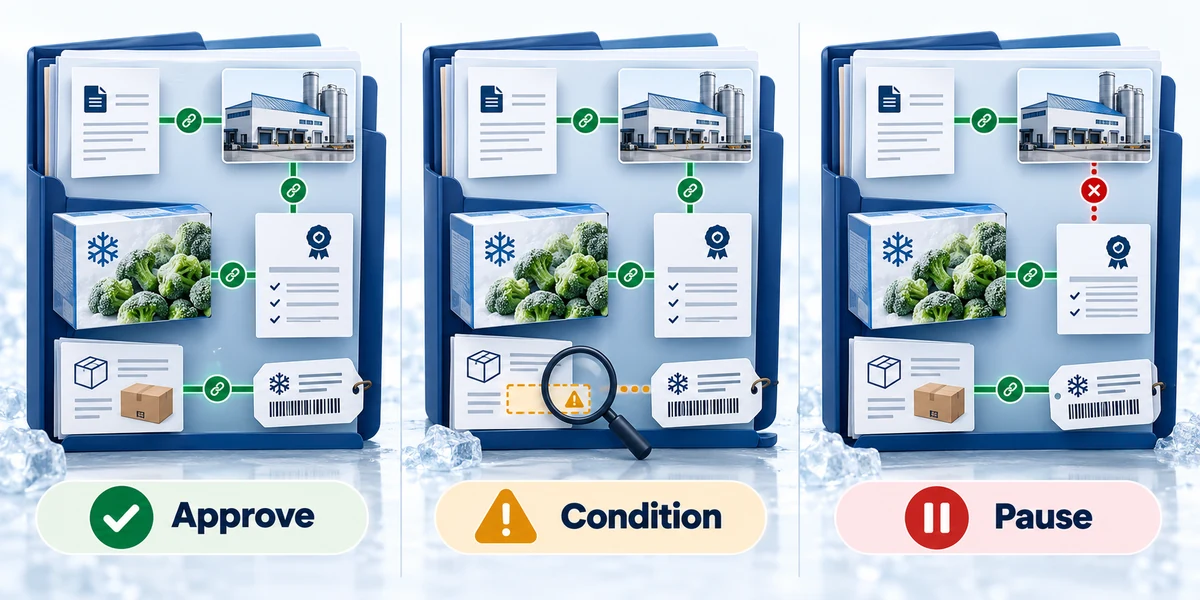
Hypothetical decision method, not an actual supplier assessment
Use a decision record with the proposed supplier, facility, SKU, approved specification version, destination, evidence reviewed, unresolved items, approvers and next review trigger. “Approved supplier” is too broad if a company offers many products through several sites. The practical status is approved for this product and facility under stated conditions, or an explicitly narrower trial status.
Approve when the identity chain is clear, mandatory requirements are satisfied and your team has accepted the evidence depth. Conditional approval can suit a noncritical missing item that has a named owner, deadline and control; for example, final private-label artwork approval before packing. Hold shipment or purchase release until the condition is closed. Pause when the actual producing site is undisclosed, the contract or payment entity changes unexplained, a required certificate covers a different site or product, a mandatory market document is unavailable, or an unresolved test or traceability failure affects release. These are examples for a buyer’s decision process, not a universal scoring rule.
Record change triggers: facility or origin switch, new product form, process or pack, certificate lapse, material audit finding, failed lot, complaint, regulatory change or a change to the entity receiving payment. For each trigger, decide which parts of the file must be checked again. A repeat order is easier because the prior crosswalk exists; it is not automatically safe because the previous order succeeded. Ask for current confirmation against the same approved reference.
How XMG coordinates a verifiable route
XMG Food is a China-based trading and supply company for frozen vegetables, fruits and mushrooms. We work with long-term partner factories and match a proposed product, origin, specification, packing, quantity, destination and schedule to a suitable route. For a qualification review, we can coordinate the product and site details relevant to your inquiry, request current facility-specific documents and keep material alternatives visible before they are treated as the approved route.
That coordination helps when the commercial counterparty and producing facility are different entities. We can identify which part of the order we manage, which facts and records belong to the selected partner facility, and which requirements your team must approve. The exact plant, certificate, process and availability remain order-specific. Send your critical qualification criteria early; they may determine which route is suitable before samples or pricing are finalised.
Questions buyers often ask
Is a trading company less verifiable than a factory-direct seller?
Not inherently. Verify the trading company’s legal and payment identity, document its relationship to the named producing facility, and scope the facility and product evidence. A factory-direct seller still needs product, certificate and lot verification. The useful distinction is whether responsibilities and evidence remain traceable through the transaction.
Can a certificate from one partner factory cover a backup factory?
Do not assume so. Check the certificate’s holder, listed sites, activity and product scope, and confirm the backup route against your customer and destination rules. A route change may require a new sample, audit, certificate or import document review.
Should I ask for every document before requesting a quote?
Send the few requirements that determine feasibility with the inquiry: product and form, destination, mandatory programme or market approval, packing and indicative quantity. Request detailed facility and lot evidence in stages as the route is proposed and production is scheduled. A requirement that affects site choice should not wait until after the order is placed.
Review one proposed route with us
We supply frozen vegetables, fruits and mushrooms through relevant partner factories in China. If you are comparing a supplier and its actual plant, send the product and form, destination market, required certificate or approval, and indicative quantity and timing. We will review the brief and confirm which route details and order-specific evidence can be provided for your qualification process.
References
- National Enterprise Credit Information Publicity System — official Chinese company registry; search availability varies by network.
- [1] GFSI certificate guidance↑ — programme and scope verification context.
- [2] U.S. FDA FSVP guidance↑ — U.S. importer verification context for covered foods.
