


On this page
The best frozen apricot for a fruit preparation is not simply the ripest or the highest-Brix sample. A more mature lot may deliver fuller apricot flavor yet soften into the base, while a firmer lot may retain attractive pieces but need more adjustment to its sweet-acid balance. Compare maturity under one declared fruit form, recipe and heating profile. Measure soluble solids and titratable acidity on a consistent sample basis, then judge fruit-piece survival and flavor in the finished preparation. The winning sample is the one that meets that product’s texture and taste brief with a manageable formulation, not a universal number.
We would begin with two or three identified candidate lots or agreed maturity bands. Keep the cut, sample mass, thaw procedure, fruit loading, sugar addition, heating and hold the same. Taste the finished fruit preparation at its real serving temperature and record how much recognizable fruit remains. This is a buyer trial design; the outcomes must come from your samples. Published fresh-apricot maturity studies explain variables to measure but do not report how an XMG commercial lot performs in your recipe.
What ripeness changes and what it does not prove
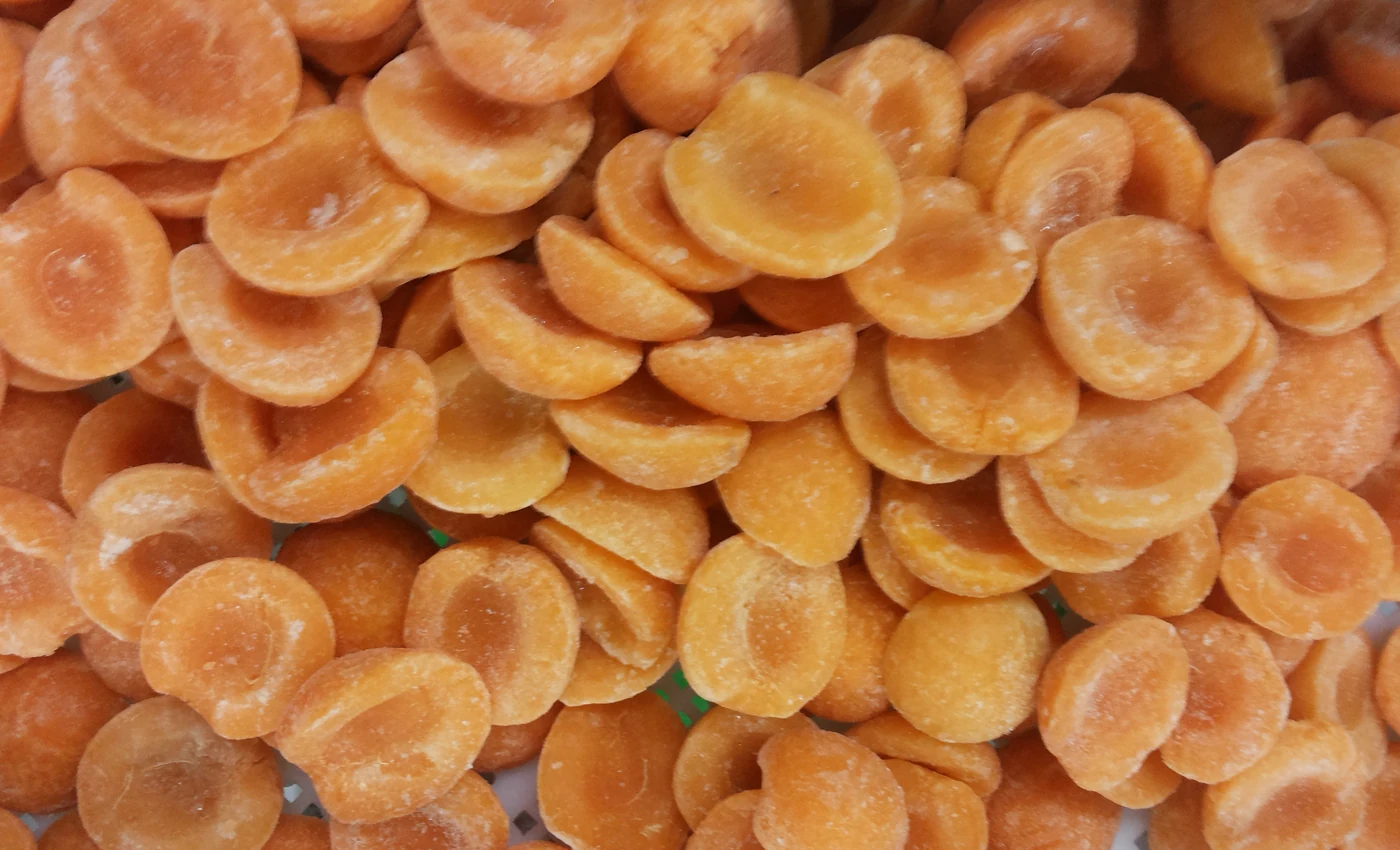
The genuine frozen fruit shows the form, not a measured harvest maturity.
As apricots mature, firmness, acidity, soluble solids, aroma and color can change together, but not necessarily at the same speed in every cultivar. One two-cultivar maturity experiment [1] found that firmness and titratable acidity declined from its immature to over-mature classes, while pH and other traits changed. A separate five-cultivar study [2] observed different hardness and sugar-acid patterns across cultivars. Neither paper defines a commercial frozen-apricot Brix limit for fruit preparations. Their sample fruit, maturity classes and test purposes differ from a buyer’s thaw-and-cook application.
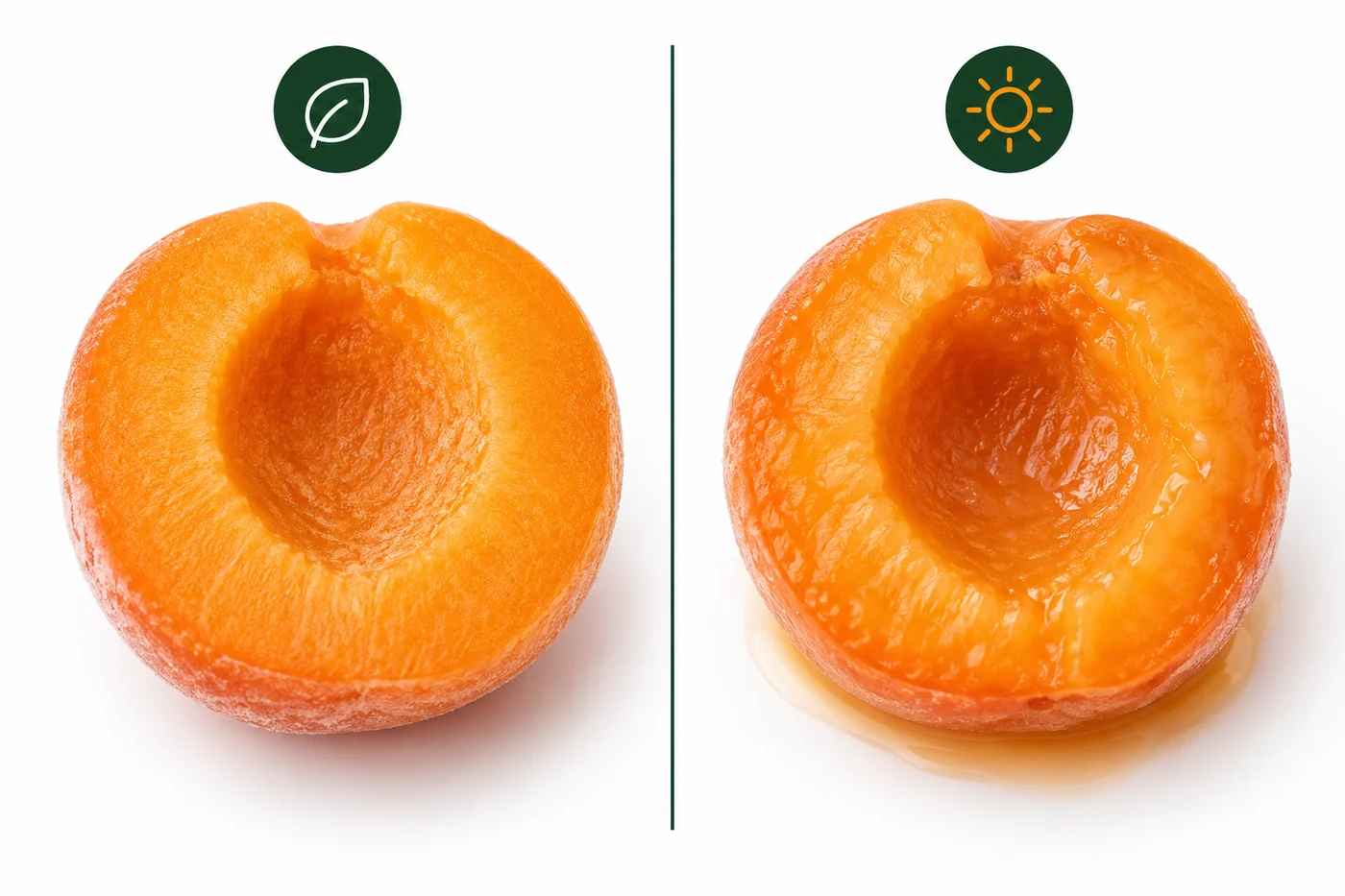
Conceptual comparison only: appearance cannot establish Brix or final suitability for a lot.
“Ripe” on a supplier document can mean harvest maturity, an internal sorting category or simply a sensory description. Ask what observation or measurement supports it. Skin ground color is one clue for fresh fruit; it is not a substitute for a recorded fruit specification. More orange color can accompany ripening in a given cultivar but may also differ by cultivar, lighting and processing. A photographed sample can help identify the presented lot, not settle flavor or cooked-piece stability.
The target depends on the final product. A smooth fruit base can use a softer piece if it gives the desired flavor and yield. A yogurt preparation with visible apricot cubes needs recognizable pieces after mixing and shelf-life evaluation. A bakery filling may require both pieces and controlled free liquid after heating. If those applications share one incoming apricot specification without separate performance checks, one team may approve flavor while another later rejects texture.
Do not infer that a higher soluble-solids reading means the preparation will taste better. Sweetness perception also depends on acids and the recipe’s sugar, and the fruit may be measured on a different basis from the finished product. A fresh-apricot consumer study [3] found that preference was not driven by sugar alone; acidity, firmness and flavor mattered. This supports multi-factor evaluation, while the buyer must still test the actual frozen fruit and formulation.
Keep the apricot comparison truly matched

Match cut, pack and lot sampling before comparing measured maturity indicators.
Fix the question before opening the bags. Are you comparing two maturity bands of one cultivar, two supplier lots described as different ripeness, or a new shipment against an approved reference? Record the cultivar or origin when known. If these differ, call the test a lot comparison rather than claiming that ripeness alone caused the result. Variety, cut, freeze process and storage history can all contribute to the observed difference.
Use the same fruit form in each arm. A half, cube and crush have different exposed surface area and different mechanical survival under stirring. The existing XMG apricot halves-versus-dice guide treats that form decision; this trial holds form steady so maturity-associated attributes have a chance to be seen. If the offers are available only in different forms, first establish which form the recipe needs, then compare like with like or report that the trial cannot isolate ripeness.
Take representative portions from identified packs. Write down batch/lot code, received condition, pack mass, cut distribution, visible frost or clumps, and the date of testing. Avoid selecting only the best-colored pieces from one bag. When a decision concerns repeat supply, draw samples from more than one pack or position according to the buyer’s own plan and keep enough material for a repeat preparation. A narrow sample can conceal the very variation the specification must control.
Define whether the product is plain IQF, sweetened or syrup packed. That choice changes the meaning of a thaw-liquid Brix reading and the recipe’s sugar balance. If one offer contains added sugar and another does not, do not compare the raw readings as if both represent fruit solids alone. Note the ingredient statement and carry the product’s complete fruit-plus-liquid contribution into the preparation. A useful supplier question is “which material and liquid were included in your laboratory result?”
We would also record the temperature and time history of the samples used in the trial. A partially thawed bag or an opened pack held through several tests may no longer reflect the original lot condition. Keep the comparison pieces separate and label them before thawing. Use an approved food-handling procedure appropriate to the product and facility. This is essential for a defensible sensory comparison and for normal food safety, but this article does not prescribe a universal thaw schedule.
Measure flavor and texture on a declared basis
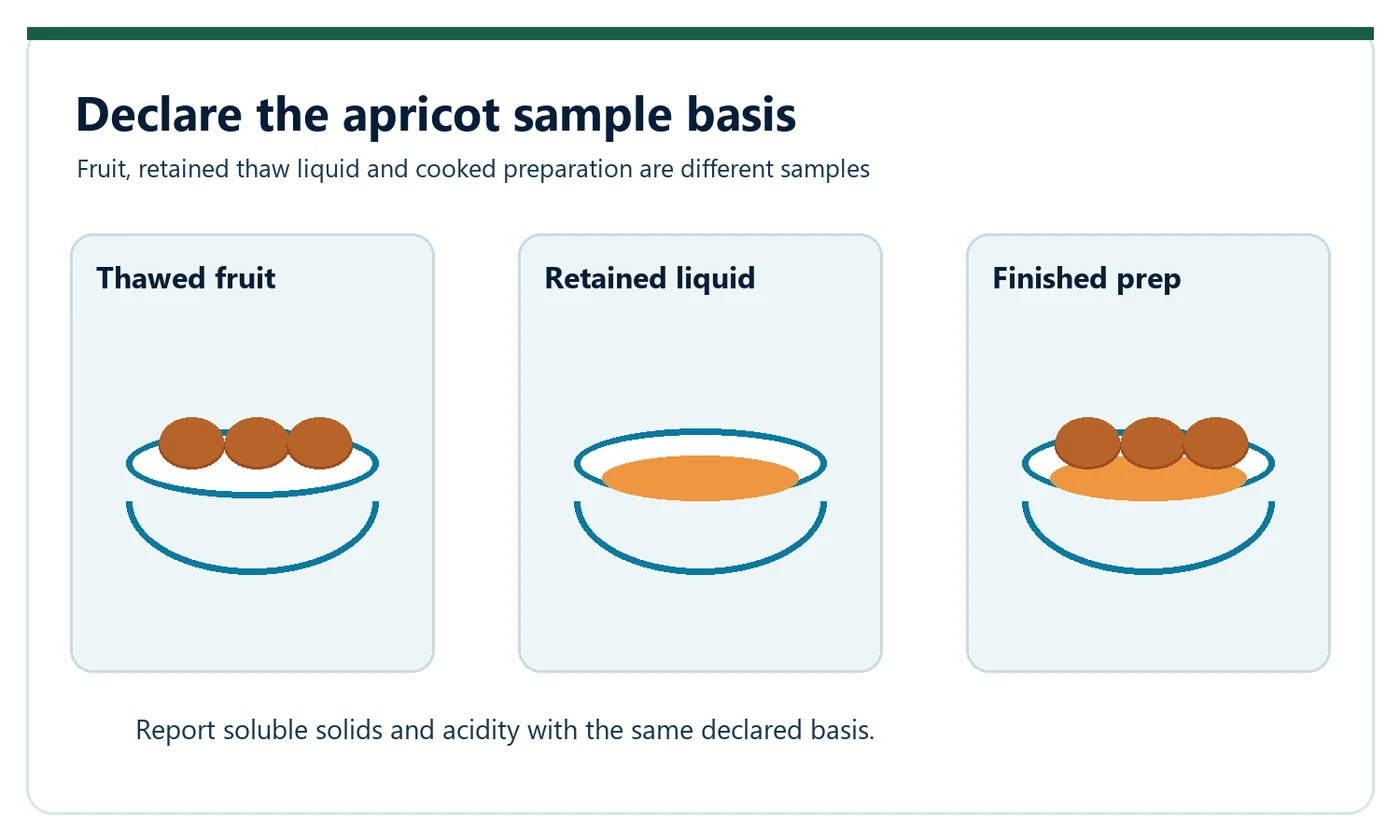
Report soluble solids and acidity with the sample fraction and preparation method.
For each candidate, the minimum analytical record is often soluble solids, titratable acidity and the measurement basis, alongside sensory flavor notes. Soluble solids expressed in degrees Brix are useful but are not a direct sweetness meter when acids and other soluble material are present. Titratable acidity gives a different aspect of the acid load than pH; both can be useful, but they are not interchangeable. Record the method, units, sample preparation and temperature basis when a laboratory or supplier result is supplied.
Choose the material being tested: thawed fruit with its retained liquid homogenized, drained fruit, expressed juice or the finished preparation. Do not compare a supplier’s fruit juice reading with your sweetened finished filling as if they were the same measurement. If you need to assess incoming fruit, define the fruit-plus-liquid treatment consistently. If you need a final-product target, measure it separately after formulation. Keep the two values in separate columns.
A practical texture description should separate frozen appearance from after-thaw firmness. Record whether pieces can be lifted without collapse, whether the skin separates, and whether the flesh remains coherent under the normal mixing step. The exact measurement may be an agreed sensory score, a count of intact pieces or an instrumental method designed by the buyer’s QA team. The important point is not sophistication for its own sake; it is that the same definition is used for all samples and future repeat lots.
Avoid importing fresh-fruit thresholds into this contract. [4] describes fresh-apricot ripeness cues, while the USDA frozen-apricot grades [5] describe attributes such as character and color. Neither sets the optimum Brix, pH or cooked-piece percentage for your yogurt, bakery or sauce formulation. If you elect to use a recognized grade, state the exact grade and supplement it with the application criteria that matter.
Cook the same fruit preparation and score the result
The decisive step is the finished-preparation trial. Weigh fruit and other ingredients into separate matched batches. Keep sugar, acid, pectin or thickener, fruit concentration, equipment, vessel geometry, stirring, addition order and heat endpoint constant for the initial comparison. If the production process folds apricot into a base without cooking, use that process. If it cooks and then chills, evaluate after the same cooling and hold. A spoonful tasted while warm can give a different impression from a chilled dairy fruit layer.
When the recipe is designed for one incumbent lot, an unfamiliar lot may look worse in the first fixed-formula pass because the formulation has not been optimized. That first pass is still valuable: it shows the substitution cost. You may then run a second trial in which sugar, acid or thickener is adjusted within the product’s allowed design space. Keep those results apart. “Lot B works after extra thickener” is a different commercial result from “Lot B matches the current formula.”
Record visible-piece survival after the actual mechanical load. The fruit may pass a gentle stovetop trial and fail a depositor or pumping step. Define “intact” before counting: does it mean the original cube, any recognizable apricot segment, or a piece above an agreed size? A photo reference can help operators apply the definition. Decide whether the denominator is a count of input pieces, a mass of retained pieces or a weighed sample of the final preparation. No universal percentage follows from the studies cited above.
Taste flavor after the process has settled. Note apricot character, perceived sweetness, acidity and any off-note separately. If a more mature candidate is richer in aroma but too soft for visible pieces, that is a useful application split rather than a contradiction. A softer lot might be suitable for a smooth spread, while a firmer one may be chosen for a chunky inclusion. Do not call either universally superior.
We would inspect free liquid and final body as well. A syrupy thaw liquid may help a cooked preparation but require a different thickener dose or heating profile. If you drain it for the incoming-fruit test, document that choice; if production retains it, evaluate the product with it retained. A recipe that uses the entire fruit mass should not choose a supplier based on a drained-fruit measurement alone.
Read the outcome by application

Piece retention matters for visible inclusions; a smooth preparation puts more weight on flavour balance.
| Intended product | Most useful observation | What can change the decision |
|---|---|---|
| Visible-fruit yogurt or dessert layer | Recognizable piece count after folding and the normal hold, plus flavor at serving temperature | Soft pieces may smear even when the fruit tastes good |
| Bakery filling | Piece retention, free liquid, thickener load and post-bake flavor | A firm incoming piece may still collapse during baking |
| Smooth sauce or jam | Flavor, acidity balance, usable yield and consistency | A softer fruit can be entirely suitable if skin fragments and yield meet the brief |
| Retail frozen fruit for later use | Frozen form, defects and agreed preparation performance | A finished-preparation trial may need to cover more than one customer use |
Use this table as a way to select measurements, not as a substitute for your actual customer specification. A single “maturity index” can hide a split outcome: appealing sweet-acid balance but poor visible pieces, or robust pieces but weak flavor in the existing formula. Write both. Procurement can then ask whether a different confirmed lot, cultivar, sorting band or recipe adjustment is feasible.
Keep cost-in-use in view without inventing a price advantage. If one sample has a lower offer price but forces a higher fruit dose to reach flavor, a larger thickener addition, or extra sorting loss, compare the finished yield and formulation change before awarding the order. If the target product sells on visible pieces, the percentage surviving the entire process may matter more than the raw pack price per kilogram.
Translate the trial into an approval specification
The approved record should name the product form, cut size or range, cultivar or origin if commercially relevant, sweetening status, pack and lot identity, sample draw, thaw method, analytical basis, heating/mixing profile, serving condition and acceptance definitions. Attach the signed reference sample or retained photographs where they help an inspector. State which values are information only and which are release criteria.
Do not write an artificial Brix or pH number into the specification because a paper used it. The two-cultivar study [1] defined maturity classes for its own material and purpose; its cutoffs do not become a universal frozen-fruit target. If the buyer wants a numeric range, derive it from the approved product and validated trial, choose a measurement method and tolerance, and state how variation and retesting will be handled. A number without a basis is hard to enforce and easy to misinterpret.
One way to check whether the proposed range is realistic is to look at the distribution within each drawn pack, not only the mean. A pack with some very soft fruit and some firm fruit can average into an attractive number while behaving unevenly during filling. Ask the quality team to note how many pieces fall outside the desired texture description and whether those pieces cluster by cut size, visible damage or portion of the pack. If the sample is too small to estimate variability, the record should say so. This avoids converting a neat laboratory average into a promise about every piece.
The analytical basis also needs a tolerance for normal measurement uncertainty. Two refractometers, operators or sample-preparation routes can produce small differences that do not reflect a meaningful fruit change. When a future delivery approaches a proposed boundary, use the agreed retest procedure and the finished-product observation before rejecting or releasing it. That procedure should be settled during approval, not invented during a shipment dispute. A customer may ultimately value a stable flavor profile more than an unrealistically narrow numerical band.
Include the application outcome in words. “Maintain identifiable apricot pieces after the stated heat and hold” can be operationalized by a photo reference and count method. “Balanced flavor” needs agreed sensory descriptors or a product standard. When a team finds a failure, the record should say whether it was acidity, flavor, piece loss, free liquid, skin texture or an unrelated defect. That separation points to an actionable next sample.
Approve conditional uses when appropriate. A lot may be suitable for a pureed sauce yet fail a visible-piece layer. Label it for the approved application so another team does not transfer the approval to a different product. Review the specification if the recipe, cut or plant equipment changes. The intended decision is repeatable purchasing and production, not a one-time tasting victory.
Keep a brief revision history with the reference sample. If a product developer later reduces sugar, changes a stabilizer or moves from a gentle kettle to a pump-fed depositor, revisit the apricot criteria and retest the current approved lot. A maturity band that supported the old recipe may no longer give the desired balance or piece count. Recording the change protects both parties: the buyer can show why a new sample was requested, and the supplier can identify the precise requirement that changed instead of chasing a vague claim of poorer fruit.
How XMG coordinates apricot samples
We supply frozen apricot options from our partner network and match the fruit form and order specification to the buyer’s application. For a maturity comparison, we can clarify which candidate lots are actually comparable, coordinate representative samples and help carry the agreed measurements into the specification and sampling record. Fruit form, packing and any requested analytical fields must be confirmed for the proposed order; we do not apply one universal Brix or pH promise across all lots.
Discuss Your Trial with XMG Food
Send the product form, intended use and trial criteria; we will review the brief and confirm suitable frozen produce and supply options.
Send Your Trial Brief →References
- [1] Apricot maturity and sensory quality in two cultivars↑. Primary study; its maturity classes are not frozen-product contract values.
- [2] Changes across five apricot cultivars↑. Primary study of hardness, sugars and acids.
- [3] Fresh apricot postharvest preference and quality study↑. Fresh-fruit evidence for multi-factor flavor and texture assessment.
- [5] USDA frozen-apricot grades↑. Grade definitions, not finished-recipe limits.
