


On this page
Different berries in one frozen mix can become soft and release liquid at different moments because they are not identical heat-transfer objects. Piece size and shape determine the distance from the surface to the center. Skin and tissue structure affect how a berry appears and leaks as ice melts. Contact with other frozen pieces, the depth of the pack and the thaw method add another layer of variation. A berry that looks collapsed is not necessarily the one whose center warmed first.
For a useful comparison, keep the starting condition, portion mass, container, cold environment and observation times the same. Then record two separate outcomes: when each representative piece is thawed through, and how it holds its shape or releases juice. Do not publish a fixed “raspberry before blueberry” timetable from appearance alone. The rank can change with berry size, variety, clumping and the conditions used.
What unequal thawing actually means
People often call a mixed bag “unevenly thawed” when one type is mushy and another still looks firm. That may describe the eating experience, but it combines thermal state with texture. A berry can lose its structure early because its delicate tissue was damaged during freezing or handling, even while part of it remains cold. A berry with a more resistant skin can retain its outline after it has warmed. Both statements are plausible without proving which center reached a given temperature first.

Genuine mixed-berry photograph shows species and size variation, not a thaw timeline.
Make the question precise. Does the user need every berry to be fully thawed before blending? Do they want whole fruit to remain recognizable on a topping? Are they measuring free liquid for a filling? A smoothie maker can tolerate different visible softening if all pieces enter a blender safely and consistently. A bakery or yogurt topping may care strongly about which species leaks color first. The same mix can be suitable for one process and inconvenient for another.
Commercial frozen mixed berries commonly combine raspberries, blackberries, blueberries and strawberries. The FAO frozen-fruit guide [1] notes that frozen berry mixtures are common and that wholeness and shape retention depend partly on fruit structure and cultivar. It does not give a universal thaw-time order for every species. That absence matters: an honest guide should explain the variables and show how to compare them in the buyer’s own pack.
Size and contact change each berry’s heat path
Heat reaches a frozen piece from its surroundings and moves toward its center. A small berry generally has a shorter path to the center than a large berry of otherwise comparable condition. A slice or broken piece exposes more area than a whole large fruit. Yet “size” is only one variable. The starting temperature, surface contact, air circulation, container material and whether fruit is in a shallow layer or a clump also affect the path.
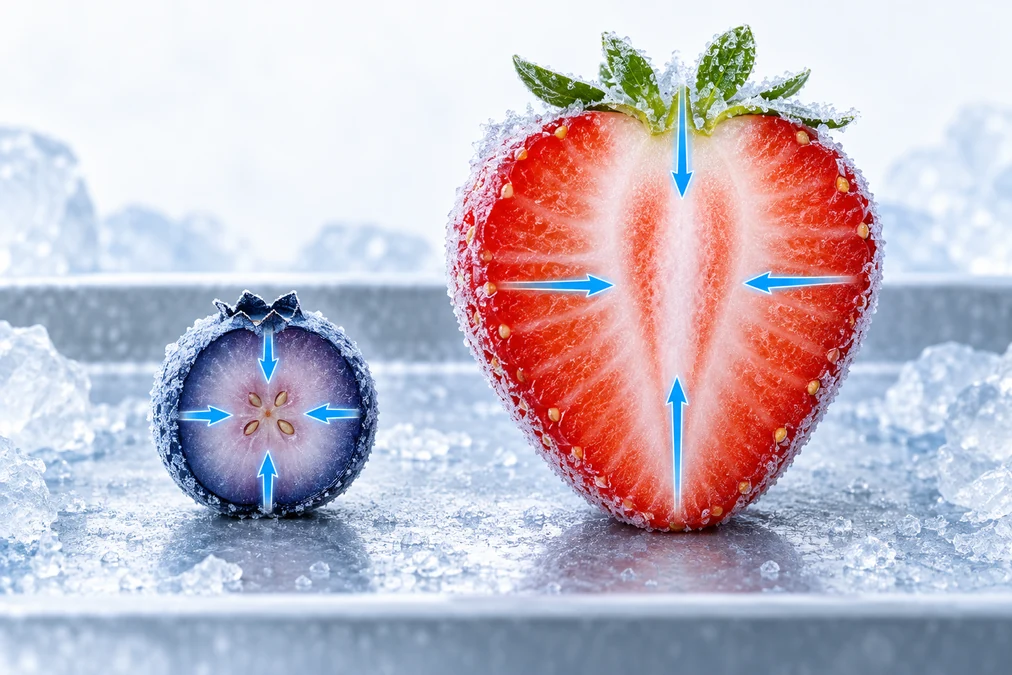
Conceptual heat-path comparison; no species-specific thaw time is asserted.
Look at the mix before thawing. Whole strawberries can be much larger than small blueberries. A large blackberry may sit among compact berries and be insulated by them. Some pieces may have already accumulated frost or be joined in a clump. If the pack is tipped into a deep bowl, outside pieces see the cold room air while center pieces remain surrounded by frozen fruit. A flat tray changes that geometry. The tray comparison should use the same mass and starting state, otherwise the arrangement is not the only difference.
Composition also matters. Water, sugars and other solids influence freezing behavior, but the fruit’s measured composition varies with species, cultivar and ripeness. It would be misleading to assign every berry a single thaw time based on a general sugar percentage. A research paper on berry thermal properties during freezing reported different values across the samples it examined. Those results support the idea that berries are not thermally identical; they are not direct predictions for a mixed consumer bag thawing in a refrigerator.
If the buyer must know actual thermal thaw, use a suitable temperature method on representative pieces or a validated process instruction. Avoid relying on a finger squeeze. Squeezing changes a fragile berry and confounds softness with temperature. At the same time, do not make the measurement so elaborate that it obscures the product decision. For many applications, controlled observations of piece condition and drip at defined times are the useful first step.
Skin and tissue change the visible softening and drip
Freezing changes fresh fruit texture. Water forms ice crystals, and thawed produce commonly becomes softer because cell structure has been disrupted. The University of Minnesota Extension freezing guide [2] explains this general effect. The degree seen in a particular berry depends on its tissue and on the fruit’s history before the test. Freezing rate, storage, handling and repeated warming can also influence how much free liquid appears later.

Genuine raspberry photograph shows fragile fruit structure, not its measured thaw rate.
Raspberries are made of delicate drupelets and can crush readily. Blueberries are often more compact and may keep a recognizable outline. Blackberries and strawberries introduce their own range of size and tissue traits. These descriptions help explain why a tray may look uneven; they are not a guarantee that one named species always warms or leaks first. A small intact berry and a large damaged one can reverse an expectation based on their names alone.

Conceptual distinction between tissue damage, visible drip and thermal state.
Observe shape retention and free juice independently. On a white tray, note whole pieces, broken pieces, surface staining and pooled liquid at each observation point. If a dark berry stains a neighboring strawberry, photograph the boundary rather than declaring the strawberry itself to be leaking dark juice. If a berry remains round but has softened internally, a visual count of whole pieces may miss the texture change. Sampling a standard spoonful can reveal that difference.
The intended product determines whether drip is a defect. In a smoothie, released juice remains part of the blend. In a visible fruit topping, pooled liquid may alter presentation or weight distribution. In a bakery filling, the liquid can affect formulation and heat performance. A blend selected for one use should not inherit the same acceptance criteria in every application.
The bag and thaw method can overwhelm species differences
Compare two arrangements of the same blend: a shallow, covered layer and a deeper mass in its bag or a bowl. Even if the berries are identical, their contact and center distance differ. A deep clump can still contain frozen pieces after exposed surface fruit has softened. Stirring or spreading changes the condition again, and rough stirring may break fragile species. Record the arrangement so a later team does not attribute every difference to berry variety.

Conceptual refrigerator-thaw arrangement showing different heat paths, not timed results.
Temperature control is a separate requirement. The processor should follow its food-safety plan and the intended use. For household guidance, the University of Minnesota recommends refrigerator thawing because food stays cold and leakage can be contained. A factory or foodservice user needs its own validated time and temperature controls. Leaving a large mixed pack on a warm bench merely to make the centers catch up can expose the outside fruit to unnecessary warming; it is not a clean comparison method.
The method should also match the application. Some ingredients are added while still frozen, especially when a subsequent blending or heating step is planned. Others are thawed to evaluate drip or to portion into a cold dessert. “Thaw everything first” is not a universal rule. State the process and use the same method for all candidate blends when comparing them.
Check pack condition before use. Excessive clumping can result from several histories, including surface moisture or temperature fluctuation, and it alters how pieces separate and warm. It should be noted, but a clump alone does not prove an unsafe product or identify a single cause. If there is an unexplained product-quality concern, retain the lot and temperature history for supplier review.
Set up a controlled mixed-berry thaw comparison
Start with representative portions from the same lot or from clearly identified candidate lots. Record species ratio, approximate piece sizes, whole versus broken condition, clumping and starting temperature. Use identical containers, portion masses and covering methods. Place them in the same controlled cold environment, leaving enough space for similar exposure. Decide observation points before the trial begins. These are suggested trial controls, not measured XMG results or a universal thaw schedule.
At each point, note which pieces remain visibly icy, which are soft or collapsed, which still hold a clean outline, and where free liquid collects. Weighing a separated liquid fraction can be useful if the process decision depends on drip, but state exactly how fruit and liquid were separated. A change in separation technique can produce an apparent difference unrelated to the berry mix. For thermal questions, pair visual observations with a suitable center-temperature assessment rather than substituting one for the other.
Take photographs in a consistent position with a plain background and an identification card outside the food. Avoid treating one attractive photo as a full lot result. A mix can vary within a bag, and a few large pieces can dominate a small sample. If the application is a prepared food, run a second test through the actual formulation: fold the fruit into yogurt, blend it, or heat it as the product requires. The thaw tray alone does not predict the final matrix.
Read the result by application. For a visible topping, ask whether the most fragile fruit still looks appealing when the largest fruit has reached the intended service state. For a smoothie, ask whether the pieces separate and enter the blender as planned. For a cooked filling, focus on total liquid and color behavior after the full cooking step. Record the observation criteria with the recipe, portion and temperature history.
Choose the blend for its intended use
An ingredient brief should state more than “mixed berries.” Give the species mix or an agreed ratio range, intended use, typical piece form, acceptable breakage or fines, packaging, and the planned thaw or direct-use method. If drip and color matter, agree on a sampling method and finished-product reference. Do not translate a controlled test into a promise that every pack will thaw uniformly in an unspecified kitchen.
Frozen Mixed Berries
Review our frozen mixed berries range, product forms and specification options.
View Frozen Mixed Berries →References and related XMG reading
